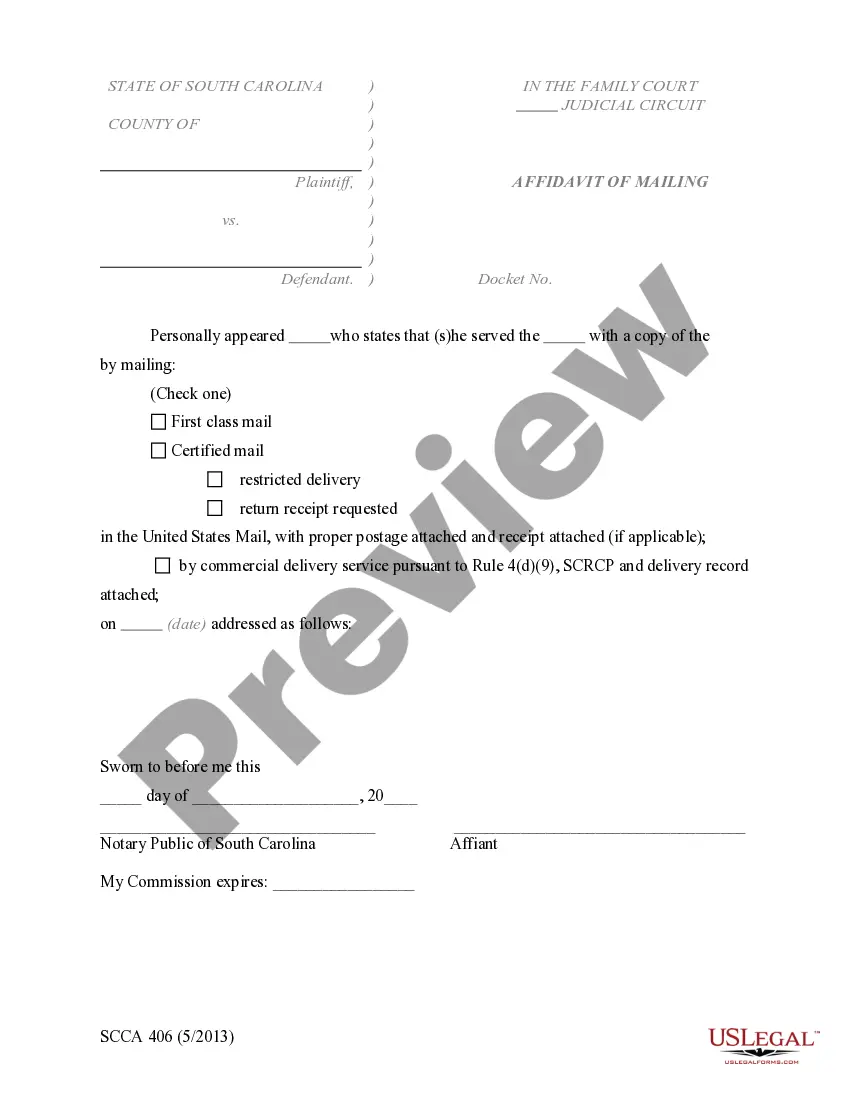
South Carolina Affidavit of Mailing
What is this form?
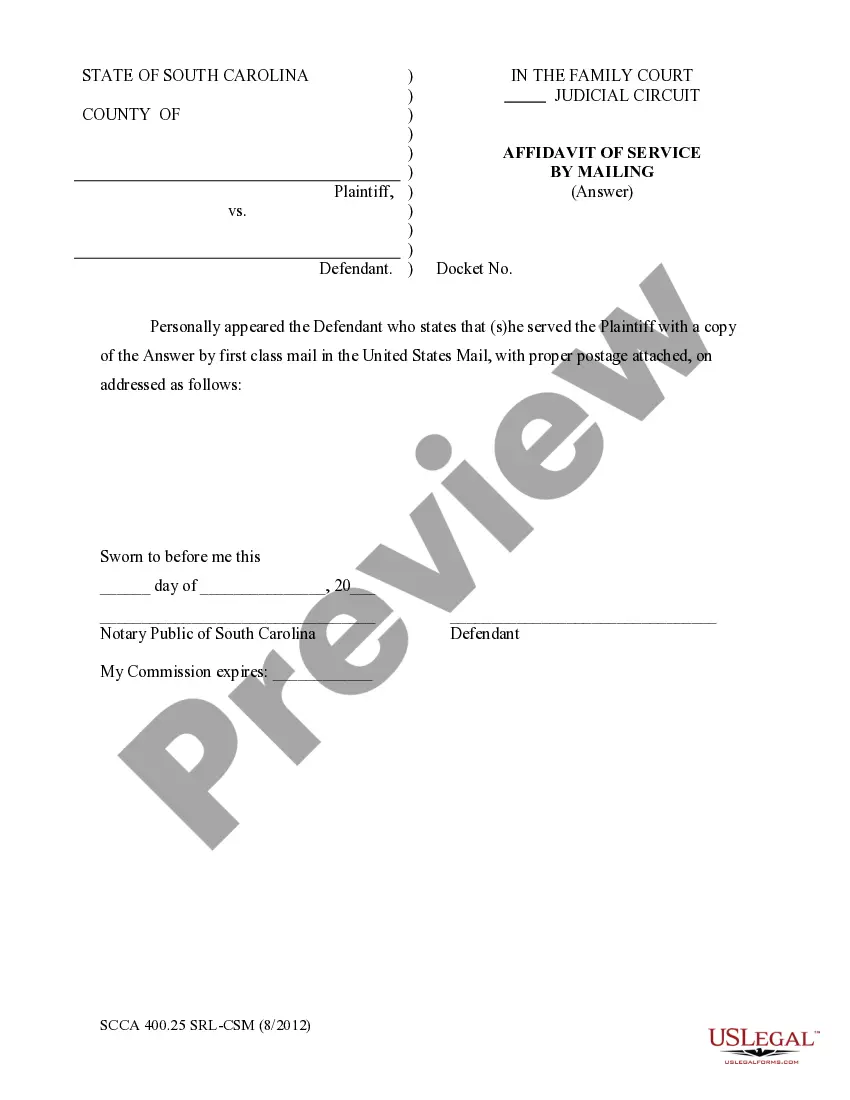
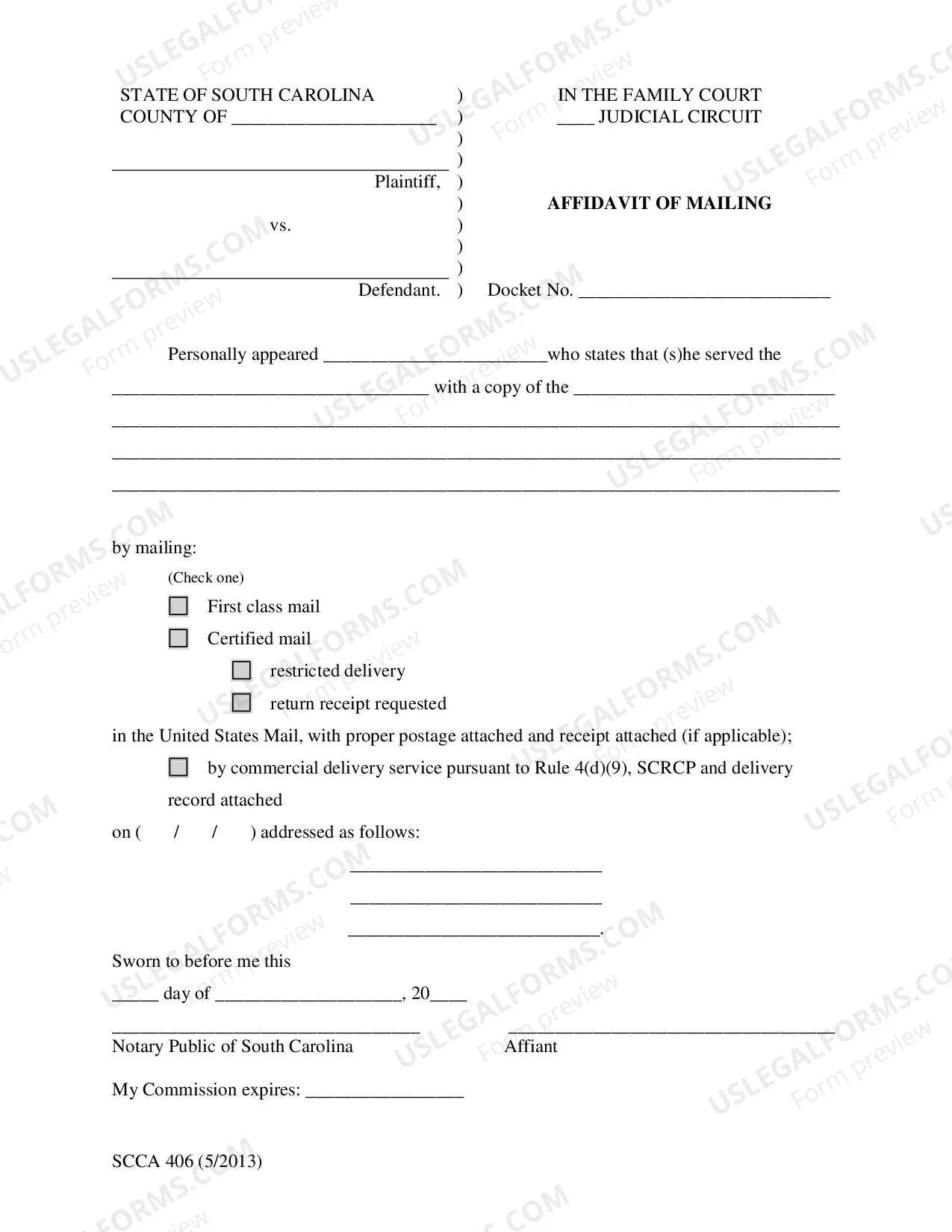
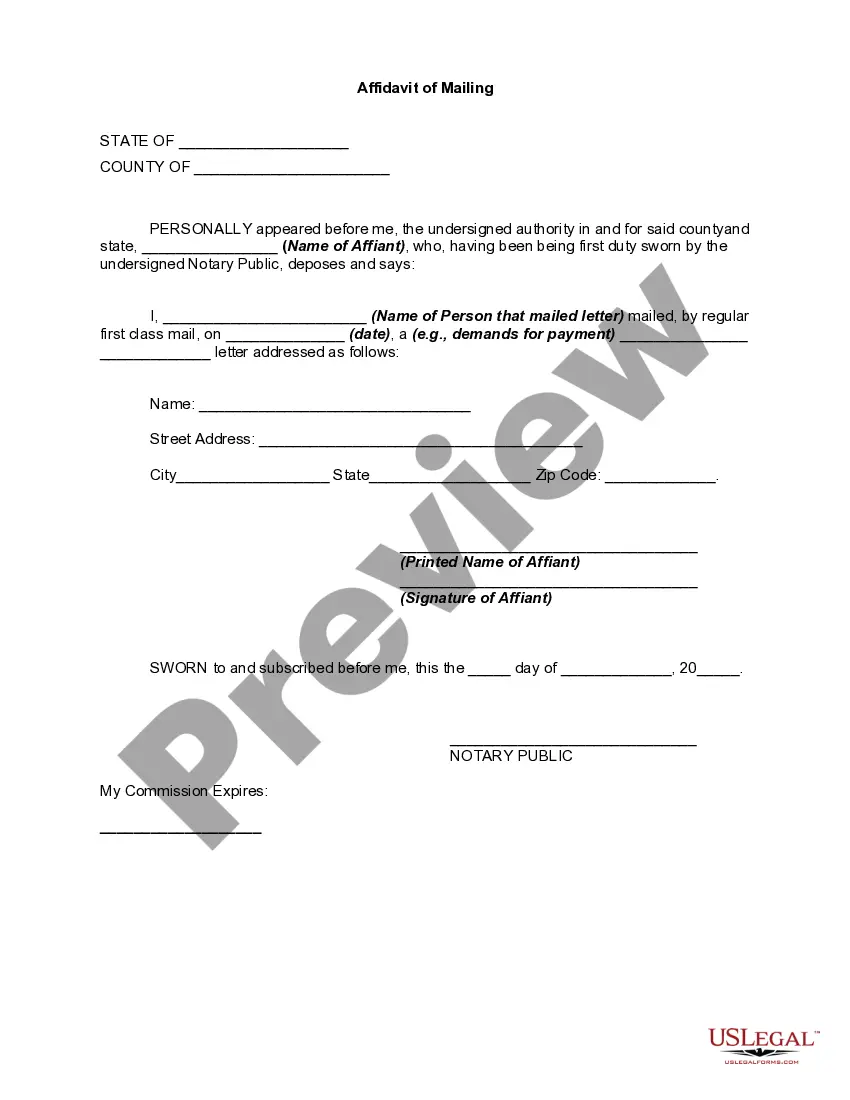
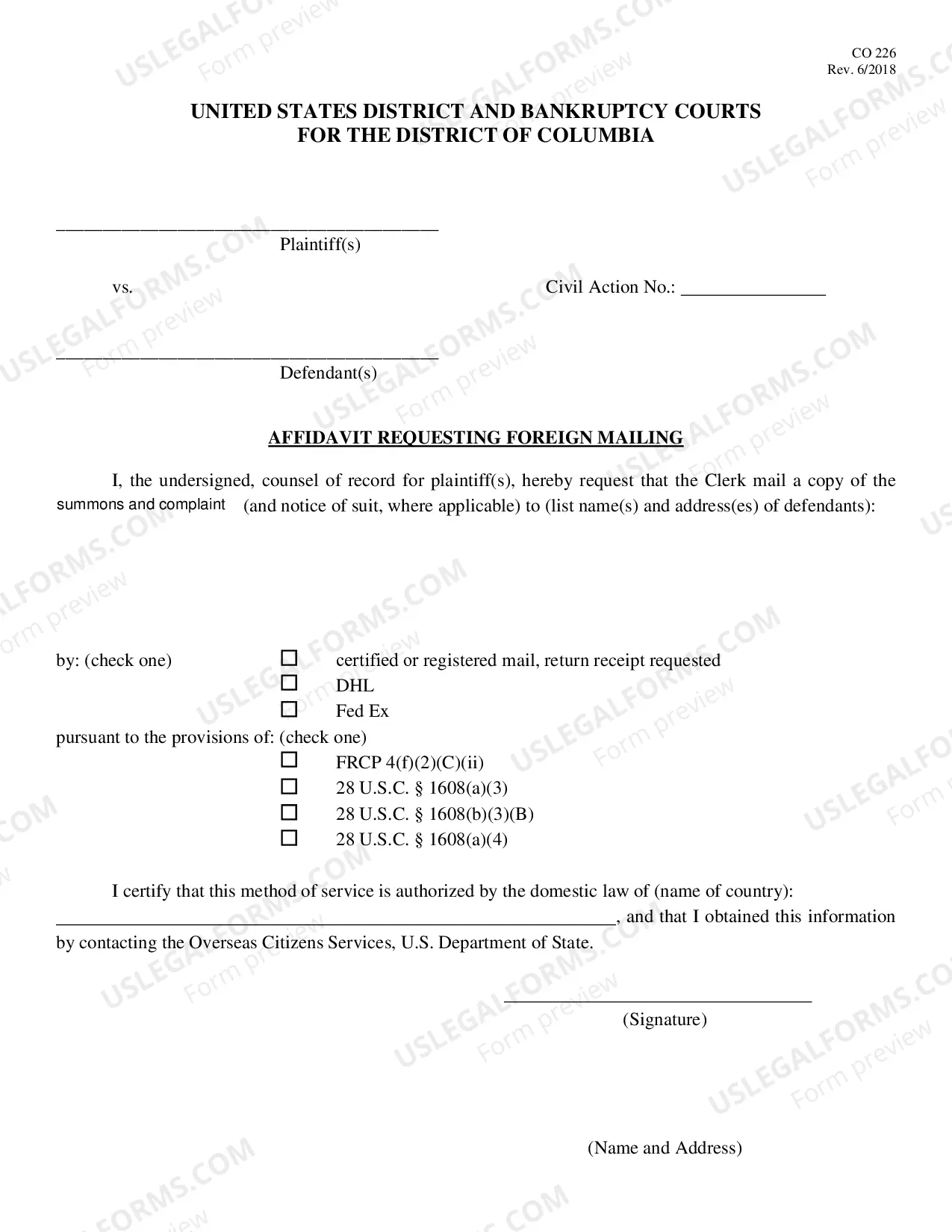
The Affidavit of Mailing is a sworn, written statement attesting to the sending of documents through the mail. It serves to confirm that a specific item was mailed to a certain recipient, typically under conditions like restricted delivery or return receipt requested. This form is crucial for legal situations where proof of mail delivery is essential, distinguishing it from other affidavits that do not specifically pertain to mailing events.
Key parts of this document
- Identification of the parties involved in the mailing.
- Details of the mailing method used (e.g., U.S. Mail with proper postage).
- Confirmation of delivery receipt, if applicable.
- Notary acknowledgment fields for verifying the affiant's signature and the statement's authenticity.
When to use this document
This form is used when you need to prove that certain documents or notices have been sent to a recipient. Situations include court documents, legal notices, or any correspondence that requires official verification of mailing, especially in disputes where delivery confirmation may be contested.
Who this form is for
- Individuals involved in legal proceedings who must demonstrate that documents were sent to other parties.
- Attorneys filing legal documents requiring proof of service.
- Business owners needing to substantiate communication with clients or partners.
- Anyone needing a reliable record of mailed correspondence in legal or formal contexts.
How to prepare this document
- Begin by filling in your details as the affiant.
- Clearly state the recipient's information and address.
- Indicate the mailing method and any specific conditions (e.g., return receipt requested).
- Attach any relevant delivery records or receipts, if available.
- Sign the affidavit in the presence of a notary public, who will then notarize the document.
Does this form need to be notarized?
Yes, this form must be notarized to be legally valid. Notarization ensures that the declarations made in the affidavit are authentic and verifiable. US Legal Forms offers integrated online notarization services that are available 24/7, allowing you to complete the process via secure video call without needing to travel.
Get your form ready online
Our built-in tools help you complete, sign, share, and store your documents in one place.
Make edits, fill in missing information, and update formatting in US Legal Forms—just like you would in MS Word.
Download a copy, print it, send it by email, or mail it via USPS—whatever works best for your next step.
Sign and collect signatures with our SignNow integration. Send to multiple recipients, set reminders, and more. Go Premium to unlock E-Sign.
If this form requires notarization, complete it online through a secure video call—no need to meet a notary in person or wait for an appointment.
We protect your documents and personal data by following strict security and privacy standards.

Make edits, fill in missing information, and update formatting in US Legal Forms—just like you would in MS Word.

Download a copy, print it, send it by email, or mail it via USPS—whatever works best for your next step.

Sign and collect signatures with our SignNow integration. Send to multiple recipients, set reminders, and more. Go Premium to unlock E-Sign.

If this form requires notarization, complete it online through a secure video call—no need to meet a notary in person or wait for an appointment.

We protect your documents and personal data by following strict security and privacy standards.
Avoid these common issues
- Failing to include complete recipient information, which may invalidate the document.
- Not providing the required delivery receipt or proof of mailing.
- Overlooking the notary requirement, leading to an unenforceable affidavit.
- Using incorrect mailing options that do not meet the specified legal requirements.
Why use this form online
- Convenient access to a legally drafted template ready for your specific needs.
- Edit and customize the form easily to fit your circumstances.
- Instant downloads eliminate wait times and provide immediate documentation.
- Access to professional guidance helps ensure compliance with legal standards.
Looking for another form?
Form popularity
FAQ
After the process server serves the papers, he or she must prepare an affidavit that they completed service of process. This affidavit must be notarized. File the affidavit with the Clerk of Court's office where the case is filed.
After the process server serves the papers, he or she must prepare an affidavit that they completed service of process. This affidavit must be notarized. File the affidavit with the Clerk of Court's office where the case is filed.
Pursuant to Rule 40(j), SCRCP, the parties agree that if the claim is restored within one year of the date stricken that the statute of limitations will be tolled during the time that the case is stricken and that any unexpired portion of the statute of limitations on the date the case was stricken shall remain and
To be an admissible Affidavit, the acknowledgment must be sworn to be true and correct to the best personal knowledge of the affiant. Furthermore, the affiant must declare that the statements contained in the Affidavit are true and correct under penalties of perjury.
It is possible to serve an official in the state of South Carolina by hand-delivery of a summons and complaint and by registered or certified mail of the same documents to the office of the Attorney General in Columbia when another official has been designated by statute as being served in that manner.
On a motion for a new trial in an action tried without a jury, the court may open the judgment if one has been entered, take additional testimony, amend findings of fact and conclusions of law or make new findings and conclusions, and direct the entry of a new judgment.
(d)(8) Service by Certified Mail. Service is effective upon the date of delivery as shown on the return receipt. Service pursuant to this paragraph shall not be the basis for the entry of a default or a judgment by default unless the record contains a return receipt showing the acceptance by the defendant.
(b) Change of Attorney. An attorney may be changed by consent, or upon cause shown, and upon such terms as shall be just, upon application, by order of the Court, and not otherwise. Written notice of change of attorney must be served as provided by Rule 5.