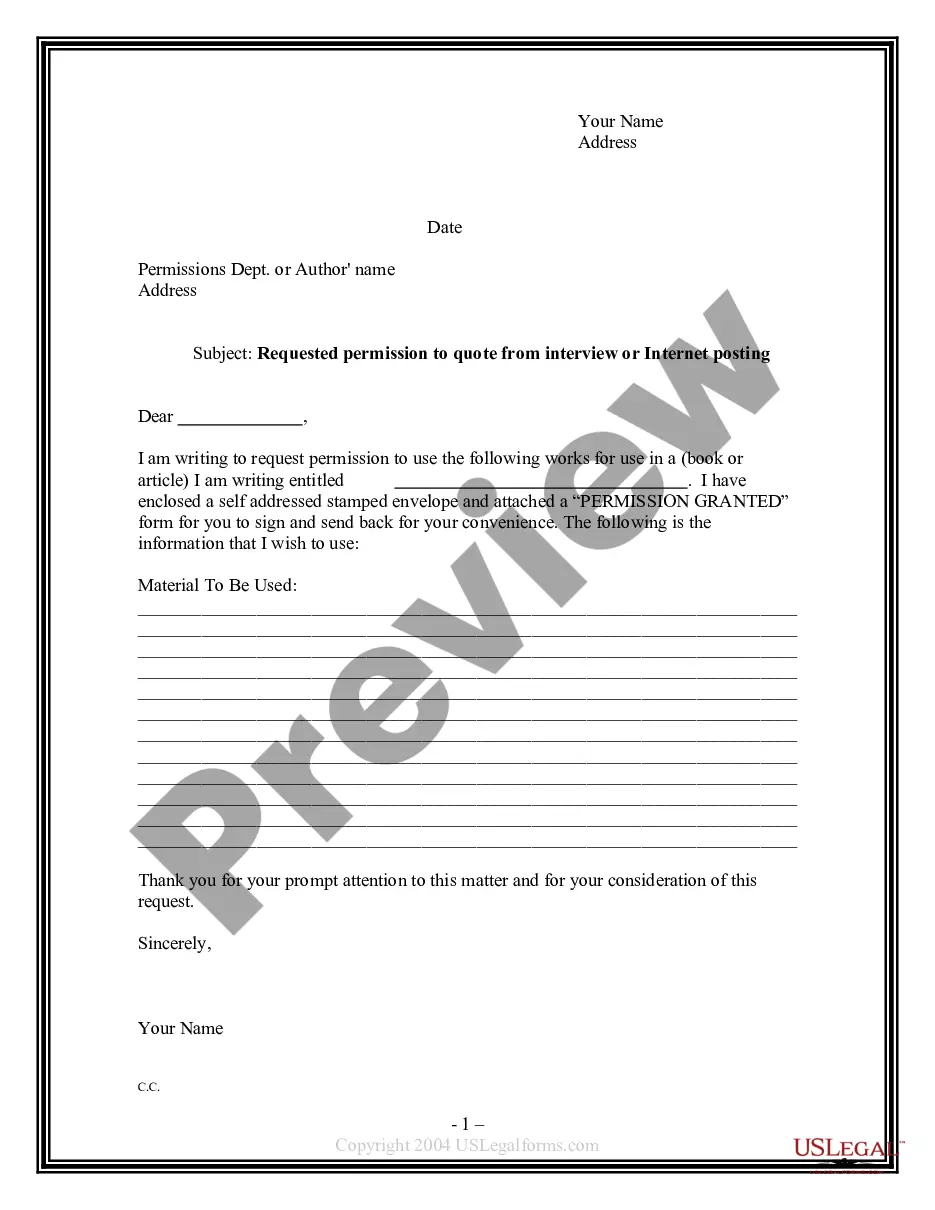
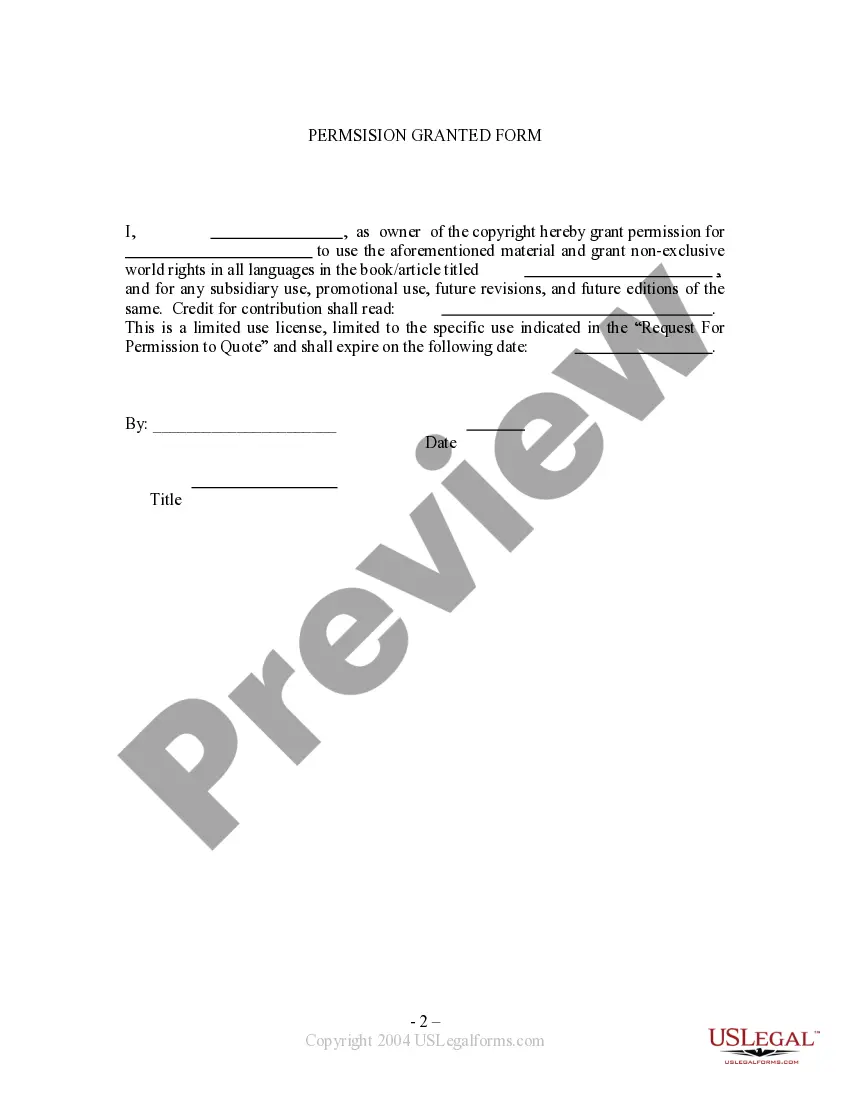
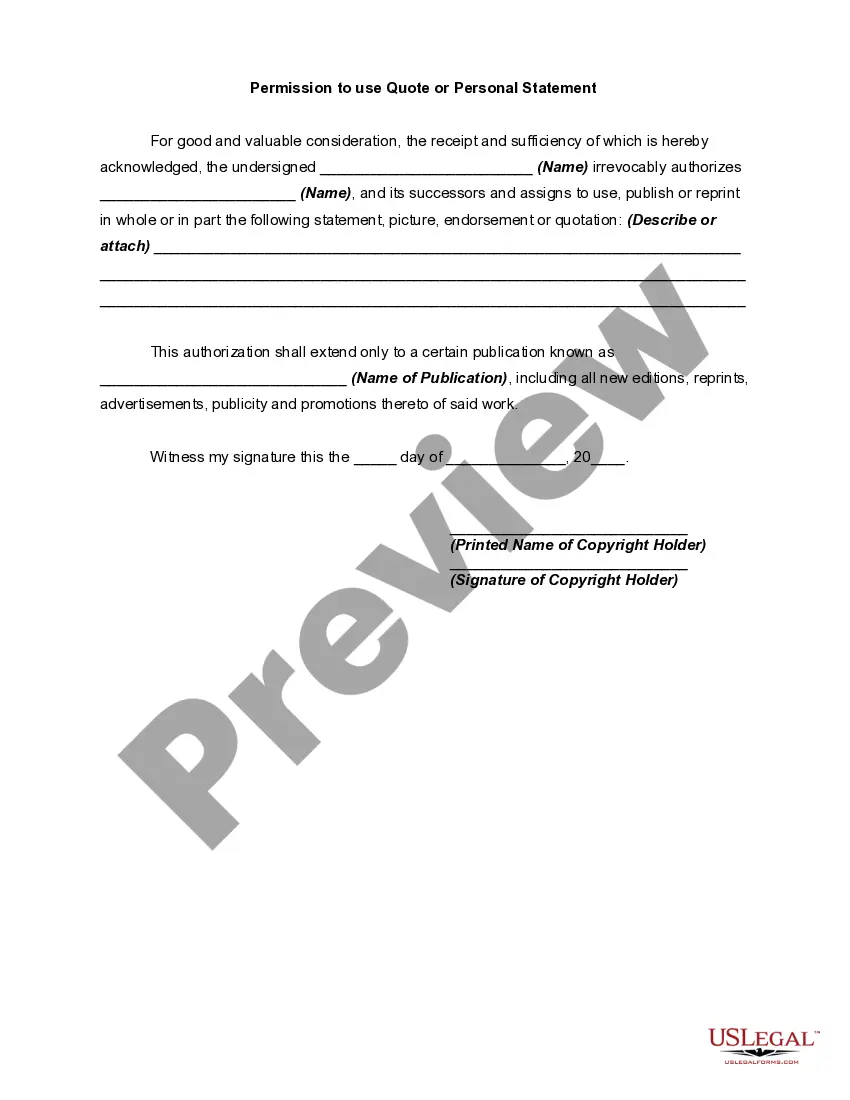
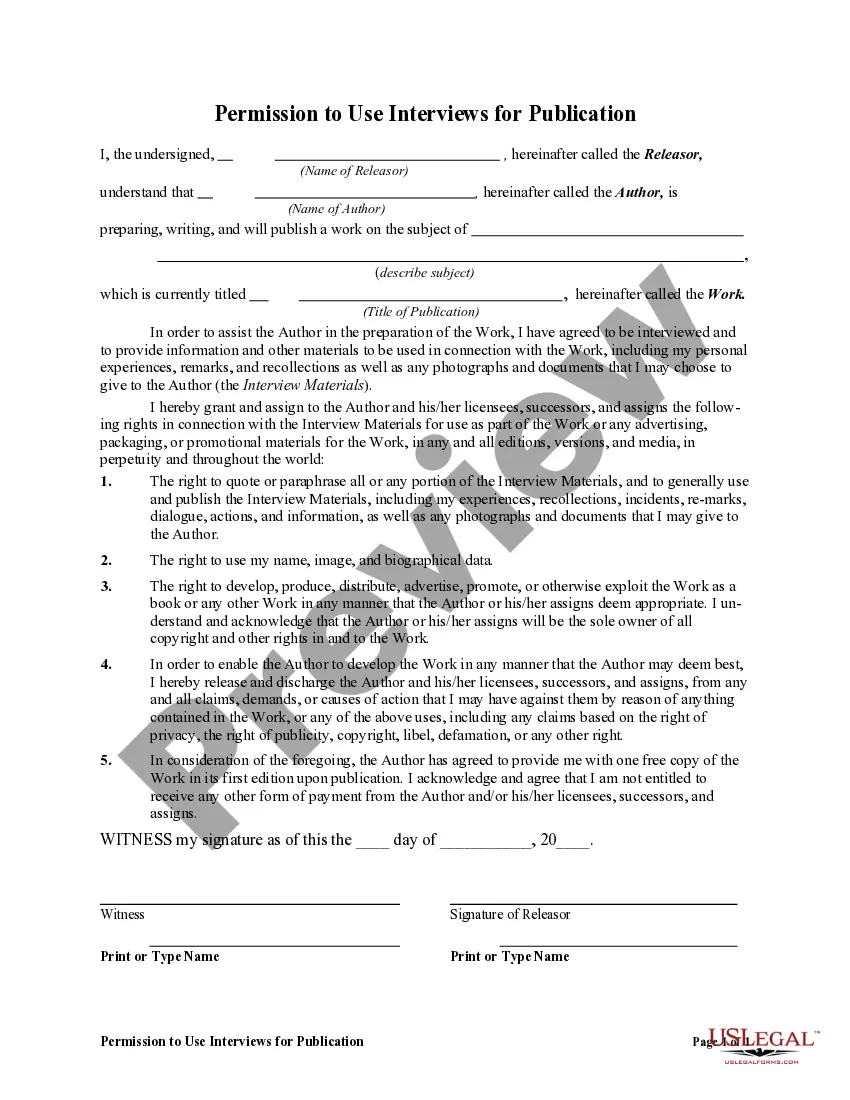
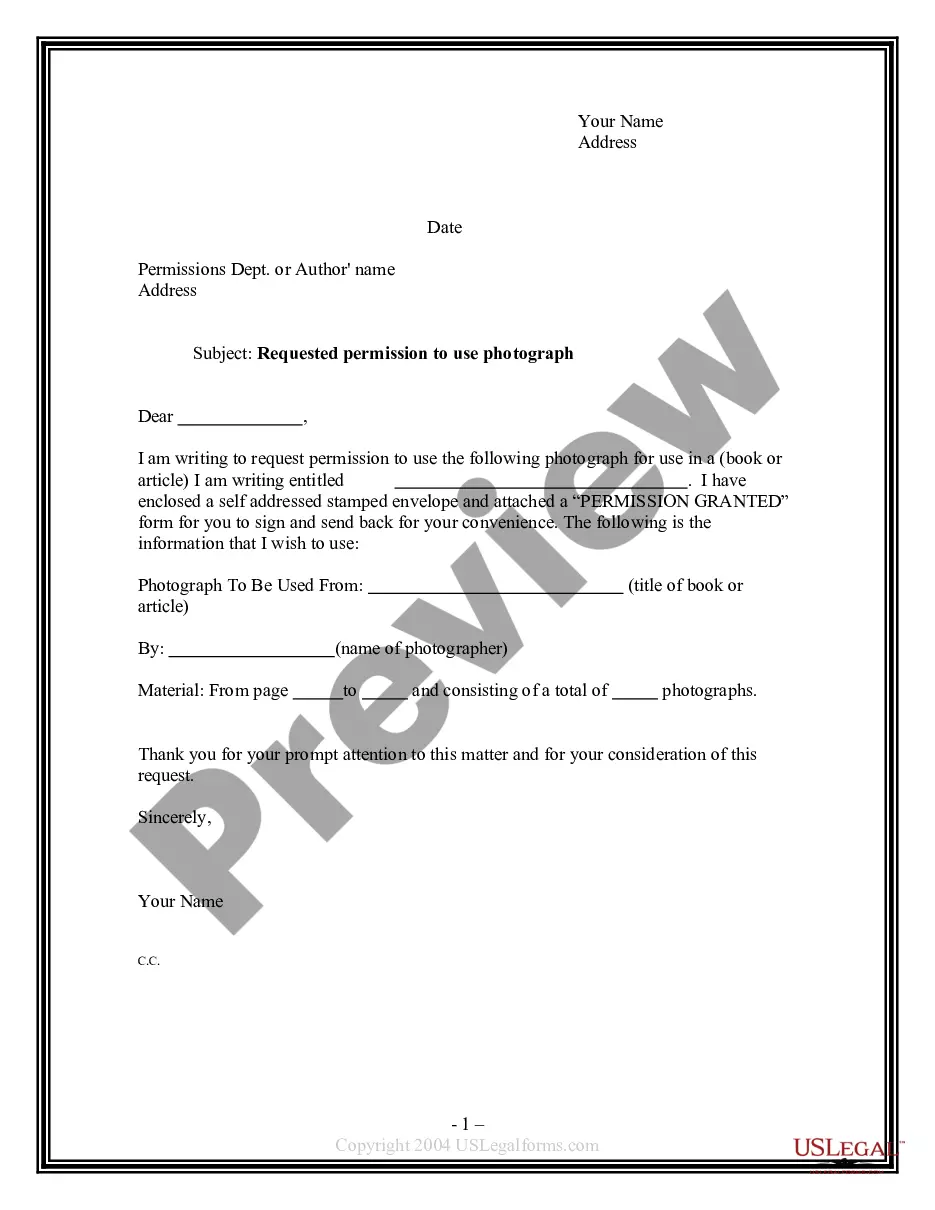
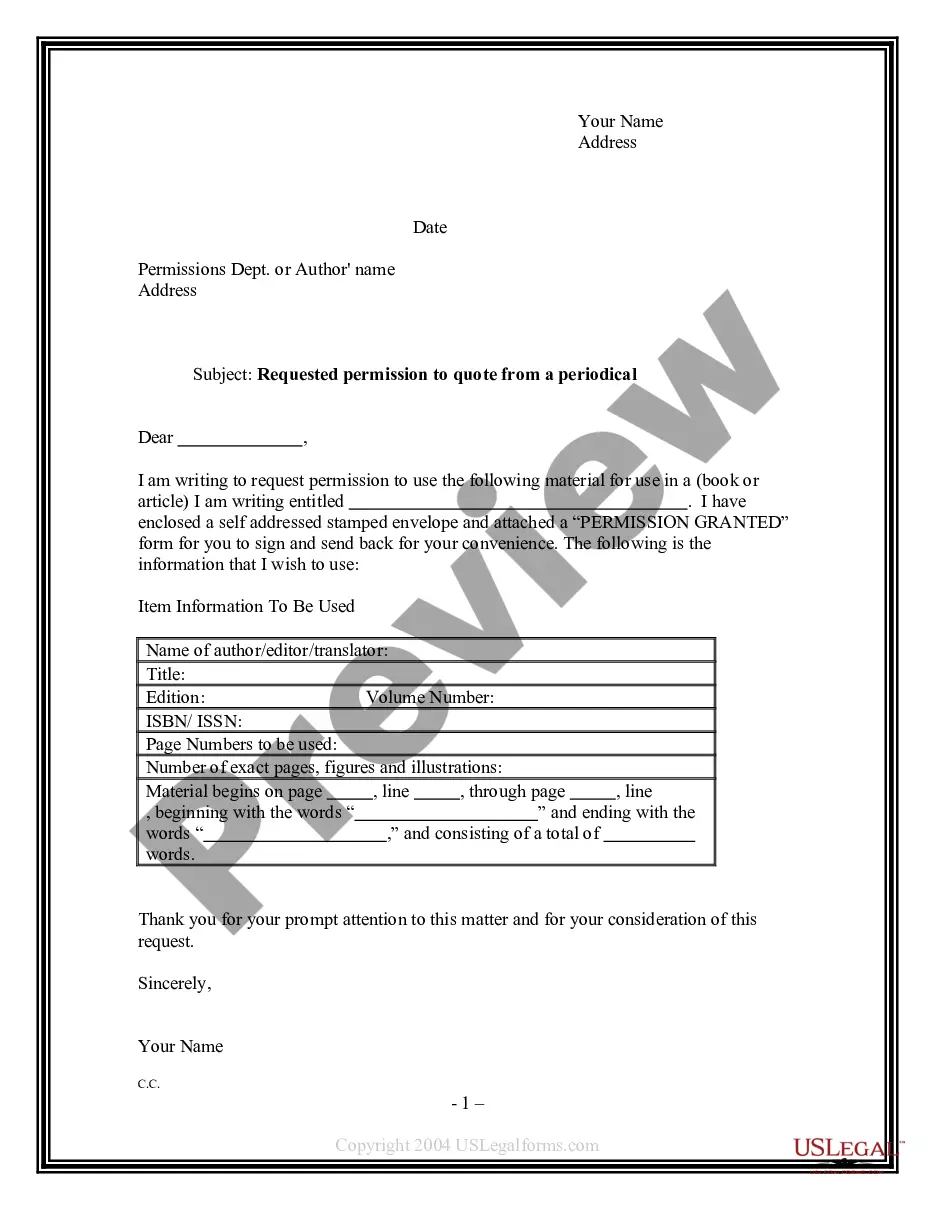
This is a request to the holder of a copyright asking permission to use the copyrighted material in a book or article. There is an attached addendum for the copyright holder to sign granting permission. The request can be granted for only a fixed period of time if the copyright holder does not want to grant the request to be used indefinitely.
Rhode Island Requested Permission to Quote From Interview or Internet Posting
Category:
State:
Multi-State
Control #:
US-PRM-06
Format:
Word;
Rich Text
Instant download
Description
Free preview

Get your form ready online
Our built-in tools help you complete, sign, share, and store your documents in one place.
Built-in online Word editor
Make edits, fill in missing information, and update formatting in US Legal Forms—just like you would in MS Word.
Export easily
Download a copy, print it, send it by email, or mail it via USPS—whatever works best for your next step.
E-sign your document
Sign and collect signatures with our SignNow integration. Send to multiple recipients, set reminders, and more. Go Premium to unlock E-Sign.
Notarize online 24/7
If this form requires notarization, complete it online through a secure video call—no need to meet a notary in person or wait for an appointment.
Store your document securely
We protect your documents and personal data by following strict security and privacy standards.

Make edits, fill in missing information, and update formatting in US Legal Forms—just like you would in MS Word.

Download a copy, print it, send it by email, or mail it via USPS—whatever works best for your next step.

Sign and collect signatures with our SignNow integration. Send to multiple recipients, set reminders, and more. Go Premium to unlock E-Sign.

If this form requires notarization, complete it online through a secure video call—no need to meet a notary in person or wait for an appointment.

We protect your documents and personal data by following strict security and privacy standards.
Looking for another form?








How to fill out Requested Permission To Quote From Interview Or Internet Posting?
US Legal Forms - one of the most important collections of legal documents in the United States - provides a broad array of legal form templates that you can download or print.
By utilizing the website, you can access thousands of forms for business and personal use, organized by categories, states, or keywords. You can find the latest versions of forms such as the Rhode Island Requested Permission to Quote From Interview or Internet Posting in moments.
If you already have a subscription, Log In and retrieve the Rhode Island Requested Permission to Quote From Interview or Internet Posting from the US Legal Forms library. The Download button will show up on every form you view. You can access all previously downloaded forms from the My documents tab in your account.
Complete the transaction. Use your credit card or PayPal account to finalize the payment.
Select the format and download the form to your device. Make edits. Fill out, modify, and print and sign the downloaded Rhode Island Requested Permission to Quote From Interview or Internet Posting. Each template you add to your account has no expiration date and is yours indefinitely. Therefore, if you wish to download or print another copy, simply go to the My documents section and click on the form you need. Access the Rhode Island Requested Permission to Quote From Interview or Internet Posting with US Legal Forms, one of the most extensive libraries of legal document templates. Utilize thousands of professional and state-specific templates that fulfill your business or personal requirements and needs.
- If you want to use US Legal Forms for the first time, here are simple steps to get you started.
- Ensure you have selected the correct form for your location/county.
- Click the Preview button to review the form's content.
- Read the form description to ensure you have chosen the right form.
- If the form does not meet your needs, use the Search area at the top of the screen to find one that does.
- Once you are satisfied with the form, confirm your choice by clicking the Buy now button.
- Then, select the payment plan you prefer and provide your details to create an account.
Form popularity
FAQ
In many cases, a journalist can quote you without permission, especially if the information is obtained from public sources. However, the Rhode Island Requested Permission to Quote From Interview or Internet Posting emphasizes the importance of consent for ethical reporting. While the law may allow it, seeking permission can enhance the integrity of the journalism process. Utilizing USLegalForms can help journalists navigate these legal complexities, ensuring they comply with best practices.
Yes, it is generally advisable to seek permission from the interviewee before quoting them in your report. This practice aligns with the Rhode Island Requested Permission to Quote From Interview or Internet Posting guidelines. Obtaining consent not only respects the interviewee's rights but also fosters trust in your reporting. By using a reliable platform like USLegalForms, you can easily create the necessary documentation to secure this permission.
To ask for copyright permission, first identify the owner of the content you wish to quote. You can usually find this information on the website or publication where the content appears. Next, draft a clear and polite request that specifies how you intend to use the quoted material. When you mention the Rhode Island Requested Permission to Quote From Interview or Internet Posting, it illustrates your awareness of the legal requirements, making your request more credible.
You should always cite your sources to indicate the source of information and ideas in your research. Attribution (or citation), however, is separate from permission. The copyright holder has exclusive rights to reproducing the work. Keep in mind, the author of the work may not be the copyright holder.
YES. You can legally use quotes in small business that are in the public domain. Generally, quotes said before 1923 are in public domain because the protection on them is now expired.
One way to make sure your intended use of a copyrighted work is lawful is to obtain permission or a license from the copyright owner. Contact a copyright owner or author as far as pos- sible in advance of when you want to use the material specified in your permissions request.
Giving attribution to an author's quote does not make it legal to use, however it is recommended that you always give attribution and not pass work off as your own- even if it's in public domain or you have written permission to use.
If you're seeking permission to quote from a book, look on the copyright page for the rights holder; it's usually the author. However, assuming the book is currently in print and on sale, normally you contact the publisher for permission. You can also try contacting the author or the author's literary agent or estate.
In order to establish your initial claim for Unemployment Insurance, you may do so online at the Unemployment Claims page. Customers may call the Call Center Monday through Thursday from a.m. until p.m. and Friday from 9 a.m. until 3 p.m. You can also visit our Frequently Asked Questions (FAQs) page.
Nope, because you'd be paraphrasing their work and presenting it as your own, and that would still be plagiarism.