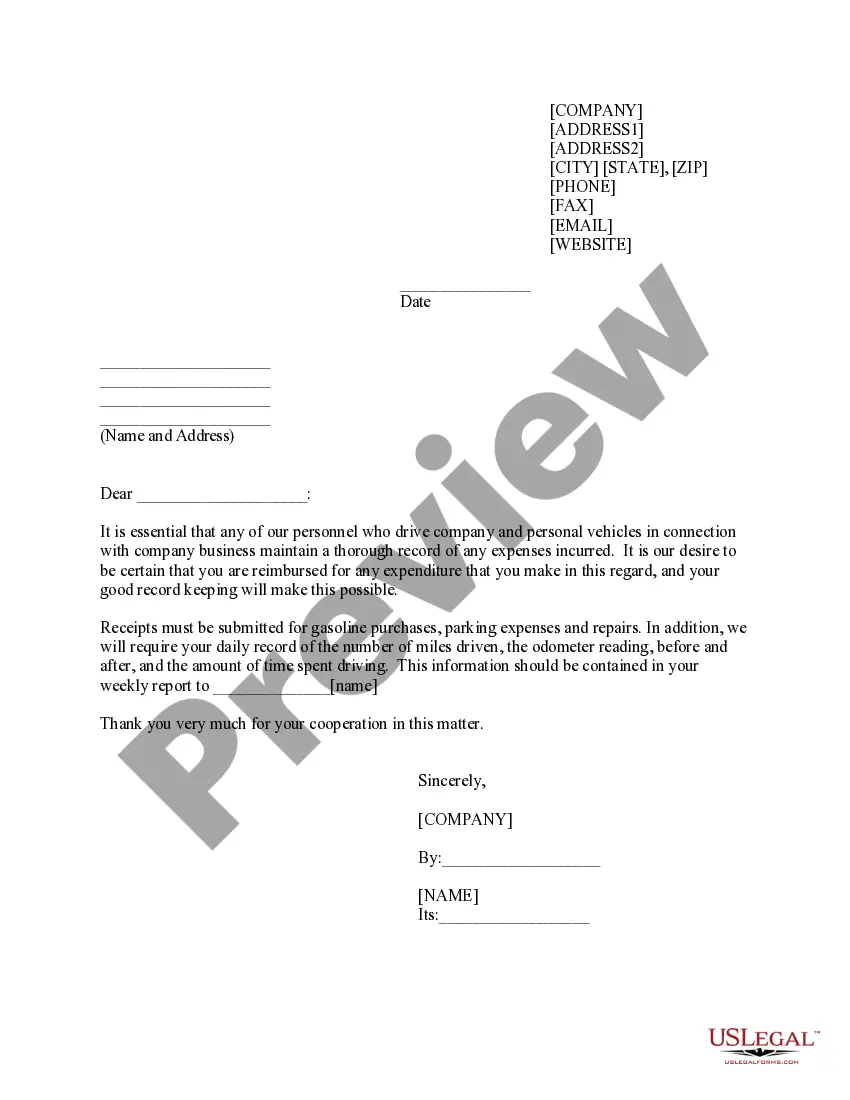
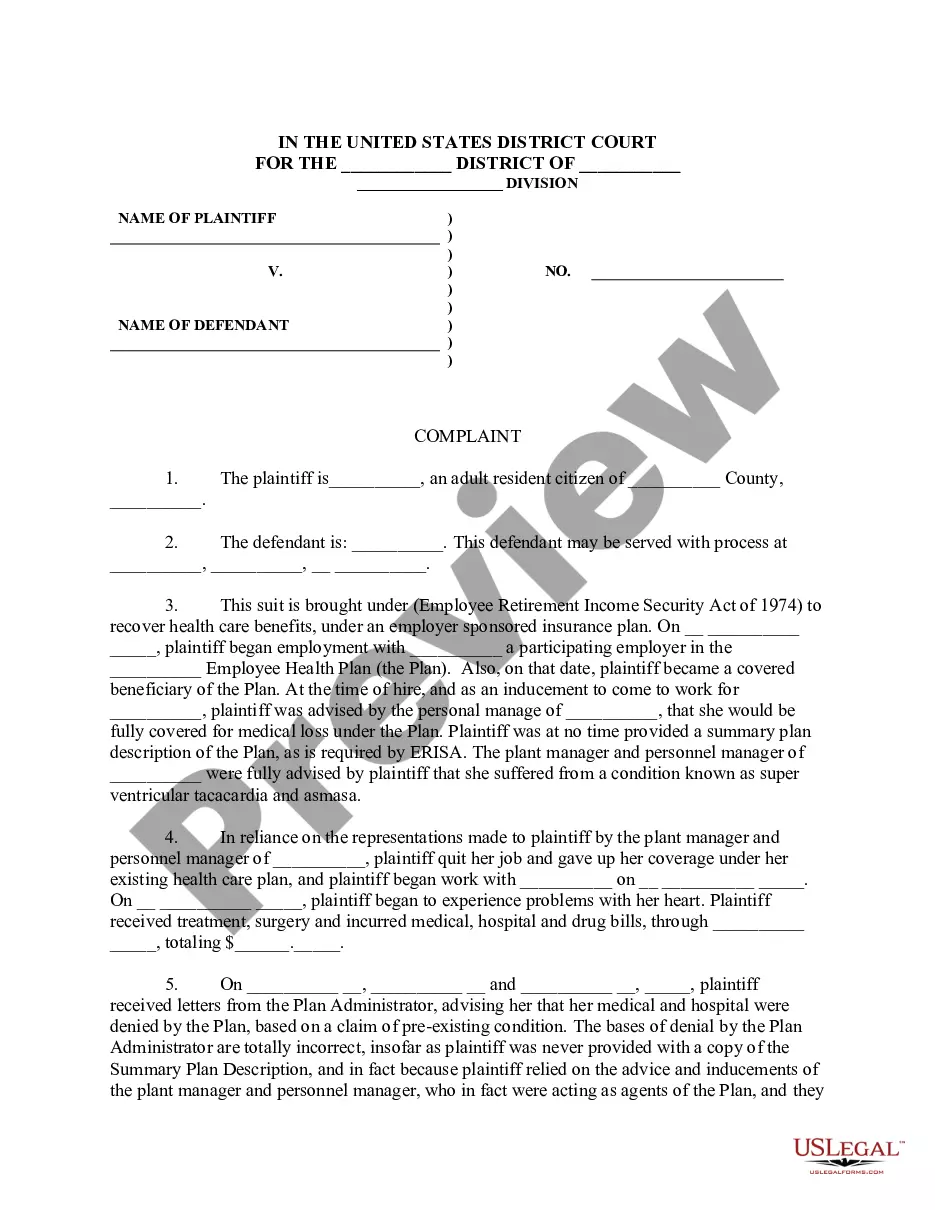
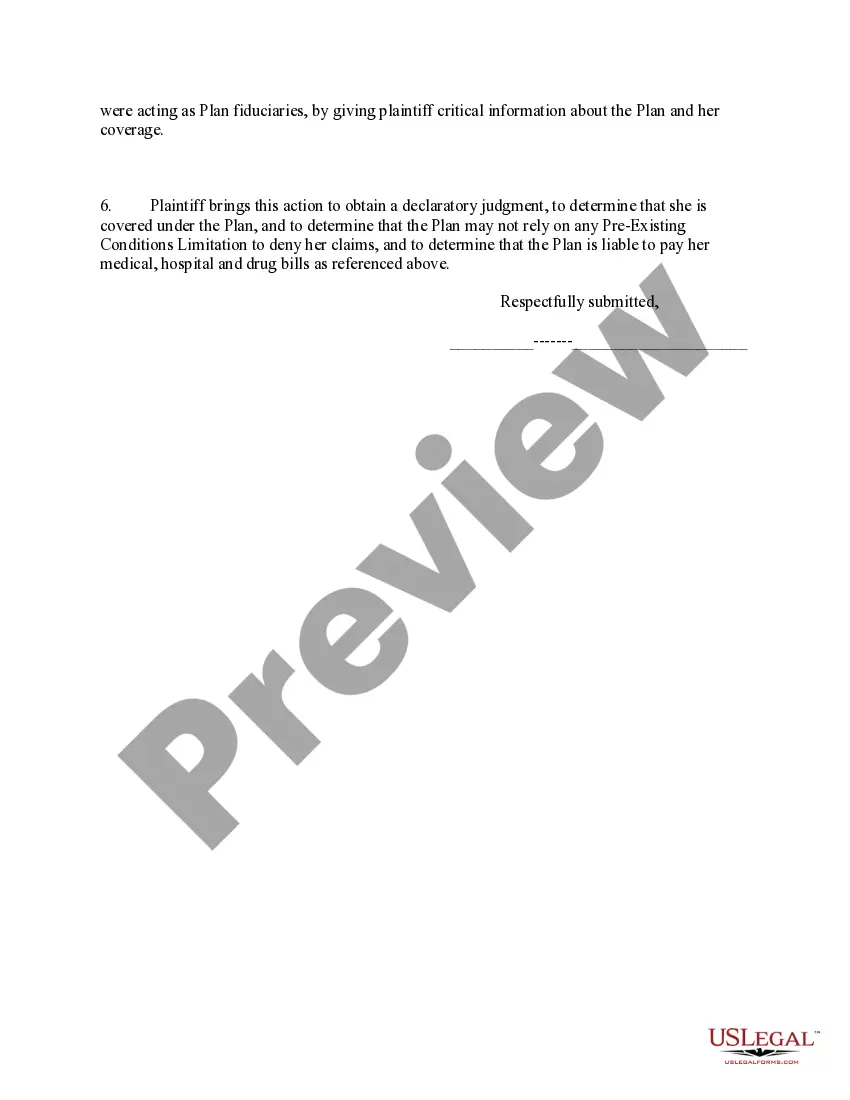
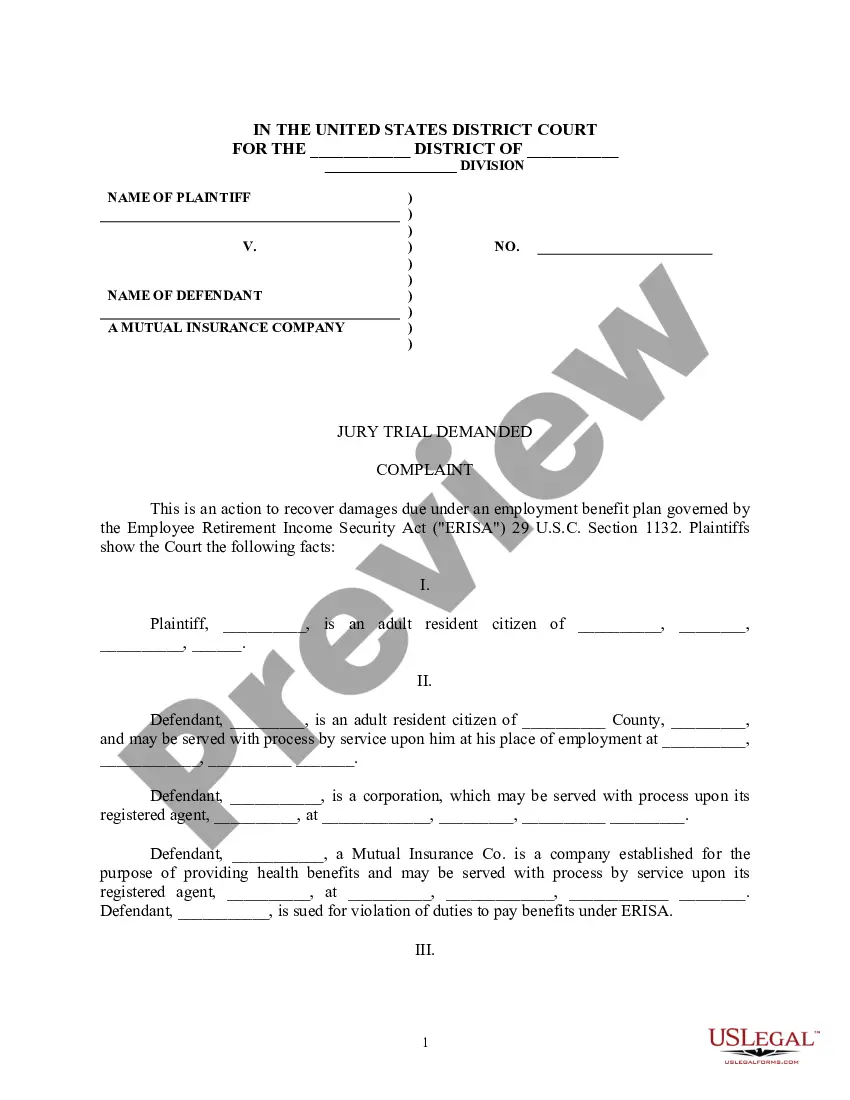
This form is a Complaint For Declaratory Judgment To Determine ERISA Coverage. Adapt to your specific circumstances. Don't reinvent the wheel, save time and money.
Rhode Island Complaint For Declaratory Judgment To Determine ERISA Coverage
Instant download
Description
Free preview
Get your form ready online
Our built-in tools help you complete, sign, share, and store your documents in one place.
Built-in online Word editor
Make edits, fill in missing information, and update formatting in US Legal Forms—just like you would in MS Word.
Export easily
Download a copy, print it, send it by email, or mail it via USPS—whatever works best for your next step.
E-sign your document
Sign and collect signatures with our SignNow integration. Send to multiple recipients, set reminders, and more. Go Premium to unlock E-Sign.
Notarize online 24/7
If this form requires notarization, complete it online through a secure video call—no need to meet a notary in person or wait for an appointment.
Store your document securely
We protect your documents and personal data by following strict security and privacy standards.

Make edits, fill in missing information, and update formatting in US Legal Forms—just like you would in MS Word.

Download a copy, print it, send it by email, or mail it via USPS—whatever works best for your next step.

Sign and collect signatures with our SignNow integration. Send to multiple recipients, set reminders, and more. Go Premium to unlock E-Sign.

If this form requires notarization, complete it online through a secure video call—no need to meet a notary in person or wait for an appointment.

We protect your documents and personal data by following strict security and privacy standards.
Looking for another form?



How to fill out Complaint For Declaratory Judgment To Determine ERISA Coverage?
If you desire to be thorough, obtain, or print out authentic document templates, utilize US Legal Forms, the largest collection of legal documents available online.
Employ the site's simple and user-friendly search tool to locate the files you require.
Numerous templates for business and personal purposes are categorized by types and states, or keywords. Use US Legal Forms to locate the Rhode Island Complaint For Declaratory Judgment To Determine ERISA Coverage in just a few clicks.
Step 5. Process the transaction. You may use your credit card or PayPal account to complete the payment.
Step 6. Choose the format of the legal form and download it to your device. Step 7. Fill out, modify, and print or sign the Rhode Island Complaint For Declaratory Judgment To Determine ERISA Coverage. Every legal document template you obtain is yours indefinitely. You have access to every form you acquired in your account. Click on the My documents section and select a form to print or download again. Stay competitive and obtain, and print the Rhode Island Complaint For Declaratory Judgment To Determine ERISA Coverage with US Legal Forms. There are many professional and state-specific templates you can utilize for your business or personal needs.
- If you are already a US Legal Forms user, Log In to your account and click on the Download button to obtain the Rhode Island Complaint For Declaratory Judgment To Determine ERISA Coverage.
- You can also access forms you have previously obtained from the My documents section of your account.
- If you are using US Legal Forms for the first time, follow the steps outlined below.
- Step 1. Ensure you have selected the form for the correct city/state.
- Step 2. Utilize the Preview function to review the form's details. Don't forget to read the description.
- Step 3. If you are not satisfied with the form, use the Search field at the top of the screen to find other versions of the legal form template.
- Step 4. Once you have found the form you need, select the Get now button. Choose the pricing plan you prefer and enter your credentials to register for an account.
Form popularity
FAQ
An insurance company may request a declaratory judgment when it seeks clarification on its obligations under a policy, especially when there are conflicting interpretations of coverage. This action can prevent future disputes by resolving uncertainties upfront. In cases involving ERISA plans, a Rhode Island Complaint For Declaratory Judgment To Determine ERISA Coverage can help ensure that both the insurer and the insured understand their rights and responsibilities.
It may be appropriate to bring a declaratory judgment action when there is uncertainty regarding the interpretation of an insurance policy or plan benefits. In situations where a claim has been denied, and the terms of coverage are in dispute, filing a Rhode Island Complaint For Declaratory Judgment To Determine ERISA Coverage can provide legal clarity and help protect your rights.
ERISA does not typically allow for punitive damages in cases involving employee benefit plans. Instead, the law focuses on ensuring that individuals receive the benefits they are entitled to under their plans. Therefore, if you believe a plan has wrongfully denied your claim, a Rhode Island Complaint For Declaratory Judgment To Determine ERISA Coverage may be a more appropriate route to seek resolution.
The ERISA appeal process allows individuals to challenge a denial of benefits by an employer-sponsored plan. This process typically involves submitting a written appeal to the plan administrator, who must then review the decision based on the evidence provided. If a claim is denied again, individuals may consider filing a Rhode Island Complaint For Declaratory Judgment To Determine ERISA Coverage to seek judicial review.
A declaratory judgment in insurance is a court decision that clarifies the rights and obligations of the parties involved in an insurance policy. This legal determination can help resolve disputes over coverage, especially in complex cases involving ERISA. In the context of a Rhode Island Complaint For Declaratory Judgment To Determine ERISA Coverage, this judgment can provide clarity on whether an individual is entitled to benefits under a specific plan.
A common way of eliminating this uncertainty is with a declaratory judgment action, also called a declaration. This is a court-issued judgment that has the court clarify and affirm any rights, obligations and responsibilities of one or more parties involved in insurance litigation or other civil disputes.
A declaratory judgment is typically requested when a party is threatened with a lawsuit but the lawsuit has not yet been filed; or when a party or parties believe that their rights under law and/or contract might conflict; or as part of a counterclaim to prevent further lawsuits from the same plaintiff (for example, ...
An example of a declaratory judgment in an insurance situation may occur when a policyholder and an insurer disagree about whether a particular claim is covered under the insurance policy. For instance, suppose a homeowner files a claim with their insurance company for damages to their home caused by a storm.
Declaratory judgment and injunction Order (Injunctive Relief) are different in nature but same in purpose. The effects and outcomes may be varying ing to situation and requirements. The judgment doesn't award the remedies but the injunctive relief awards the remedies on the temporary or permanent base.
For example, a policyholder believes that their denied claim is unjust. As a result, they inform the insurer that they are considering a lawsuit to recover losses. The insurer seeks a declaratory judgment to clarify its rights and obligations with hopes of preventing the lawsuit.