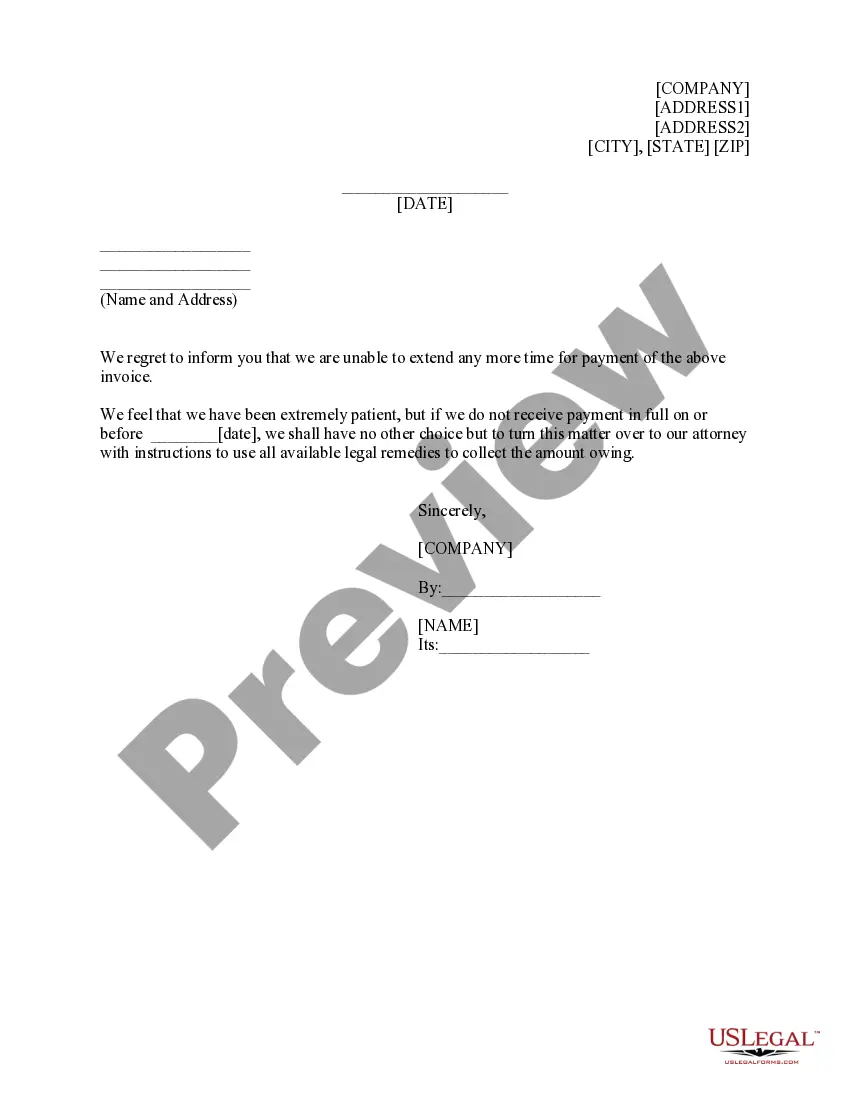
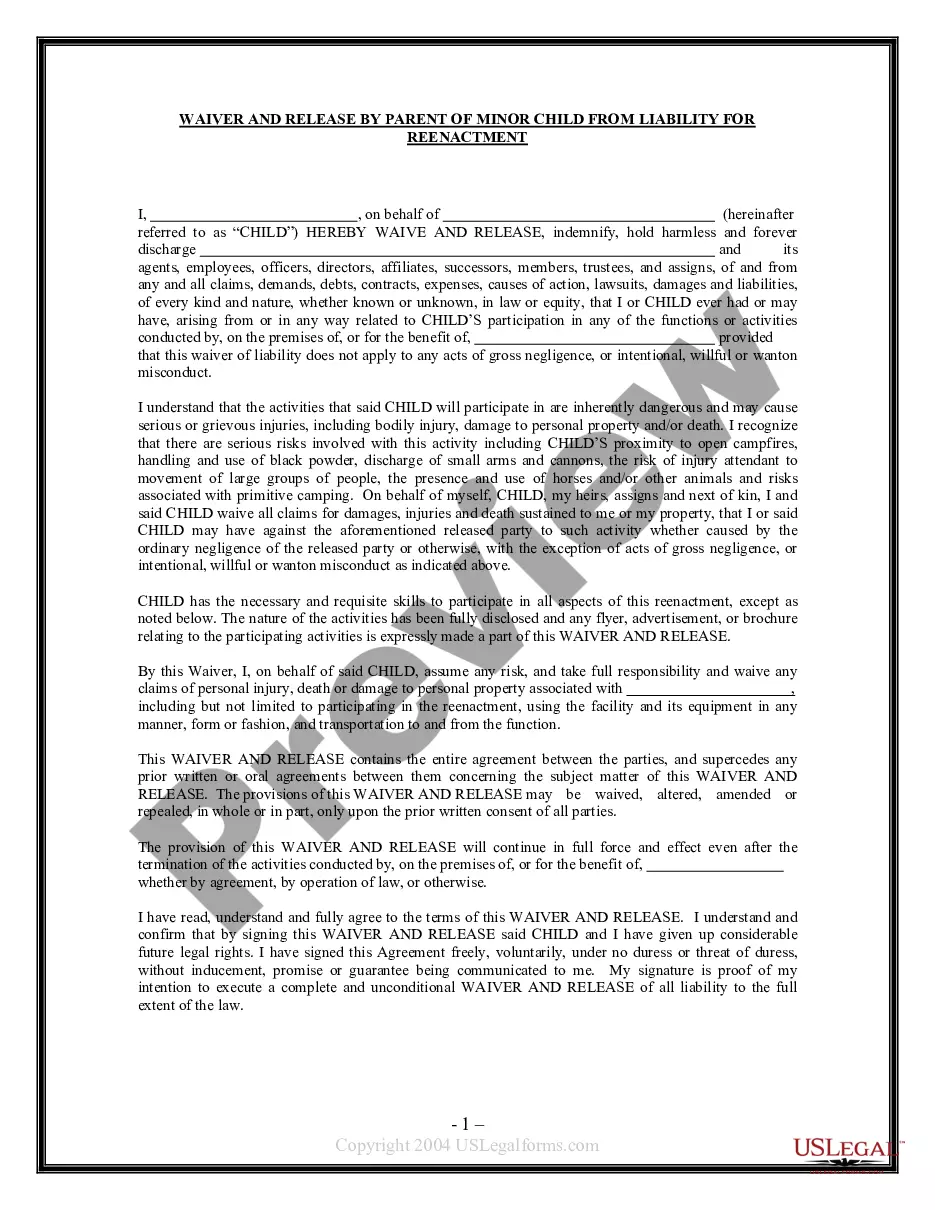
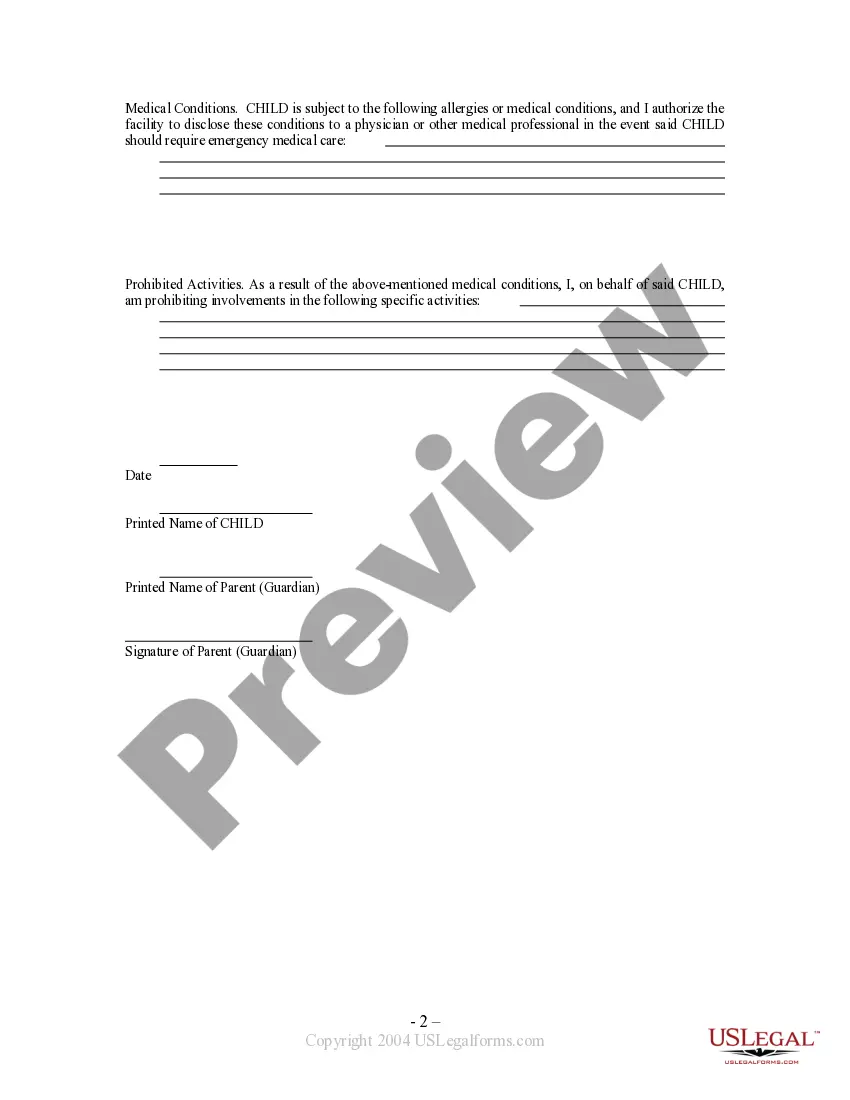
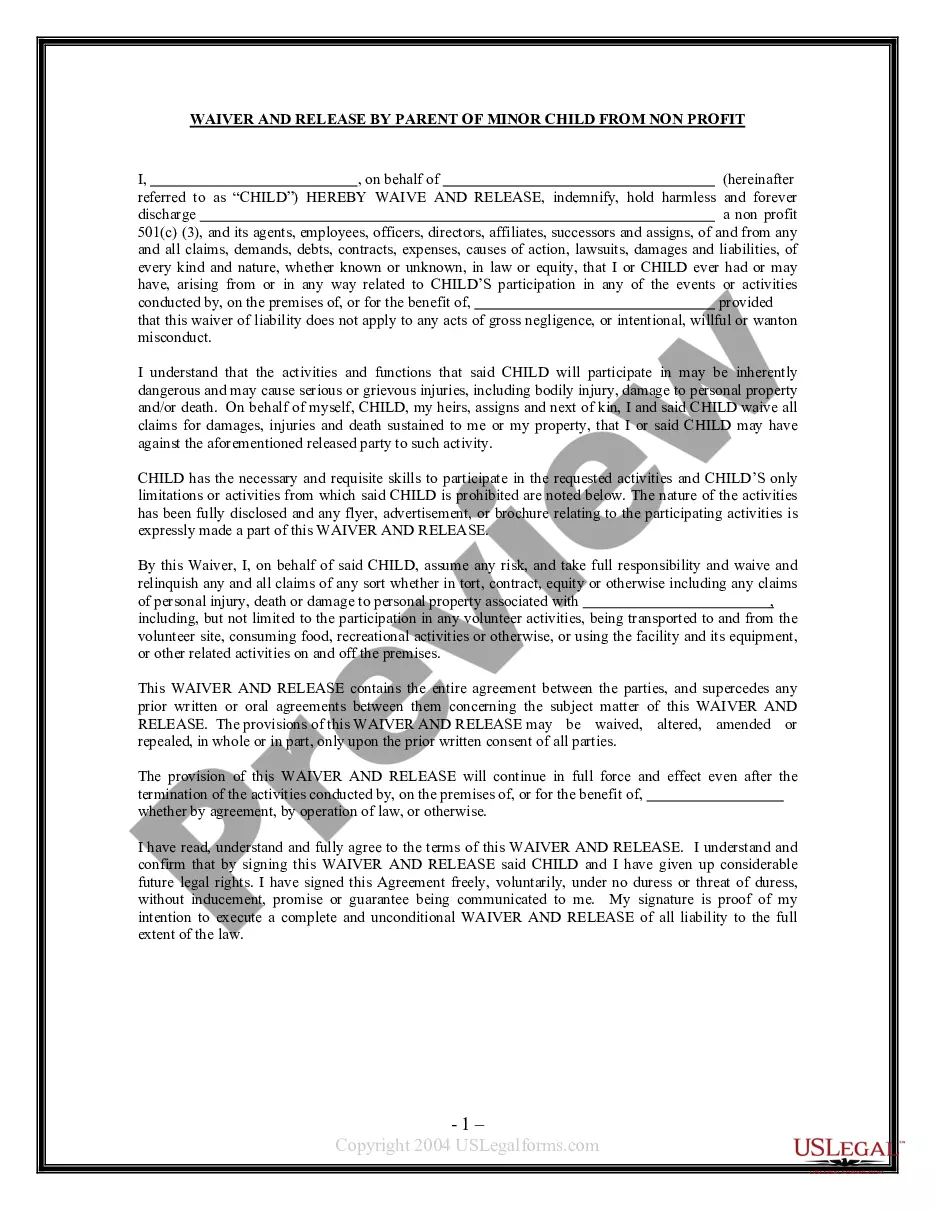
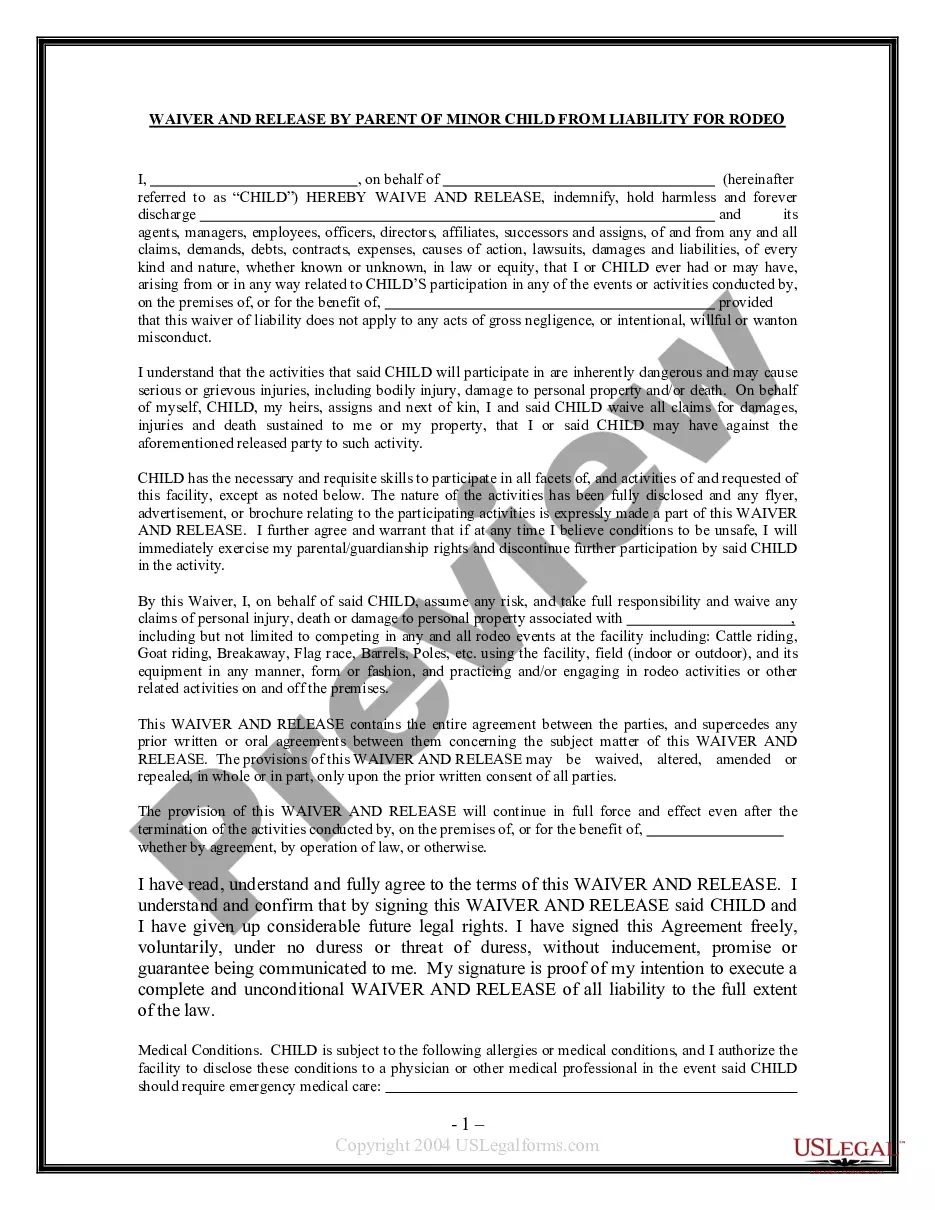
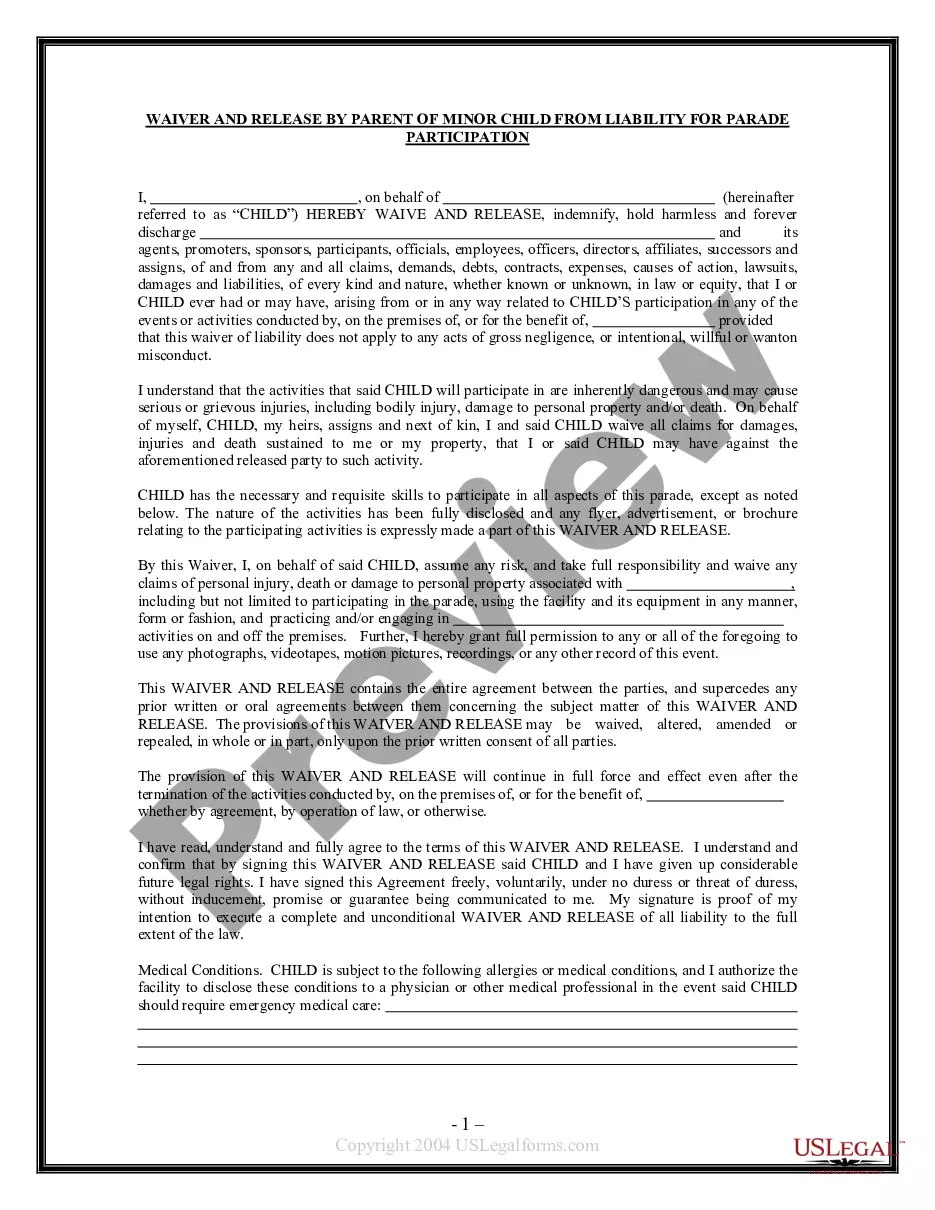
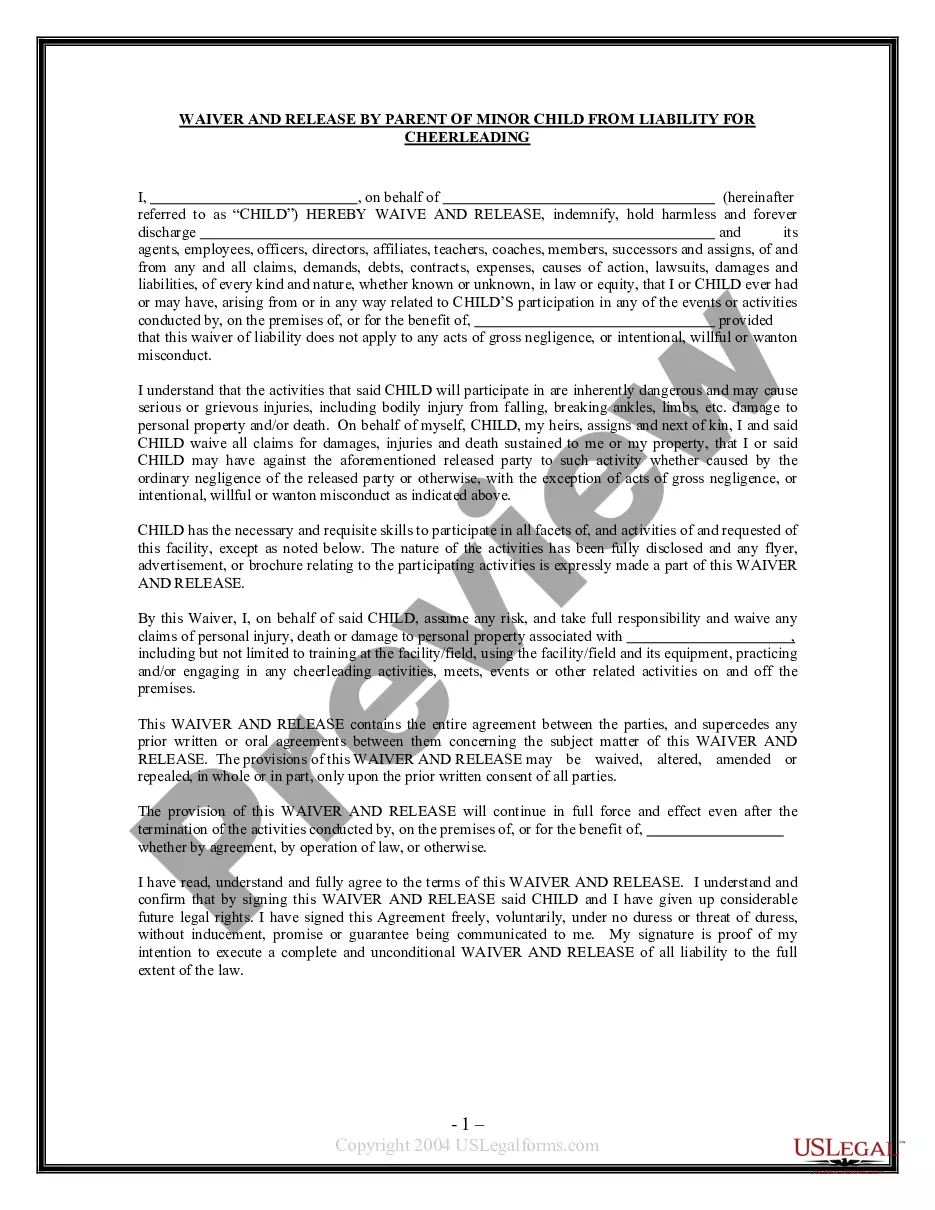
This form allows a parent or guardian to release a minor for reenactment from liability for injuries which may be incurred by a minor child while on the premises, taking part in activities, etc.
Pennsylvania Waiver and Release From Liability For Minor Child for Reenactment
Category:
State:
Multi-State
Control #:
US-WAV-79M
Format:
Word;
Rich Text
Instant download
Description
Free preview
How to fill out Waiver And Release From Liability For Minor Child For Reenactment?
If you need to be thorough, acquire, or create official document templates, utilize US Legal Forms, the largest collection of legal forms available online. Take advantage of the site's simple and user-friendly search to locate the documents you require. Various templates for commercial and personal purposes are organized by categories and states, or keywords. Use US Legal Forms to obtain the Pennsylvania Waiver and Release From Liability For Minor Child for Reenactment with just a few clicks.
If you are already a US Legal Forms user, Log In to your account and click the Download button to retrieve the Pennsylvania Waiver and Release From Liability For Minor Child for Reenactment. You can also access forms you previously stored in the My documents section of your account.
If you are using US Legal Forms for the first time, follow the steps below: Step 1. Ensure you have selected the form for the correct area/region. Step 2. Use the Preview option to review the form’s content. Don’t forget to read the summary. Step 3. If you are not satisfied with the form, utilize the Search field at the top of the screen to find other versions of the legal form template. Step 4. Once you have found the form you need, click the Get Now button. Choose the pricing plan you prefer and enter your information to register for an account. Step 5. Complete the transaction. You can use your credit card or PayPal account to finalize the purchase. Step 6. Select the format of the legal form and download it to your device. Step 7. Complete, edit, and print or sign the Pennsylvania Waiver and Release From Liability For Minor Child for Reenactment.
- Every legal document template you obtain is yours permanently.
- You have access to every form you saved in your account.
- Click on the My documents section and select a form to print or download again.
- Be proactive and obtain, and print the Pennsylvania Waiver and Release From Liability For Minor Child for Reenactment with US Legal Forms.
- There are numerous professional and state-specific forms you can use for your business or personal needs.
Form popularity
FAQ
In Pennsylvania, the statute of limitations for a minor to file a lawsuit typically extends until they reach the age of majority, which is 18 years old. This means a minor has until their 20th birthday to bring a claim. A Pennsylvania Waiver and Release From Liability For Minor Child for Reenactment can play a significant role in legal proceedings, so understanding the timeline is crucial.
Waivers are enforceable in Pennsylvania, provided they adhere to certain legal criteria. A Pennsylvania Waiver and Release From Liability For Minor Child for Reenactment must clearly state the risks involved and be signed by a parent or guardian. Understanding these requirements can help ensure that your waiver holds up in court.
Common mistakes on liability waivers include vague language and failing to specify the activities covered by the waiver. A Pennsylvania Waiver and Release From Liability For Minor Child for Reenactment should be clear and specific to avoid confusion. Additionally, not obtaining proper signatures or not providing the waiver in advance can undermine its enforceability.
In Pennsylvania, you can sue a minor, but it often involves additional legal considerations. A Pennsylvania Waiver and Release From Liability For Minor Child for Reenactment may complicate matters, as minors typically have limited capacity to enter into binding contracts. It's advisable to consult with a legal expert to understand your options when dealing with minors in a lawsuit.
Yes, liability waivers are generally enforceable in Pennsylvania, provided they meet specific legal requirements. A Pennsylvania Waiver and Release From Liability For Minor Child for Reenactment can protect organizations from legal claims, as long as they are clear and unambiguous. However, enforceability can depend on various factors, including how the waiver is presented and the nature of the activity.
A Pennsylvania Waiver and Release From Liability For Minor Child for Reenactment can limit your ability to sue for certain injuries. However, it does not completely eliminate your right to file a lawsuit, especially in cases of negligence or misconduct. Understanding the specific terms of the waiver is important, as they dictate what rights you may be waiving.
To sum it up, customers can still sue business owners even when they've signed a waiver to use the business.
A waiver is a legally binding provision where either party in a contract agrees to voluntarily forfeit a claim without the other party being liable. Waivers can either be in written form or some form of action.
In Pennsylvania, such liability waivers, or exculpatory agreements, are generally enforceable, except in cases of intentional, reckless, or grossly negligent conduct.
Liability waivers are common in the recreational context and the sporting world, as a means of limiting the financial exposure of those who operate such enterprises. These waivers often intimidate prospective injury plaintiffs, and for good reason in Pennsylvania, liability waivers are generally enforceable.