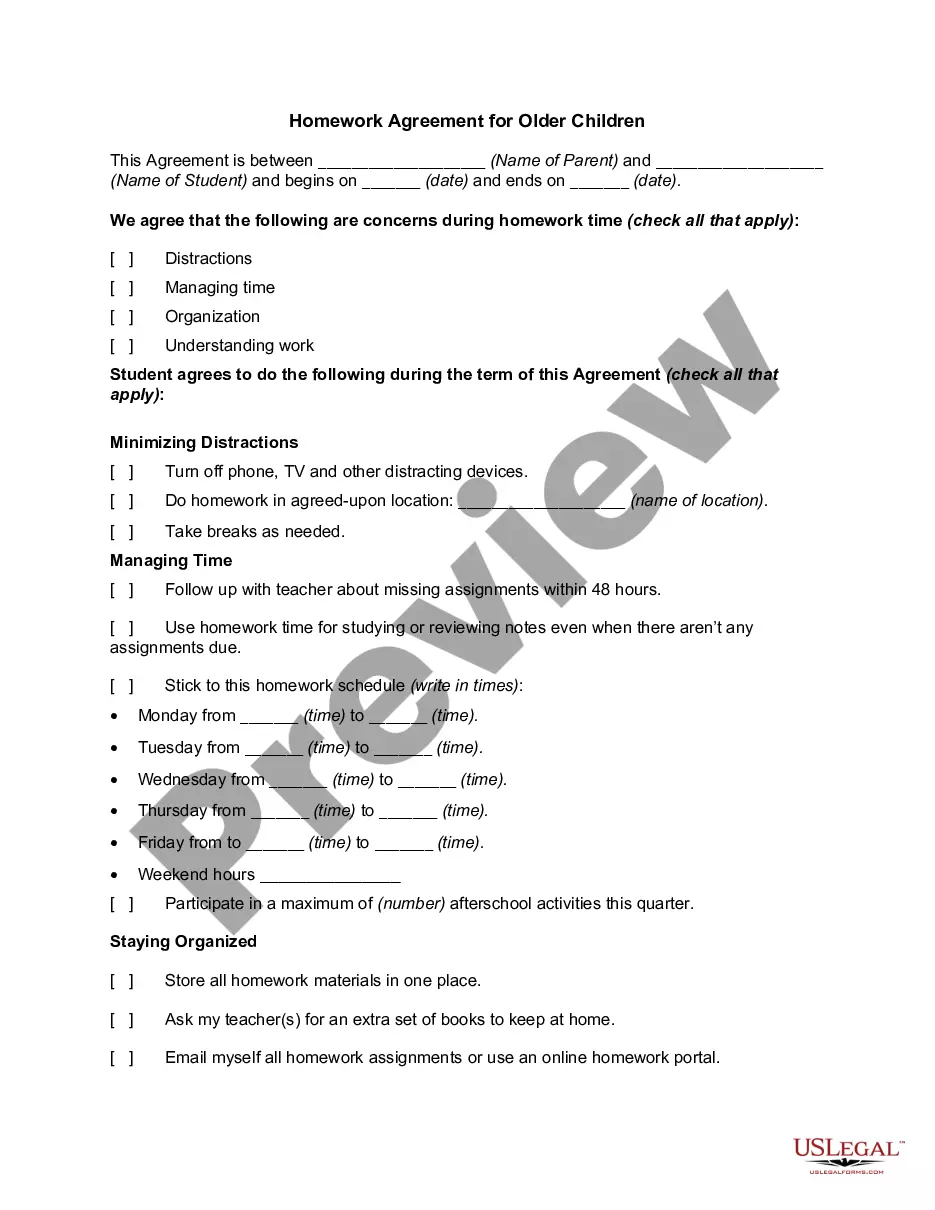
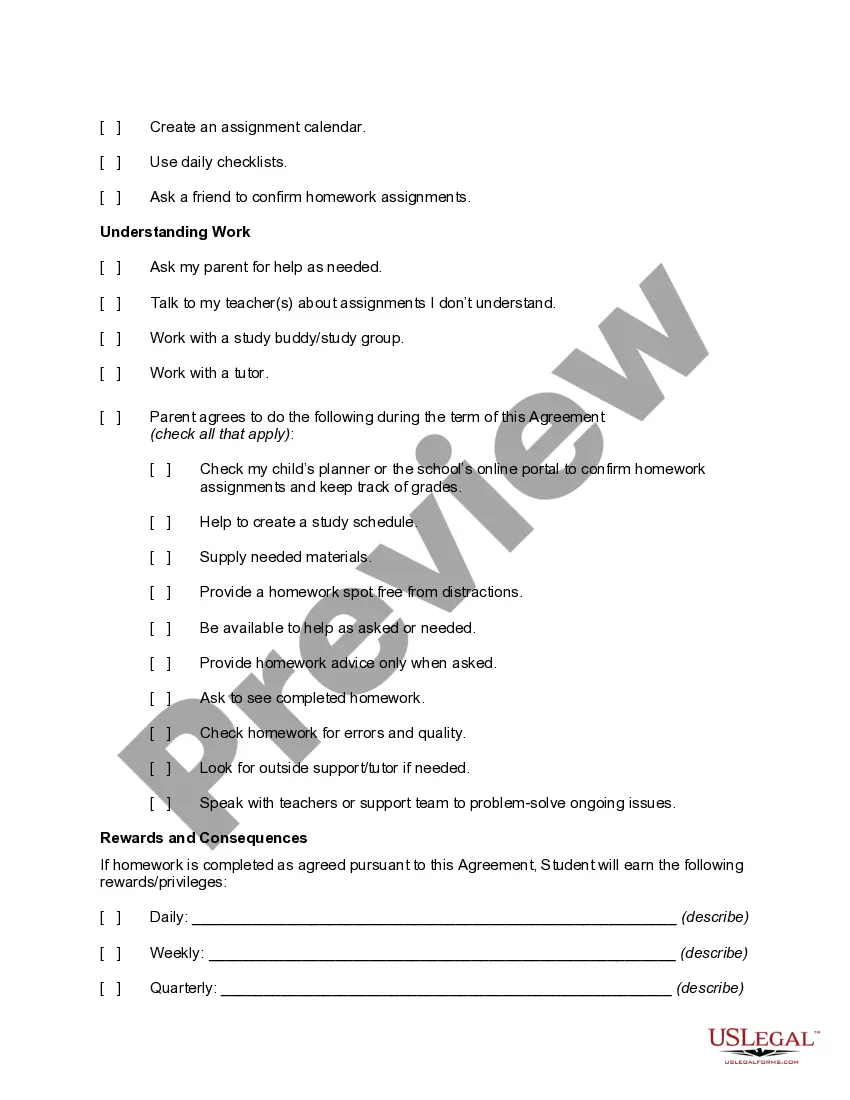
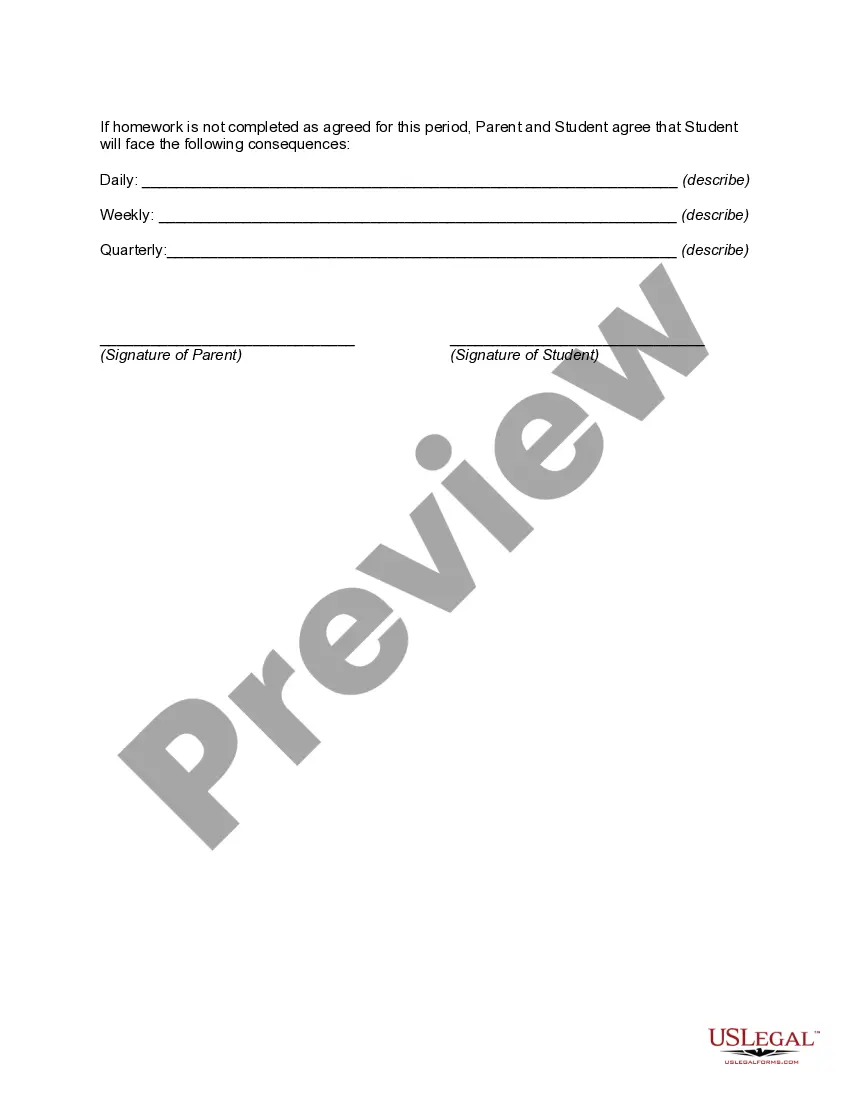
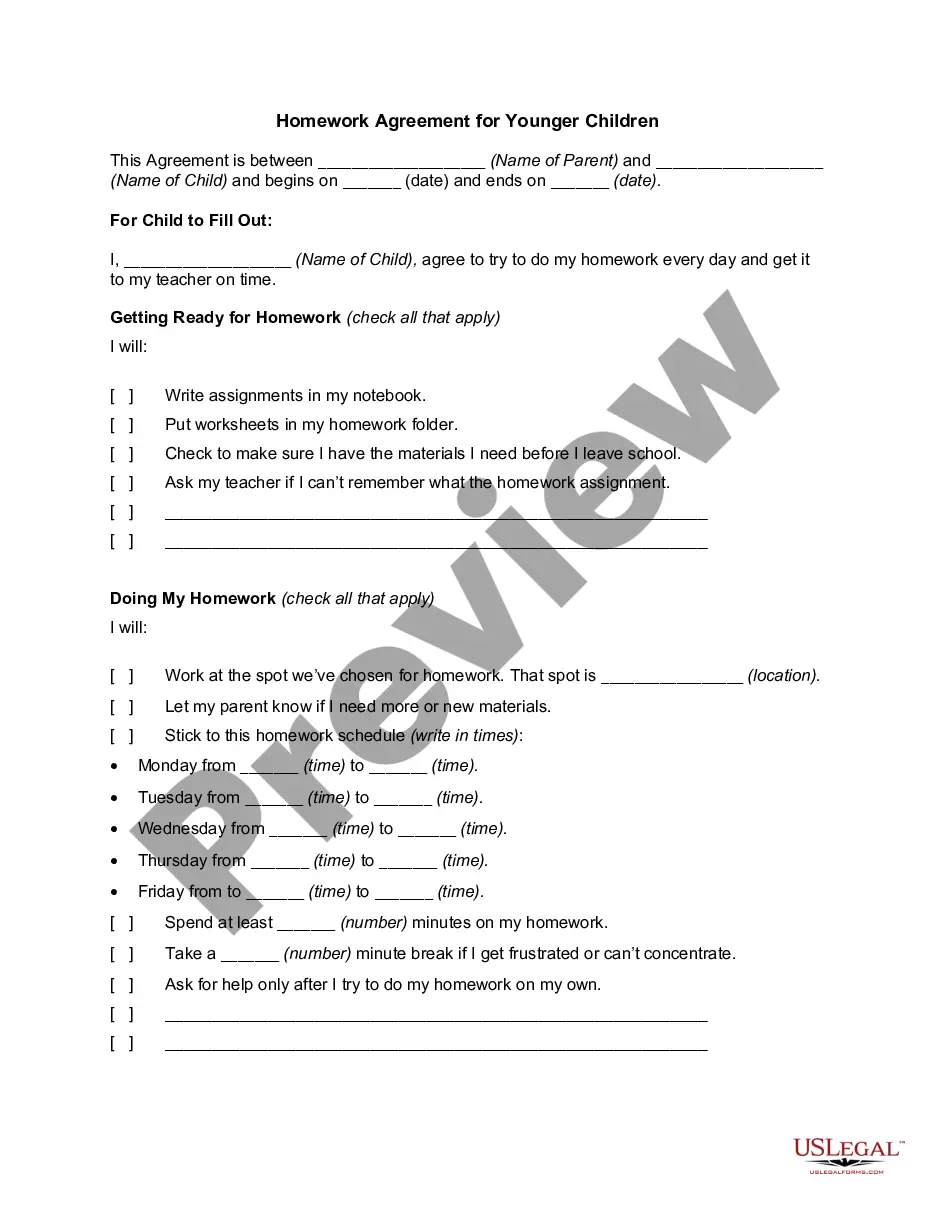
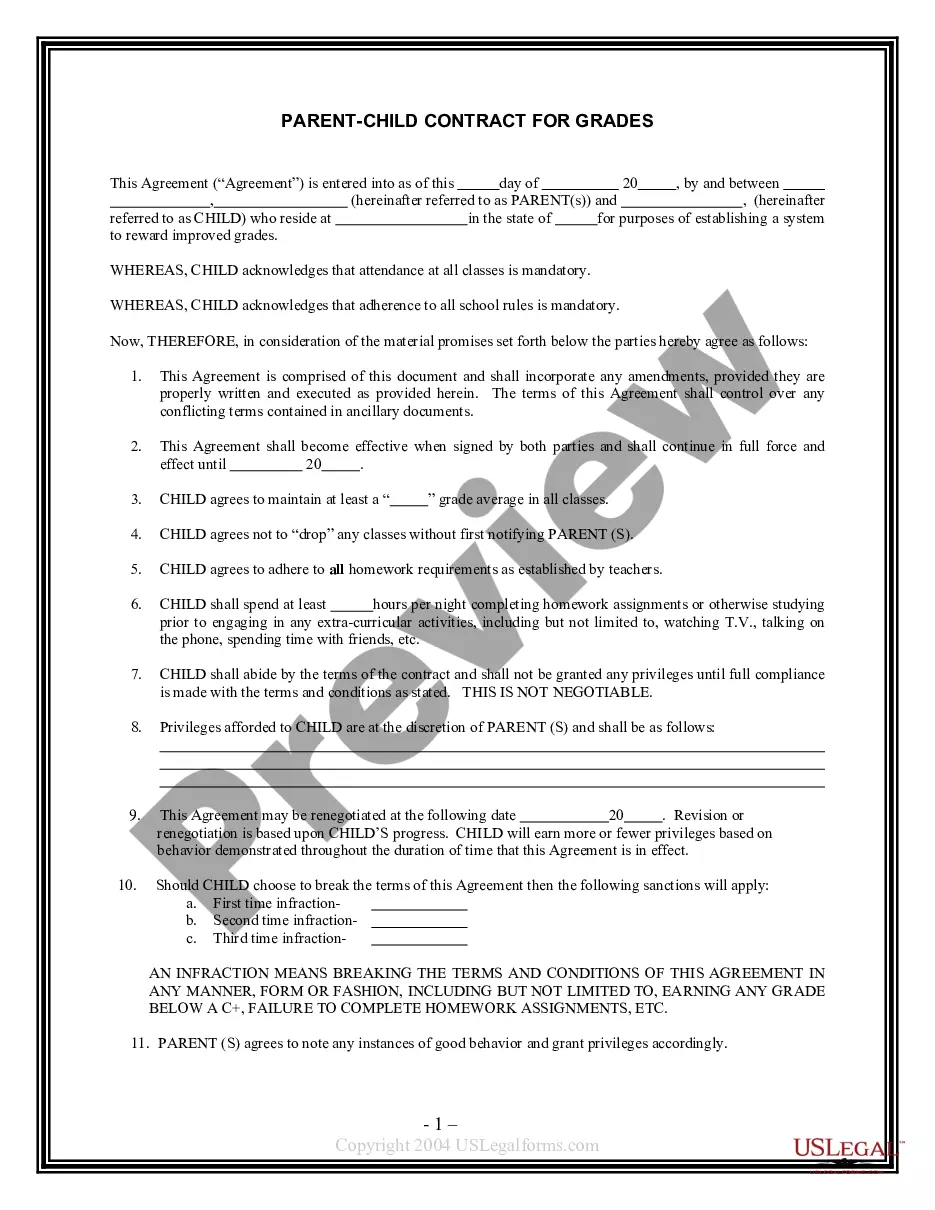
Pennsylvania Homework Agreement for Older Children
Description
Get your form ready online
Our built-in tools help you complete, sign, share, and store your documents in one place.
Make edits, fill in missing information, and update formatting in US Legal Forms—just like you would in MS Word.
Download a copy, print it, send it by email, or mail it via USPS—whatever works best for your next step.
Sign and collect signatures with our SignNow integration. Send to multiple recipients, set reminders, and more. Go Premium to unlock E-Sign.
If this form requires notarization, complete it online through a secure video call—no need to meet a notary in person or wait for an appointment.
We protect your documents and personal data by following strict security and privacy standards.

Make edits, fill in missing information, and update formatting in US Legal Forms—just like you would in MS Word.

Download a copy, print it, send it by email, or mail it via USPS—whatever works best for your next step.

Sign and collect signatures with our SignNow integration. Send to multiple recipients, set reminders, and more. Go Premium to unlock E-Sign.

If this form requires notarization, complete it online through a secure video call—no need to meet a notary in person or wait for an appointment.

We protect your documents and personal data by following strict security and privacy standards.
Looking for another form?

How to fill out Homework Agreement For Older Children?
Selecting the appropriate legal document layout can be a challenge.
Clearly, there are numerous templates accessible online, but how do you find the legal form you need.
Utilize the US Legal Forms website. The platform offers a vast array of templates, including the Pennsylvania Homework Agreement for Older Children, which can serve both business and personal purposes.
You can review the form using the Review button and read the form description to ensure it is the right one for you.
- All templates are reviewed by experts and comply with state and federal regulations.
- If you are already registered, Log In to your account and click on the Download button to obtain the Pennsylvania Homework Agreement for Older Children.
- Use your account to browse through the legal forms you have previously acquired.
- Go to the My documents tab of your account and retrieve another copy of the document you need.
- If you are a new user of US Legal Forms, here are basic steps for you to follow.
- First, make certain you've chosen the correct form for your city/state.
Form popularity
FAQ
Many experts have found that helping with homework cultivates positive learning behaviors, reinforces class material and signals to children that their education is important. The federal Department of Education says that parents play an important role in their children's learning when they help with homework.
Additionally, as of July 1, 2020, children may no longer withdraw from school at age 17. Students under the age of 18 who previously withdrew from school, or who have graduated from high school, are not required to re-enroll.
It may feel tempting proper even to help your child with homework, but parents who get involved this way don't improve their kids' test scores or grades, and can hurt their academic achievement, two researchers have found. We need to do away with the assumption that anything parents do will help.
Additionally, as of July 1, 2020, children may no longer withdraw from school at age 17. Students under the age of 18 who previously withdrew from school, or who have graduated from high school, are not required to re-enroll.
By year 12, parents should step back completely. If they don't, students can rely on the adults in their lives to take a high level of responsibility for them completing their academic work, which may reduce their motivation in school work.
Pennsylvania students can't drop out legally until they turn 17, but there are exceptions for some younger students who are working. Under Pennsylvania's "compulsory education laws," children between the ages of 8 and 17 must attend full-time school.
The annual survey revealed that more than 60 percent of parents with children in grades K 8 (60.1 percent) admit they have trouble helping with their children's homework, up from 49.1 percent in 2013.
Homework is based on the assumption that a student can sustain attention on an assignment for a period of at least 20-30 minutes. For most children until 9 or 10 years of age, we cannot rely on this level of independence.
Effective with the 2020-2021 school year, a child must comply with compulsory attendance requirements from age 6 to age 18. Specifically, a child who has attained the age of 6 on or before September 1 must enroll and attend school or begin a home school program that year.
The bottom line is yes, you as a human being have a right to refuse to do something like homework, but you don't have the right to do that and remain a pupil of your school. Your school can be seen as a bit like a small-scale version of the country and its rules are a bit like the laws that protect us.