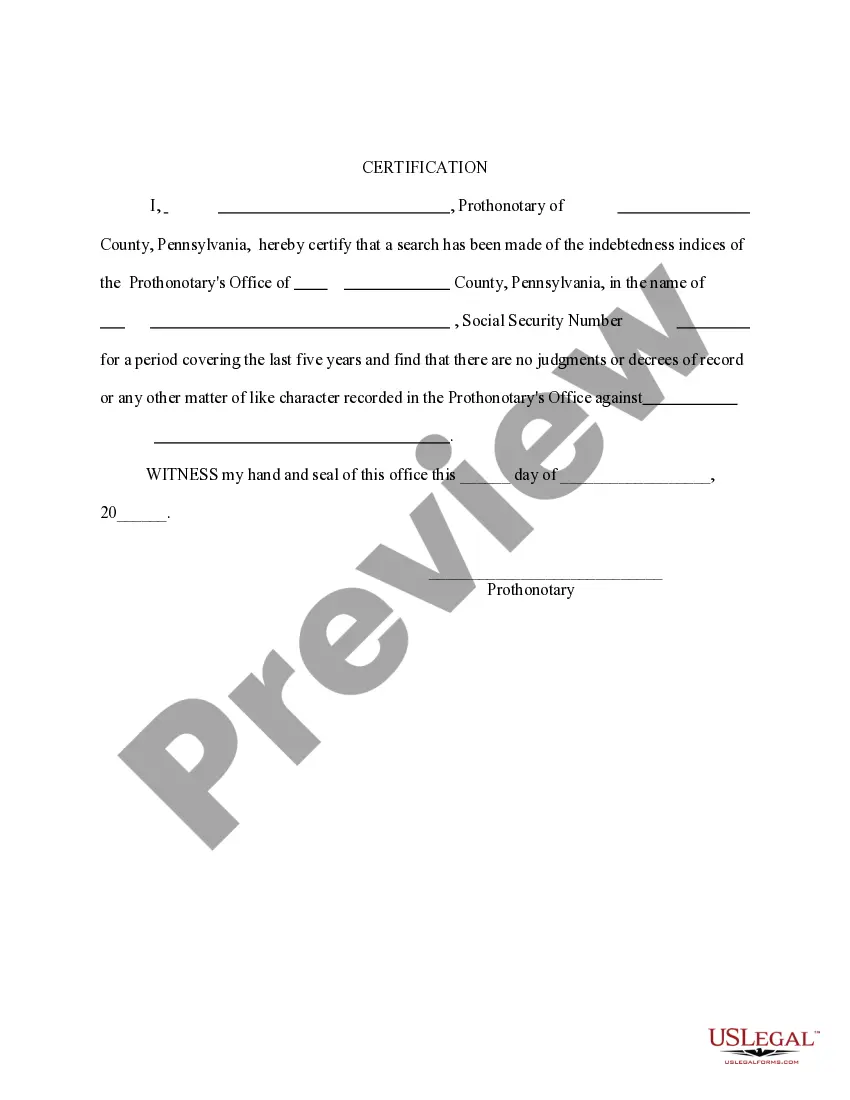
Pennsylvania Certification - Prothonotary for Adult Name Change
What is this form?
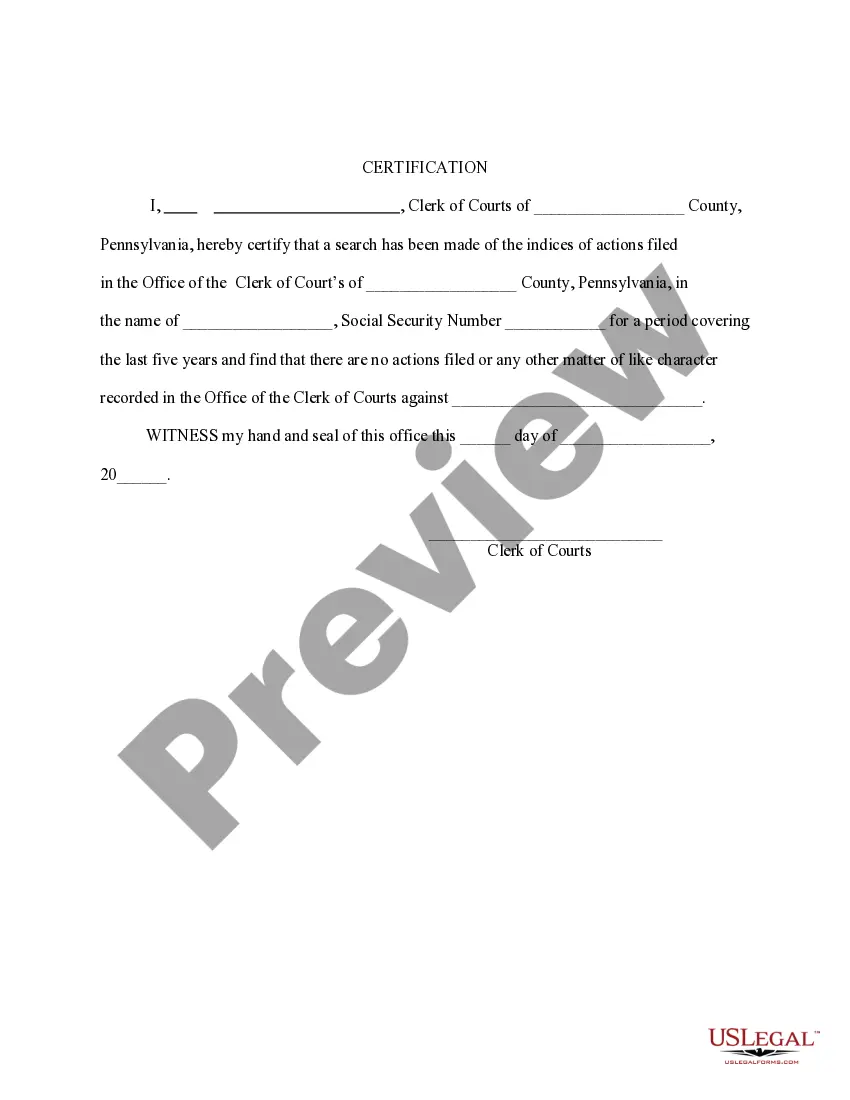
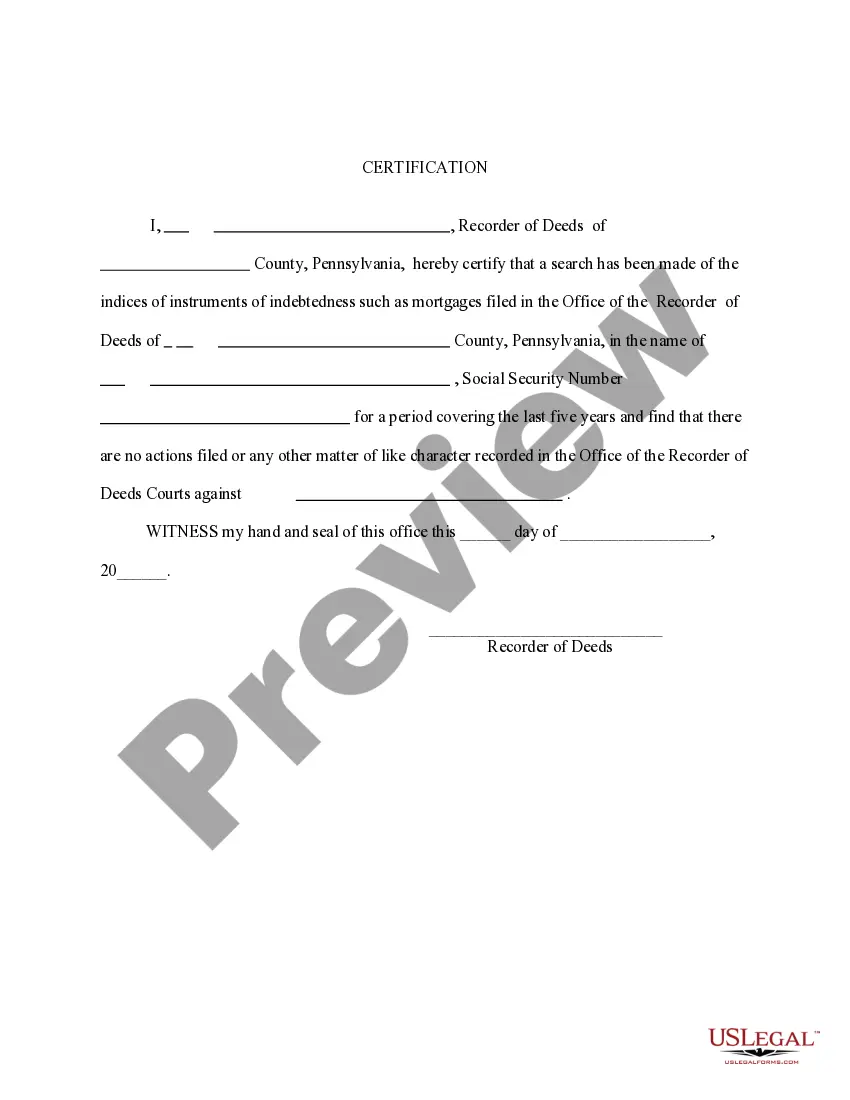
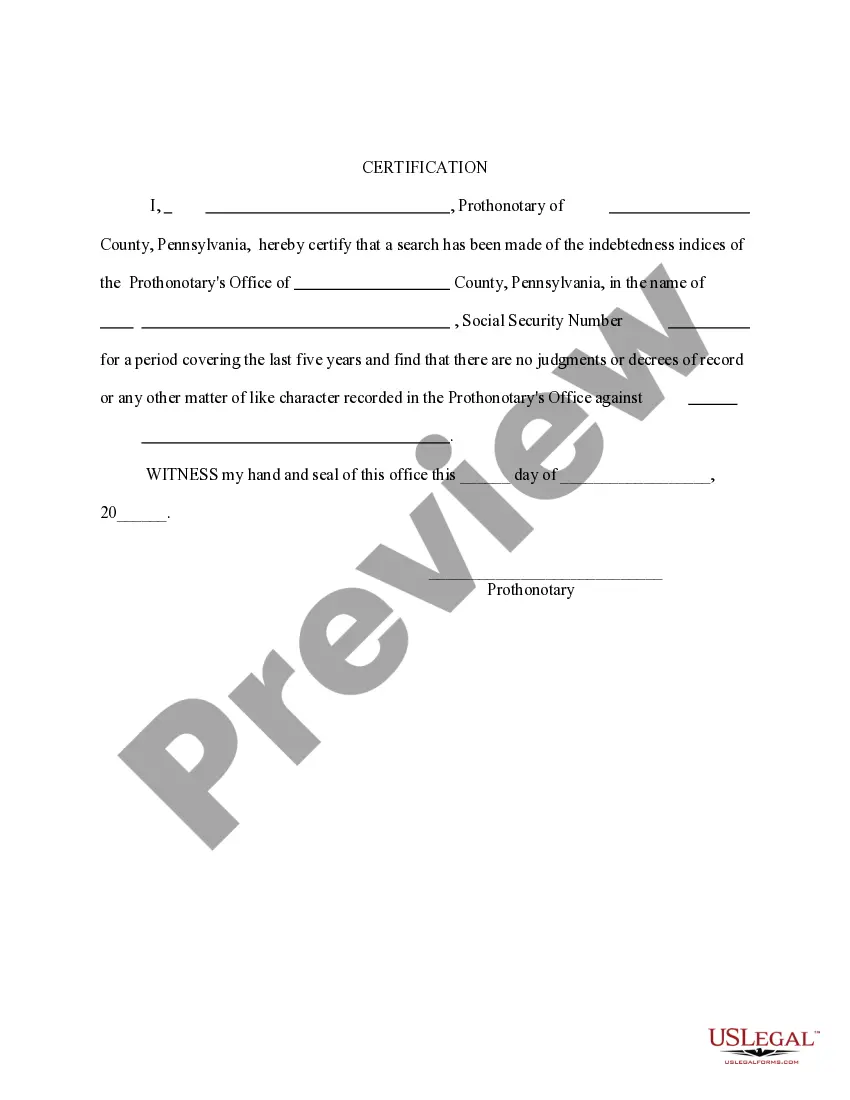
The Certification - Prothonotary for Adult Name Change is a legal document that certifies the absence of pending legal actions or debts, such as judgments or mortgages, against an individual seeking a name change. This form is essential for individuals undergoing a legal name change to ensure that their new identity is free from legal encumbrances, distinguishing it from other name change forms that may not require this certification.
Form components explained
- Certification section confirming the absence of pending actions or debts.
- Details of the individual requesting the name change.
- Signature and date fields for verification.
Situations where this form applies
This form should be used when an adult is applying for a legal name change. It serves as proof that the individual has no outstanding legal issues that could complicate or invalidate the name change process. You'll typically need this form when filing for a name change through a court or other legal entity.
Who needs this form
- Adults seeking to change their legal name.
- Individuals who have no pending legal actions or debts.
- Persons required to provide legal certification to support their name change application.
Steps to complete this form
- Enter your full name as it currently appears on legal documents.
- Provide any necessary identifying information required by your jurisdiction.
- Review the certification section to confirm that there are no pending actions or debts.
- Sign the document to validate the certification.
- Date the certification to ensure it is current at the time of submission.
Notarization requirements for this form
This form does not typically require notarization unless specified by local law. It is advised to verify specific state or local requirements to ensure compliance.
Get your form ready online
Our built-in tools help you complete, sign, share, and store your documents in one place.
Make edits, fill in missing information, and update formatting in US Legal Forms—just like you would in MS Word.
Download a copy, print it, send it by email, or mail it via USPS—whatever works best for your next step.
Sign and collect signatures with our SignNow integration. Send to multiple recipients, set reminders, and more. Go Premium to unlock E-Sign.
If this form requires notarization, complete it online through a secure video call—no need to meet a notary in person or wait for an appointment.
We protect your documents and personal data by following strict security and privacy standards.

Make edits, fill in missing information, and update formatting in US Legal Forms—just like you would in MS Word.

Download a copy, print it, send it by email, or mail it via USPS—whatever works best for your next step.

Sign and collect signatures with our SignNow integration. Send to multiple recipients, set reminders, and more. Go Premium to unlock E-Sign.

If this form requires notarization, complete it online through a secure video call—no need to meet a notary in person or wait for an appointment.

We protect your documents and personal data by following strict security and privacy standards.
Avoid these common issues
- Failing to sign and date the document, making it invalid.
- Providing inaccurate personal information, which could delay processing.
- Not checking for state-specific requirements before submission.
Benefits of completing this form online
- Convenient access to the form anytime, saving time and effort.
- Editable fields allow for easy customization to fit your needs.
- Templates are reliable and drafted by licensed attorneys for accuracy.
What to keep in mind
- The Certification - Prothonotary for Adult Name Change verifies absence of legal encumbrances.
- It is a critical step in the name change process for adults.
- Completion of this form requires careful attention to detail, especially regarding legal debts.
Looking for another form?

Form popularity
FAQ
Going to court and filing a detailed petition. Submitting your fingerprints to the Pennsylvania State Police. Publishing notice of your intention to change your name in two newspapers of general circulation in the county where you live.
Prepare an Application to Restore Your Former Name. File Your Application and Order in the correct court. Pay the required fees. Get Your Court Order and Certified Copy(s) of it. Change your ID and Official Records.
Adult Name Changes If the divorce was filed in another county or state, the person seeking the name change can file the decree and the name change form in the Prothonotary's office. There is a small fee for the forms and filing. The fee varies from $5.00 to $8.00.
There is a small fee for the forms and filing. The fee varies from $5.00 to $8.00. A name change is not so simple when an adult wishes to have his/her given name or surname changed for a reason other than divorce.
Visit the Prothonotary office in your county and ask for a Notice (or Election) to Resume Maiden Name Form (or download in Adobe PDF). Bring a copy of your birth certificate (to show proof of maiden name) and a copy of your divorce decree.
Petition to change your name by filling out a name change form, an order to show cause for legally changing your name, and a decree to legally change your name. Take these forms to the court clerk and file them along with your state's required filing fees.
All you need to do is include a name change request form with your divorce petition. You can ask the county clerk for help if you have any questions and bring the form to your divorce hearing. In states like these, you can put in a request with the judge to enter a formal order so you can return to your maiden name.
Visit the Prothonotary office in your county and ask for a Notice (or Election) to Resume Maiden Name Form (or download in Adobe PDF). Bring a copy of your birth certificate (to show proof of maiden name) and a copy of your divorce decree.