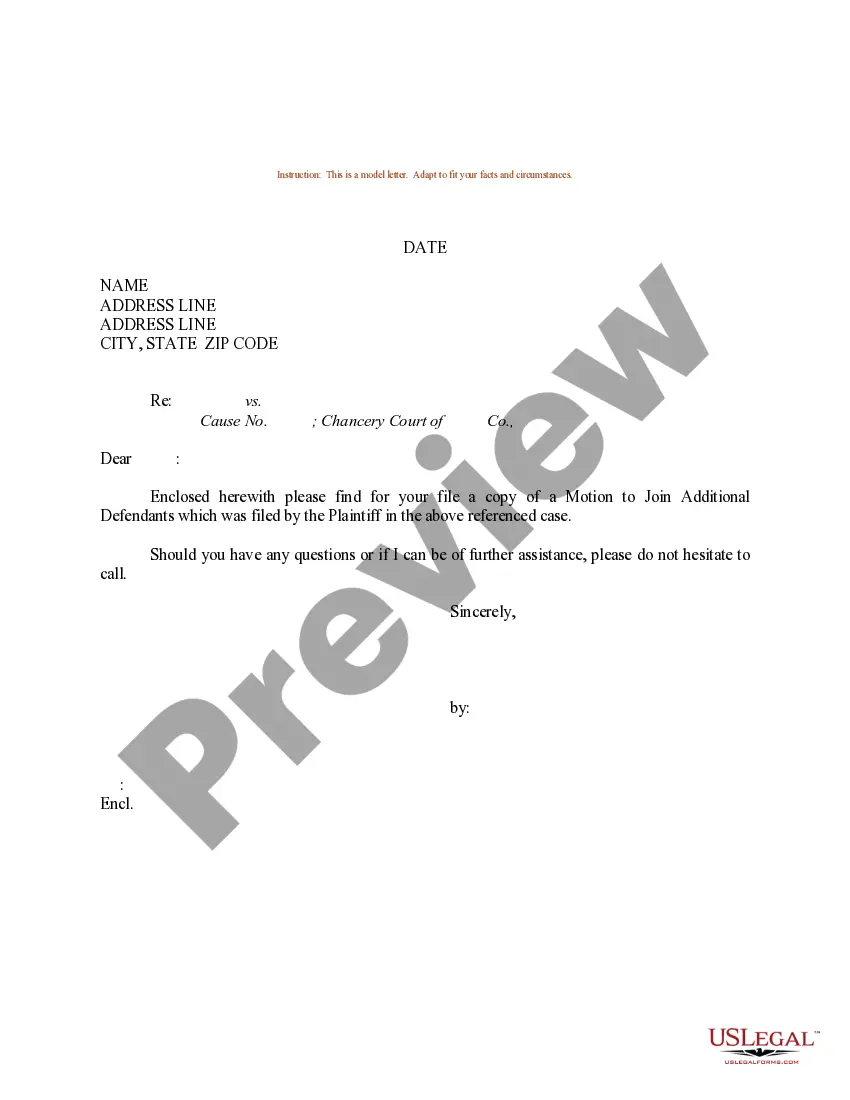
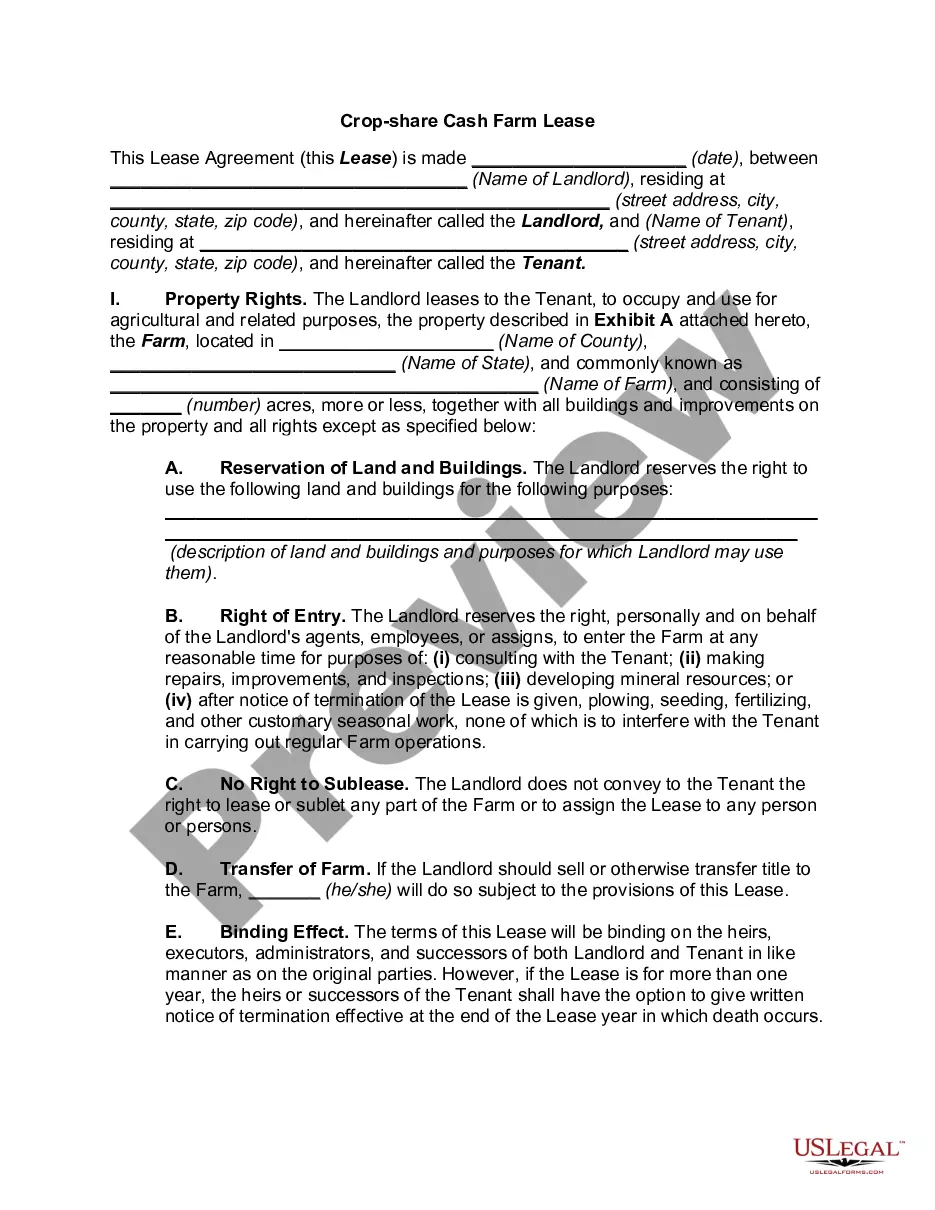
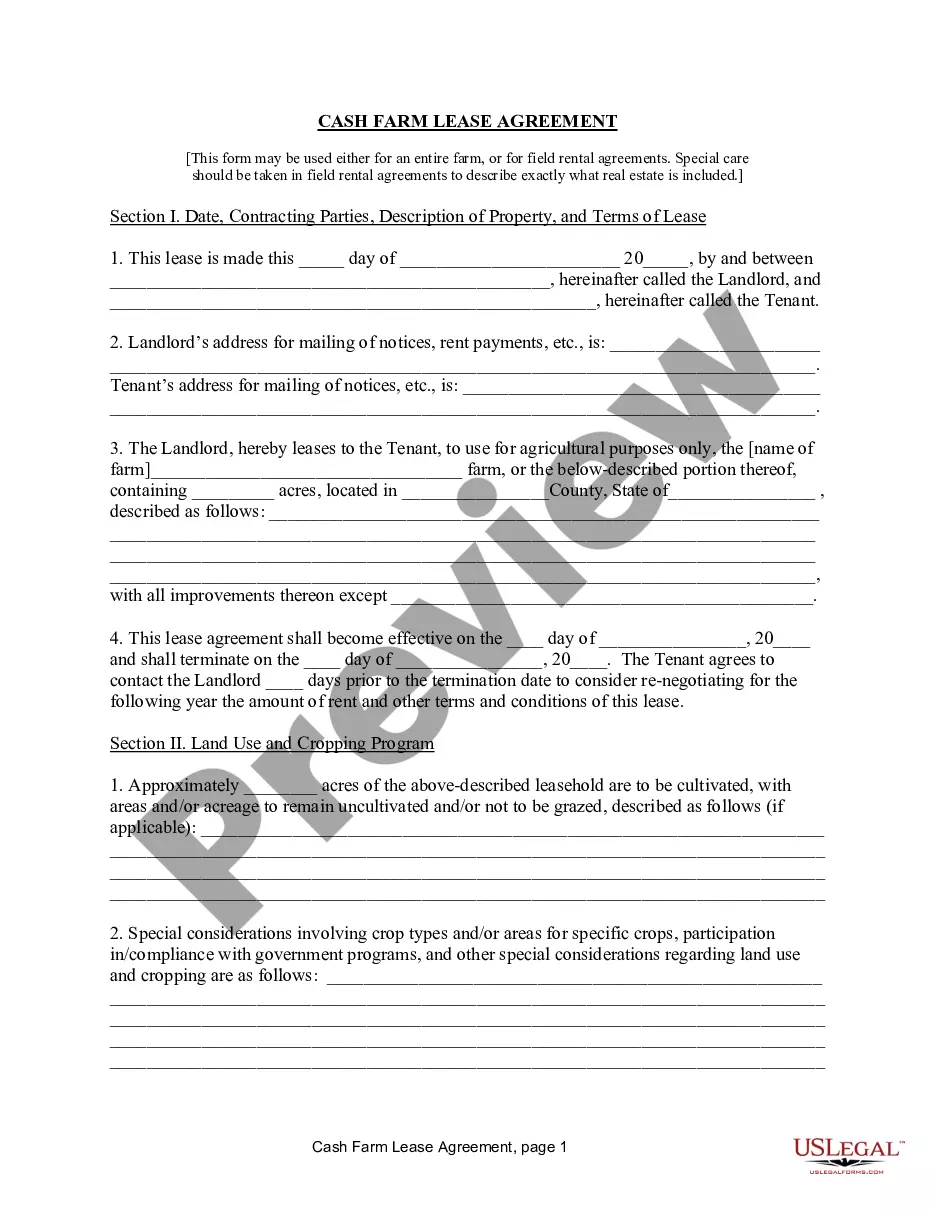
Detailed crop share farmland lease. Costs and crops are shared by landowner and tenant. Provides for detailed division of costs.
Oregon Farm Lease or Rental - Crop Share
State:
Multi-State
Category:
Control #:
US-854LT
Format:
Word;
Rich Text
120 downloads
Description
Free preview
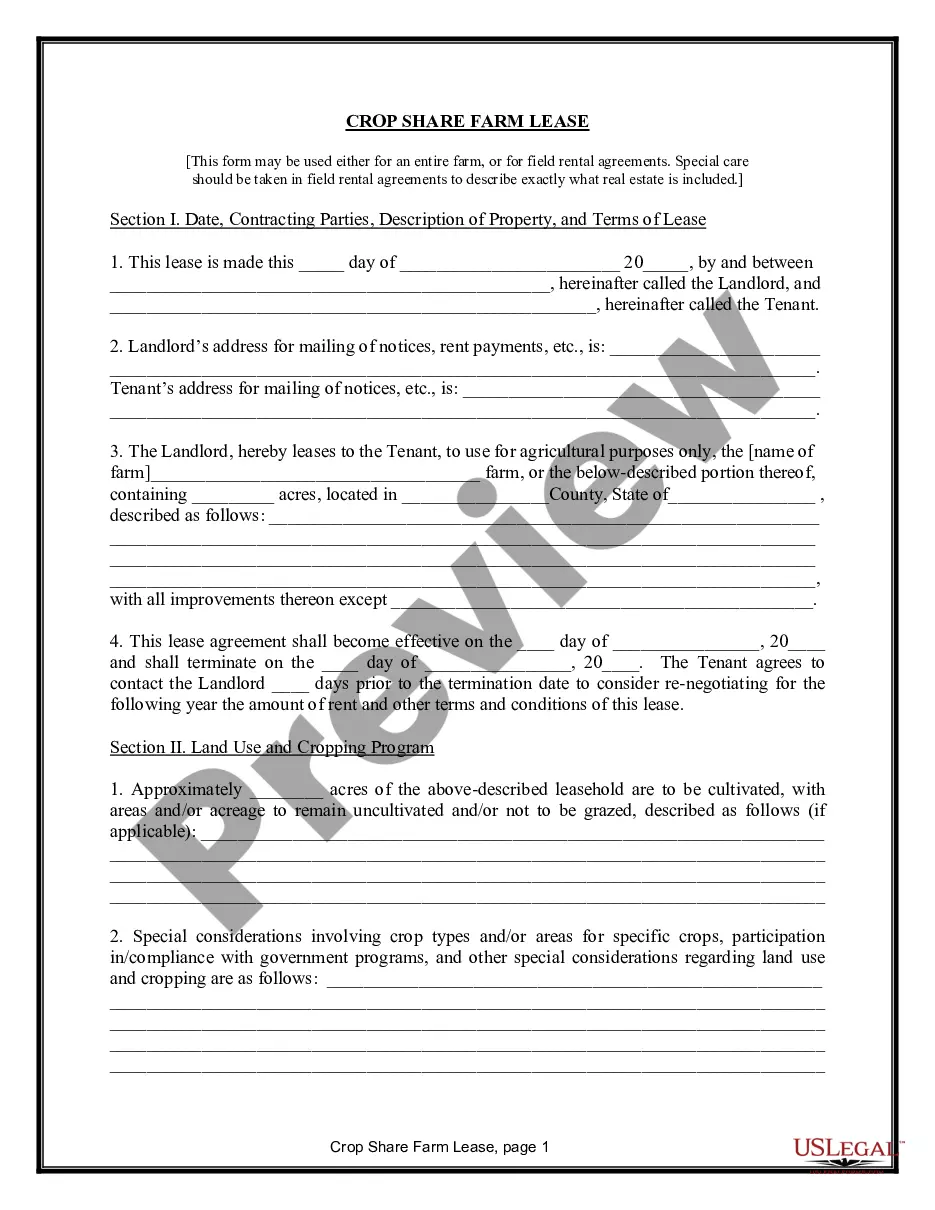
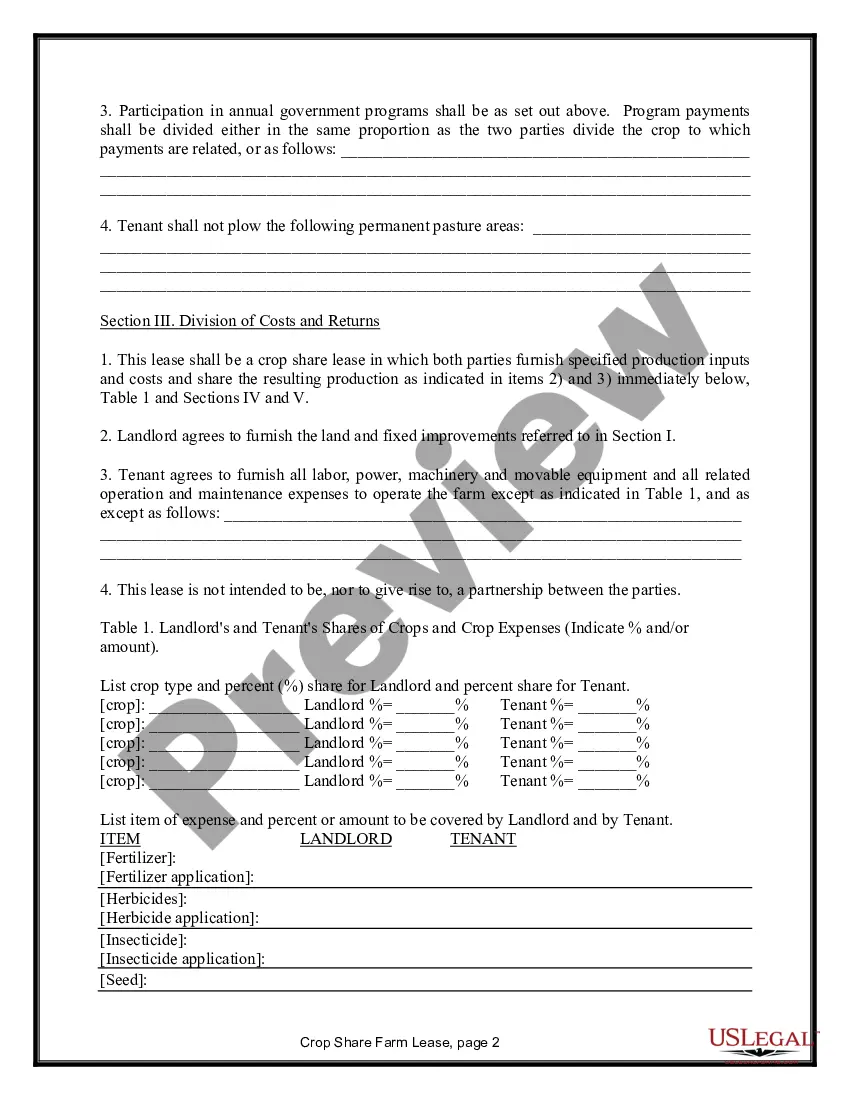
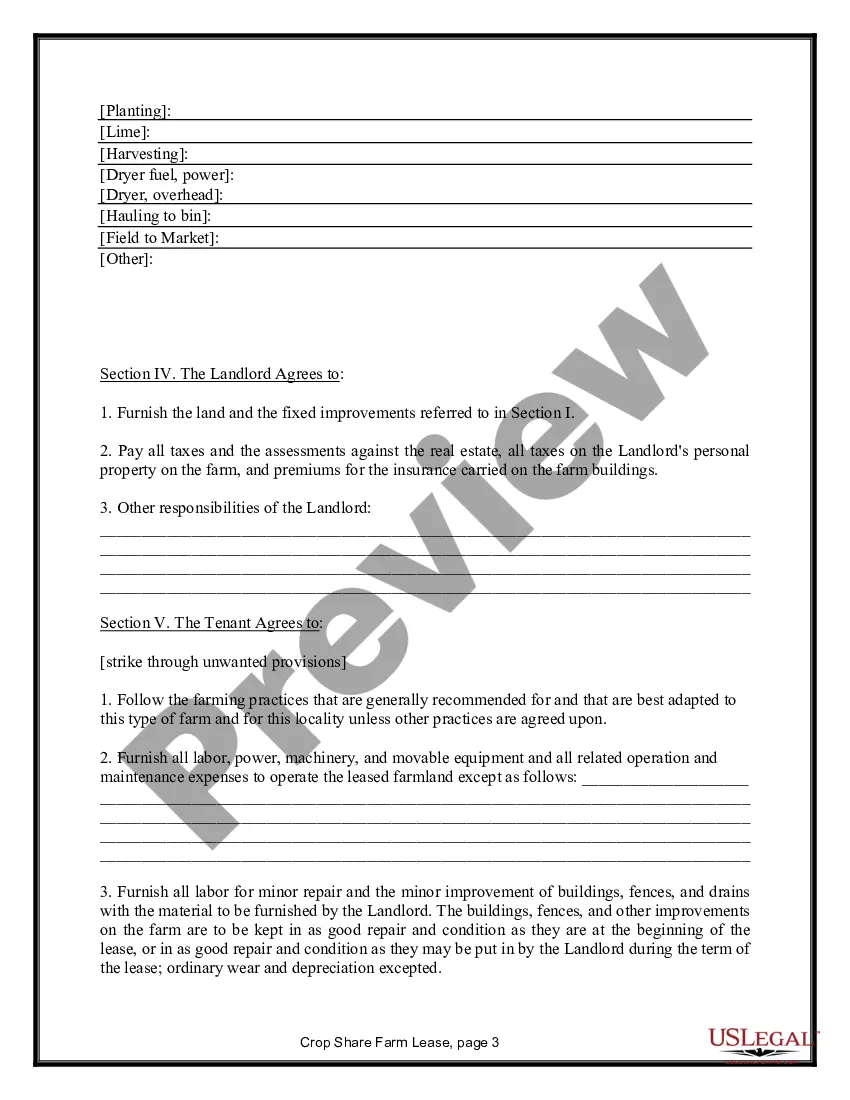
Get your form ready online
Our built-in tools help you complete, sign, share, and store your documents in one place.
Built-in online Word editor
Make edits, fill in missing information, and update formatting in US Legal Forms—just like you would in MS Word.
Export easily
Download a copy, print it, send it by email, or mail it via USPS—whatever works best for your next step.
E-sign your document
Sign and collect signatures with our SignNow integration. Send to multiple recipients, set reminders, and more. Go Premium to unlock E-Sign.
Notarize online 24/7
If this form requires notarization, complete it online through a secure video call—no need to meet a notary in person or wait for an appointment.
Store your document securely
We protect your documents and personal data by following strict security and privacy standards.

Make edits, fill in missing information, and update formatting in US Legal Forms—just like you would in MS Word.

Download a copy, print it, send it by email, or mail it via USPS—whatever works best for your next step.

Sign and collect signatures with our SignNow integration. Send to multiple recipients, set reminders, and more. Go Premium to unlock E-Sign.

If this form requires notarization, complete it online through a secure video call—no need to meet a notary in person or wait for an appointment.

We protect your documents and personal data by following strict security and privacy standards.
Looking for another form?

How to fill out Farm Lease Or Rental - Crop Share?
You can devote hours online searching for the legal document template that fulfills the state and federal requirements you need.
US Legal Forms offers a multitude of legal forms that are reviewed by experts.
You can easily download or print the Oregon Farm Lease or Rental - Crop Share from the service.
If available, use the Review button to look through the document template as well.
- If you already possess a US Legal Forms account, you can Log In and click the Download button.
- After that, you can complete, modify, print, or sign the Oregon Farm Lease or Rental - Crop Share.
- Each legal document template you purchase is yours indefinitely.
- To obtain another copy of any purchased form, navigate to the My documents tab and click the corresponding button.
- If you are using the US Legal Forms website for the first time, follow the simple instructions below.
- First, ensure that you have chosen the correct document template for the state/city that you select.
- Review the form outline to confirm you have chosen the appropriate form.
Form popularity
FAQ
The advantages of the first are that the tenant in many cases is free to manage the farm as he pleases, and as a long-time proposition he may pay less rent than under crop-sharing arrangements. The chief disadvantage is that the tenant agrees to pay a definite sum before he knows what his income will be.
With a crop-share lease, the landlord receives a share of the crops produced in exchange for the use of the land by the tenant. The amount of the share typically depends on local custom. The landlord usually agrees to pay a portion of the input costs under a crop-share lease.
The traditional share arrangement for a grain crop like corn or wheat is one-third to the landowner and two-thirds to the tenant. Usually, the expenses paid, and crop received, are equal to the share i.e. the landowner would pay one-third of the expenses and receive one-third of the crop.
Over the last 20 years, farmland rental rates per acre in oregon have risen from an average of $160 per acre in 2019 to $160 per acre in 2019. This represents an increase of $0 over this time period with an average implied capitalization rate of 5.4%.
With a land lease agreement (also known as a ground lease), you purchase the home but rent the land. One of the main advantages is the lower price of this unique arrangement. One of the main disadvantages is that you will not be able to build valuable equity in the land on which you live.
"Leases of irrigated land have ranged from $1200 to $1600 per hectare plus irrigation pumping costs and water charges," Banks said. "Groundwater reliability and the type of irrigation infrastructure in use, for example, rotorainer versus centre pivot, are key factors in assessing irrigated land lease values.
Most farmers find that a combination of both ownership and leasing is desirable, especially when capital is limited. For many new farmers, especially in areas where land is quite expensive, leasing land is often the best option.
A farm lease is a written agreement between a landowner and a tenant farmer. Through a farm lease, the landowner grants the tenant farmer the right to use the farm property. Key terms of basic leases include the length of the lease, rent amounts and frequency of payment, how to renew or end the lease, and more.
Laws in India also restrict leasing rights for agricultural land. These laws force farmers to lease their land in the black market since formal leasing is either banned or poses significant risks.
Farmland has historically been a good investment. Unfortunately, not many investors have been able to benefit from this asset class, given the high upfront costs of buying farmland.