Oregon Monthly Retirement Planning
Description


Get your form ready online
Our built-in tools help you complete, sign, share, and store your documents in one place.
Make edits, fill in missing information, and update formatting in US Legal Forms—just like you would in MS Word.
Download a copy, print it, send it by email, or mail it via USPS—whatever works best for your next step.
Sign and collect signatures with our SignNow integration. Send to multiple recipients, set reminders, and more. Go Premium to unlock E-Sign.
If this form requires notarization, complete it online through a secure video call—no need to meet a notary in person or wait for an appointment.
We protect your documents and personal data by following strict security and privacy standards.

Make edits, fill in missing information, and update formatting in US Legal Forms—just like you would in MS Word.

Download a copy, print it, send it by email, or mail it via USPS—whatever works best for your next step.

Sign and collect signatures with our SignNow integration. Send to multiple recipients, set reminders, and more. Go Premium to unlock E-Sign.

If this form requires notarization, complete it online through a secure video call—no need to meet a notary in person or wait for an appointment.

We protect your documents and personal data by following strict security and privacy standards.
Looking for another form?







How to fill out Monthly Retirement Planning?
It is feasible to spend hours online attempting to locate the legal document template that satisfies the state and federal requirements you will need.
US Legal Forms offers a vast array of legal templates that are reviewed by professionals.
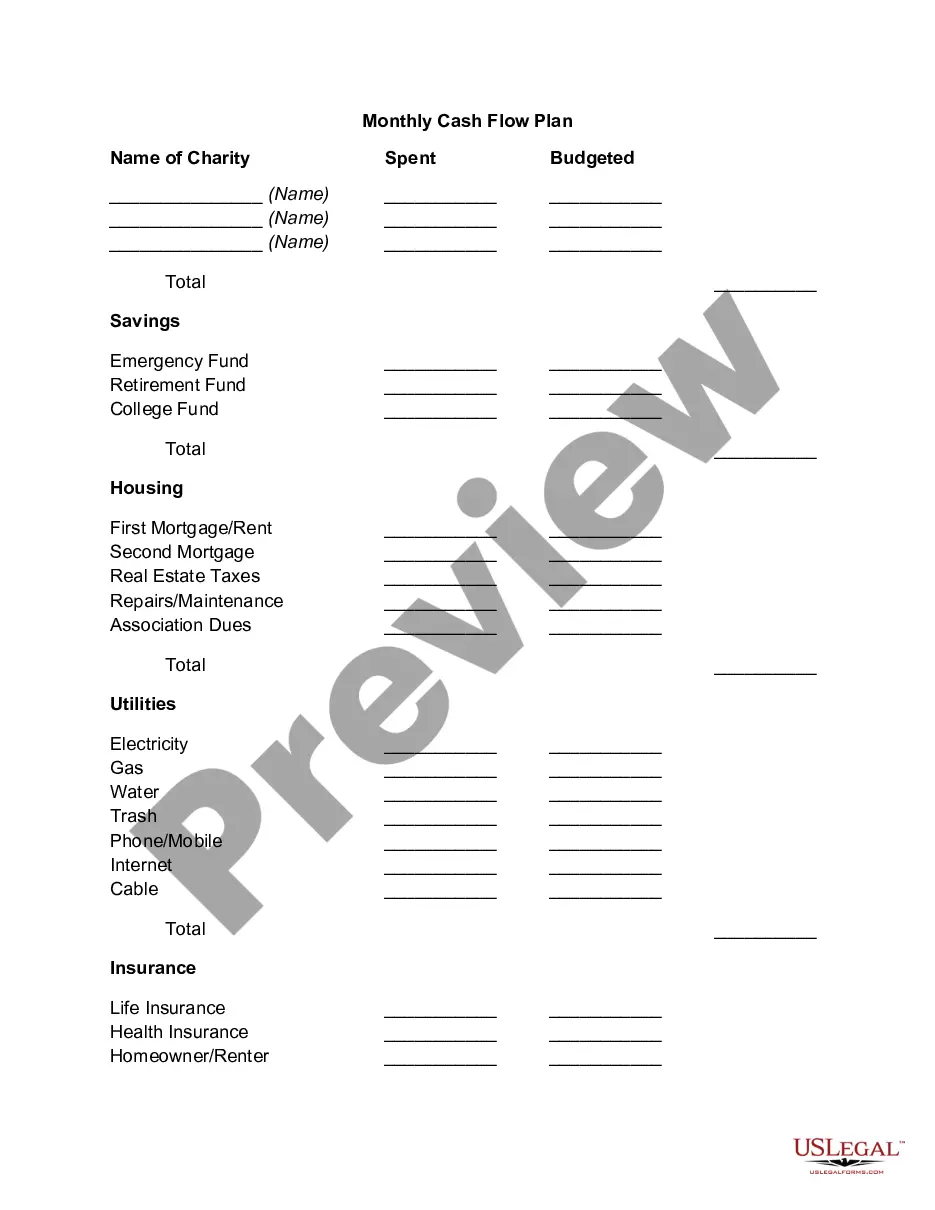
You can acquire or create the Oregon Monthly Retirement Planning through the service.
If available, use the Preview button to view the document template at the same time.
- If you already have a US Legal Forms account, you can Log In and click the Download button.
- Then, you can fill out, modify, produce, or sign the Oregon Monthly Retirement Planning.
- Each legal document template you obtain is yours permanently.
- To get another copy of the purchased form, visit the My documents tab and click on the corresponding button.
- If you are using the US Legal Forms website for the first time, follow the simple instructions below.
- First, ensure you have selected the correct document template for the county/city of your choice.
- Check the form description to make sure you have chosen the right form.
Form popularity
FAQ
Your retirement benefit is calculated using a formula with three factors: Service credit (Years) multiplied by your benefit factor (percentage per year) multiplied by your final monthly compensation equals your unmodified allowance. Service Credit - Total years of employment with a CalPERS employer.
Full formula - a method of calculating retirement benefits which multiplies three factors to compute a retirement benefit: Final average salary (generally, the member's highest three years) Years and months of creditable service, and.
PERS uses a formula to determine your OPSRP Pension Program benefit at retirement: 1.5 percent (1.8 percent for police and fire members) x years of retirement credit x final average salary.
The Individual Account Program (IAP) is an account-based retirement benefit for members of the Public Employees Retirement System (PERS). Oregon State Treasury oversees the investment of IAP funds and the Oregon Public Employees Retirement Fund.
OregonSaves is a state-mandated retirement plan, meaning that certain employers must either enroll their employees in the program or sponsor a qualifying plan of their own through the private market. Eligible businesses that fail to comply may be penalized.
Your IAP is subject to earnings or losses until you receive the funds. PERS works with employers to ensure that member contributions are accurate and complete before allocating earnings on a year-end balance basis so members are not adversely affected by posting delays or corrections.
Your retirement benefit is calculated using a formula with three factors: Service credit (Years) multiplied by your benefit factor (percentage per year) multiplied by your final monthly compensation equals your unmodified allowance. Service Credit - Total years of employment with a CalPERS employer.
When you retire, PERS will calculate your monthly benefit using the following formula: General service: 1.5 percent x years of retirement credit x final average salary. Normal retirement age for general service members is age 65, or age 58 with 30 years of retirement credit.
The IAP: 2022 Informs incident personnel of the incident objectives for the operational. period, the specific resources that will be applied, actions taken during the. operational period to achieve the objectives, and other operational information. (e.g., weather, constraints, limitations, etc.
The formula also uses your final average salary. In general, this salary figure is calculated as either the average of your highest salaries from three consecutive years or 1/3 of your total salary in the last 36 months of employment.
