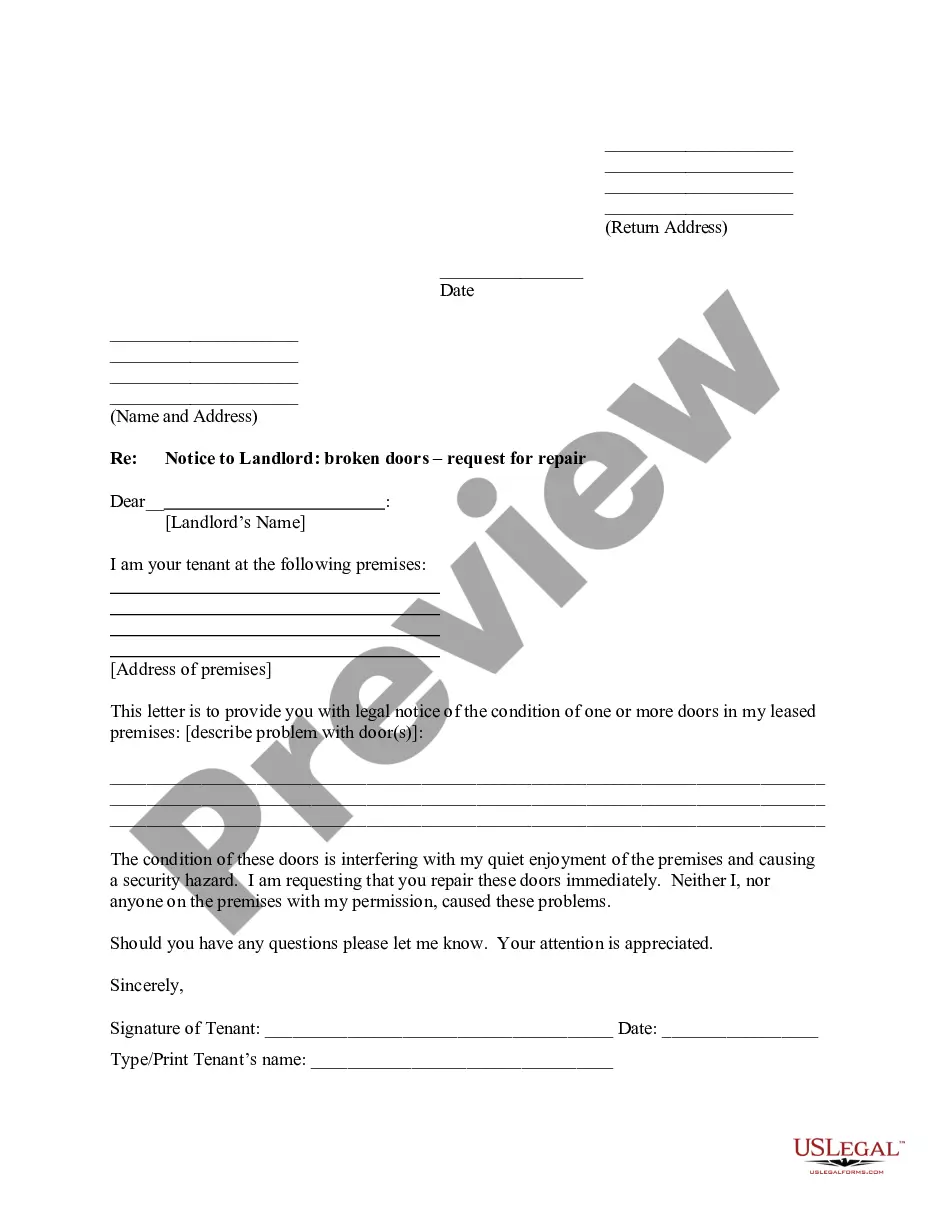
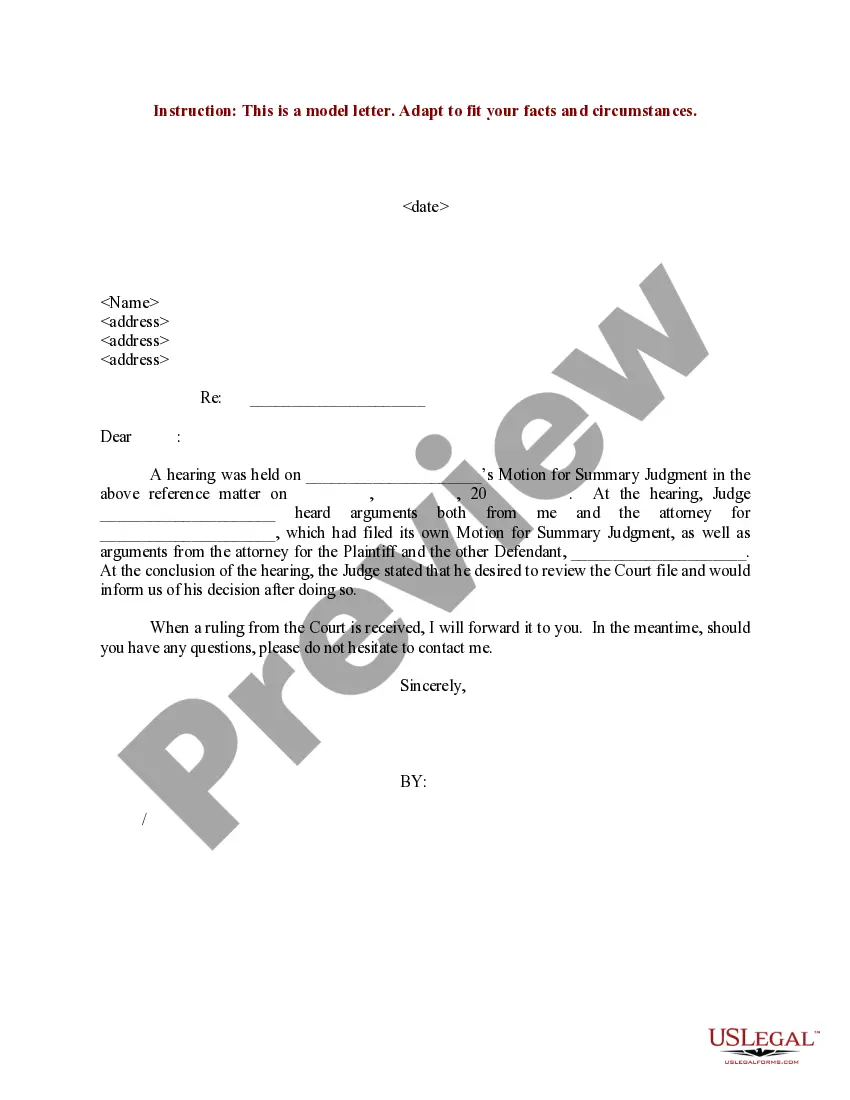
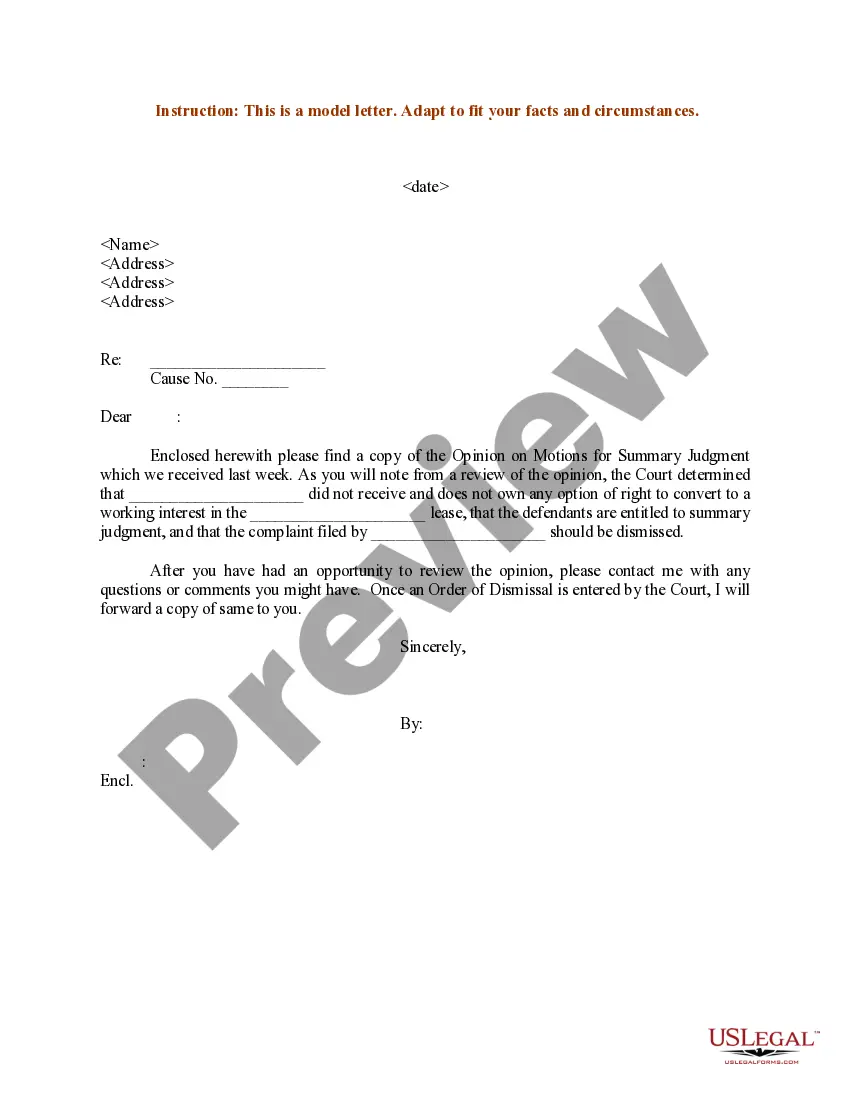
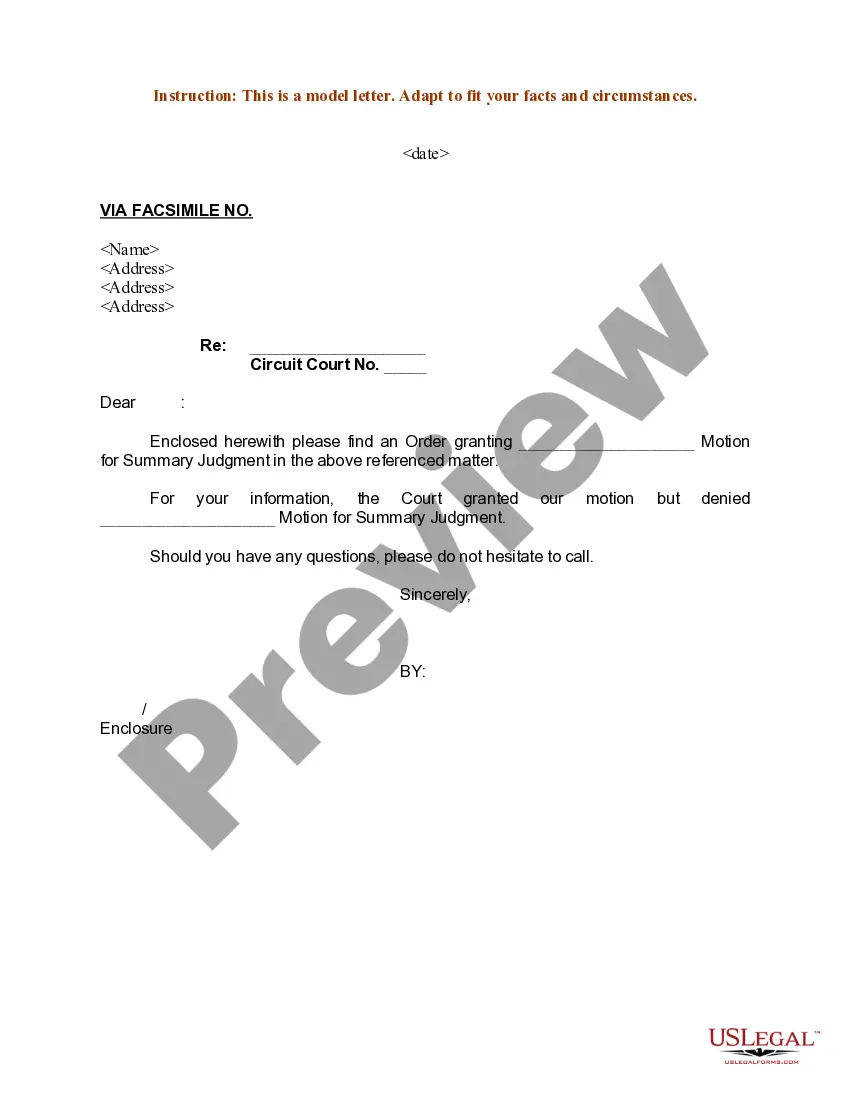
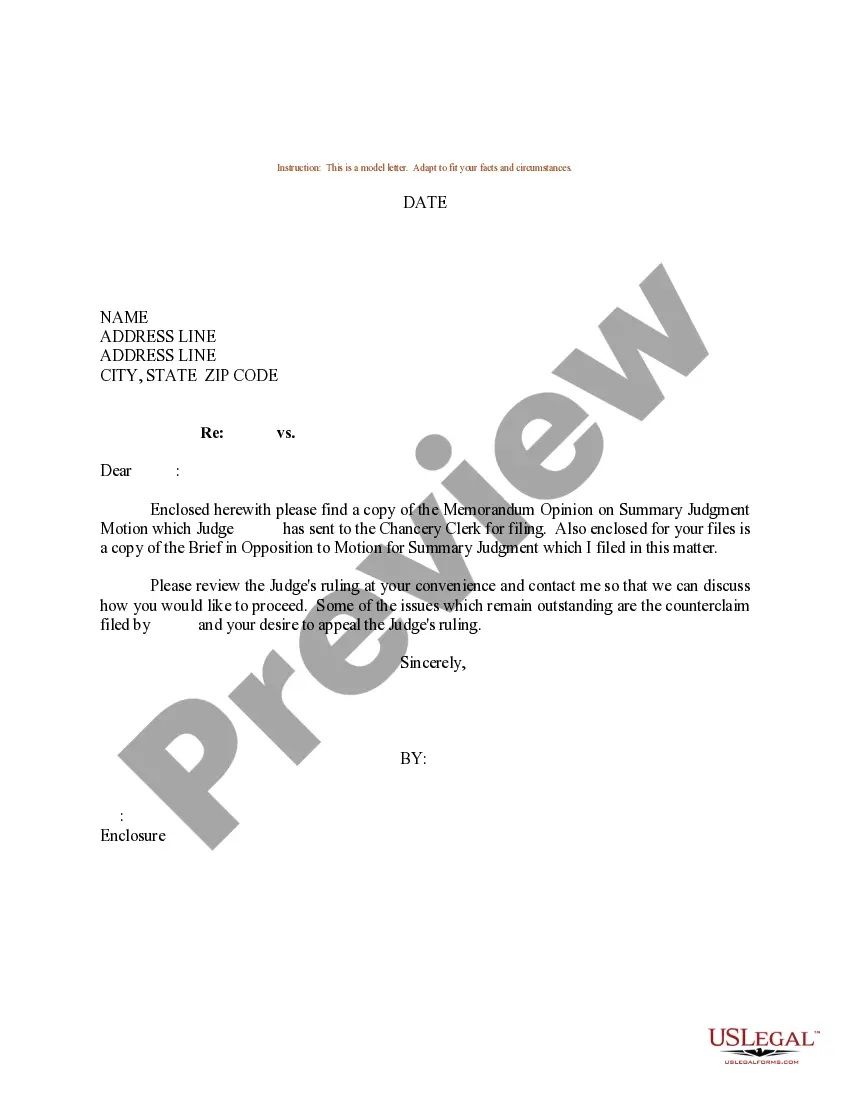
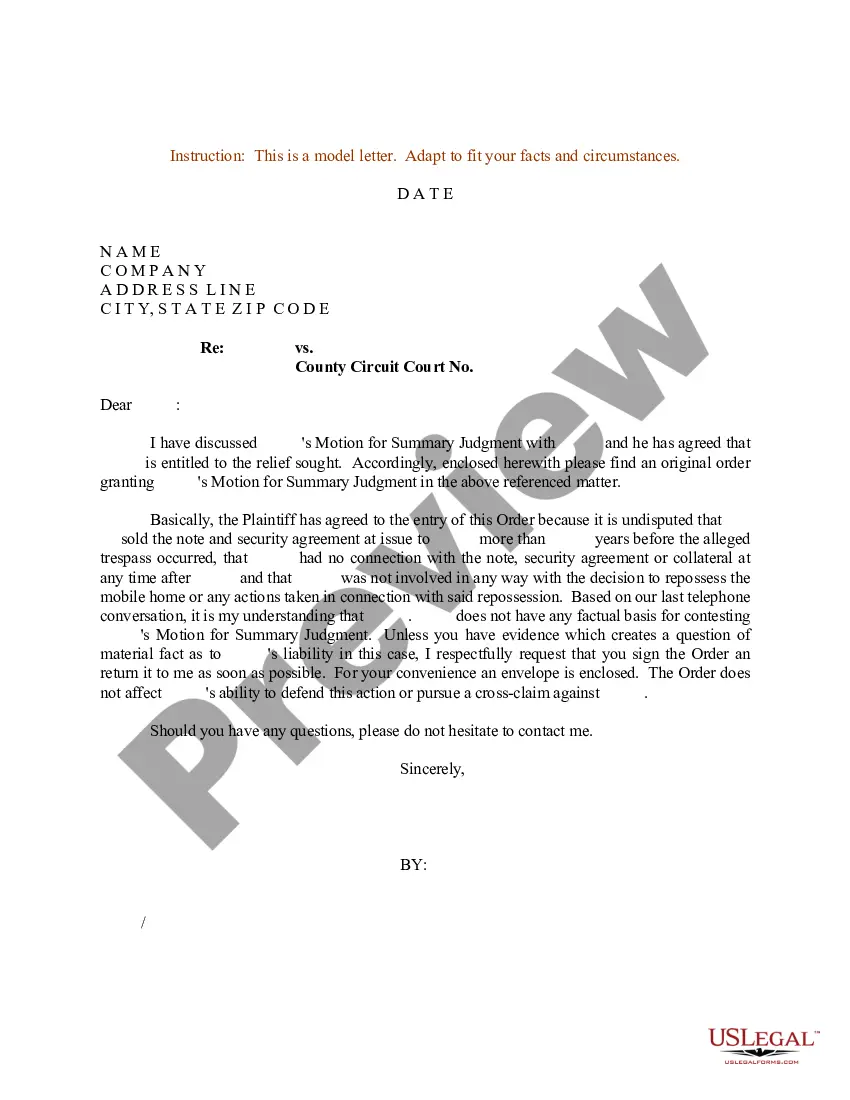
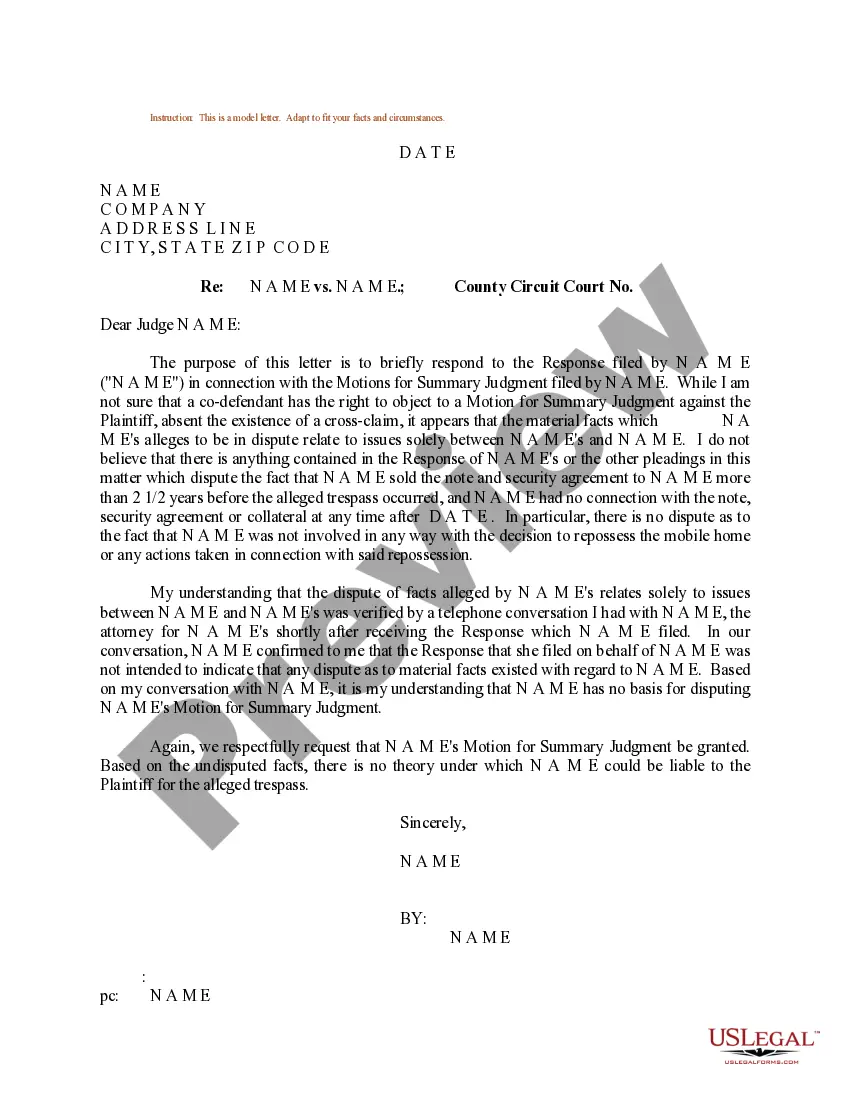
This form is a sample letter in Word format covering the subject matter of the title of the form.
Oregon Sample Letter to Client concerning Hearing on Motion of Summary Judgment
Category:
State:
Multi-State
Control #:
US-0007LTR
Format:
Word;
Rich Text
Instant download
Description
Get your form ready online
Our built-in tools help you complete, sign, share, and store your documents in one place.
Built-in online Word editor
Make edits, fill in missing information, and update formatting in US Legal Forms—just like you would in MS Word.
Export easily
Download a copy, print it, send it by email, or mail it via USPS—whatever works best for your next step.
E-sign your document
Sign and collect signatures with our SignNow integration. Send to multiple recipients, set reminders, and more. Go Premium to unlock E-Sign.
Notarize online 24/7
If this form requires notarization, complete it online through a secure video call—no need to meet a notary in person or wait for an appointment.
Store your document securely
We protect your documents and personal data by following strict security and privacy standards.

Make edits, fill in missing information, and update formatting in US Legal Forms—just like you would in MS Word.

Download a copy, print it, send it by email, or mail it via USPS—whatever works best for your next step.

Sign and collect signatures with our SignNow integration. Send to multiple recipients, set reminders, and more. Go Premium to unlock E-Sign.

If this form requires notarization, complete it online through a secure video call—no need to meet a notary in person or wait for an appointment.

We protect your documents and personal data by following strict security and privacy standards.
Looking for another form?




How to fill out Sample Letter To Client Concerning Hearing On Motion Of Summary Judgment?
US Legal Forms - one of the most prominent collections of legal templates in the United States - provides a variety of legal document formats you can obtain or print. By using the website, you can discover numerous forms for business and personal purposes, categorized by types, jurisdictions, or keywords. You can find the latest versions of documents such as the Oregon Sample Letter to Client regarding Hearing on Motion of Summary Judgment within moments.
If you already have a subscription, sign in and retrieve Oregon Sample Letter to Client regarding Hearing on Motion of Summary Judgment from your US Legal Forms collection. The Download button will appear on every template you view. You can access all previously downloaded forms in the My documents section of your account.
If you are using US Legal Forms for the first time, here are straightforward guidelines to assist you in getting started: Ensure you have selected the correct template for your region/county. Click the Preview button to review the document's content. Read the template description to confirm that you have chosen the right one. If the template does not meet your requirements, utilize the Search area at the top of the screen to find one that does. If you are content with the template, confirm your choice by clicking the Get now button. Then, select the payment plan you prefer and provide your details to register for the account. Complete the purchase. Use your Visa or Mastercard or PayPal account to finalize the transaction. Choose the format and download the document to your device. Make modifications. Complete, edit, and print and sign the downloaded Oregon Sample Letter to Client regarding Hearing on Motion of Summary Judgment. Every template you added to your account has no expiration date and is yours permanently. So, if you wish to download or print another copy, simply go to the My documents section and click on the template you need.
- Access the Oregon Sample Letter to Client regarding Hearing on Motion of Summary Judgment with US Legal Forms, the most extensive library of legal document formats.
- Utilize thousands of professional and state-specific templates that fulfill your business or personal requirements and specifications.
Form popularity
FAQ
To write a good motion for summary judgment, ensure your arguments are clear and well-supported by evidence. Structure your motion logically and address all relevant legal standards. Remember to utilize the Oregon Sample Letter to Client concerning Hearing on Motion of Summary Judgment to keep your client informed and engaged throughout the process.
Writing an opposition to a summary judgment involves addressing the arguments made by the moving party. You should highlight any factual disputes and provide evidence that counters the motion. The Oregon Sample Letter to Client concerning Hearing on Motion of Summary Judgment can serve as an effective tool to inform your client about the opposition's role in this process.
An example of summary judgment is when a court decides a case without a trial because one party has no genuine dispute over material facts. For instance, if the evidence overwhelmingly favors one side, the court may grant summary judgment. Referencing the Oregon Sample Letter to Client concerning Hearing on Motion of Summary Judgment can guide your client through understanding such decisions.
A motion for summary judgment typically includes a title, introduction, statement of facts, legal argument, and conclusion. Each section should flow logically, providing clarity and support for your claims. Utilizing the Oregon Sample Letter to Client concerning Hearing on Motion of Summary Judgment can help articulate these components to your client.
To create a motion for summary judgment sample, start by stating the facts of your case. Clearly outline the legal standards that apply, and provide supporting evidence. Additionally, incorporate the Oregon Sample Letter to Client concerning Hearing on Motion of Summary Judgment to communicate effectively with your client about the process.
Stated differently, to successfully defend against summary judgment the non-moving party (you) should seek to demonstrate that indeed there are material facts in dispute. Alternatively, the non-moving party (you) can argue that the undisputed facts support a judgment as a matter of law in your favor.
Respond To A Motion The Right Way Determine Whether a Response is Needed. Not all motions require a response. ... Review the Motion. If you decide to respond, review the motion carefully and thoroughly. ... Research and Prepare. ... Structure Your Response. ... Craft Persuasive Arguments. ... Use Clear and Concise Language. ... Summarize.
The survival trick is the early outlining of the claims and defenses, while actually drafting on Day 1 the jury instruction setting forth the required elements for the case. Toward this end, you should design your discovery to obtain the necessary evidence to prevail on the anticipated summary judgment motion.
Fill out the Motion for Order to Vacate Judgment/Order of Dismissal/Order of Default and Declaration in Support (MOTION). Fill out the Certificate of Mailing (CERTIFICATE). Fill out and sign the Notice of Proposed Judgment or Order (NOTICE). Make two copies of the MOTION, CERTIFICATE, and NOTICE.
Answer each numbered fact proposed by the moving party in separate paragraphs, using the same number. The court strongly prefers that the responding party repeat verbatim the moving party's proposed fact and then respond to it. 2. All responses should be succinctly stated.