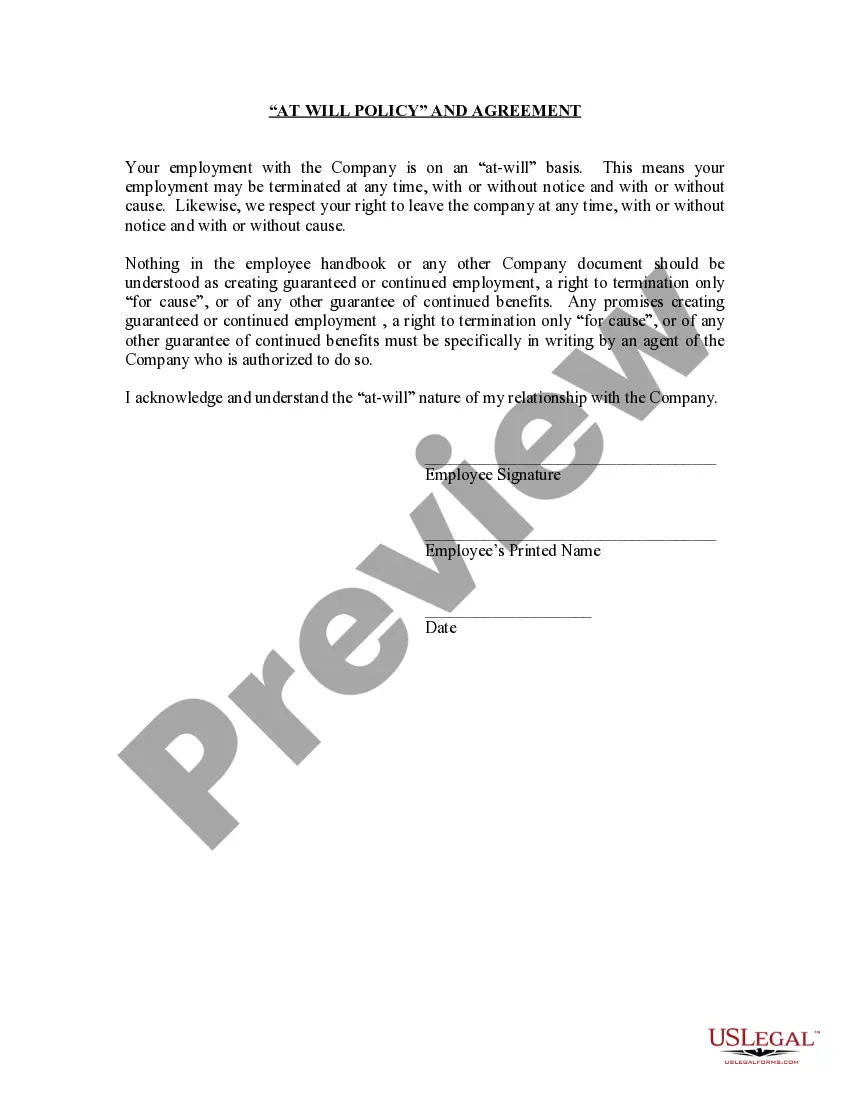
Oklahoma At Will Policy and Agreement
Description




How to fill out At Will Policy And Agreement?
US Legal Forms - one of the largest collections of legal documents in the United States - provides a vast selection of legal form templates that you can obtain or print.
Through the site, you can access countless forms for commercial and personal purposes, organized by categories, states, or keywords.
You can find the latest forms such as the Oklahoma At Will Policy and Agreement in moments.
Review the form description to ensure you have selected the correct form.
If the form does not meet your needs, utilize the Search field at the top of the page to find the one that does.
- If you already possess a subscription, Log In and obtain the Oklahoma At Will Policy and Agreement from the US Legal Forms library.
- The Get button will appear on every form you view.
- You can access all previously downloaded forms in the My documents tab of your account.
- If you are using US Legal Forms for the first time, here are simple steps to get you started.
- Make sure you have chosen the appropriate form for your area/state.
- Click on the Preview button to review the form's content.
Form popularity
FAQ
Because Oklahoma is designated as an at-will employment state, in most circumstances employers are permitted to terminate workers at any time, for any reason and without prior notice required.
What are some of the exceptions to the employment at will doctrine? These exceptions include the public policy exception, the implied contract exception, and the implied covenant of good faith and fair dealing exception. only refers to state constitutional protections or state statutory law.
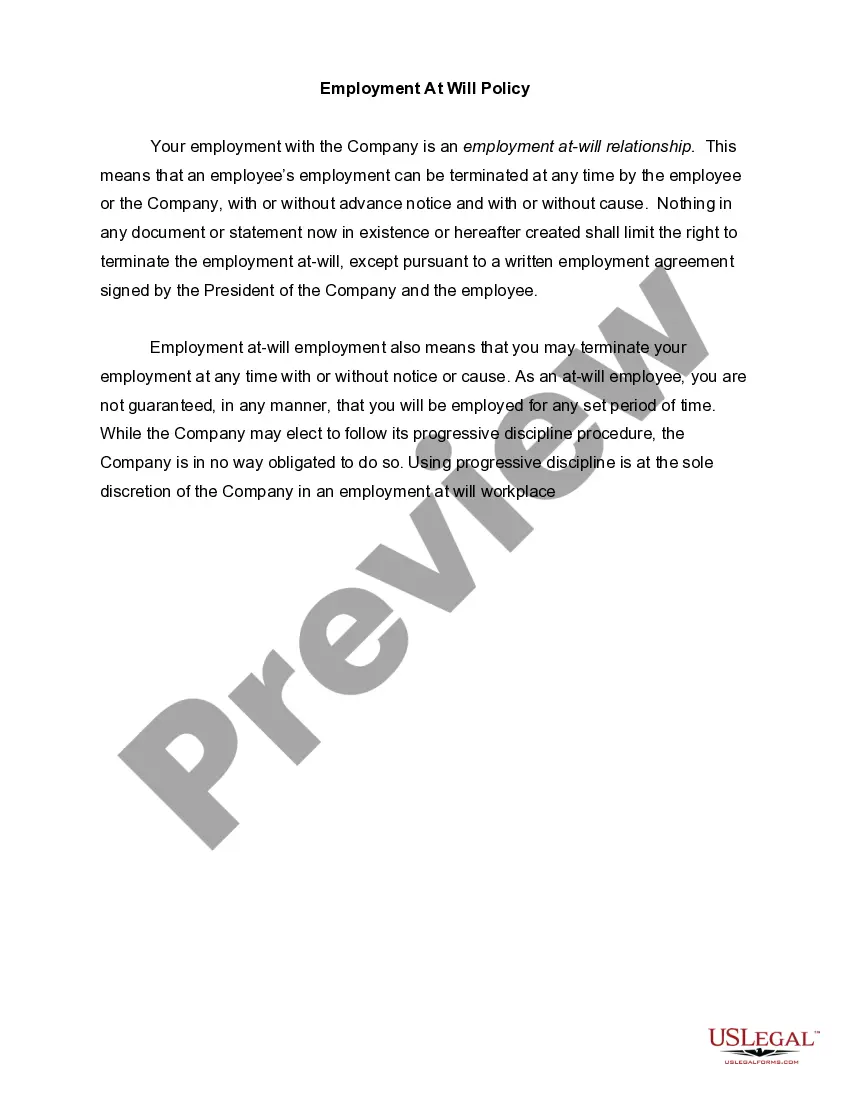
A: Oklahoma has traditionally recognized the at will doctrine, meaning that an employee works and a business employs on an at will basis, and either may cease the employment relationship at any time. However, the ability to terminate an employee at will is limited under some circumstances.
Employers can terminate at-will employees at any time for almost any reason, even without an explanation or warning. Contract employees usually have clearly defined language in their contracts pertaining to discipline and termination. At-will limitations protect employees from wrongful termination situations.
The three major common law exceptions are public policy, implied contract, and implied covenant of good faith. The at-will presumption is strong, however, and it can be difficult for an employee to prove that his circumstances fall within one of the exceptions.
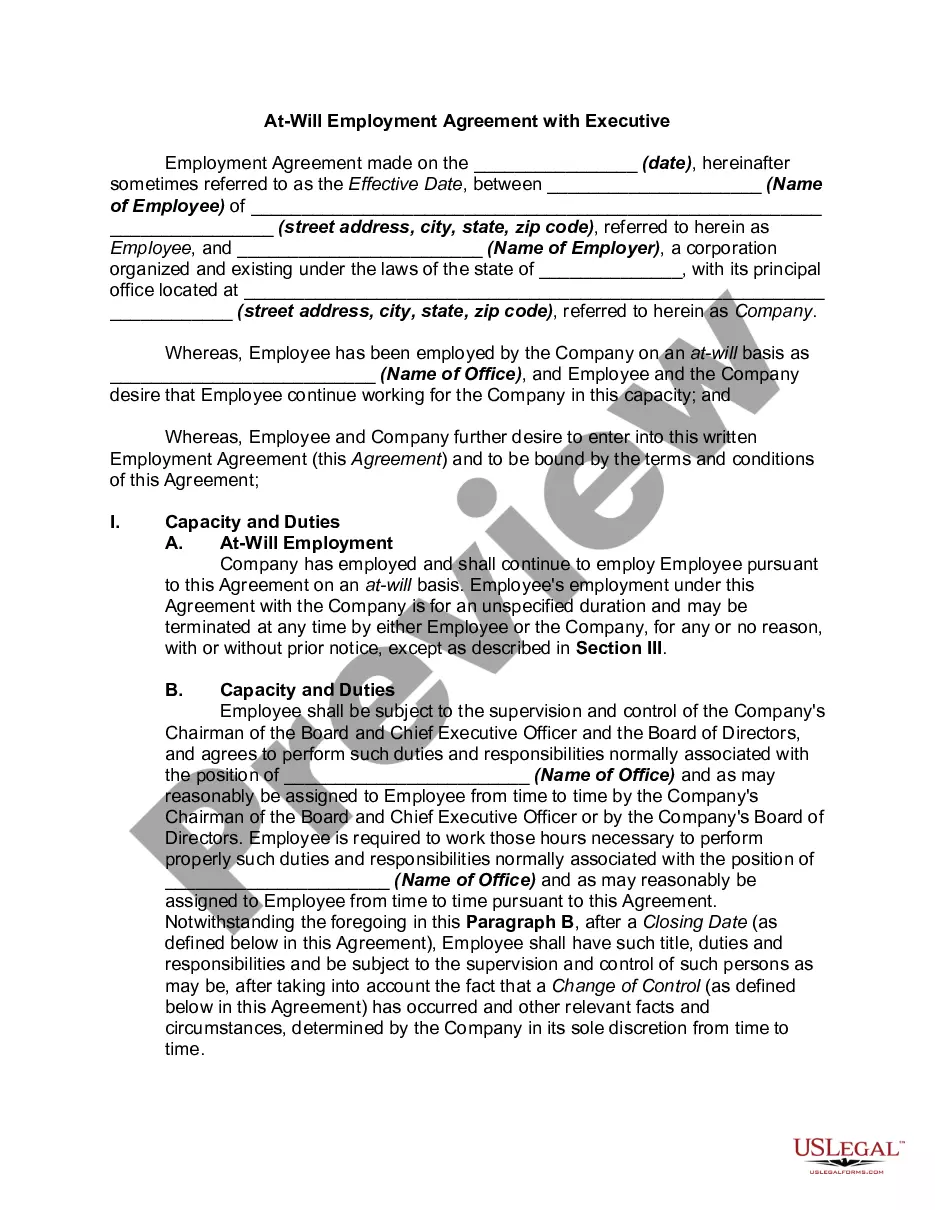
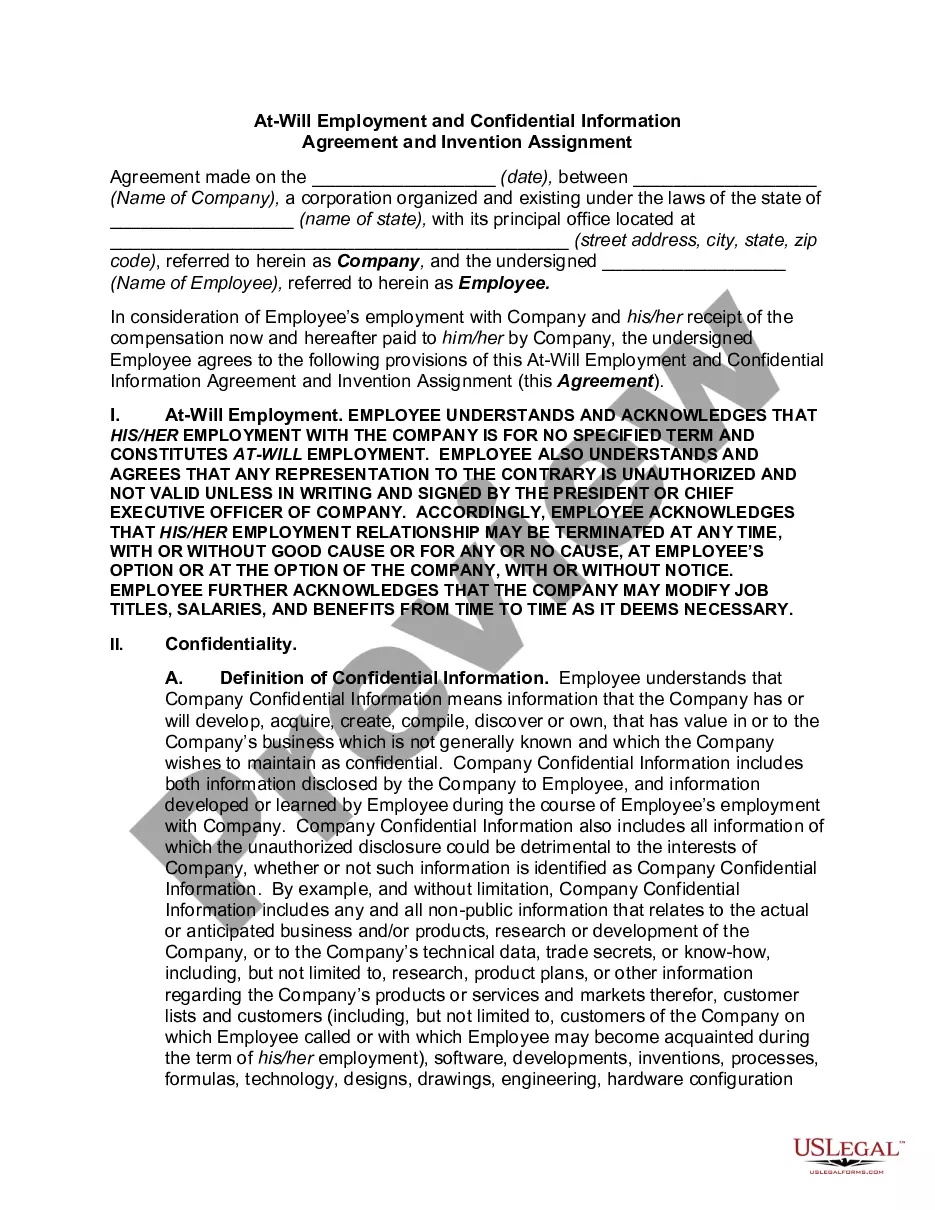
This document is not a contract, but rather is known as an at-will employment agreement. Employers might ask employees to sign an offer letter, handbook acknowledgment, or other document agreeing to at-will employment, for example.
The implied contract exception means that an employee may have an expectation of a fixed term or even indefinite employment based on something the supervisor has done.
Public-policy exception For example, in most States, an employer cannot terminate an employee for filing a workers' compensation claim after being injured on the job, or for refusing to break the law at the re- quest of the employer.
Employment at will, however, comes with some limitations because discrimination laws still apply. Under federal law, you cannot terminate someone because of the person's age, race, gender, color, national origin, equal pay, pregnancy, genetic information, religion or disability.
At-will contracts between an employee and an employer mean that the employee may be terminated at any time, for any reason, and the employer does not need to give any notice when this happens. No specific document is needed for this contract, so many workers are surprised to find out about their at-will status.