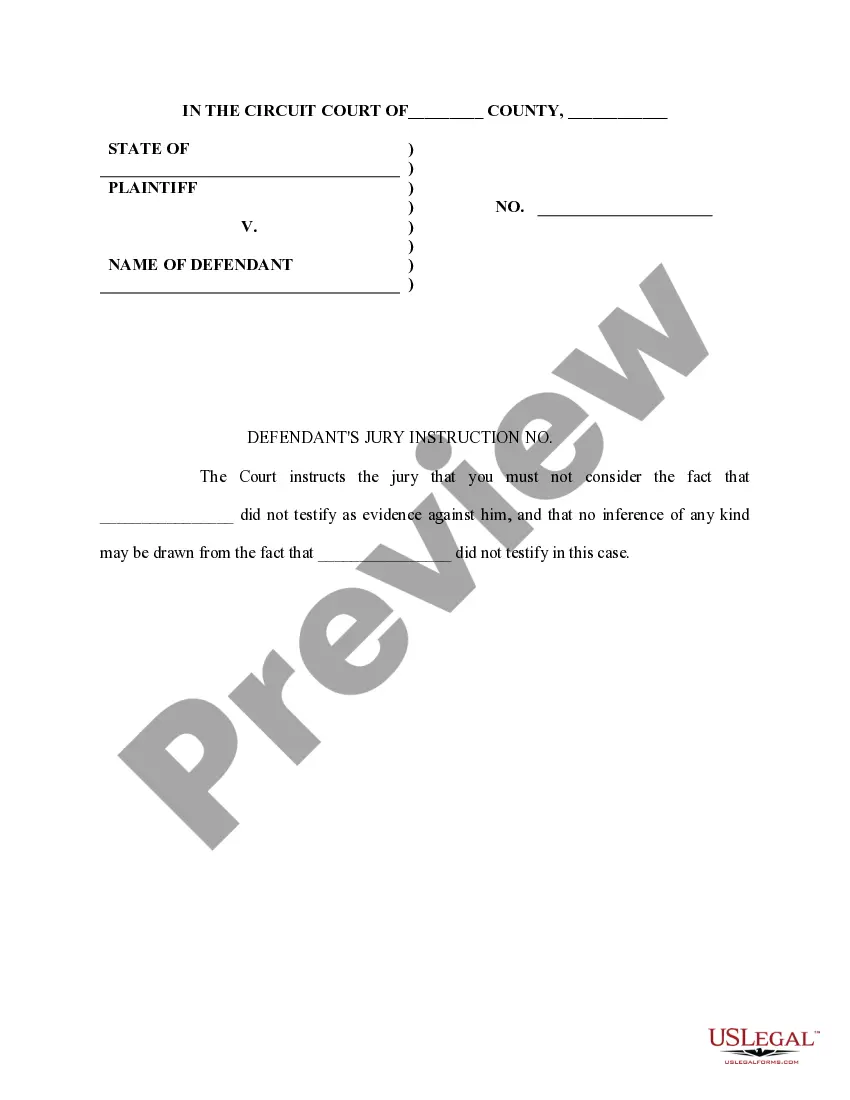
Oklahoma Jury Instructions - Defendant's Failure to Testify
Description
Get your form ready online
Our built-in tools help you complete, sign, share, and store your documents in one place.
Make edits, fill in missing information, and update formatting in US Legal Forms—just like you would in MS Word.
Download a copy, print it, send it by email, or mail it via USPS—whatever works best for your next step.
Sign and collect signatures with our SignNow integration. Send to multiple recipients, set reminders, and more. Go Premium to unlock E-Sign.
If this form requires notarization, complete it online through a secure video call—no need to meet a notary in person or wait for an appointment.
We protect your documents and personal data by following strict security and privacy standards.

Make edits, fill in missing information, and update formatting in US Legal Forms—just like you would in MS Word.

Download a copy, print it, send it by email, or mail it via USPS—whatever works best for your next step.

Sign and collect signatures with our SignNow integration. Send to multiple recipients, set reminders, and more. Go Premium to unlock E-Sign.

If this form requires notarization, complete it online through a secure video call—no need to meet a notary in person or wait for an appointment.

We protect your documents and personal data by following strict security and privacy standards.
Looking for another form?






How to fill out Jury Instructions - Defendant's Failure To Testify?
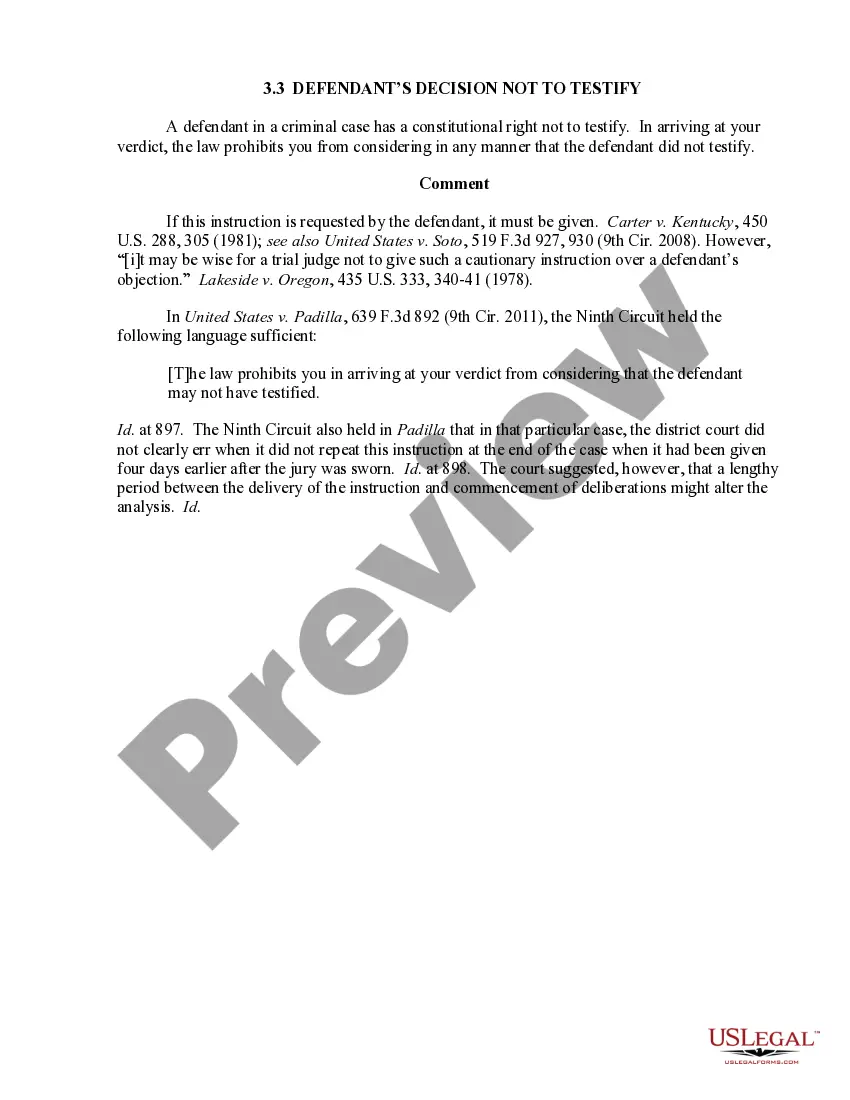
Finding the appropriate legal document template can be a challenge. Clearly, there are numerous templates available online, but how do you locate the legal form you require? Utilize the US Legal Forms website. The platform offers thousands of templates, including the Oklahoma Jury Instructions - Defendant's Failure to Testify, which you can utilize for business and personal purposes. All of the forms are vetted by professionals and comply with federal and state regulations.
If you are already registered, Log In to your account and click the Download button to obtain the Oklahoma Jury Instructions - Defendant's Failure to Testify. Use your account to review the legal forms you have previously purchased. Visit the My documents section of your account and retrieve another copy of the documents you need.
If you are a new user of US Legal Forms, here are simple steps you can follow: First, ensure you have chosen the correct form for your city/state. You can examine the form using the Review button and read the form description to confirm it is the right one for you. If the form does not meet your needs, utilize the Search field to find the correct form. Once you are confident that the form is suitable, click the Acquire now button to obtain the form. Select the pricing plan you desire and enter the necessary information. Create your account and pay for the order using your PayPal account or Visa or Mastercard. Choose the file format and download the legal document template to your device. Complete, modify, print, and sign the obtained Oklahoma Jury Instructions - Defendant's Failure to Testify.
Make the most of this service to efficiently obtain legally sound documents tailored to your requirements.
- US Legal Forms is the largest collection of legal forms available.
- You can find a variety of document templates.
- Utilize the service to download properly crafted documents.
- All documents adhere to state regulations.
- Ensure compliance with legal standards.
- Access support if needed during the process.
Form popularity
FAQ
Article Talk. Jury instructions, also known as charges or directions, are a set of legal guidelines given by a judge to a jury in a court of law.
Oklahoma Uniform Jury Instructions (civil & criminal only) are also available on Lexis and Westlaw within the Oklahoma databases.
It is not required that the government prove guilt beyond all possible doubt. A reasonable doubt is a doubt based upon reason and common sense and is not based purely on speculation. It may arise from a careful and impartial consideration of all the evidence, or from lack of evidence.
The jury is the fact-finder, but it is left to "find" facts only from the evidence which is legally admissible. The judge instructs the jury on the legal principles or rules that must be followed in weighing the facts. If the jury finds the accused guilty or liable, it is up to the judge to sentence the defendant.
Jury instructions are the only guidance the jury should receive when deliberating and are meant to keep the jury on track regarding the basic procedure of the deliberation and the substance of the law on which their decision is based.
In its current form, Rule 30 requires that the court instruct the jury after the arguments of counsel. In some districts, usually where the state practice is otherwise, the parties prefer to stipulate to instruction before closing arguments.
The judge instructs the jury about the relevant laws that should guide its deliberations. (In some jurisdictions, the court may instruct the jury at any time after the close of evidence. This sometimes occurs before closing arguments.) The judge reads the instructions to the jury.
When you receive a summons, you are required to appear at the court described at the time that is listed on the summons. Failure to report can result in contempt charges and the imposition of a fine and/or community service for the length of the trial on which you would have served.