Oklahoma Verified Complaint to Confirm
What is this form?
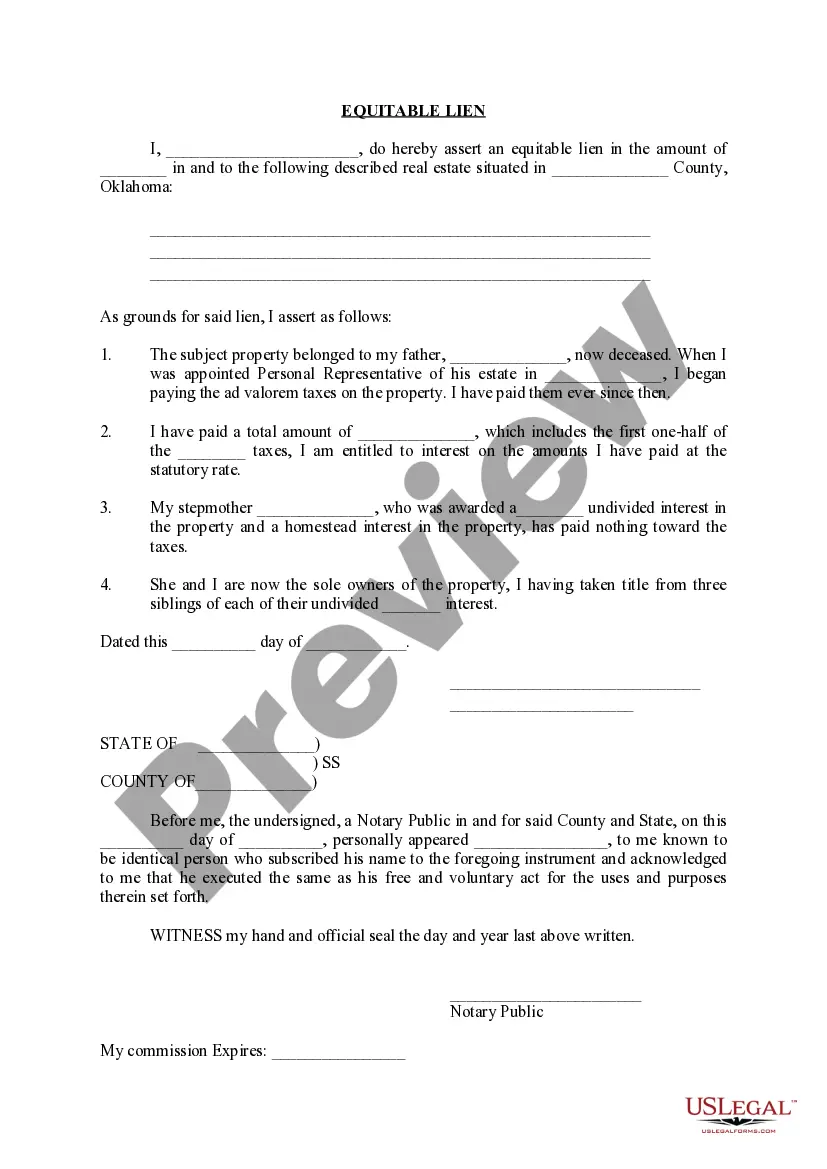
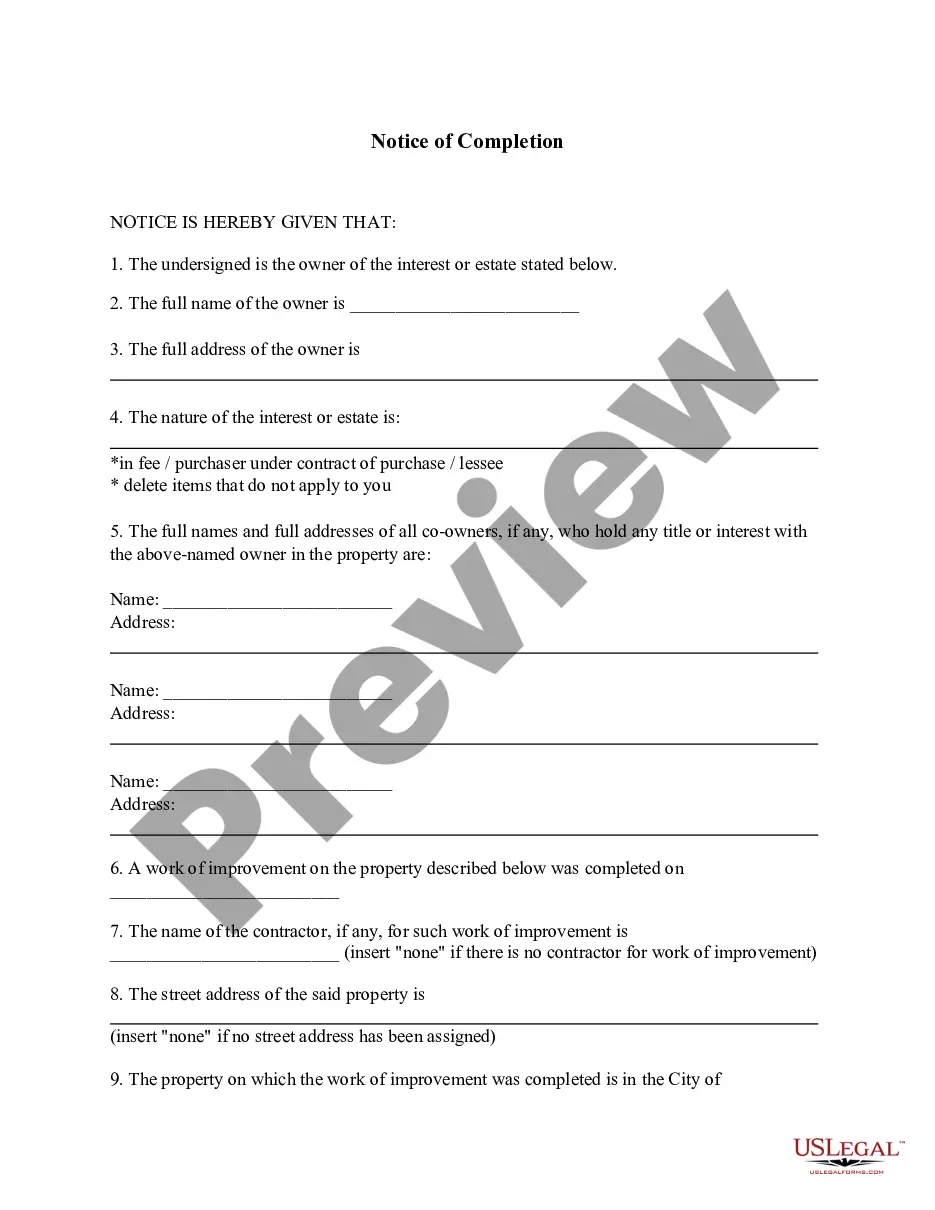
The Verified Complaint to Confirm is a legal document used to assert an equitable lien on a property. This form serves to establish a claimant's right to a property owned by someone else due to contributions made toward the property, usually in terms of paying taxes or other debts. Unlike similar forms, this one specifically addresses situations where one party holds possession of property on behalf of another, highlighting fairness and equity within the property context.
What’s included in this form
- Identification of the claimant and the equitable lien amount.
- Description of the real estate involved in the lien.
- Detailed grounds for asserting the lien, including payment history and relationships between parties.
- Signature of the claimant and notary acknowledgment of the document.
When to use this document
You should use the Verified Complaint to Confirm in situations where you believe you have an equitable lien on a property for which you have made payments, such as taxes. Common scenarios include when you have inherited property or taken on responsibilities for an estate but have not received full compensation from other parties involved in the property ownership.
Who can use this document
- Individuals acting as personal representatives of an estate.
- Heirs who have contributed to property expenses but lack formal recognition of their claims.
- Property owners seeking to confirm or establish their equitable lien rights.
How to complete this form
- Identify yourself and enter the amount of the equitable lien to be asserted.
- Provide a detailed description of the property related to the lien.
- State the grounds for asserting the lien, including relevant payment history and relationships.
- Sign the form and include the date.
- Obtain notarization to finalize the document's legal standing.
Notarization guidance
Yes, this form must be notarized to be legally valid. US Legal Forms provides an integrated online notarization service, available 24/7, which allows you to complete notarization via a secure video call. This ensures your document is legally binding without the need for travel.
Get your form ready online
Our built-in tools help you complete, sign, share, and store your documents in one place.
Make edits, fill in missing information, and update formatting in US Legal Forms—just like you would in MS Word.
Download a copy, print it, send it by email, or mail it via USPS—whatever works best for your next step.
Sign and collect signatures with our SignNow integration. Send to multiple recipients, set reminders, and more. Go Premium to unlock E-Sign.
If this form requires notarization, complete it online through a secure video call—no need to meet a notary in person or wait for an appointment.
We protect your documents and personal data by following strict security and privacy standards.

Make edits, fill in missing information, and update formatting in US Legal Forms—just like you would in MS Word.

Download a copy, print it, send it by email, or mail it via USPS—whatever works best for your next step.

Sign and collect signatures with our SignNow integration. Send to multiple recipients, set reminders, and more. Go Premium to unlock E-Sign.

If this form requires notarization, complete it online through a secure video call—no need to meet a notary in person or wait for an appointment.

We protect your documents and personal data by following strict security and privacy standards.
Common mistakes
- Failing to accurately describe the property can lead to complications.
- Omitting signatures or dates may invalidate the form.
- Neglecting to include detailed payment records and relationships can weaken your claim.
Why complete this form online
- Convenient access to downloadable legal templates tailored to your needs.
- Editable formats allow you to customize the document easily.
- Reliable forms created and reviewed by licensed attorneys for legal accuracy.
Looking for another form?

Form popularity
FAQ
Equitable lien. n. a lien on property imposed by a court in order to achieve fairness, particularly when someone has possession of property which he/she holds for another.
Equitable liens are created when there is no adequate remedy at law2 for a breach of contract or other harm, which usually means a money judgment is impractical or impossible.
In title theory states, a lender holds the actual legal title to a piece of real estate for the life of the loan while the borrower/mortgagor holds the equitable title.
An equitable lien differs from a common law lien in that a common law lien is founded on possession and, except as modified by statute, merely confers a right to detain the property until payment, whereas an equitable lien, which exists quite irrespective of possession confers on the holder the right to a judicial sale
An equitable lien is a claim on a wrongdoer's property that is placed by a court of equity, or through an equivalent legal proceeding.A common example of a situation where an equitable lien might be appropriate involves the embezzlement of the proceeds from a trust by a trust administrator or trustee.