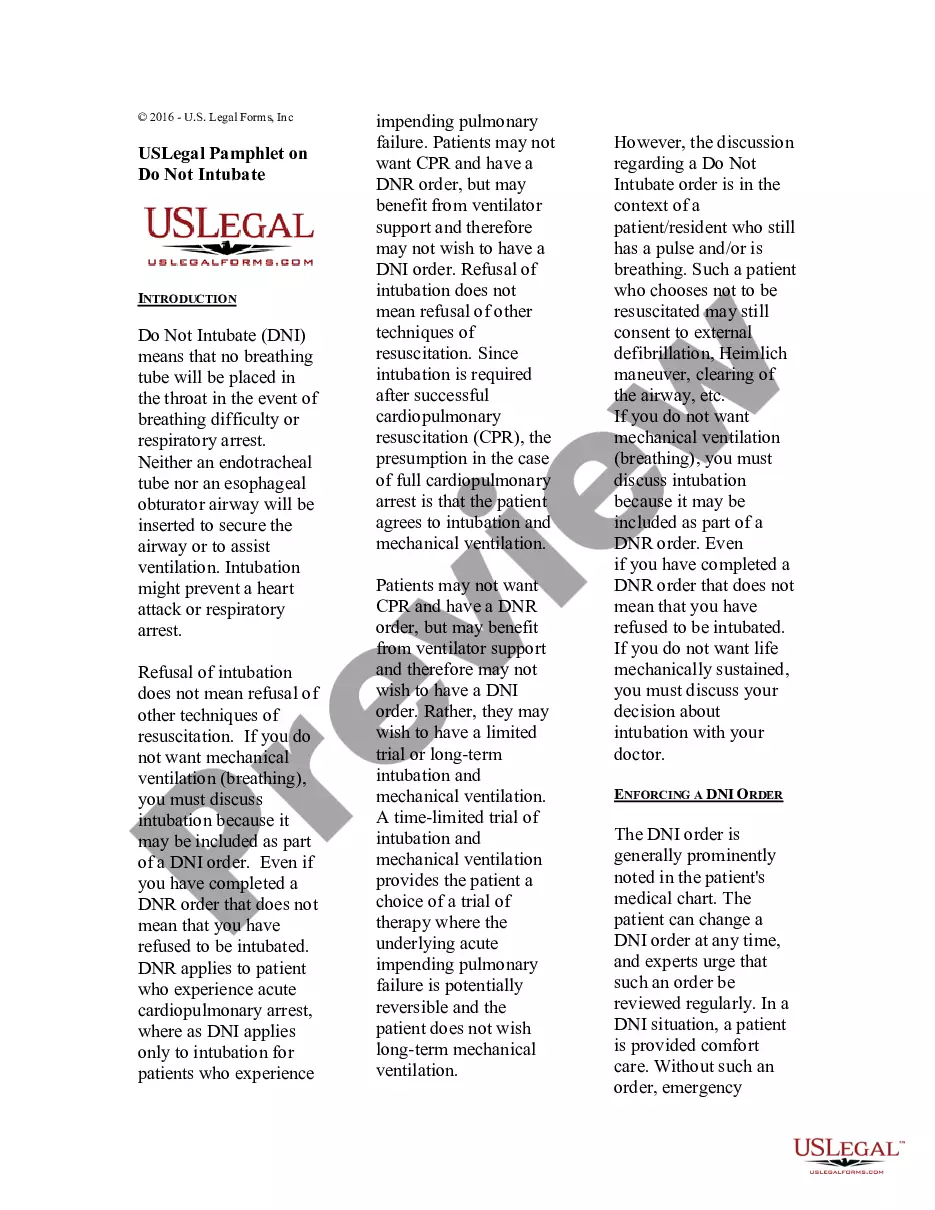
This pamphlet provides an overview on Do Not Resuscitate (DNI) orders. A comparison of DNI and DNR orders is included.
Ohio USLegal Pamphlet on Do Not Intubate - DNI
State:
Multi-State
Category:
Control #:
US-PMPH-05
Format:
Word;
Rich Text
57 downloads
Description
Free preview
Get your form ready online
Our built-in tools help you complete, sign, share, and store your documents in one place.
Built-in online Word editor
Make edits, fill in missing information, and update formatting in US Legal Forms—just like you would in MS Word.
Export easily
Download a copy, print it, send it by email, or mail it via USPS—whatever works best for your next step.
E-sign your document
Sign and collect signatures with our SignNow integration. Send to multiple recipients, set reminders, and more. Go Premium to unlock E-Sign.
Notarize online 24/7
If this form requires notarization, complete it online through a secure video call—no need to meet a notary in person or wait for an appointment.
Store your document securely
We protect your documents and personal data by following strict security and privacy standards.

Make edits, fill in missing information, and update formatting in US Legal Forms—just like you would in MS Word.

Download a copy, print it, send it by email, or mail it via USPS—whatever works best for your next step.

Sign and collect signatures with our SignNow integration. Send to multiple recipients, set reminders, and more. Go Premium to unlock E-Sign.

If this form requires notarization, complete it online through a secure video call—no need to meet a notary in person or wait for an appointment.

We protect your documents and personal data by following strict security and privacy standards.
Looking for another form?
How to fill out USLegal Pamphlet On Do Not Intubate - DNI?
Are you currently in a position where you require documents for either business or personal purposes almost every day.
There are numerous legal document templates accessible online, but finding reliable ones is not easy.
US Legal Forms offers thousands of form templates, such as the Ohio USLegal Pamphlet on Do Not Intubate - DNI, that are designed to meet federal and state requirements.
Select the pricing plan you prefer, fill in the necessary details to create your account, and pay for your order using PayPal or Visa or Mastercard.
Choose a suitable file format and download your copy. Access all the document templates you have purchased in the My documents section. You can obtain an additional copy of the Ohio USLegal Pamphlet on Do Not Intubate - DNI anytime, if needed. Simply click on the required form to download or print the document template. Use US Legal Forms, the most comprehensive collection of legal forms, to save time and avoid errors. Create an account on US Legal Forms and start making your life a bit simpler.
- If you are already familiar with the US Legal Forms website and have an account, simply Log In.
- Then, you can download the Ohio USLegal Pamphlet on Do Not Intubate - DNI template.
- If you do not have an account and wish to start using US Legal Forms, follow these instructions.
- Locate the form you need and ensure it is for the correct city/county.
- Utilize the Preview button to review the form.
- Check the description to verify that you have selected the correct form.
- If the form isn’t what you’re looking for, use the Search field to find the form that fits your requirements.
- Once you find the right form, click on Buy now.
Form popularity
FAQ
Strictly defined, a do not resuscitate/do not intubate (DNR/DNI) status indicates a patient does not want to receive CPR or intubation in the event of cardiopulmonary arrest.
When you request a Do Not Resuscitate (DNR) order, your doctor may ask you whether or not you also want a Do Not Intubate (DNI) order. The two are separate because you can have trouble breathing before your heartbeat or breathing stops. If your breathing problems continue, your heart or lungs may go into full arrest.
In medical terms, a DNI means that patients do not want a breathing tube inserted into their trachea, via the nose or mouth, to restore normal breathing. If the patient's breathing remains impaired, the tube remains in place and is eventually connected to a ventilator to maintain breathing.
A natural reaction to medicine's use of CPR and MV was the advent of advance directives and more specific Do-Not-Resuscitate (DNR) and Do-Not-Intubate (DNI) orders meant to protect a patient's ability to remain autonomous with their end of life decisions. 1.
DNI's only apply to situations where a patient has no pulse or is not breathing, but they do not restrict any other clinically indicated care. There does not need to be a formal advance directive or living will to have DNR and DNI orders in place.
A DNI or Do Not Intubate order means that chest compressions and cardiac drugs may be used, but no breathing tube will be placed. An AND or Allow Natural Death order is a term used at some hospitals as an alternative to the more traditional DNR order.
Choosing a Do Not Intubate Order DNI's only apply to situations where a patient has no pulse or is not breathing, but they do not restrict any other clinically indicated care. There does not need to be a formal advance directive or living will to have DNR and DNI orders in place.
A ventilator keeps oxygen flowing into and out of the lungs when patients are unable to breathe on their own. A patient can sign a DNI and continue to benefit from oxygen therapy and non-invasive ventilation, such as through BiPAP.
It is an emergency rescue technique that was developed to save the life of people who are generally in good health. NOTE: If you do not have a DNR orders, health care providers will begin CPR in an emergency.
Conclusions: Conflation of DNR and DNI into DNR/DNI does not reliably distinguish patients who refuse or accept intubation for indications other than cardiac arrest, and thus may inappropriately deny desired intubation for those who would accept it, and inappropriately impose intubation on patients who would not.