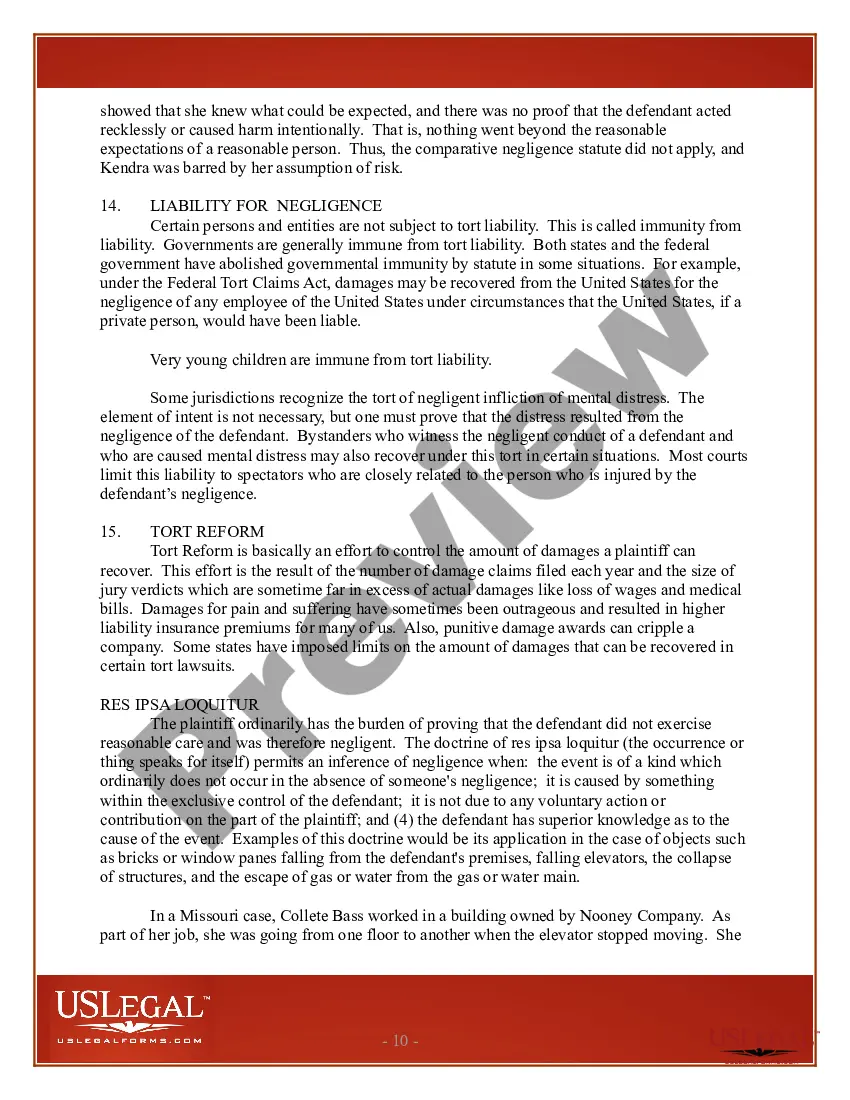
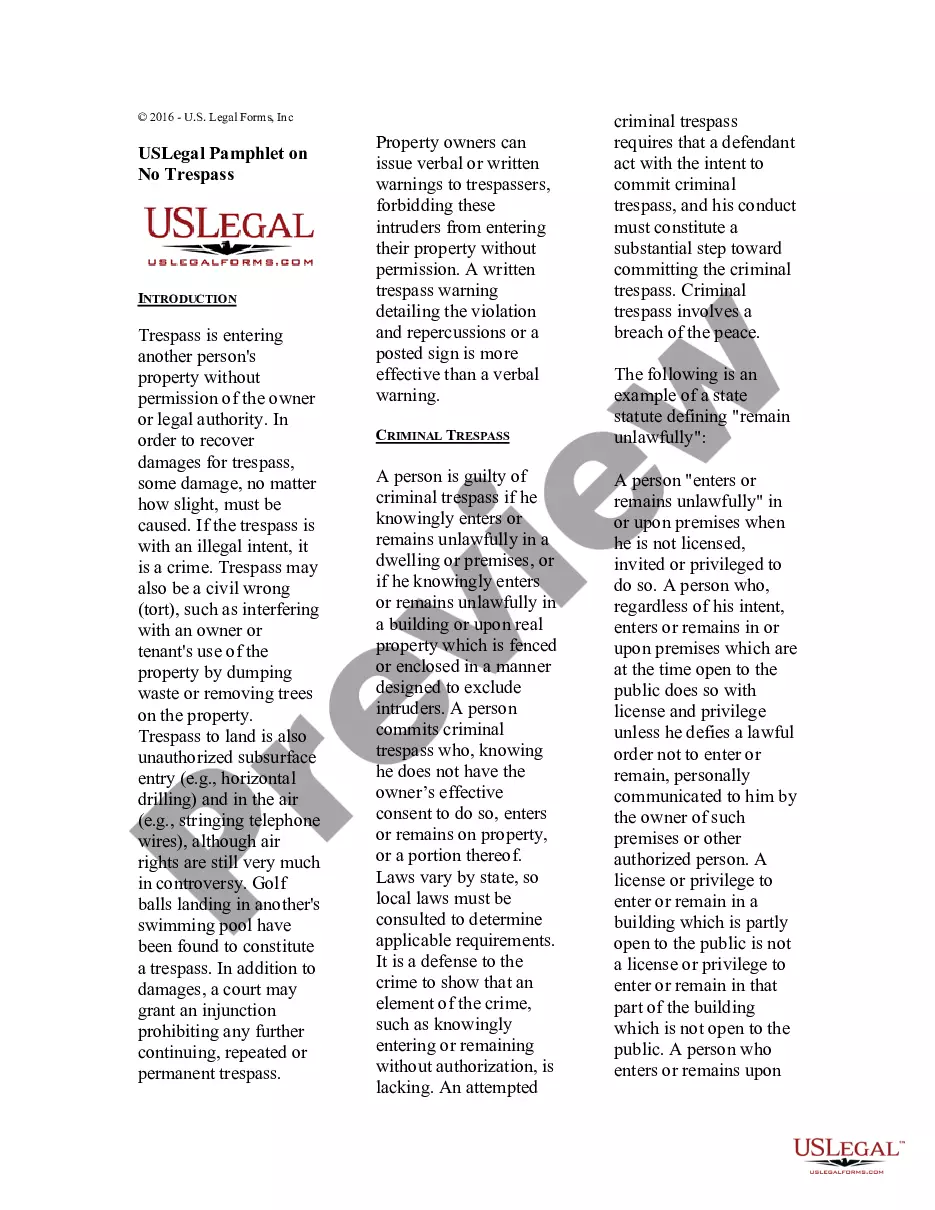
Ohio USLegal Law Pamphlet on Torts
Description




Get your form ready online
Our built-in tools help you complete, sign, share, and store your documents in one place.
Make edits, fill in missing information, and update formatting in US Legal Forms—just like you would in MS Word.
Download a copy, print it, send it by email, or mail it via USPS—whatever works best for your next step.
Sign and collect signatures with our SignNow integration. Send to multiple recipients, set reminders, and more. Go Premium to unlock E-Sign.
If this form requires notarization, complete it online through a secure video call—no need to meet a notary in person or wait for an appointment.
We protect your documents and personal data by following strict security and privacy standards.

Make edits, fill in missing information, and update formatting in US Legal Forms—just like you would in MS Word.

Download a copy, print it, send it by email, or mail it via USPS—whatever works best for your next step.

Sign and collect signatures with our SignNow integration. Send to multiple recipients, set reminders, and more. Go Premium to unlock E-Sign.

If this form requires notarization, complete it online through a secure video call—no need to meet a notary in person or wait for an appointment.

We protect your documents and personal data by following strict security and privacy standards.
Looking for another form?
How to fill out USLegal Law Pamphlet On Torts?
You can spend several hours online trying to locate the official document template that meets the federal and state standards you need. US Legal Forms offers a multitude of legal forms that are reviewed by experts. It is easy to download or print the Ohio USLegal Law Pamphlet on Torts from their services.
If you possess a US Legal Forms account, you may Log In and then click the Obtain button. After that, you can complete, modify, print, or sign the Ohio USLegal Law Pamphlet on Torts. Every legal document template you purchase is yours indefinitely. To get another copy of the acquired form, visit the My documents tab and click the corresponding button.
If you are using the US Legal Forms website for the first time, follow the simple instructions below: First, ensure that you have selected the correct document template for the region/city of your choice. Review the form description to confirm you have chosen the correct template. If available, utilize the Preview button to view the document template as well.
- If you wish to find another version of the form, use the Search field to locate the template that suits your needs and requirements.
- Once you have found the template you desire, click Acquire now to proceed.
- Select the pricing plan you want, enter your details, and register for a free account on US Legal Forms.
- Complete the transaction. You can use your credit card or PayPal account to pay for the legal document.
- Choose the format of the document and download it to your device.
- Make edits to your document if necessary. You can complete, modify, sign, and print the Ohio USLegal Law Pamphlet on Torts.
- Obtain and print a multitude of document layouts using the US Legal Forms website, which provides the most extensive collection of legal forms. Utilize professional and state-specific templates to address your business or personal needs.
Form popularity
FAQ
The amount of damages in a tort case is calculated based on various factors, including medical expenses, lost wages, and pain and suffering. The specifics can vary widely depending on the nature of the case and the extent of the injuries involved. Utilizing the Ohio USLegal Law Pamphlet on Torts can help you understand how damages are assessed and what you might expect in your claim.
The four main types of torts are intentional torts, negligence, strict liability, and economic torts. Each type addresses different circumstances and legal responsibilities. The Ohio USLegal Law Pamphlet on Torts breaks down these categories, helping you identify which type may apply to your situation and guiding you through the legal process.
Yes, Ohio is a tort state where individuals can seek compensation for injuries caused by the negligence of others. The laws surrounding torts in Ohio are designed to protect victims and hold wrongdoers accountable. The Ohio USLegal Law Pamphlet on Torts provides essential insights into how tort law operates in Ohio, enabling you to understand your rights.
In Ohio, the statute of limitations for tort claims typically allows you to file a lawsuit within two years from the date of the injury. This timeline can vary based on specific cases, such as medical malpractice, which may have different limits. The Ohio USLegal Law Pamphlet on Torts can be a valuable resource to ensure you meet all legal deadlines.
The tort limit in Ohio can vary based on the circumstances of each case. Generally, Ohio follows a modified comparative fault rule, which affects the amount you can recover if you share responsibility for the injury. The Ohio USLegal Law Pamphlet on Torts outlines these limits clearly, helping you navigate your legal options effectively.
In Ohio, the cap on damages largely depends on the type of case. For personal injury cases, Ohio law limits noneconomic damages to $250,000 or three times the amount of economic damages, whichever is greater. The Ohio USLegal Law Pamphlet on Torts provides detailed information on these limits, ensuring you understand your rights and potential compensation.
The concept of tort law is to redress a wrong done to a person and provide relief from the wrongful acts of others, usually by awarding monetary damages as compensation. The original intent of tort is to provide full compensation for proved harms. Lawsuits involving contracts fall under contract law.
A tort is an act or omission that gives rise to injury or harm to another and amounts to a civil wrong for which courts impose liability. In the context of torts, "injury" describes the invasion of any legal right, whereas "harm" describes a loss or detriment in fact that an individual suffers.
A tort is an act or omission that causes legally cognizable harm to persons or property. Tort law, in turn, is the body of rules concerned with remedying harms caused by a person's wrongful or injurious actions.
Legally speaking, a tort occurs when a medical professional acts in a negligent manner and injures someone in their care. A tort is different from a criminal act. For example, if a medical technician injects poison into a patient's veins that is a criminal act?not a tort.