Ohio Business Credit Application
Understanding this form
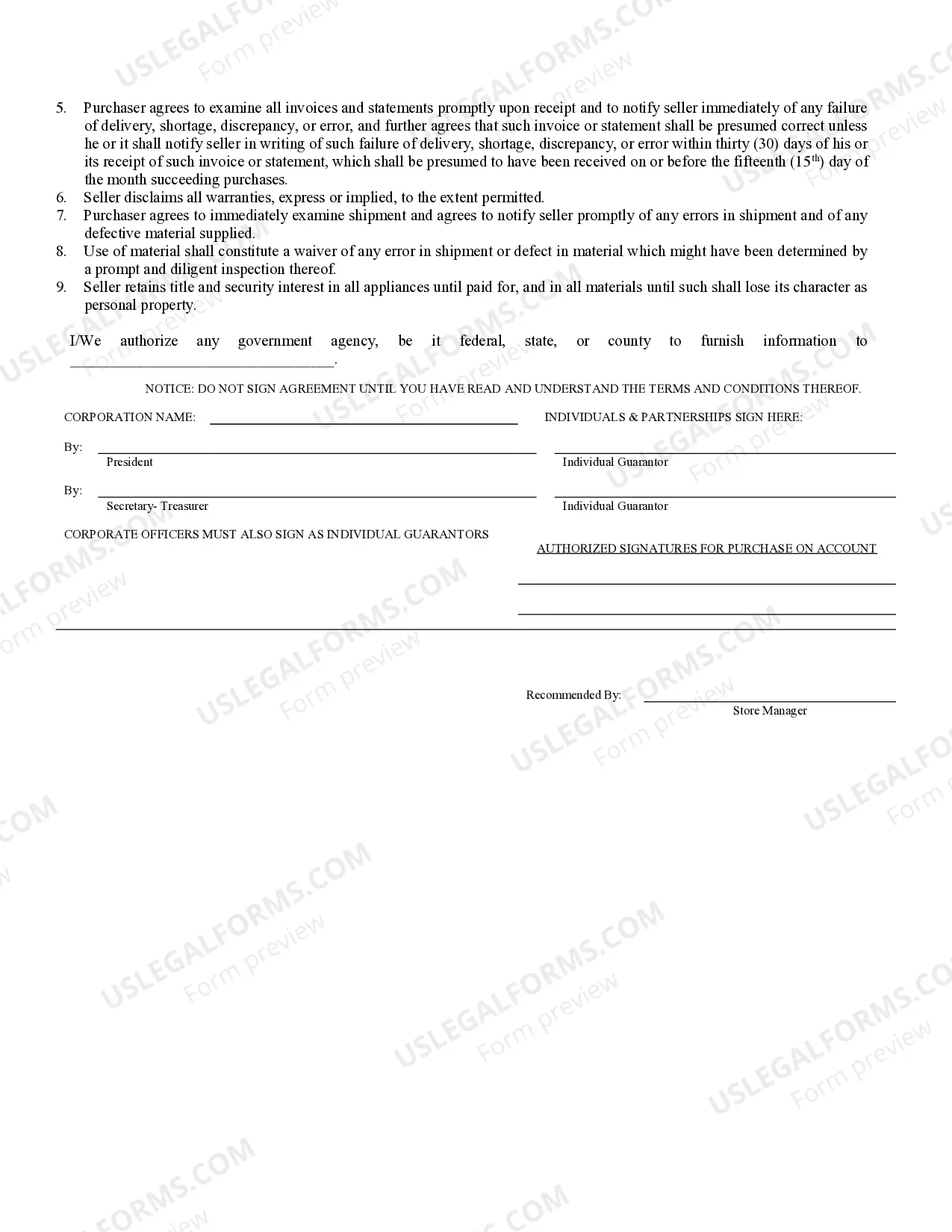
The Business Credit Application is a legal document used by individuals seeking to apply for credit from a business. This form outlines the terms for repayment, interest rates, and default provisions. Unlike other credit forms, this application includes specific clauses addressing warranties, the sellerâs retention of title, and personal liability for business executives or partners. It ensures clarity in the borrowing process and protects the interests of the seller.
Main sections of this form
- Borrower information, including name and business structure (individual, corporation, partnership)
- Terms of sale, specifying the payment due date and service charge rates for late payment
- Default provisions outlining consequences for failure to pay
- Warranties and disclaimers by the seller regarding goods sold
- Retention of title clause ensuring ownership of goods until payment is made
- Signature fields for individuals and authorized representatives of the business




When to use this form
This form should be used when a buyer intends to purchase goods or services on credit from a seller. It is particularly relevant for small business owners and entrepreneurs who need to establish a credit arrangement for operational expenditures. Completing a Business Credit Application helps set clear expectations regarding payment terms and liabilities, minimizing potential disputes in the future.
Who can use this document
This form is suitable for:
- Individuals seeking credit for business purchases
- Business owners, including corporations and partnerships
- Executives or partners who need to personally guarantee payment
How to prepare this document
- Identify the seller's name and the buyer's details, including business structure.
- Specify the terms of sale, including payment due date and interest rates for late payments.
- Review the default provisions and agree to personal liability if applicable.
- Complete the signature section, ensuring authorized individuals sign the application.
- Keep a copy for your records before submitting it to the seller.
Does this document require notarization?
This form does not typically require notarization unless specified by local law. It is advisable to check any jurisdiction-specific requirements regarding notarization to ensure that the application is legally valid.
Get your form ready online
Our built-in tools help you complete, sign, share, and store your documents in one place.
Make edits, fill in missing information, and update formatting in US Legal Forms—just like you would in MS Word.
Download a copy, print it, send it by email, or mail it via USPS—whatever works best for your next step.
Sign and collect signatures with our SignNow integration. Send to multiple recipients, set reminders, and more. Go Premium to unlock E-Sign.
If this form requires notarization, complete it online through a secure video call—no need to meet a notary in person or wait for an appointment.
We protect your documents and personal data by following strict security and privacy standards.

Make edits, fill in missing information, and update formatting in US Legal Forms—just like you would in MS Word.

Download a copy, print it, send it by email, or mail it via USPS—whatever works best for your next step.

Sign and collect signatures with our SignNow integration. Send to multiple recipients, set reminders, and more. Go Premium to unlock E-Sign.

If this form requires notarization, complete it online through a secure video call—no need to meet a notary in person or wait for an appointment.

We protect your documents and personal data by following strict security and privacy standards.
Common mistakes
- Failing to read and understand the terms before signing
- Not providing accurate information regarding the business structure
- Neglecting to get all necessary signatures, especially from guarantors
Benefits of completing this form online
- Easy access to a downloadable template, saving time and effort
- Ability to edit and customize the form as needed for your specific business situation
- Reliable legal standards backing the drafted content by licensed attorneys
Legal use & context
- This form establishes a formal credit relationship and outlines the liabilities of the purchaser.
- It is enforceable in court as a contract, provided all terms are agreed upon and duly signed.
- Failure to comply with the terms may result in legal actions from the seller.
Quick recap
- The Business Credit Application is essential for formalizing business credit agreements.
- Proper completion and understanding of the terms are crucial to avoid potential legal issues.
- This form is adaptable for use across multiple states with attention to state-specific laws.
Looking for another form?







Form popularity
FAQ
Currently, six states Nevada, Ohio, South Dakota, Texas, Washington, and Wyoming do not have a corporate income tax.Ohio has a commercial activity tax (CAT) that applies to nearly every Ohio business and is based on gross receipts.
Ohio LLCs are not taxable entities as such, but Ohio does impose filing, withholding, and tax remission obligations on them. General rule is LLCs must withhold, and pay to the Ohio Treasurer, an amount equal to 5% of the distributive share of income, gain, expense or loss allocable to individuals.
By utilizing the Ohio BID, Ohio taxpayers filing jointly can deduct up to $250,0002 of business income from their Federal Adjusted Gross Income (AGI) when calculating their Ohio taxable income. The excess amount of business income left after the BID is taxed at the 3% flat rate.
Like a sole proprietorship, a single-member LLC is taxed as a disregarded entity by default. Because the government ignores disregarded entities, they undergo "pass-through taxation." This means all profits or losses from the business pass through the business directly to you, the business owner.
LLCs give business owners significantly greater federal income tax flexibility than a sole proprietorship, partnership and other popular forms of business organization. Make sure you have a financial plan in place for your small business.
Small businesses pay an average of 19.8 percent in taxes depending on the type of small business. Small businesses with one owner pay a 13.3 percent tax rate on average and ones with more than one owner pay an average of 23.6 percent.
Please note that as of 2016, taxable business income is taxed at a flat rate of 3%. The tax brackets have been indexed for inflation per Ohio Revised Code section 5747.02. Taxpayers with $22,150 or less of income are not subject to income tax for 2020.
The IRS treats one-member LLCs as sole proprietorships for tax purposes. This means that the LLC itself does not pay taxes and does not have to file a return with the IRS. As the sole owner of your LLC, you must report all profits (or losses) of the LLC on Schedule C and submit it with your 1040 tax return.