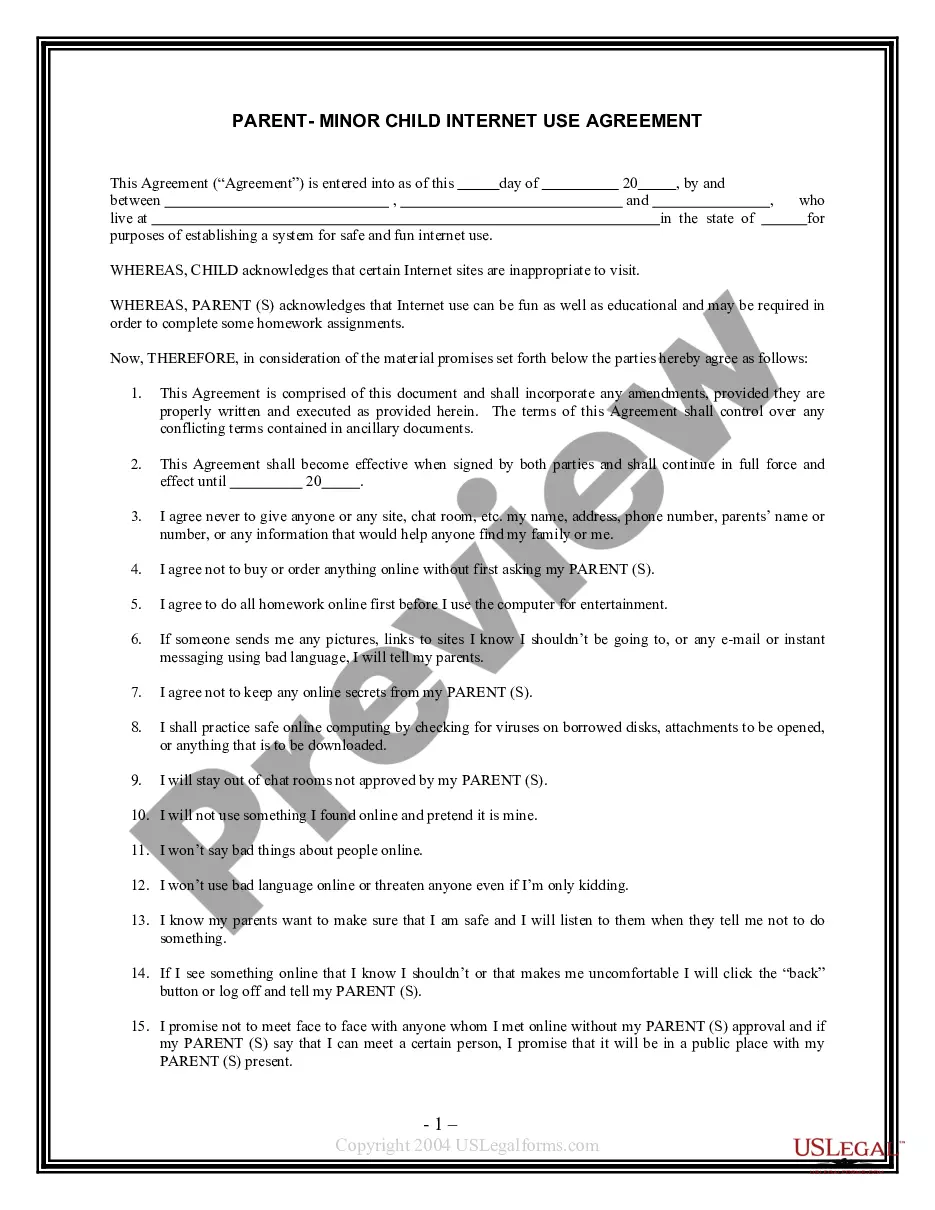
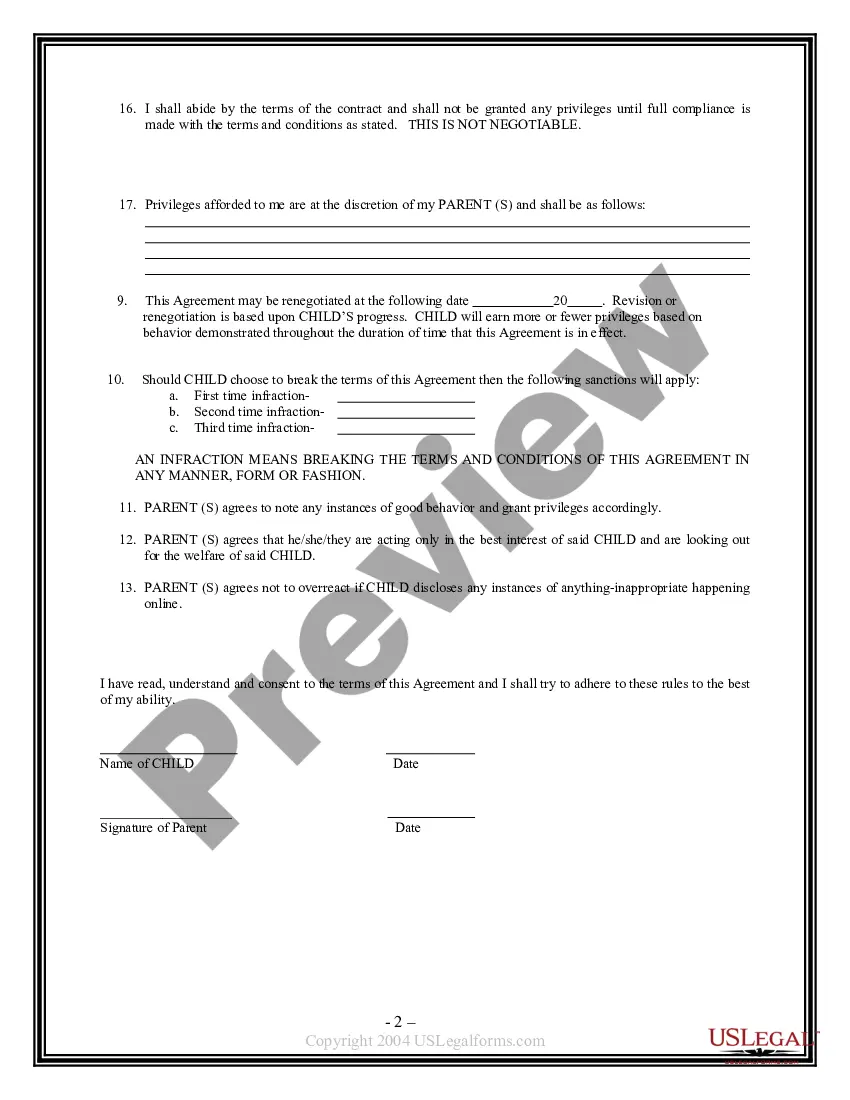
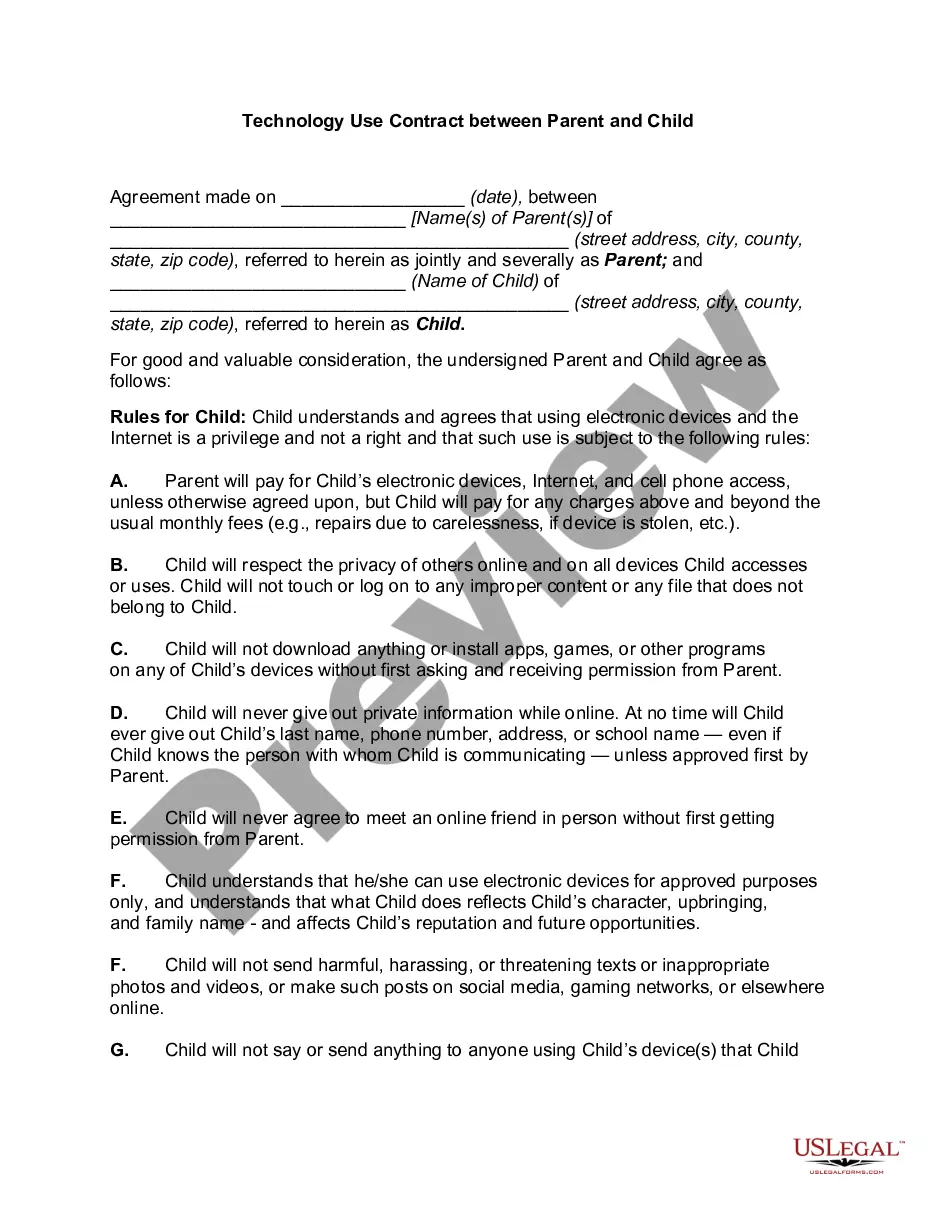
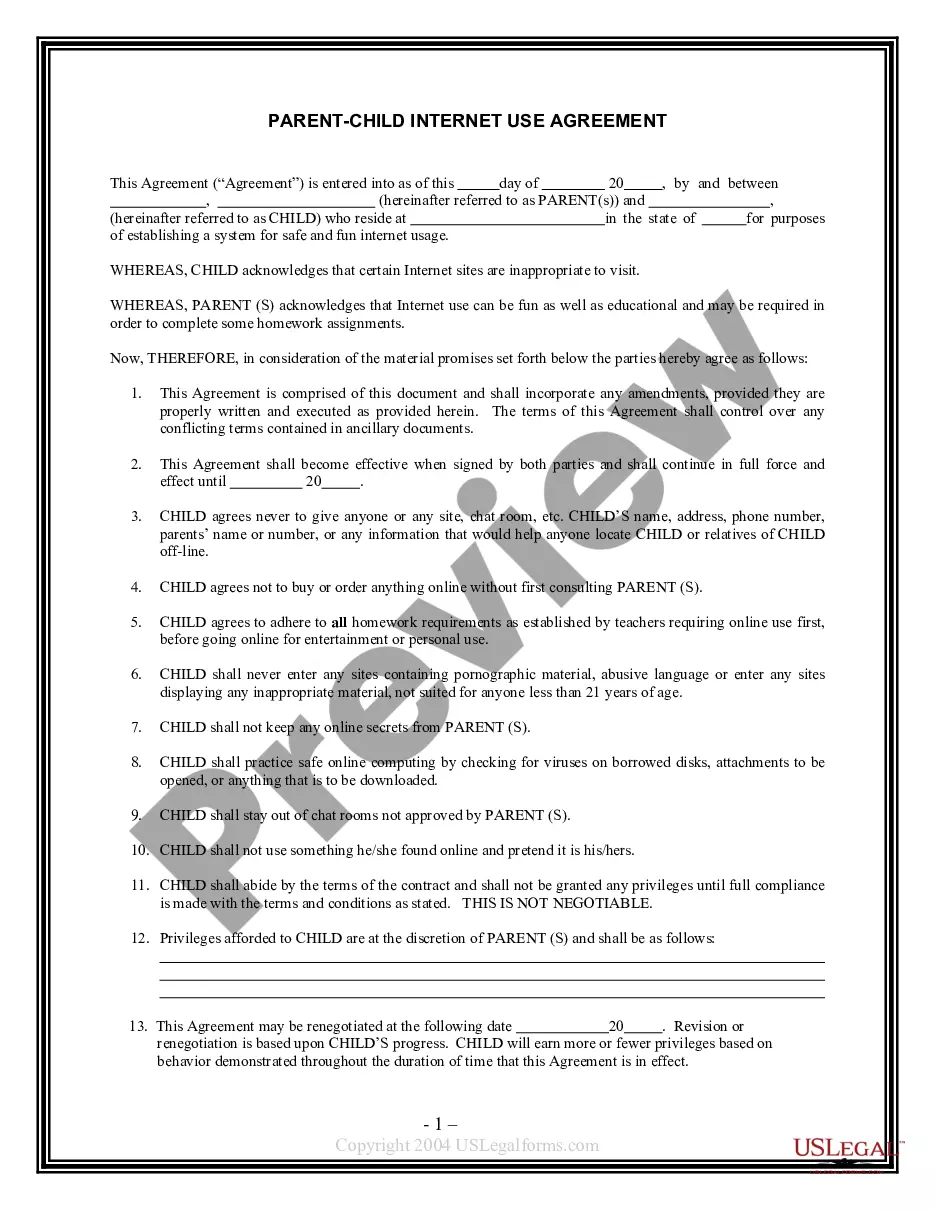
This is a contract between parent(s) and a younger child introducing child to Internet safety by describing what types of sites child should not contact and other general rules for Internet use.
New York Parent - Minor Child Internet Use Agreement
Category:
State:
Multi-State
Control #:
US-PC10
Format:
Word;
Rich Text
Instant download
Description
Free preview
How to fill out Parent - Minor Child Internet Use Agreement?
You might spend hours online looking for the proper legal document template that fulfills the federal and state requirements you will need. US Legal Forms offers a wide array of legal forms that have been assessed by experts. You can obtain or create the New York Parent - Minor Child Internet Use Agreement from the platform.
If you already have a US Legal Forms account, you can Log In and select the Download option. After that, you can fill out, edit, print, or sign the New York Parent - Minor Child Internet Use Agreement. Every legal document template you acquire is yours permanently. To obtain another copy of the purchased form, go to the My documents section and click on the relevant option.
If you are accessing the US Legal Forms website for the first time, follow the simple instructions outlined below: First, ensure that you have selected the correct document template for the area/city you have chosen. Review the form description to confirm you have picked the right form. If available, use the Preview option to view the document template as well.
- If you wish to obtain another version of the form, use the Search field to find the template that meets your needs and requirements.
- Once you have found the template you desire, click Get now to continue.
- Select the pricing plan you prefer, enter your credentials, and register for an account on US Legal Forms.
- Complete the transaction. You can use your credit card or PayPal account to pay for the legal form.
- Choose the format of the document and download it to your device.
- Make modifications to your document if necessary. You can fill out, edit, sign, and print the New York Parent - Minor Child Internet Use Agreement.
- Access and print numerous document templates using the US Legal Forms website, which offers the largest collection of legal forms. Utilize professional and state-specific templates to address your business or personal requirements.
Form popularity
FAQ
Juvenile Justice (Care and Protection of Children) Act, 2015: Juvenile Justice (Care and Protection of Children) Act came into effect on 15th January 2016. It aims at ensuring proper care, development, and social reintegration of children in difficult circumstances by adopting a child-friendly approach.
In New York state, a parent must support their child until the child is 21 years of age or becomes emancipated. How Old Does a Minor Have to Be, to Be Emancipated? A minor must be at least 16 years of age to be emancipated.
COPPA imposes certain requirements on operators of websites or online services directed to children under 13 years of age, and on operators of other websites or online services that have actual knowledge that they are collecting personal information online from a child under 13 years of age. Text of Rule. File.
Whilst recognising that COPPA is a US Rule, its global impact on children is manifest, as they access and are accessed by online services that operate throughout the world, including in the UK.
On July 22, 2008, the 3rd U.S. Circuit Court of Appeals upheld the 2007 decision. On January 21, 2009, the United States Supreme Court refused to hear appeals of the lower court decision, effectively shutting down the law.
In the 22 years since COPPA became law, the FTC has invited comments on the rule three times, once in 2005 and once in 2010 and, most recently, in 2019.
The 1998 Child Online Protection Act made it a crime for commercial Web sites to knowingly place material that is "harmful to minors" within their unrestricted reach. The American Civil Liberties Union claims the law violates the First Amendment guarantee of free speech.
Parental obligations typically end when a child reaches the age of majority, which is 18 years old in most states. However, you may wish to check your state's legal ages laws to see if they vary from this standard.
COPPA rules that site operators allow parents to review children's personal information. In practice, this means that any relevant site has to provide full access to all user records, profiles and login information when a parent requests it.
COPPA requires that you give parents direct notice of your information practices before collecting information from their kids. In addition, if you make a material change to the practices parents previously agreed to, you have to send an updated direct notice. The notice should be clear and easy to read.