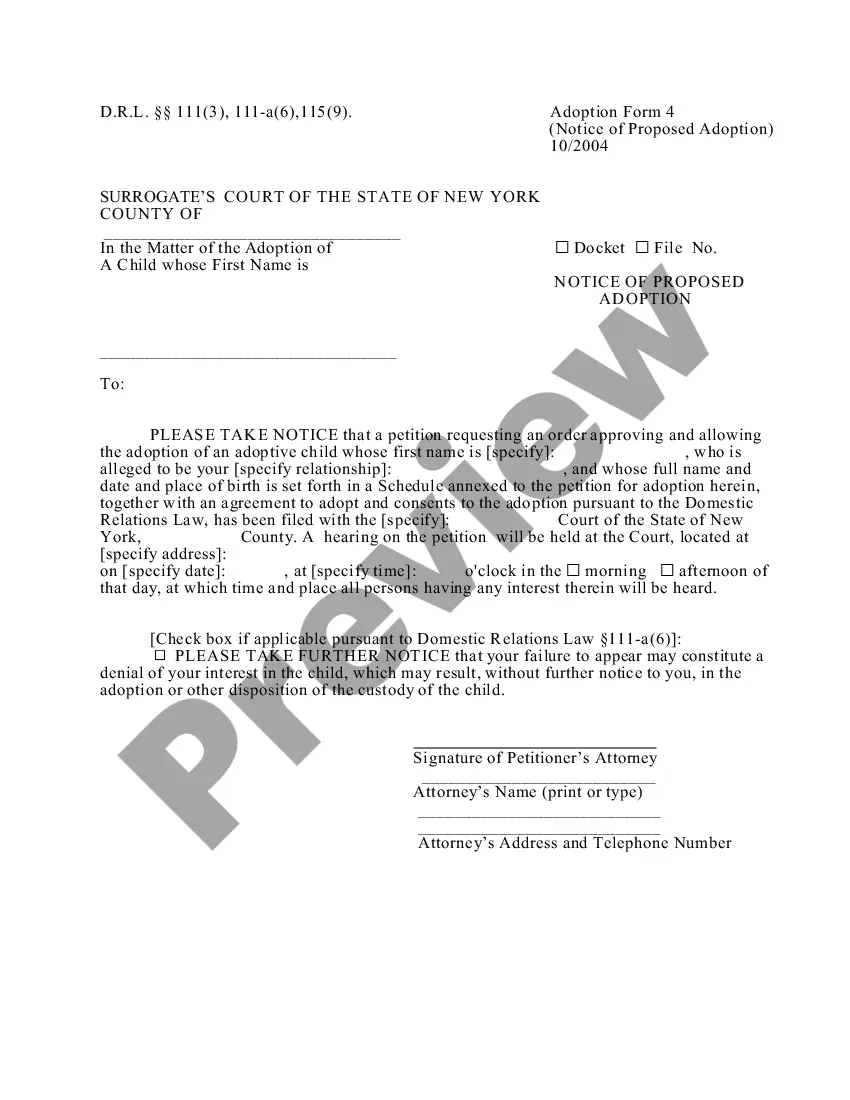
New York Notice of Proposed Adoption
What is this form?
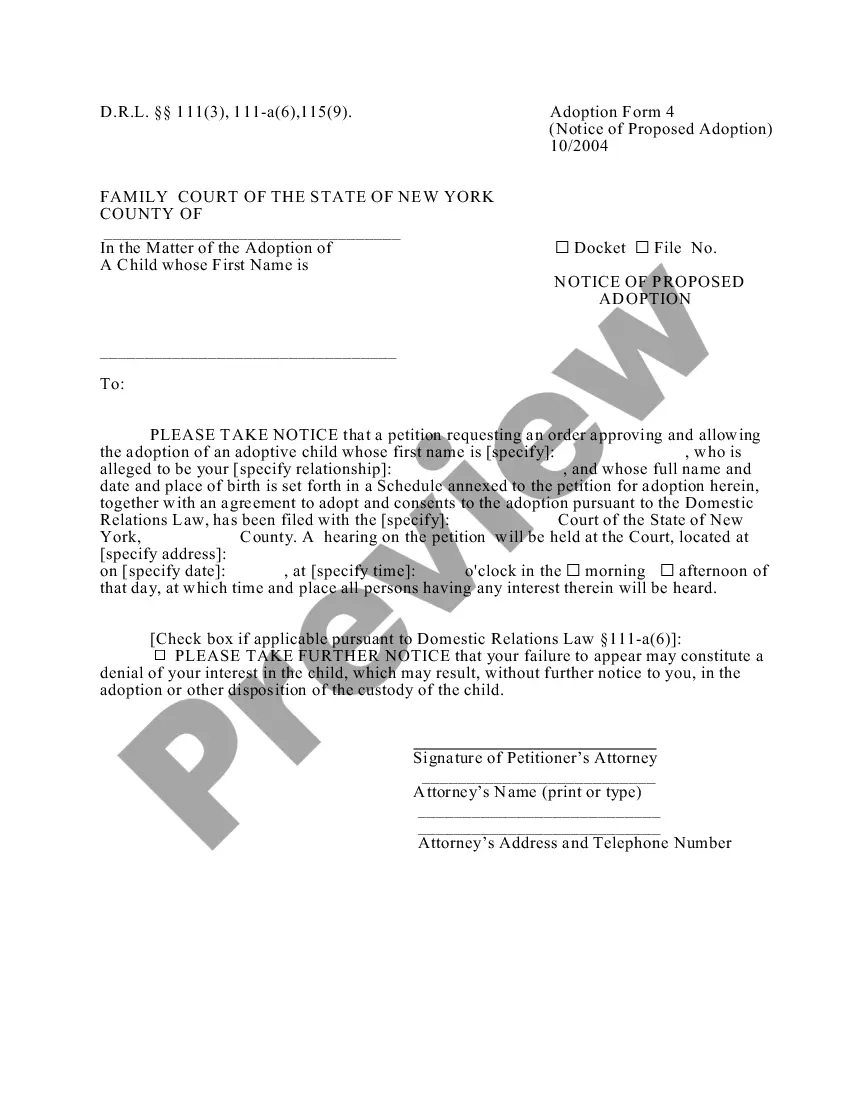
The Notice of Proposed Adoption is an official form used in New York State that notifies relevant parties about a petition for the adoption of a child. This form is crucial for ensuring that everyone with a legal interest in the child's welfare is aware of the proceedings and has the opportunity to respond. Unlike other adoption forms, this notice explicitly outlines the hearing details and the consequences of not appearing.
Form components explained
- Case identifier: Docket and file number related to the adoption.
- Petitioner's details: Name and contact information of the petitioner and their attorney.
- Childâs information: Full name, date of birth, and the relationship of the notified party to the child.
- Hearing details: Date, time, and location for the adoption hearing.
- Consequences notification: Information on what failing to appear may mean for interested parties.
When this form is needed
This form should be used when a petition for adoption has been filed in New York. It serves to inform all parties with a potential interest in the child's adoption about the hearing scheduled to discuss the petition. It is crucial for ensuring that all relevant parties are present to voice any concerns or objections.
Who should use this form
This form is intended for:
- Petitioners seeking to adopt a child in New York State.
- Attorneys representing parties in adoption proceedings.
- Biological parents or legal guardians of a child being adopted, who need to be notified about the proceedings.
Steps to complete this form
- Identify the child: Clearly specify the childâs first name and relationship to the notifying party.
- Fill in the court details: Enter the name of the court handling the adoption and the county it is located in.
- Specify hearing information: Provide the date, time, and location of the scheduled hearing.
- Include petitionerâs attorney details: Write the attorneyâs name, address, and contact number.
- Check applicable notifications: Indicate if there are any special notices based on the Domestic Relations Law.
Does this form need to be notarized?
This form does not typically require notarization unless specified by local law. It is essential to verify any local regulations that may impose additional requirements.
Get your form ready online
Our built-in tools help you complete, sign, share, and store your documents in one place.
Make edits, fill in missing information, and update formatting in US Legal Forms—just like you would in MS Word.
Download a copy, print it, send it by email, or mail it via USPS—whatever works best for your next step.
Sign and collect signatures with our SignNow integration. Send to multiple recipients, set reminders, and more. Go Premium to unlock E-Sign.
If this form requires notarization, complete it online through a secure video call—no need to meet a notary in person or wait for an appointment.
We protect your documents and personal data by following strict security and privacy standards.

Make edits, fill in missing information, and update formatting in US Legal Forms—just like you would in MS Word.

Download a copy, print it, send it by email, or mail it via USPS—whatever works best for your next step.

Sign and collect signatures with our SignNow integration. Send to multiple recipients, set reminders, and more. Go Premium to unlock E-Sign.

If this form requires notarization, complete it online through a secure video call—no need to meet a notary in person or wait for an appointment.

We protect your documents and personal data by following strict security and privacy standards.
Typical mistakes to avoid
- Failing to provide complete information in the childâs section.
- Not including the correct date, time, and location of the hearing.
- Omitting key details about the petitionerâs attorney.
- Not checking the box for applicable legal notifications when required.
- Submitting the form without ensuring all parties are properly notified.
Why use this form online
- Convenience: Download and complete the form at your own pace from anywhere.
- Editability: Customize the form directly to fit your specific details without the risk of formatting issues.
- Reliability: Obtain a legally sound, attorney-drafted document that complies with New York laws.
Looking for another form?

Form popularity
FAQ
Under California law, a noncustodial parent's consent isn't necessary for adoption if the parent willfully fails to communicate with and to pay for the care, support, and education of the child (when they were able to do so) for a period of at least one year.
The most common form of adoption, stepchild adoption is the process where someone assumes financial and legal responsibility for the child of their spouse. The stepparent must file for a petition to claim the child ("Stepchild Adoption").
Adopting Through an Agency. Adopting Independently. Adopting Through Identification. Adopting Internationally. Adopt as Stepparents. Adopting as a Same-Sex Couple. Relative Adoptions. Adult Adoptions.
An independent adoption can cost $15,000 to $40,000, according to the Child Welfare Information Gateway, a federal service. These fees typically cover a birth mother's medical expenses, legal representation for adoptive and birth parents, court fees, social workers and more.
Attend an orientation session and choose an adoption agency. Submit an application and medical history information, complete a national and state criminal background check, and complete a check by the New York Statewide Central Register of Child Abuse and Maltreatment. Complete the home study process.
It may take six months or more from the time you apply before a child is placed in your home; it will take at least three to twelve months after that before the adoption may be finalized in court. The basic tasks in the adoption process in New York State are: Choosing an adoption agency.
There are three types of adoptions that may be chosen: "closed," "semi-open" and "open." These terms describe the approximate level of contact and interaction that the birth mother can expect to have with the adoptive parents both during the adoption process and afterwards.
There are many ways a family can grow through adoption, the three most common being domestic infant adoption, foster care adoption, and international adoption. Each of these types has its own set of advantages, disadvantages, and necessary steps to complete the process.
The short answer is sometimes. Legally the father has the same rights to a child as the mother.It is possible to put a child up for adoption without the father's consent. In the future, however, if the father decides that he wants his child, then this may place an already established adoption in jeopardy.