New York Order to Show Cause
Overview of this form
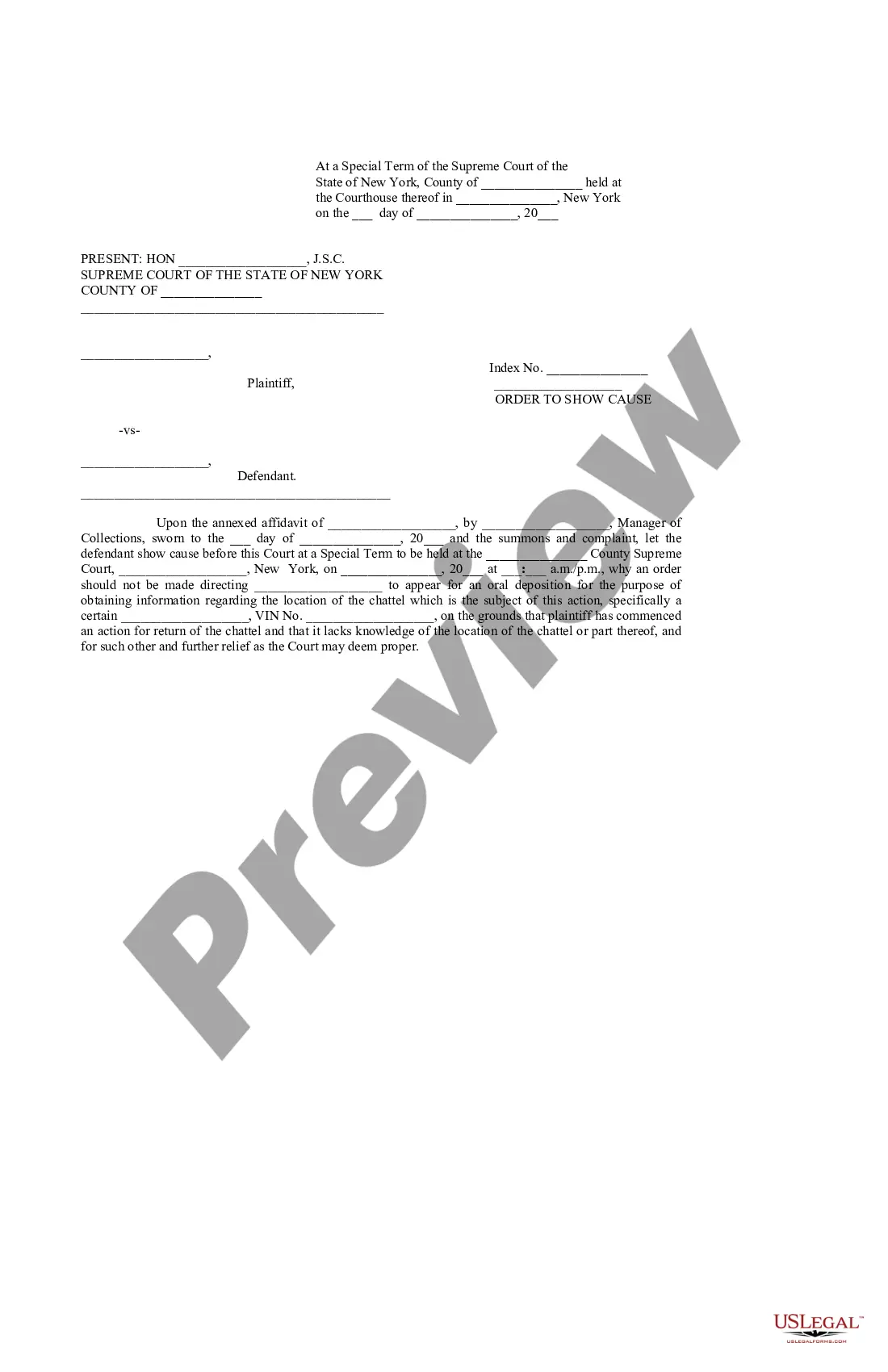
The Order to Show Cause is a legal document that requests a court hearing to require the owner of chattelâsuch as a vehicleâto explain its location. This form is essential in situations where a plaintiff seeks to retrieve property that has been wrongfully taken or is otherwise unaccounted for. Unlike other legal forms, this specific order initiates proceedings to gather necessary information from the defendant regarding the chattelâs whereabouts.
Key parts of this document
- The heading, indicating the court and county where the case is filed.
- The names of the plaintiff and defendant involved in the action.
- The index number assigned to the case for tracking purposes.
- The specific request for the defendant to provide information in a deposition.
- The date and time for the scheduled hearing.
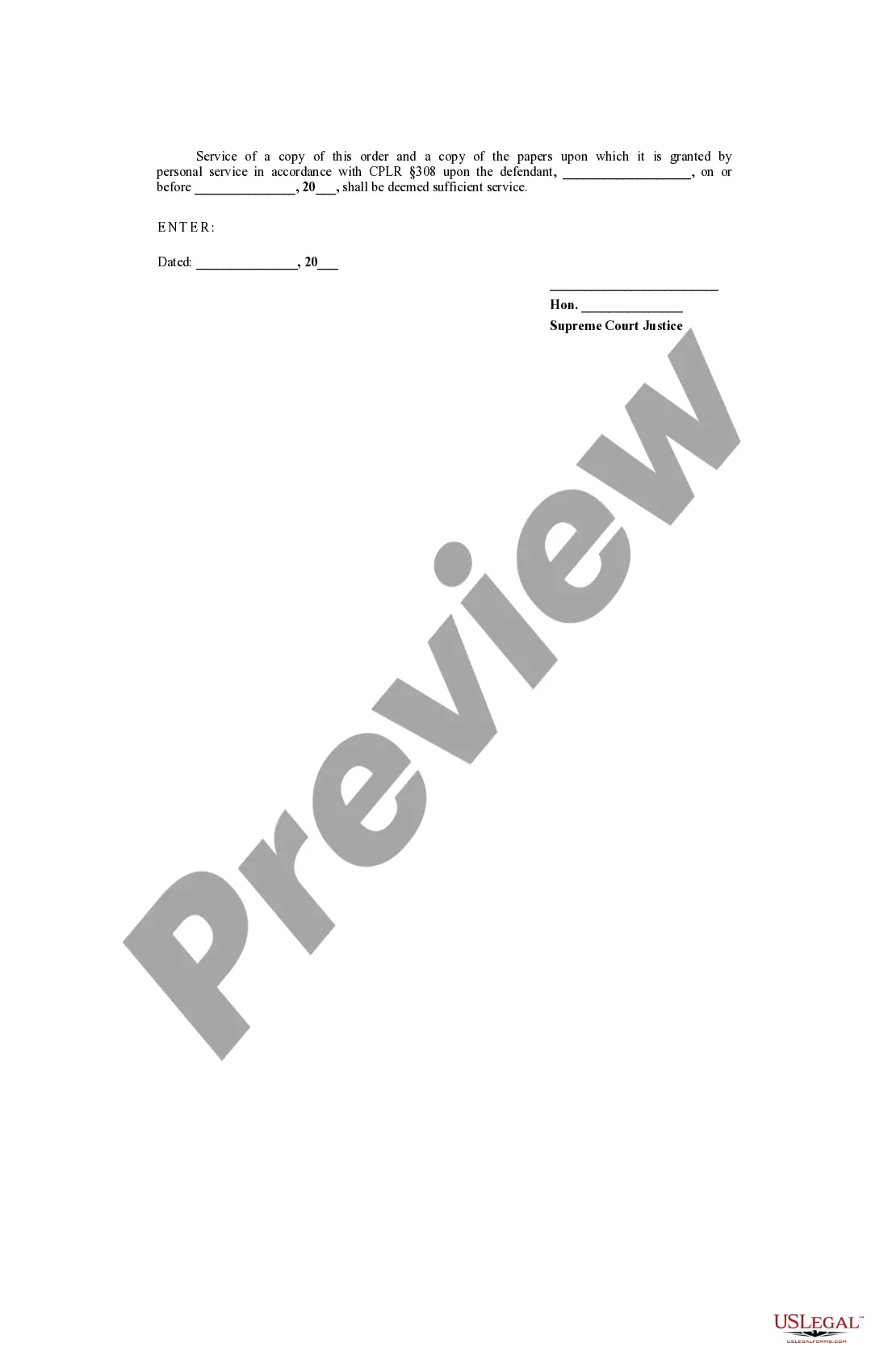
- Details regarding service of the order to the defendant.
Situations where this form applies
This form is typically used in cases where a party seeks to recover personal property, and there is uncertainty regarding its location. It is crucial when the plaintiff does not have direct access to the chattel and needs the court's assistance to obtain information from the defendant. Examples include cases involving repossessed vehicles or other valuable items that have not been returned following a dispute.
Intended users of this form
- Individuals or businesses looking to recover chattel that has been taken or is missing.
- Plaintiffs involved in lawsuits where property retrieval is an issue.
- Legal representatives acting on behalf of clients in chattel recovery cases.
How to complete this form
- Identify the parties involved by filling in the plaintiff and defendant's names.
- Fill in the index number which corresponds to your case.
- Specify the date and time for the hearing.
- Include detailed information about the chattel, including description and VIN if applicable.
- Sign and date the document, following instructions for proper service to the defendant.
Does this document require notarization?
This form does not typically require notarization unless specified by local law. Ensure to check any additional requirements based on your jurisdiction before submission.
Get your form ready online
Our built-in tools help you complete, sign, share, and store your documents in one place.
Make edits, fill in missing information, and update formatting in US Legal Forms—just like you would in MS Word.
Download a copy, print it, send it by email, or mail it via USPS—whatever works best for your next step.
Sign and collect signatures with our SignNow integration. Send to multiple recipients, set reminders, and more. Go Premium to unlock E-Sign.
If this form requires notarization, complete it online through a secure video call—no need to meet a notary in person or wait for an appointment.
We protect your documents and personal data by following strict security and privacy standards.

Make edits, fill in missing information, and update formatting in US Legal Forms—just like you would in MS Word.

Download a copy, print it, send it by email, or mail it via USPS—whatever works best for your next step.

Sign and collect signatures with our SignNow integration. Send to multiple recipients, set reminders, and more. Go Premium to unlock E-Sign.

If this form requires notarization, complete it online through a secure video call—no need to meet a notary in person or wait for an appointment.

We protect your documents and personal data by following strict security and privacy standards.
Common mistakes to avoid
- Failing to specify all necessary details regarding the chattel.
- Omitting important dates, such as the hearing date.
- Neglecting to properly serve the order to the defendant.
- Leaving sections blank or improperly completed, which could lead to delays or dismissals.
Benefits of completing this form online
- Easy access to professionally drafted legal documents tailored to your needs.
- Option to edit and customize the form to fit your specific case.
- Convenience of downloading and printing from home or office, saving time and effort.
- Reliability assured through legal language vetted by licensed attorneys.
Looking for another form?

Form popularity
FAQ
It's basically an order directing a party to appear in court and explain why that party took (or failed to take) some action, or why the court should or should not grant the requested relief.The main objective of the show cause hearing is to get the party who is not following the court's order to do so.
The judge will determine what the facts are. The main objective of the show cause hearing is to get the party who is not following the court's order to do so. The court can also order the relief requested by the moving party (for example, change visitation or transfer custody).
The party (plaintiff or defendant) presenting the Proposed Order to Show Cause is known as the movant. - There is a $45 fee to file a Proposed OSC with the court. Pay by cash, Visa/MasterCard/American Express, or postal money order made out to New York County Clerk.
It's basically an order directing a party to appear in court and explain why that party took (or failed to take) some action, or why the court should or should not grant the requested relief.The main objective of the show cause hearing is to get the party who is not following the court's order to do so.
A motion is the standard way to seek certain forms of relief from a court. An Order to Show Cause is often a quicker way to seek the same relief. It usually has some provision which directs you to do something or to refrain from doing something...
A response to an order to show cause typically requires you to show up in-person to the hearing. You can provide an answer to the order and state why you object to the order being issued.
An order to show cause is a type of court order that requires one or more of the parties to a case to justify, explain, or prove something to the court. Courts commonly use orders to show cause when the judge needs more information before deciding whether or not to issue an order requested by one of the parties.
When the opposing party disobeys an order, you ask the court to issue a Rule to Show Cause. In the request, you explain how the opposing party violated the court's order and attach a copy of that order. If the court agrees that its order was violated, it can find the violating party in contempt of court.