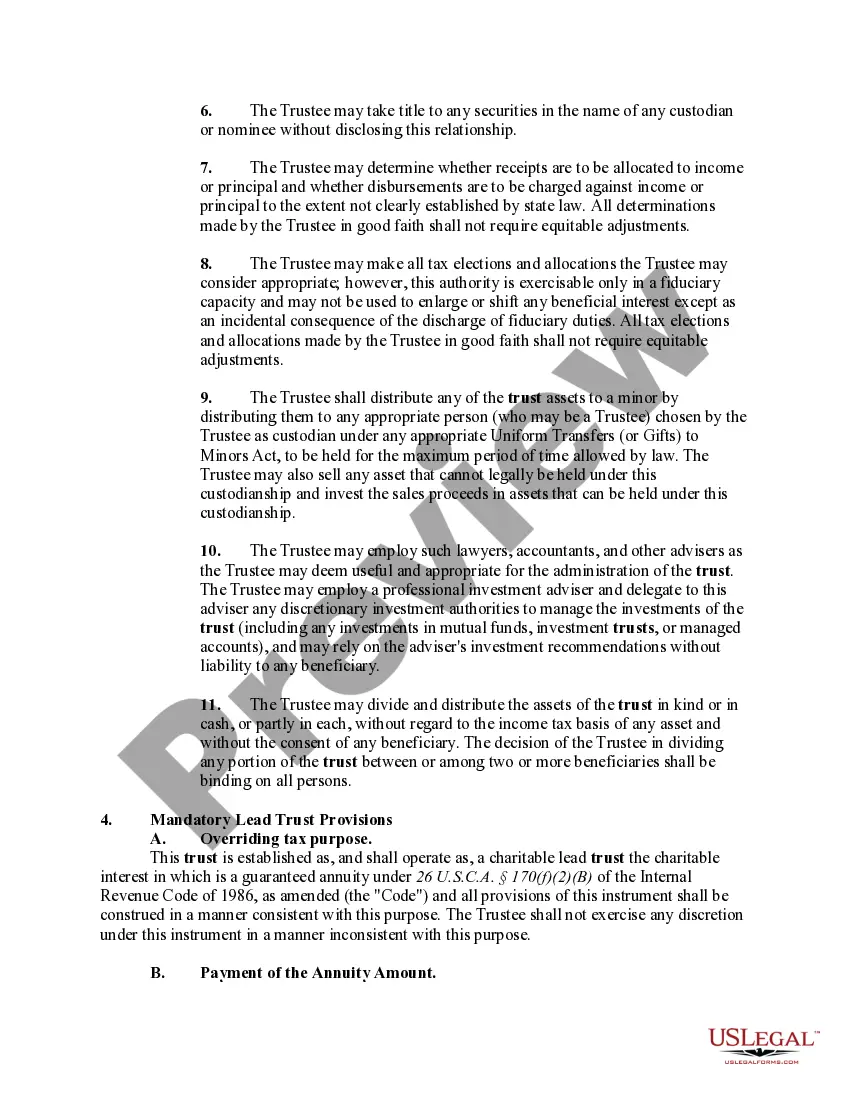
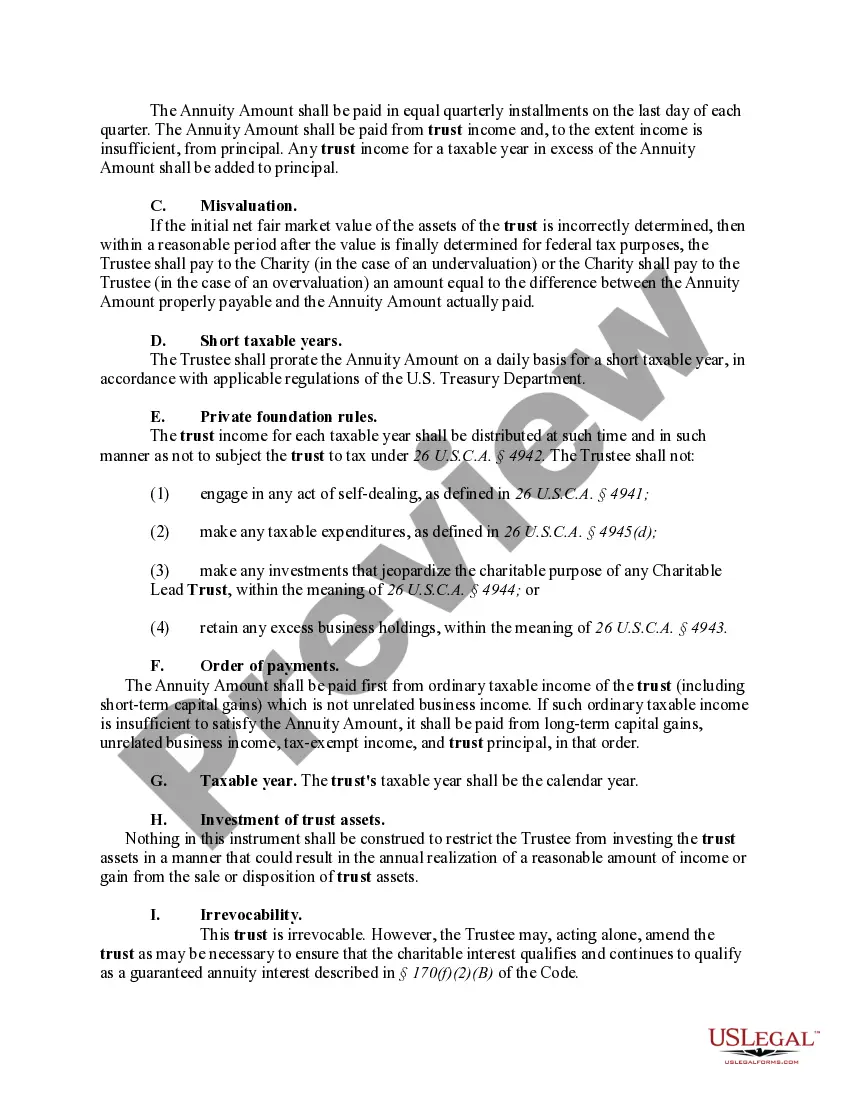
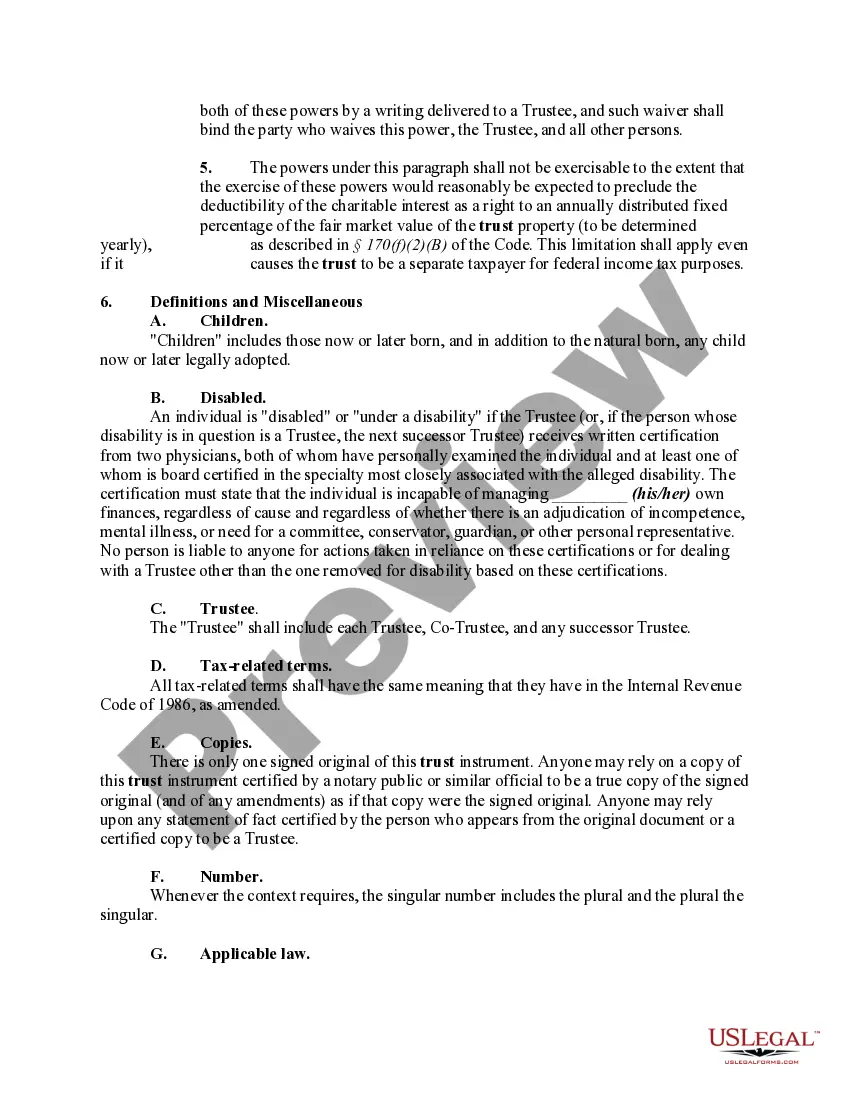
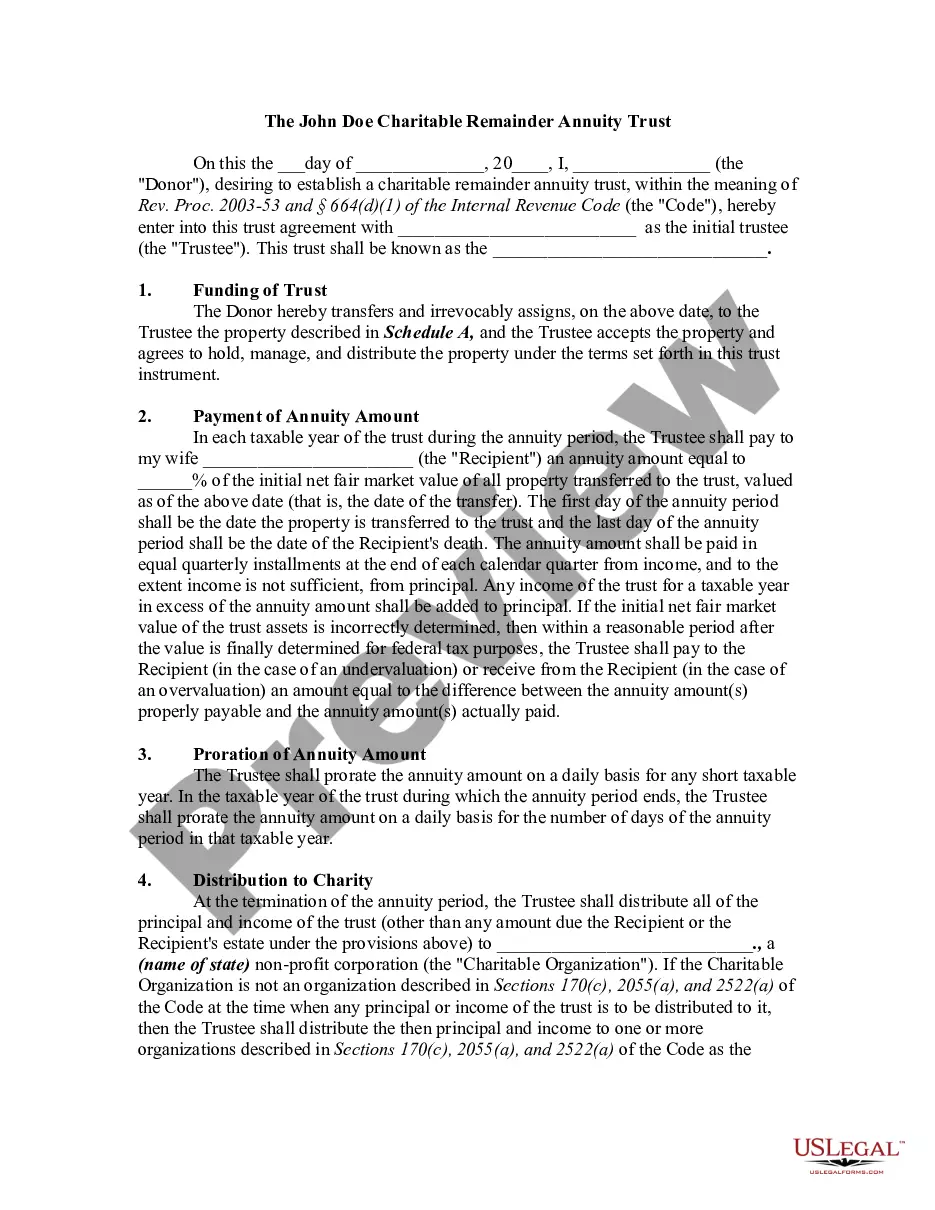
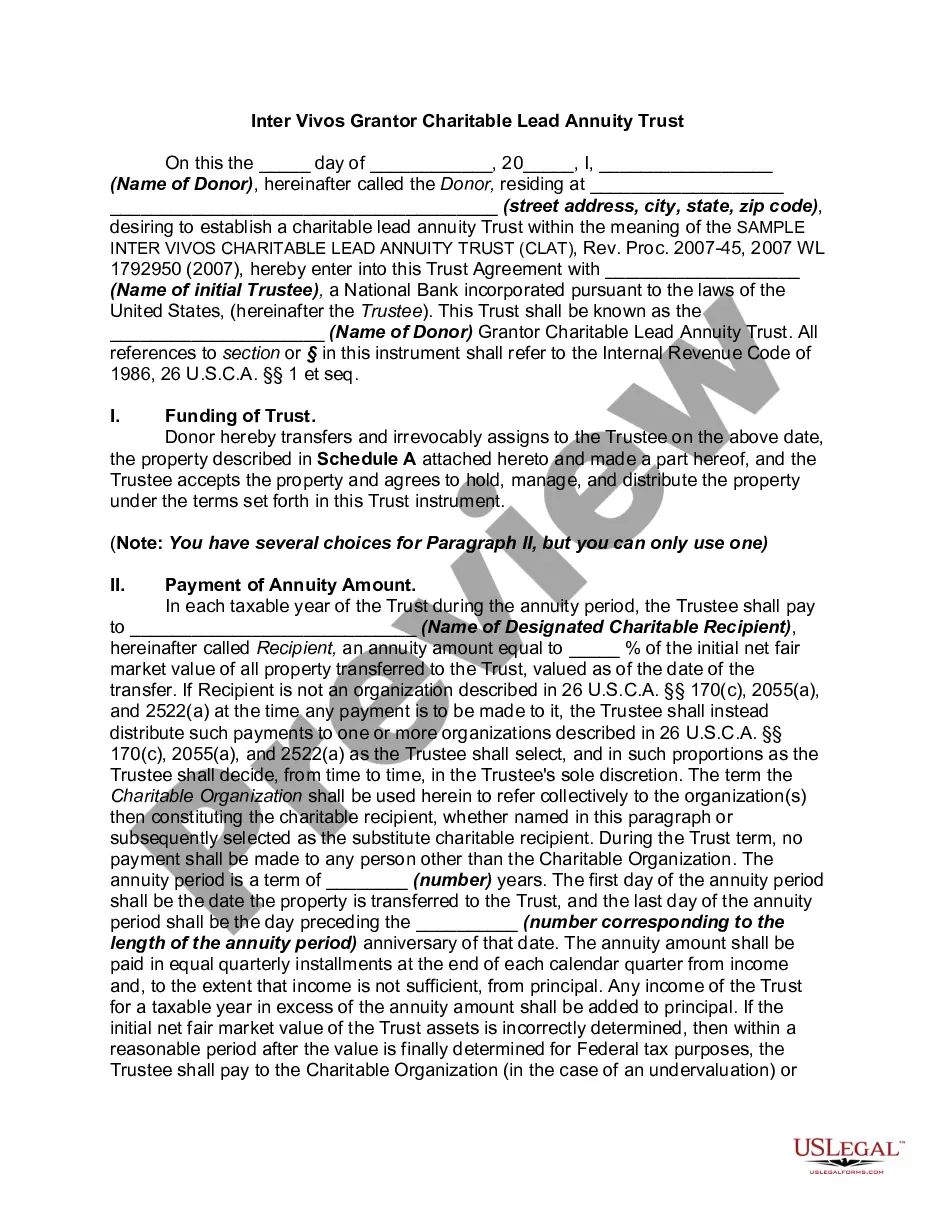
In a charitable lead trust, the lifetime payments go to the charity and the remainder returns to the donor or to the donor's estate or other beneficiaries. A donor transfers property to the lead trust, which pays a percentage of the value of the trust assets, usually for a term of years, to the charity. Unlike a charitable remainder trust, a charitable lead annuity trust creates no income tax deduction to the donor, but the income earned in the trust is not attributed to donor. The trust itself is taxed according to trust rates. The trust receives an income tax deduction for the income paid to charity.
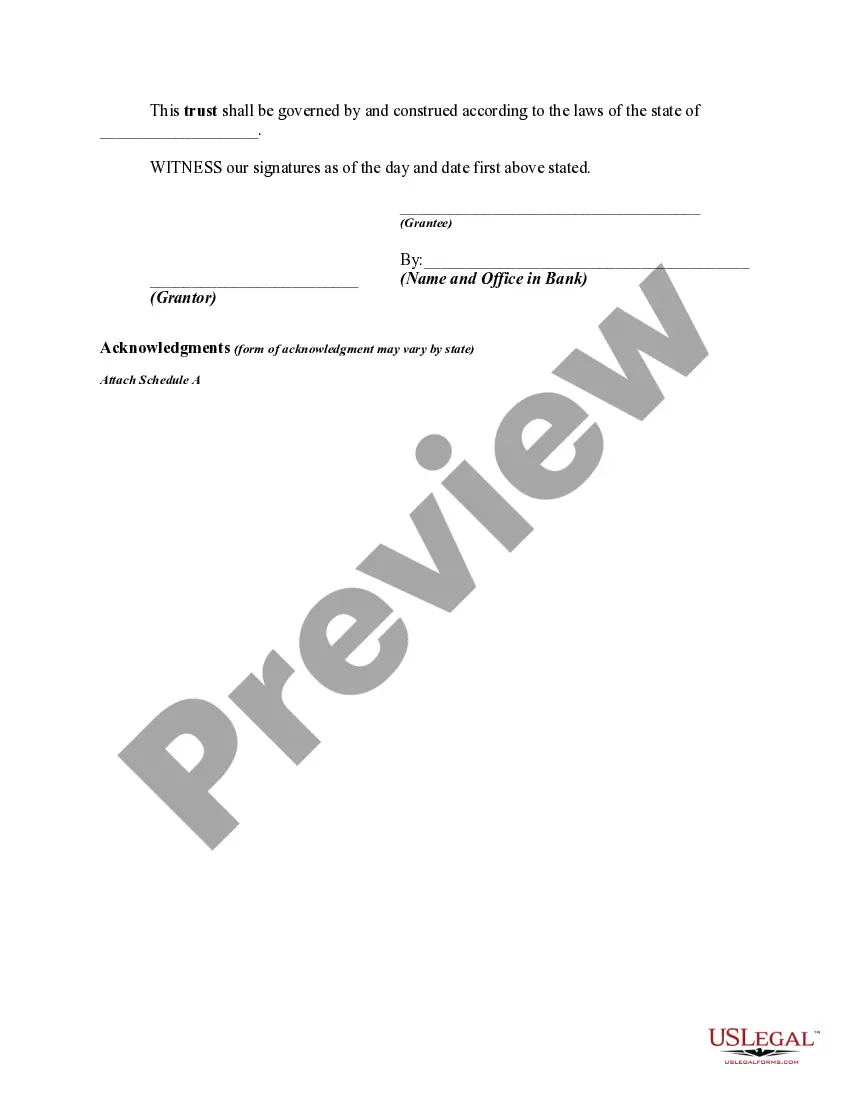
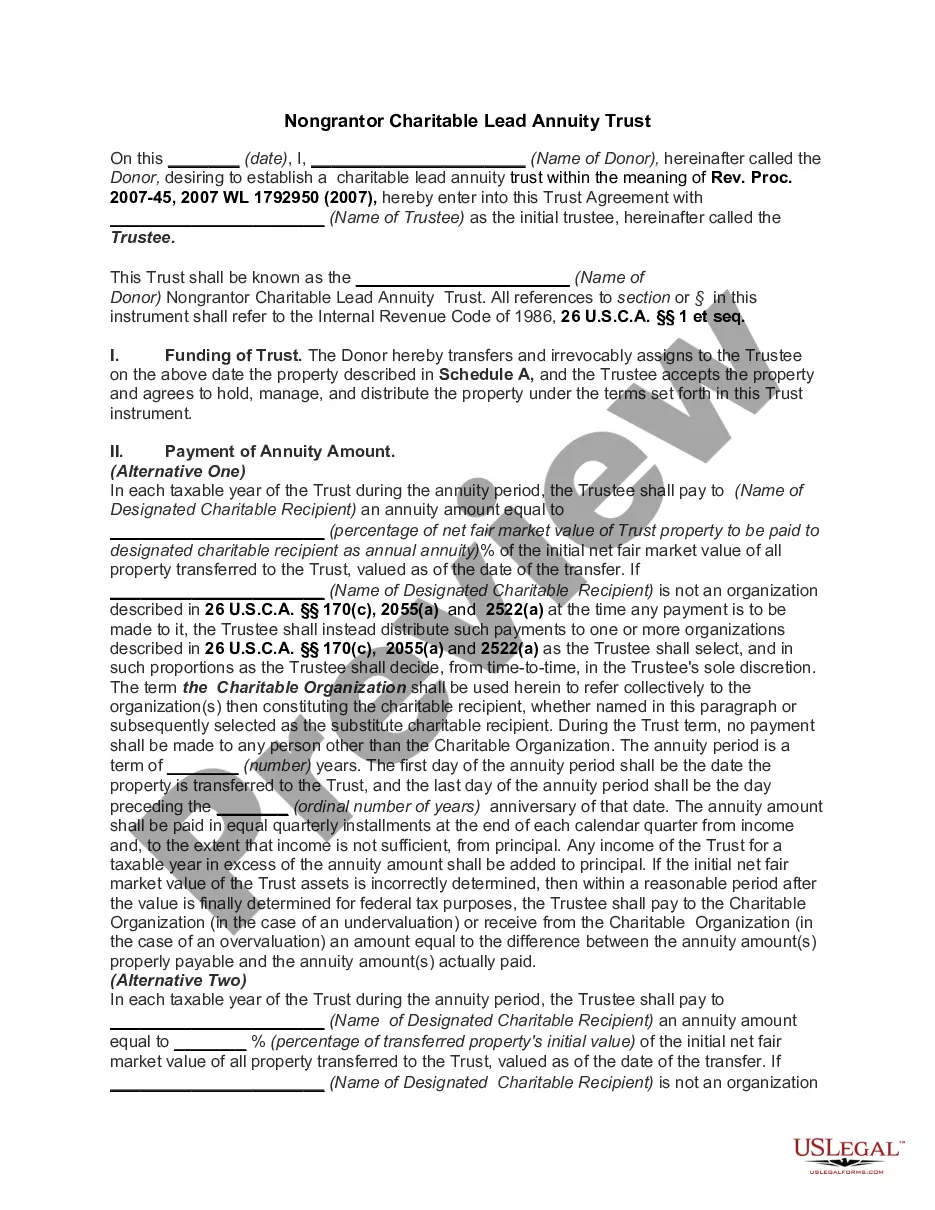
Nevada Charitable Inter Vivos Lead Annuity Trust
Instant download
Description
Free preview





Get your form ready online
Our built-in tools help you complete, sign, share, and store your documents in one place.
Built-in online Word editor
Make edits, fill in missing information, and update formatting in US Legal Forms—just like you would in MS Word.
Export easily
Download a copy, print it, send it by email, or mail it via USPS—whatever works best for your next step.
E-sign your document
Sign and collect signatures with our SignNow integration. Send to multiple recipients, set reminders, and more. Go Premium to unlock E-Sign.
Notarize online 24/7
If this form requires notarization, complete it online through a secure video call—no need to meet a notary in person or wait for an appointment.
Store your document securely
We protect your documents and personal data by following strict security and privacy standards.

Make edits, fill in missing information, and update formatting in US Legal Forms—just like you would in MS Word.

Download a copy, print it, send it by email, or mail it via USPS—whatever works best for your next step.

Sign and collect signatures with our SignNow integration. Send to multiple recipients, set reminders, and more. Go Premium to unlock E-Sign.

If this form requires notarization, complete it online through a secure video call—no need to meet a notary in person or wait for an appointment.

We protect your documents and personal data by following strict security and privacy standards.
Looking for another form?








How to fill out Charitable Inter Vivos Lead Annuity Trust?
Are you presently in a position where you require documents for potential organizational or individual use almost daily.
There is an array of legal document models available online, but finding forms you can trust is challenging.
US Legal Forms provides thousands of document models, such as the Nevada Charitable Inter Vivos Lead Annuity Trust, which can be tailored to meet federal and state requirements.
When you find the correct form, click on Buy now.
Select the payment plan you desire, complete the required details to create your account, and pay for the order using your PayPal or credit card.
- If you are already familiar with the US Legal Forms website and possess an account, simply Log In.
- After that, you can download the Nevada Charitable Inter Vivos Lead Annuity Trust template.
- If you do not have an account and wish to utilize US Legal Forms, follow these instructions.
- Locate the form you need and ensure it is for the correct city/state.
- Use the Preview button to examine the form.
- Read the description to confirm you have selected the appropriate form.
- If the form is not what you are looking for, utilize the Search box to find the form that meets your needs.
Form popularity
FAQ
A CLAT, or Charitable Lead Annuity Trust, operates similarly to a Nevada Charitable Inter Vivos Lead Annuity Trust. In this arrangement, you gift assets to the trust, which then distributes a fixed annual payment to a charity for a designated period. After the term ends, the remaining assets pass to your heirs. This structure helps to provide support for charities while allowing for potential tax advantages.
While a Nevada Charitable Inter Vivos Lead Annuity Trust offers many benefits, there are some disadvantages to consider. One downside is that you relinquish control over the assets placed in the trust. Additionally, the income generated during the trust's term may not be sufficient for all financial needs. It's essential to weigh these factors to ensure this decision aligns with your financial goals.
A Nevada Charitable Inter Vivos Lead Annuity Trust allows you to donate to a charity while receiving income during your lifetime. The trust pays a fixed amount annually to the charity for a specified term. After this term, the remaining assets go to your beneficiaries. This setup not only benefits the charity, but it also provides a potential tax deduction for you.
An inter vivos trust, created during your lifetime, allows you to manage and distribute your assets while you are still alive. This type of trust can help avoid probate, maintain privacy, and manage tax implications. It can also provide instructions for how your assets should be handled after your passing. By including a Nevada Charitable Inter Vivos Lead Annuity Trust, you can achieve your charitable goals while retaining control over your wealth during your lifetime.
A charitable remainder trust distributes income to you or your beneficiaries for a set period, after which the remaining assets go to a designated charity. In contrast, a charitable lead trust provides income to a charity first, with the remaining assets returning to you or your heirs after a specified time. Both options have unique tax advantages and estate planning benefits. When considering a Nevada Charitable Inter Vivos Lead Annuity Trust, understanding these distinctions can guide your decision.
A Nevada asset protection trust may be structured as a grantor trust, allowing you to retain certain rights and benefits. With this setup, you can manage your assets while enjoying tax benefits during your lifetime. However, the specifics depend on how the trust is drafted. Consulting with a legal expert can help clarify if your structure aligns with your goals for a Nevada Charitable Inter Vivos Lead Annuity Trust.
The purpose of a charitable trust is to hold and distribute assets for charitable purposes while also providing potential tax benefits to the grantor. This type of trust allows individuals to support causes they care about while efficiently managing their estate. A Nevada Charitable Inter Vivos Lead Annuity Trust specifically enables donors to contribute to charity while receiving income from the trust for a specified period.
A charitable lead annuity trust provides fixed income payments to a charity for a set number of years, after which remaining assets go to non-charitable beneficiaries. This structure allows donors to achieve tax benefits while supporting their favorite causes. Establishing a Nevada Charitable Inter Vivos Lead Annuity Trust can effectively align philanthropic goals with financial planning strategies.
While charitable trusts offer several benefits, they also come with potential drawbacks. One significant disadvantage is the limited flexibility since the terms are often irrevocable. Moreover, maintaining a Nevada Charitable Inter Vivos Lead Annuity Trust requires ongoing administration, which could incur costs that may diminish the overall benefit.
The minimum amount for establishing a charitable trust can vary based on the type of trust and the specific requirements of the administering institution. However, many financial advisors suggest starting with at least $100,000 to make the administrative costs worthwhile. A Nevada Charitable Inter Vivos Lead Annuity Trust might have different thresholds, so consulting with a legal expert can provide clarity.