Nevada Time Share Quitclaim Deed - Individual to Individual
Understanding this form
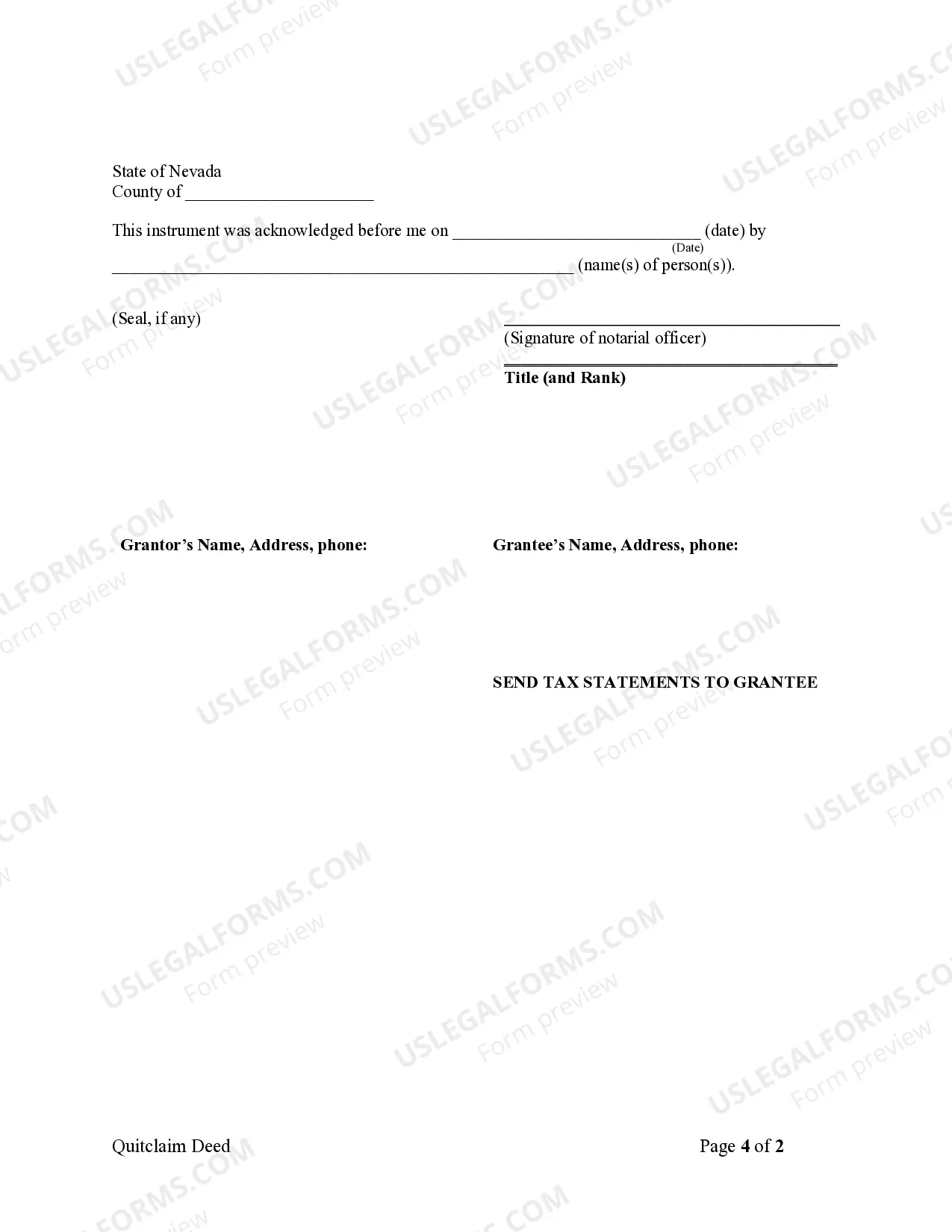
The Time Share Quitclaim Deed is a legal document used in Nevada to transfer ownership of a time share from one individual (the grantor) to another (the grantee). This form conveys the grantor's interest in the time share property without making any warranties about the title. Unlike other types of deeds, a quitclaim deed does not guarantee that the grantor holds clear legal title to the property. This makes it particularly useful for transferring property between family members or friends where the parties know each other well.
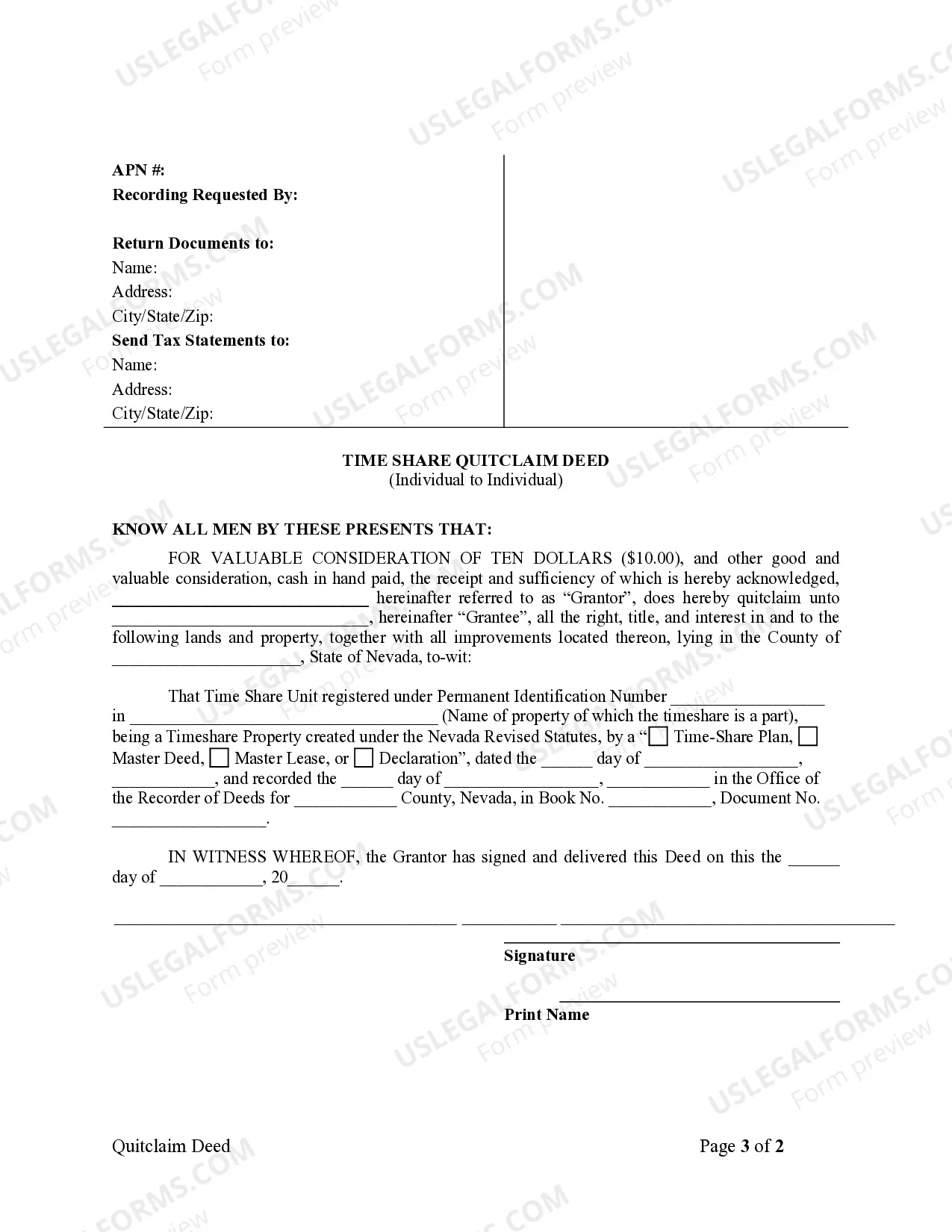
Main sections of this form
Identification of the grantor and grantee
Description of the time share property, including its identification number
Statement of the grantor's intent to convey their interest in the property
Signature lines for the grantor
Date of the transaction



When to use this document
This form is appropriate when an individual wishes to transfer their time share ownership to another individual, such as in cases of gifting or selling between family and friends. It may also be used during divorce proceedings where one party transfers their interest in a time share to the other spouse.
Who this form is for
Individuals looking to transfer their time share ownership to another person.
Family members or friends engaged in a private transfer of time share property.
Parties involved in divorce settlements that include a time share asset.
How to prepare this document
Identify the grantor and grantee, providing their full names and addresses.
Specify the time share property by including its Permanent Identification Number and property name.
Indicate the date when the transfer takes place.
Ensure the grantor signs the form to validate the transfer.
Notarization requirements for this form
To make this form legally binding, it must be notarized. Our online notarization service, powered by Notarize, lets you verify and sign documents remotely through an encrypted video session.
Get your form ready online
Our built-in tools help you complete, sign, share, and store your documents in one place.
Make edits, fill in missing information, and update formatting in US Legal Forms—just like you would in MS Word.
Download a copy, print it, send it by email, or mail it via USPS—whatever works best for your next step.
Sign and collect signatures with our SignNow integration. Send to multiple recipients, set reminders, and more. Go Premium to unlock E-Sign.
If this form requires notarization, complete it online through a secure video call—no need to meet a notary in person or wait for an appointment.
We protect your documents and personal data by following strict security and privacy standards.

Make edits, fill in missing information, and update formatting in US Legal Forms—just like you would in MS Word.

Download a copy, print it, send it by email, or mail it via USPS—whatever works best for your next step.

Sign and collect signatures with our SignNow integration. Send to multiple recipients, set reminders, and more. Go Premium to unlock E-Sign.

If this form requires notarization, complete it online through a secure video call—no need to meet a notary in person or wait for an appointment.

We protect your documents and personal data by following strict security and privacy standards.
Avoid these common issues
Failing to provide complete and accurate information for the grantor and grantee.
Not including the correct Permanent Identification Number for the time share property.
Omitting the signature of the grantor, which is critical for the deed's validity.
Benefits of completing this form online
Convenient access to a legally compliant form that can be downloaded and completed at home.
Easily editable fields allow for straightforward customization to meet individual needs.
Secure storage and retrieval options for important legal documents.
Legal use & context
- Provides a legal record of the transfer of a time share property.
- Applicable under Nevada law for valid property transfers.
- Not a guarantee of title; any existing claims can affect ownership.
Summary of main points
- The Time Share Quitclaim Deed is essential for legally transferring time share ownership.
- Completing the form accurately prevents potential legal complications.
- Review local laws to determine if additional steps like notarization are required.
Looking for another form?
Form popularity
FAQ
Fill out the quit claim deed form, which can be obtained online, or write your own using the form as a guide. The person giving up the interest in the property is the grantor, and the person receiving the interest is the grantee.
The Quit Claim Deed must be signed by the person who is relinquishing interest in the timeshare - the grantor. This individual will describe the timeshare property. In most states the grantee - the person to whom the property is being granted - must also sign the Quit Claim Deed.
Quit claim deeds can be (and often are) used to convey a timeshare ownership, but please clearly understand that there must first be a willing recipient in order for a quit claim deed to be lawful and valid.To record a quitclaim deed in the deed records without the grantee's consent would be a criminal act.
Yes, you can use a Quitclaim Deed to transfer a gift of property to someone. You must still include consideration when filing your Quitclaim Deed with the County Recorder's Office to show that title has been transferred, so you would use $10.00 as the consideration for the property.
Deed Back Documents You must fill out the resort's timeshare transfer form to start the process. To legally transfer ownership, most resorts will accept a quitclaim deed. You'll also need to provide a copy of the original deed when you first purchased the timeshare.
Foreclosure Action Deeded timeshares are a real estate property in which the buyer obtains a deed. Maintenance fees are part of the purchase contract. Failure to pay the maintenance fees results in the resort foreclosing on the property and selling it at auction to recover money owed.
Step 1Be careful. Before you even begin, make sure the other party is legitimate and trustworthy, especially if you're the seller. Step 2Create a buy sell agreement, known as an earnest money contract. Step 3Create a deed. Step 4Record your deed with the county. Step 5Notify the resort.
But you might be wondering if an owner can transfer a deed to another person without a real estate lawyer. The answer is yes. Parties to a transaction are always free to prepare their own deeds.A quitclaim deed, for example, is far simpler than a warranty deed.
Step 1Be careful. Before you even begin, make sure the other party is legitimate and trustworthy, especially if you're the seller. Step 2Create a buy sell agreement, known as an earnest money contract. Step 3Create a deed. Step 4Record your deed with the county. Step 5Notify the resort.