Nevada Motion to Reset Expired Court Date
About this form
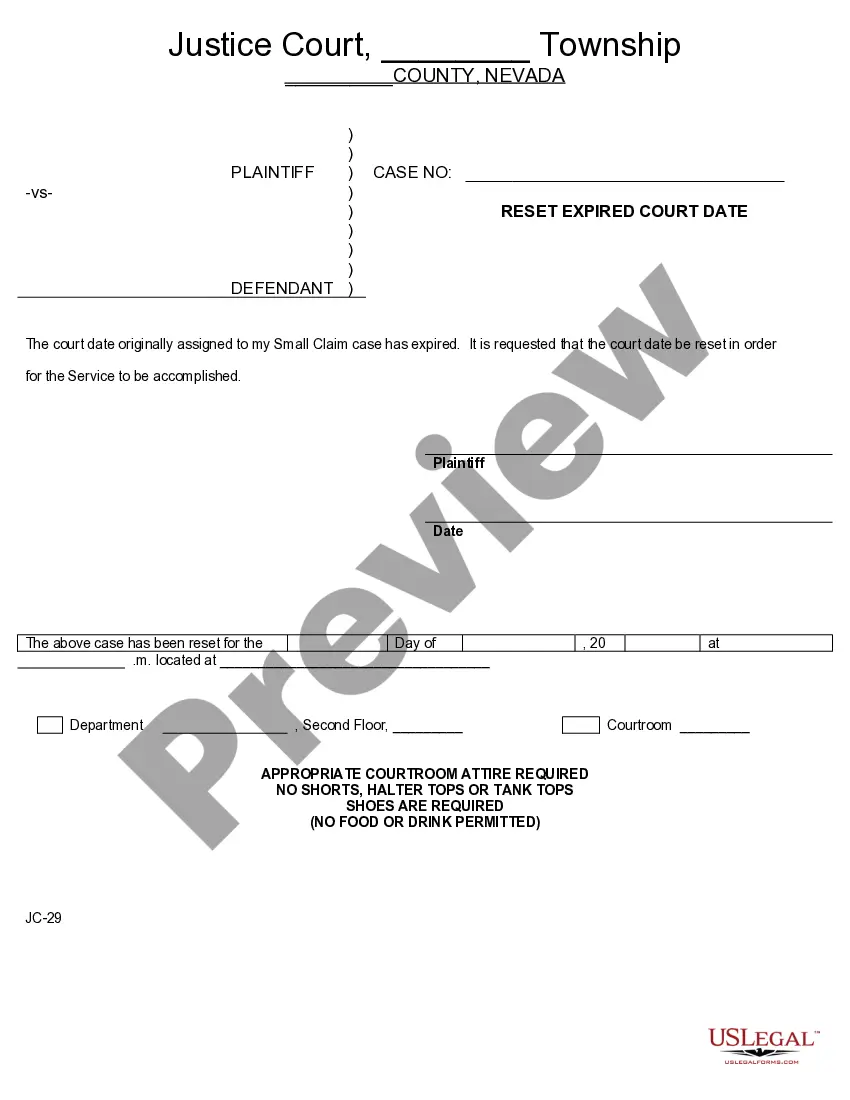
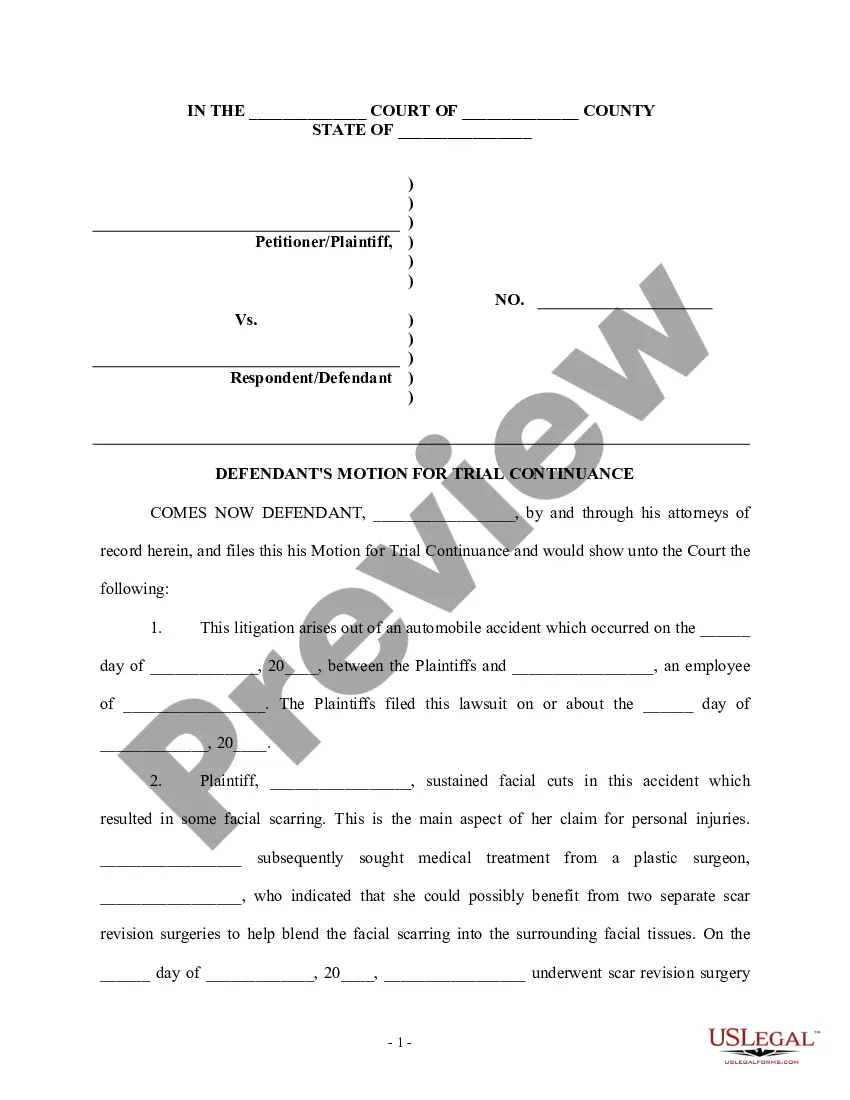
The Motion to Reset Expired Court Date is a legal document used in Nevada small claims court. This form is specifically designed for parties whose original court date has passed without resolution. By filing this motion, you request that the court reschedule your hearing, allowing for proper service and a new opportunity to present your case. It differs from other motions in that it focuses solely on resetting an expired date rather than addressing a specific legal issue or proceeding.
What’s included in this form
- Case caption with plaintiff and defendant details.
- The original court date information.
- A request to reset the court date.
- The new hearing date specified.
- Courtroom location and dress code instructions.

When to use this form
You should use the Motion to Reset Expired Court Date when the scheduled court date for your small claims case has passed without resolution. Common scenarios include situations where you could not attend the hearing due to unexpected circumstances or where you believe the court date was not adequately served to the involved parties. Resetting the court date allows for another chance to address your claims formally.
Who can use this document
- Individuals who have filed a small claims case in Nevada.
- Parties whose court date has expired.
- Those looking to request a new court date for hearing their case.
- Litigants who want to ensure proper service of court papers before proceeding.
Instructions for completing this form
- Identify the parties involved: Fill in the names of the plaintiff and defendant.
- Enter the case number provided by the court.
- Specify the expired court date that needs resetting.
- Propose a new date and time for the hearing.
- Sign and date the form to validate your request.
Notarization requirements for this form
Notarization is not commonly needed for this form. However, certain documents or local rules may make it necessary. Our notarization service, powered by Notarize, allows you to finalize it securely online anytime, day or night.
Get your form ready online
Our built-in tools help you complete, sign, share, and store your documents in one place.
Make edits, fill in missing information, and update formatting in US Legal Forms—just like you would in MS Word.
Download a copy, print it, send it by email, or mail it via USPS—whatever works best for your next step.
Sign and collect signatures with our SignNow integration. Send to multiple recipients, set reminders, and more. Go Premium to unlock E-Sign.
If this form requires notarization, complete it online through a secure video call—no need to meet a notary in person or wait for an appointment.
We protect your documents and personal data by following strict security and privacy standards.

Make edits, fill in missing information, and update formatting in US Legal Forms—just like you would in MS Word.

Download a copy, print it, send it by email, or mail it via USPS—whatever works best for your next step.

Sign and collect signatures with our SignNow integration. Send to multiple recipients, set reminders, and more. Go Premium to unlock E-Sign.

If this form requires notarization, complete it online through a secure video call—no need to meet a notary in person or wait for an appointment.

We protect your documents and personal data by following strict security and privacy standards.
Avoid these common issues
- Forgetting to sign the motion before submitting it.
- Failing to provide the correct case number, leading to processing delays.
- Not proposing an appropriate new court date.
- Omitting necessary details from the court name and location.
Why use this form online
- Convenience of filling out the form from home at any time.
- Easy customization options to fit your specific case details.
- Access to the latest updates in legal requirements and format.
- Peace of mind knowing the form is drafted by licensed attorneys.
Looking for another form?

Form popularity
FAQ
A motion, in its simplest form is a list of requests that you are asking the Court grant on your behalf. You, or your attorney on your behalf, will file a Notice of Motion which includes a list of requests for the court to rule upon.
Hearing on a motion is Motion Hearing. A Motion is a request asking a judge to issue a ruling or order on a legal matter.At a motion hearing, each party can argue its position and the judge can ask specific questions about the fact or law. After hearing the judge decides the motion and this is called an order.
There's no exact time limit on how fast a judge must do his work. In the states and federal courts I am familiar with, the lawyer files a motion and sets it for hearing about six weeks later, more or less, depending on the court's docket.
A "motion" is simply a formal request to a court that it do something or decide an issue in favor of the party that asks for it. "Granted" means the court agreed with the request, and did or decided in favor of the requester.
Each judge has her/his own habits and it's difficult to speak to the speed of a judge outside of my personal experience. But as a general rule, you can expect a decision in this type of matter in anywhere from 2 weeks to 3 months.
A motion is an application to the court made by the prosecutor or defense attorney, requesting that the court make a decision on a certain issue before the trial begins. The motion can affect the trial, courtroom, defendants, evidence, or testimony. Only judges decide the outcome of motions.
After you complete your motion, you must file it with the court.You must then serve (mail) a copy of your filed motion (including all exhibits and the date, time, and place of hearing) to all other parties in the case. If a party is represented by an attorney, mail the motion directly to the attorney's office.
After you complete your motion, you must file it with the court.You must then serve (mail) a copy of your filed motion (including all exhibits and the date, time, and place of hearing) to all other parties in the case. If a party is represented by an attorney, mail the motion directly to the attorney's office.
A motion is a written request made to the court, asking the judge to issue an order.Other parties have the chance to file and serve a written response to the motion. There is a specific deadline for filing and serving a written response, usually fourteen (14) days prior to a hearing.