New Mexico Quitclaim Deed - Individual to a Trust
What this document covers
The Quitclaim Deed - Individual to a Trust is a legal document that allows an individual (the grantor) to transfer ownership of property to a trust (the grantee) without making any warranties regarding the property title. Unlike other deed types, such as warranty deeds, a quitclaim deed offers no guarantees about the ownership status, which makes it a useful tool for transferring property into a trust for estate planning purposes.
Key parts of this document
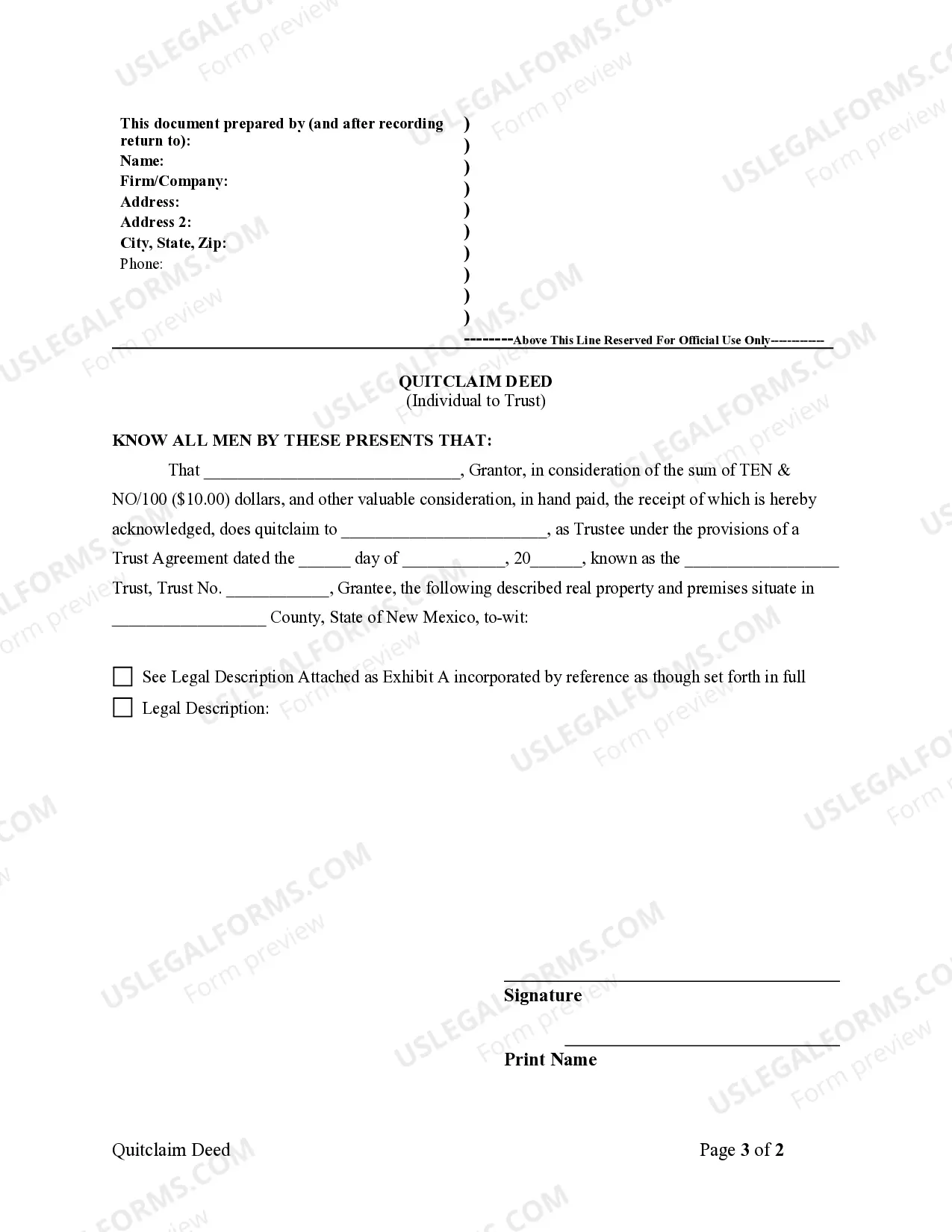
- Grantor's name and signature - identifies the individual transferring the property.
- Grantee's information - details the trust receiving the property.
- Description of the property - a legal description that specifies the property being conveyed.
- Date of execution - the date when the deed is signed.
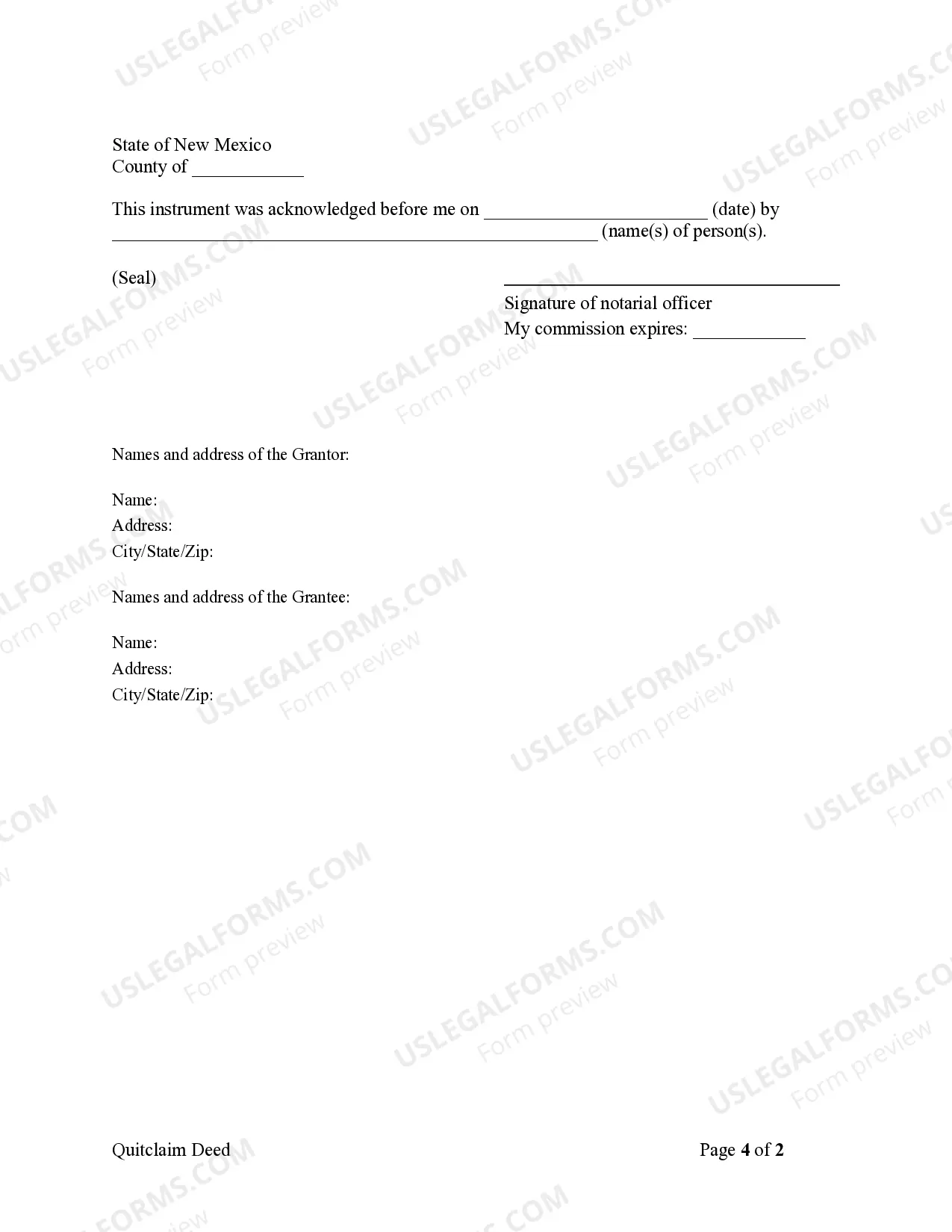
- Notarization - typically required to validate the deed.





When to use this document
This form is commonly used when an individual wants to transfer real estate to a trust. It is particularly useful in estate planning to ensure that assets are managed according to the grantor's wishes after their death. Additionally, it may be used to simplify the transfer of property without the need for a lengthy and costly legal process.
Who this form is for
This form is intended for:
- Individuals who are establishing a trust to hold real estate.
- Grantors seeking to transfer property into an existing trust.
- Anyone involved in estate planning who wants to manage property through a trust structure.
How to prepare this document
- Identify the parties involved - clearly state the names of the grantor and the trust.
- Describe the property - provide a legal description of the property being conveyed.
- Enter the date of execution - write the date on which the deed is signed.
- Sign the deed - the grantor must sign the deed in the appropriate area.
- Have the deed notarized - secure a notary's signature to validate the document.
Notarization requirements for this form
This form needs to be notarized to ensure legal validity. US Legal Forms provides secure online notarization powered by Notarize, allowing you to complete the process through a verified video call, available anytime.
Get your form ready online
Our built-in tools help you complete, sign, share, and store your documents in one place.
Make edits, fill in missing information, and update formatting in US Legal Forms—just like you would in MS Word.
Download a copy, print it, send it by email, or mail it via USPS—whatever works best for your next step.
Sign and collect signatures with our SignNow integration. Send to multiple recipients, set reminders, and more. Go Premium to unlock E-Sign.
If this form requires notarization, complete it online through a secure video call—no need to meet a notary in person or wait for an appointment.
We protect your documents and personal data by following strict security and privacy standards.

Make edits, fill in missing information, and update formatting in US Legal Forms—just like you would in MS Word.

Download a copy, print it, send it by email, or mail it via USPS—whatever works best for your next step.

Sign and collect signatures with our SignNow integration. Send to multiple recipients, set reminders, and more. Go Premium to unlock E-Sign.

If this form requires notarization, complete it online through a secure video call—no need to meet a notary in person or wait for an appointment.

We protect your documents and personal data by following strict security and privacy standards.
Avoid these common issues
- Failing to provide a complete legal description of the property.
- Not signing the deed correctly or at the wrong location.
- Neglecting to have the deed notarized, which could invalidate the transfer.
Advantages of online completion
- Convenience - easily download and complete the form from home at your own pace.
- Editability - fill out the form on your computer, ensuring accuracy in details.
- Time savings - streamline the process without needing to visit a lawyer for standard documentation.
What to keep in mind
- A Quitclaim Deed - Individual to a Trust facilitates the transfer of property ownership without warranties.
- This form is useful for estate planning and transferring property into a trust.
- Always ensure you have the deed notarized for it to be legally effective.
Looking for another form?
Form popularity
FAQ
To transfer ownership of a property a new deed must be filed with the County Clerk's Office before the name and address are changed in the Assessor's records. Once the Assessor's records are updated the Treasurer's Office will get the update in the new billing cycle.
They are commonly used to add/remove someone to/from real estate title or deed (divorce, name changes, family and trust transfers). The quitclaim deed is a legal document (deed) used to transfer interest in real estate from one person or entity (grantor) to another (grantee).
A New Mexico quitclaim deed transfers property without any guarantees, including title guarantees or a guarantee that the seller (grantor) has the right to transfer the property. Because of the risk of a quitclaim deed in New Mexico, it is best done when both parties trust each other. An alternative is a warranty deed.
Notary Public (Section 47-1-44) In New Mexico it must be signed with a Notary Public viewing the Grantor(s) signature(s). Recording A quit claim deed is required to be filed at the County Clerk's Office where the property is located along with the required recording fee(s).
Step 1 Write in the name of the grantor or seller. Step 2 Fill in the name and address of the grantee or buyer. Step 3 Specify the property information including county, lot, block and recording information. Step 4 Sign and date in the presence of a notary public.
If the lender accepts your offer of a Quit Claim, you sign a document called a Transfer of title to your lender. You and the lender both sign the Quit Claim. The Quit Claim states that you agree to transfer the ownership of your property to the lender and the lender agrees to release you from any debt owed.
But you might be wondering if an owner can transfer a deed to another person without a real estate lawyer. The answer is yes. Parties to a transaction are always free to prepare their own deeds.A quitclaim deed, for example, is far simpler than a warranty deed.
To use a Quitclaim Deed to add someone to a property deed or title, you would need to create a Quitclaim Deed and list all of the current owners in the grantor section. In the grantee section, you would list all of the current owners as well as the person you would like to add.