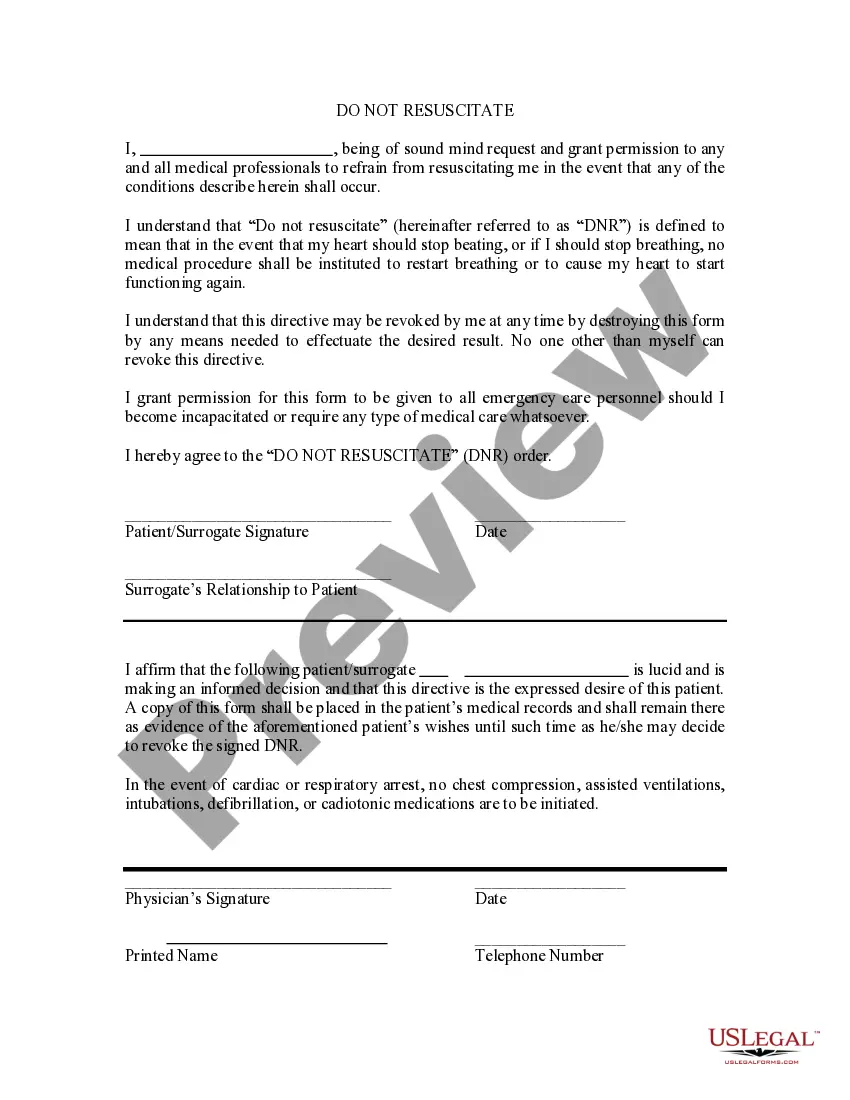
This is a form initiated by a patient requesting that he/she not be resuscitated should he/she stop breathing or should his/her heart stop beating. This form is also to be signed by a physician attesting to patient's wishes and to be placed in the patient's file.
New Hampshire Do Not Resuscitate Request - DNR
State:
Multi-State
Control #:
US-PRM-12
Format:
Word;
Rich Text
506 downloads
Description
Free preview

Get your form ready online
Our built-in tools help you complete, sign, share, and store your documents in one place.
Built-in online Word editor
Make edits, fill in missing information, and update formatting in US Legal Forms—just like you would in MS Word.
Export easily
Download a copy, print it, send it by email, or mail it via USPS—whatever works best for your next step.
E-sign your document
Sign and collect signatures with our SignNow integration. Send to multiple recipients, set reminders, and more. Go Premium to unlock E-Sign.
Notarize online 24/7
If this form requires notarization, complete it online through a secure video call—no need to meet a notary in person or wait for an appointment.
Store your document securely
We protect your documents and personal data by following strict security and privacy standards.

Make edits, fill in missing information, and update formatting in US Legal Forms—just like you would in MS Word.

Download a copy, print it, send it by email, or mail it via USPS—whatever works best for your next step.

Sign and collect signatures with our SignNow integration. Send to multiple recipients, set reminders, and more. Go Premium to unlock E-Sign.

If this form requires notarization, complete it online through a secure video call—no need to meet a notary in person or wait for an appointment.

We protect your documents and personal data by following strict security and privacy standards.
Looking for another form?


How to fill out Do Not Resuscitate Request - DNR?
If you require to complete, acquire, or print authentic document templates, utilize US Legal Forms, the largest collection of legal forms, which are accessible online.
Utilize the website's straightforward and user-friendly search to find the documents you require. Various templates for business and personal purposes are categorized by groups and states, or keywords.
Employ US Legal Forms to locate the New Hampshire Do Not Resuscitate Request - DNR within a few clicks.
Every legal document template you acquire is yours for years. You will have access to every form you downloaded in your account. Click on the My documents section and select a form to print or download again.
Complete, acquire, and print the New Hampshire Do Not Resuscitate Request - DNR with US Legal Forms. There are millions of professional and state-specific forms you can use for your business or personal needs.
- In case you are already a US Legal Forms user, Log In to your account and click on the Download button to obtain the New Hampshire Do Not Resuscitate Request - DNR.
- You can also access forms you previously downloaded in the My documents tab of your account.
- If you are using US Legal Forms for the first time, follow these steps.
- Step 1. Ensure you have selected the form for the correct city/state.
- Step 2. Use the Review option to examine the form's content. Don't forget to read through the description.
- Step 3. If you are dissatisfied with the form, use the Search field at the top of the screen to find other versions of the legal form template.
- Step 4. Once you have found the form you need, click the Purchase now button. Select the pricing plan you prefer and enter your details to register for an account.
- Step 5. Process the payment. You can use your credit card or PayPal account to complete the transaction.
- Step 6. Choose the format of the legal form and download it to your device.
- Step 7. Complete, modify, and print or sign the New Hampshire Do Not Resuscitate Request - DNR.
Form popularity
FAQ
Filling out a New Hampshire Do Not Resuscitate Request - DNR form involves providing your personal information, understanding your healthcare preferences, and signing the document. Make sure to follow the instructions carefully and consider discussing your choices with your doctor. Resources like USLegalForms offer guidance and examples to assist you in completing the form correctly. This ensures your wishes are clearly communicated to healthcare providers.
To obtain a New Hampshire Do Not Resuscitate Request - DNR, you typically need to consult with your healthcare provider. They can guide you through the process and help you understand the requirements. Additionally, you can find templates and forms on platforms such as USLegalForms, making it easy to access the documentation you need. Remember, it’s essential to discuss your wishes with your loved ones and medical team.
Yes, you can print out a New Hampshire Do Not Resuscitate Request - DNR form. Many trusted websites, including USLegalForms, provide downloadable and printable versions of this important document. Once you have the form ready, ensure you fill it out correctly and keep copies for your records. Having a printed DNR form readily available can help communicate your wishes effectively in medical situations.
To set up a New Hampshire Do Not Resuscitate Request - DNR, you first need to consult with your healthcare provider. They can provide you with the necessary forms and explain the implications of having a DNR in place. Once you fill out the form, ensure you sign it and have it witnessed according to state regulations. You may also want to discuss your preferences with family members to ensure everyone understands your wishes.
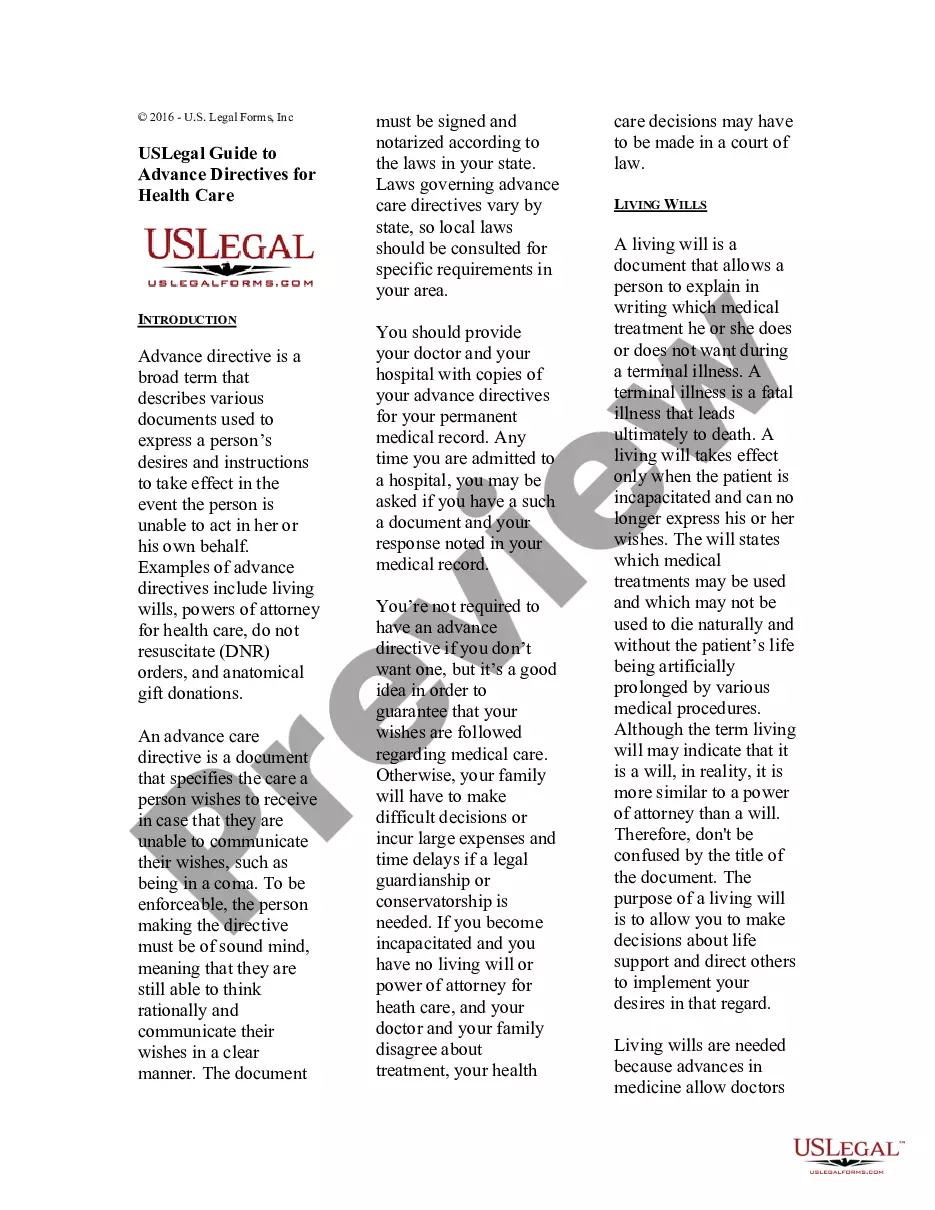
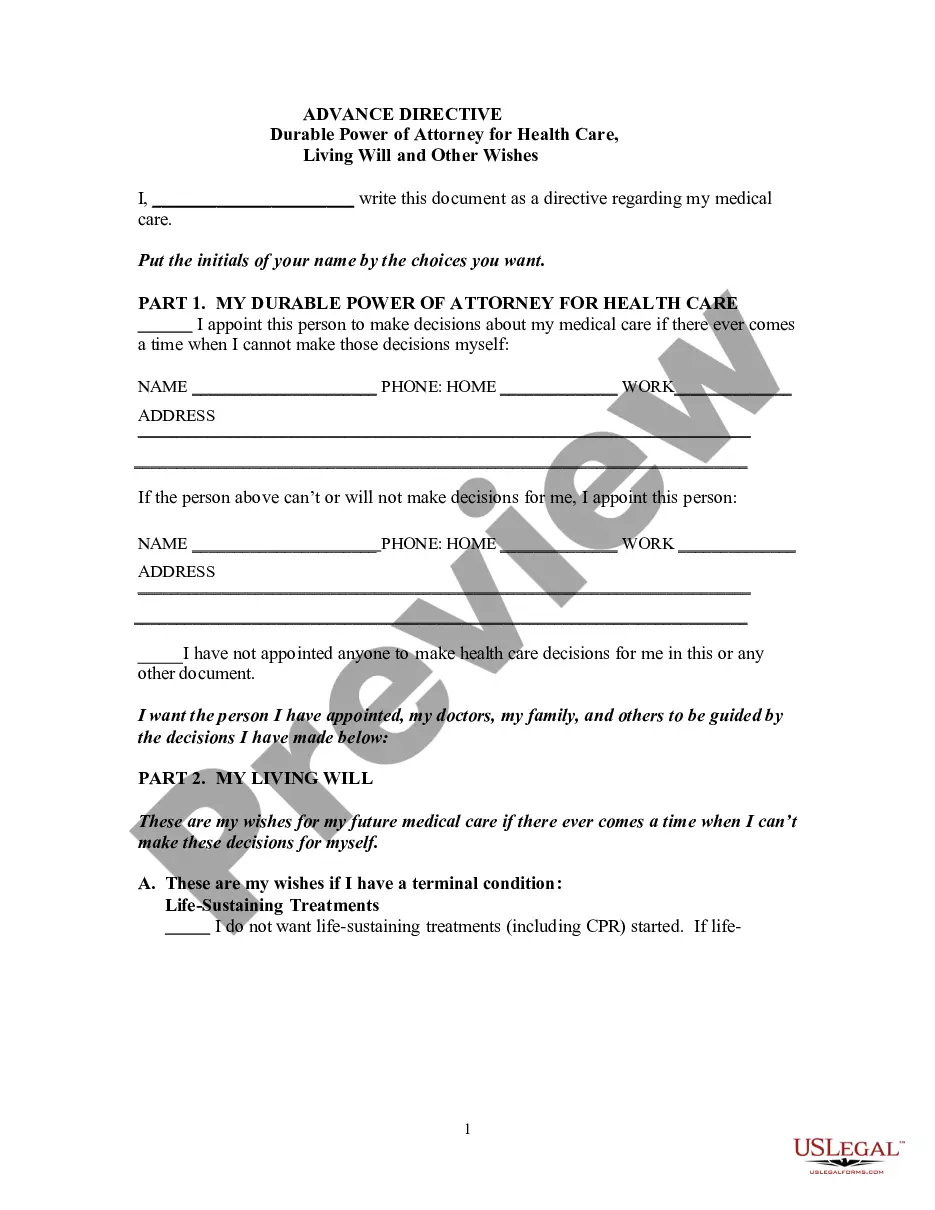
Most hospitals and GPs will be able to provide you with an advance care directive form to fill out, to get you started. Once you have created an advance care directive it is a good idea to give a copy to your doctor, a copy to your family and to keep a copy with you.
Generally, a DNR is executed when an individual has a history of chronic disease or terminal illness, such as chronic lung disease or heart disease, that has in the past or may in the future necessitate cardiopulmonary resuscitation (CPR), and the patient no longer wishes to be revived because of concerns that the use
You can make it clear to your doctor or medical team that you do not want CPR if your heart or breathing stops. Your doctor may complete a DNACPR form to indicate this and put it in your medical records.
Ordering Information: Submit completed order request form (form # 014-0350-93) to OSSDistribution@ontario.ca (preferred option) or fax to 416-679-8192. You must download Adobe Acrobat Reader (version 10.0 or above) to view/print PDF forms.
Do not resuscitate orderA DNR is a request not to have CPR if your heart stops or if you stop breathing. You can use an advance directive form or tell your doctor that you don't want to be resuscitated. Your doctor will put the DNR order in your medical chart. Doctors and hospitals in all states accept DNR orders.
notresuscitate order, or DNR order, is a medical order written by a doctor. It instructs health care providers not to do cardiopulmonary resuscitation (CPR) if a patient's breathing stops or if the patient's heart stops beating.