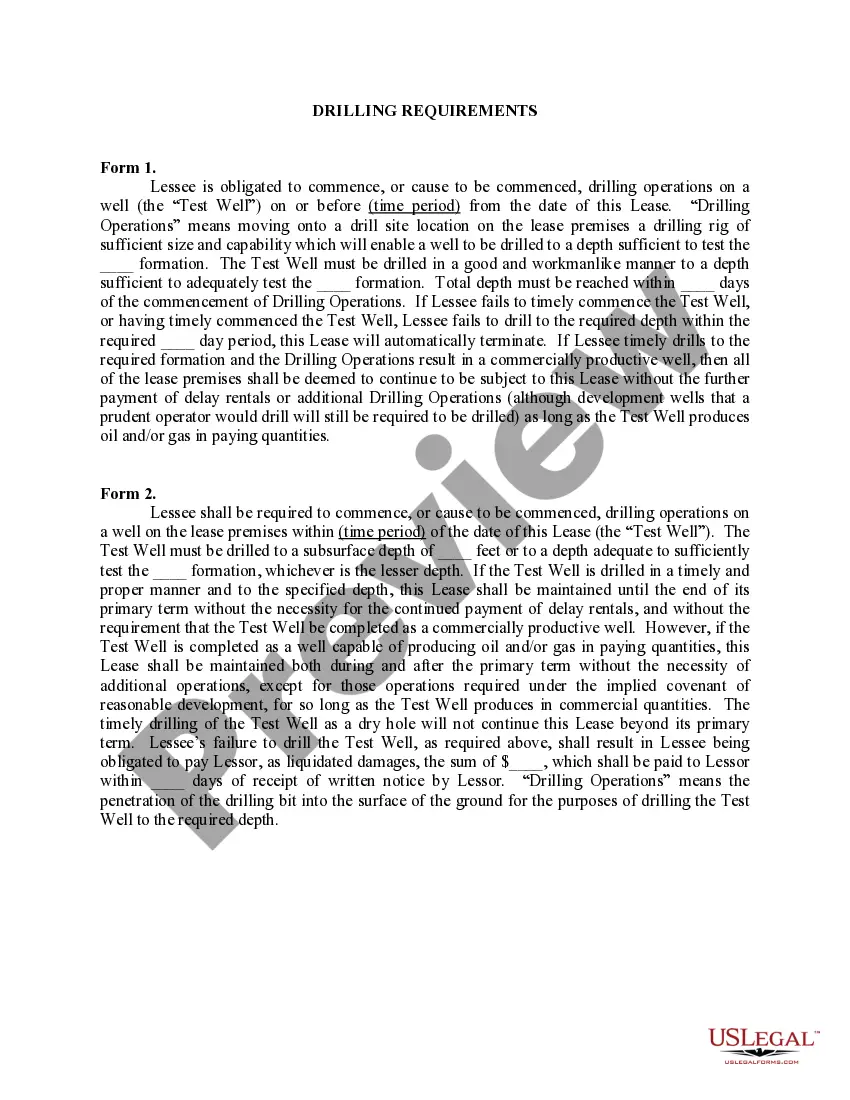
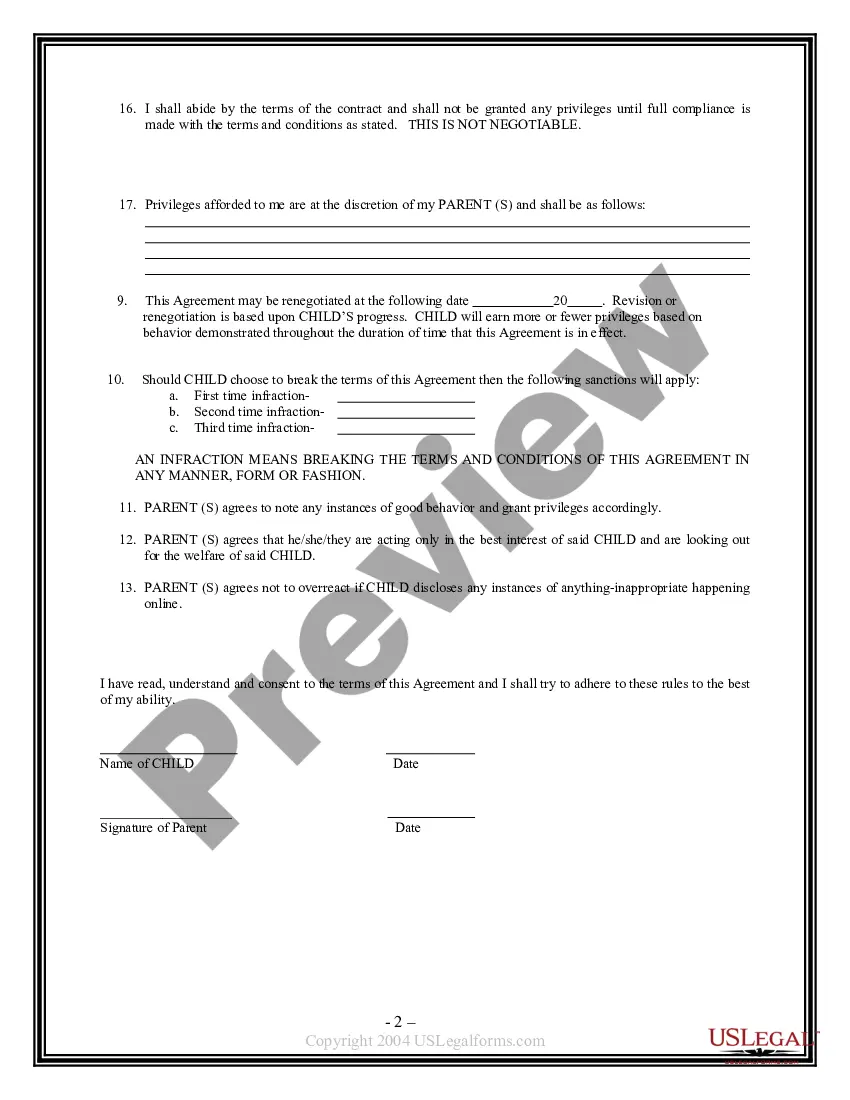
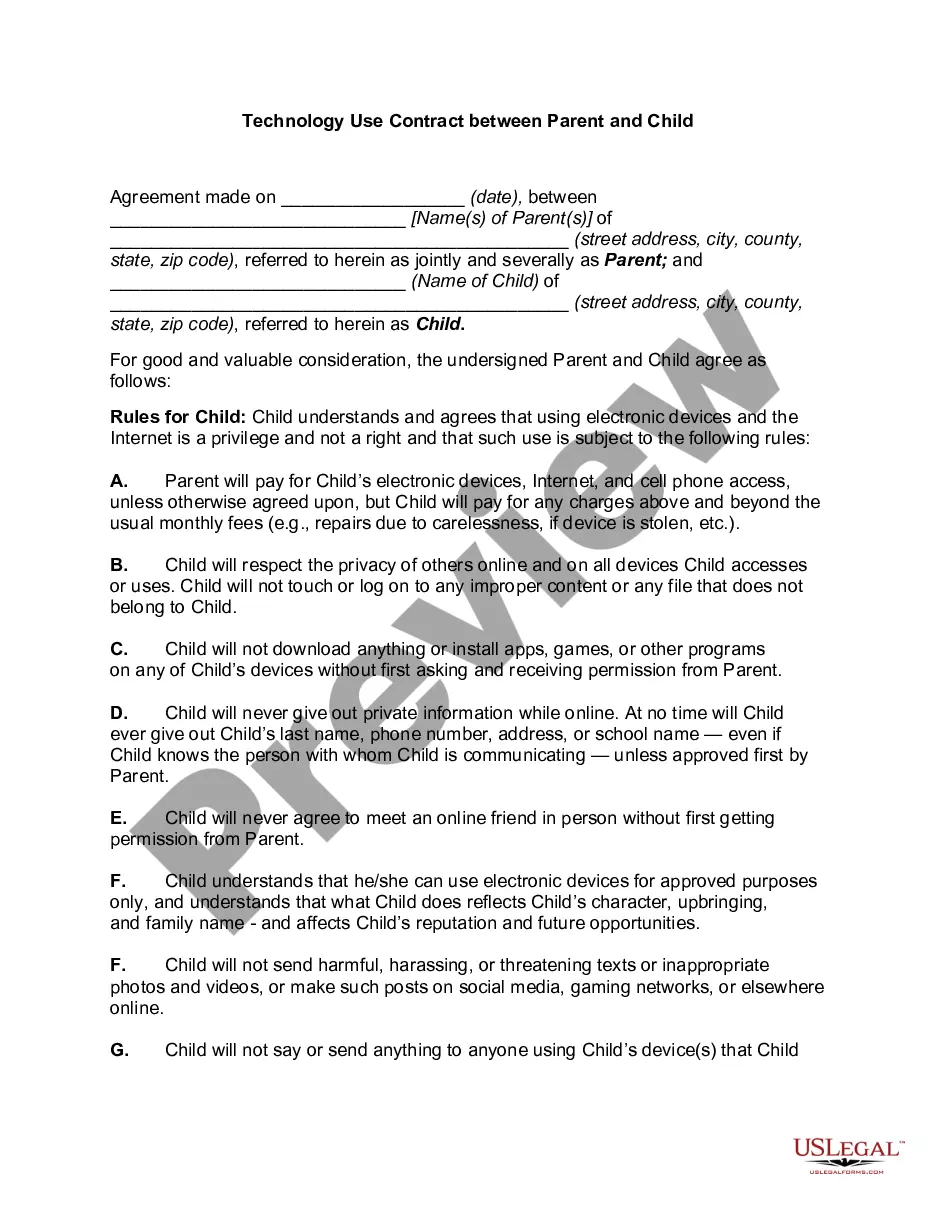
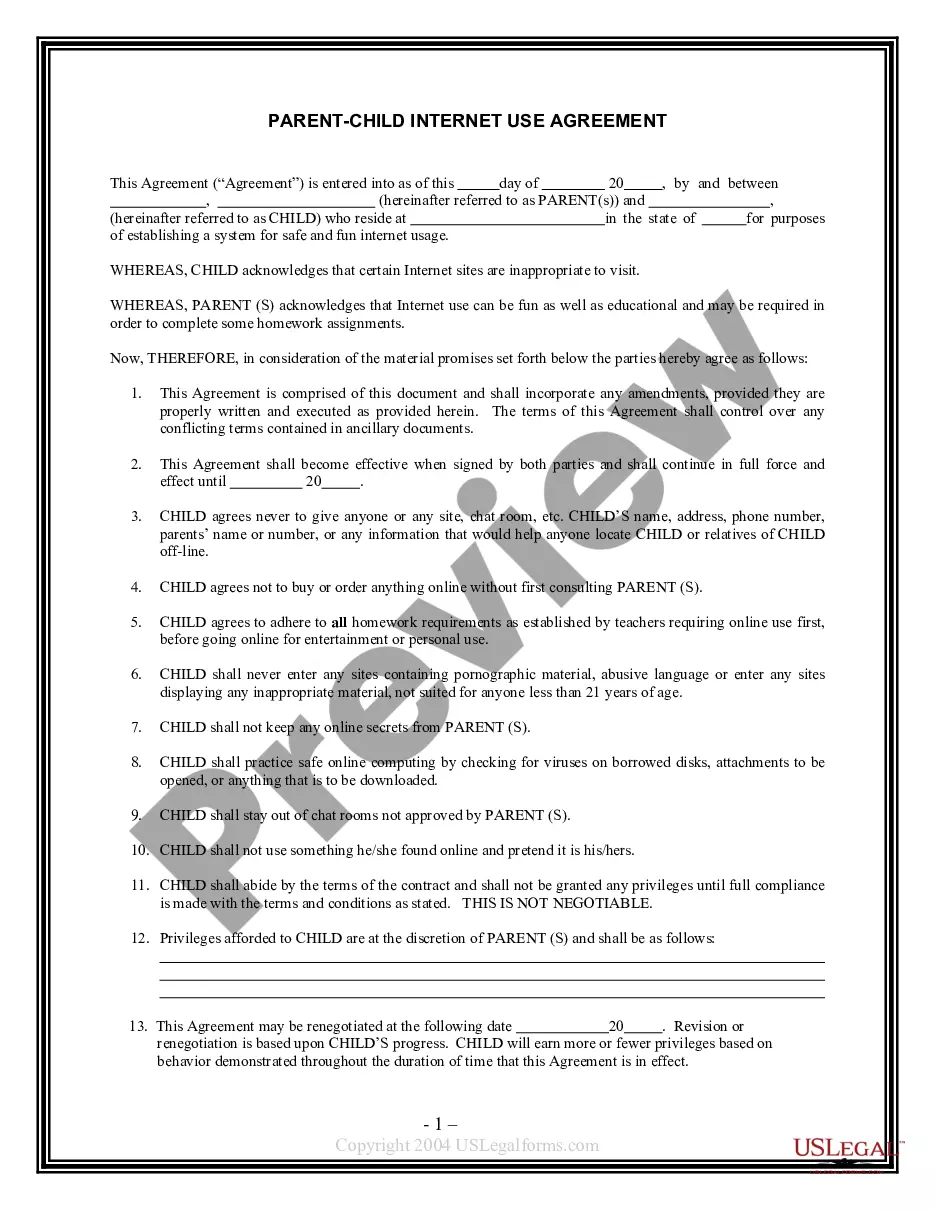
This is a contract between parent(s) and a younger child introducing child to Internet safety by describing what types of sites child should not contact and other general rules for Internet use.
New Hampshire Parent - Minor Child Internet Use Agreement
Category:
State:
Multi-State
Control #:
US-PC10
Format:
Word;
Rich Text
Instant download
Description
Free preview
Get your form ready online
Our built-in tools help you complete, sign, share, and store your documents in one place.
Built-in online Word editor
Make edits, fill in missing information, and update formatting in US Legal Forms—just like you would in MS Word.
Export easily
Download a copy, print it, send it by email, or mail it via USPS—whatever works best for your next step.
E-sign your document
Sign and collect signatures with our SignNow integration. Send to multiple recipients, set reminders, and more. Go Premium to unlock E-Sign.
Notarize online 24/7
If this form requires notarization, complete it online through a secure video call—no need to meet a notary in person or wait for an appointment.
Store your document securely
We protect your documents and personal data by following strict security and privacy standards.

Make edits, fill in missing information, and update formatting in US Legal Forms—just like you would in MS Word.

Download a copy, print it, send it by email, or mail it via USPS—whatever works best for your next step.

Sign and collect signatures with our SignNow integration. Send to multiple recipients, set reminders, and more. Go Premium to unlock E-Sign.

If this form requires notarization, complete it online through a secure video call—no need to meet a notary in person or wait for an appointment.

We protect your documents and personal data by following strict security and privacy standards.
Looking for another form?
How to fill out Parent - Minor Child Internet Use Agreement?
If you need to complete, retrieve, or print authorized document templates, utilize US Legal Forms, the largest selection of legal forms available online.
Take advantage of the site's straightforward and user-friendly search to find the documents you require.
Various templates for business and personal purposes are organized by categories and states, or keywords.
Once you have found the form you want, click the Purchase now option. Choose the pricing plan you prefer and enter your credentials to register for an account.
Process the payment. You can use your credit card or PayPal account to complete the transaction. Step 6. Select the format of the legal document and download it to your device. Step 7. Complete, modify, and print or sign the New Hampshire Parent - Minor Child Internet Use Agreement. Each legal document template you purchase is yours forever. You have access to every form you saved in your account. Click the My documents section and choose a form to print or download again. Compete, download, and print the New Hampshire Parent - Minor Child Internet Use Agreement with US Legal Forms. There are millions of professional and state-specific forms you can utilize for your business or personal needs.
- Use US Legal Forms to obtain the New Hampshire Parent - Minor Child Internet Use Agreement in just a few clicks.
- If you are already a US Legal Forms customer, Log In to your account and click the Obtain option to get the New Hampshire Parent - Minor Child Internet Use Agreement.
- You can also access forms you previously saved within the My documents tab of your account.
- If you are using US Legal Forms for the first time, follow the instructions below.
- Ensure you have selected the form for the correct city/state.
- Use the Preview option to review the form's content. Don't forget to read the description.
- If you are dissatisfied with the form, use the Search box at the top of the screen to find other versions of the legal form template.
Form popularity
FAQ
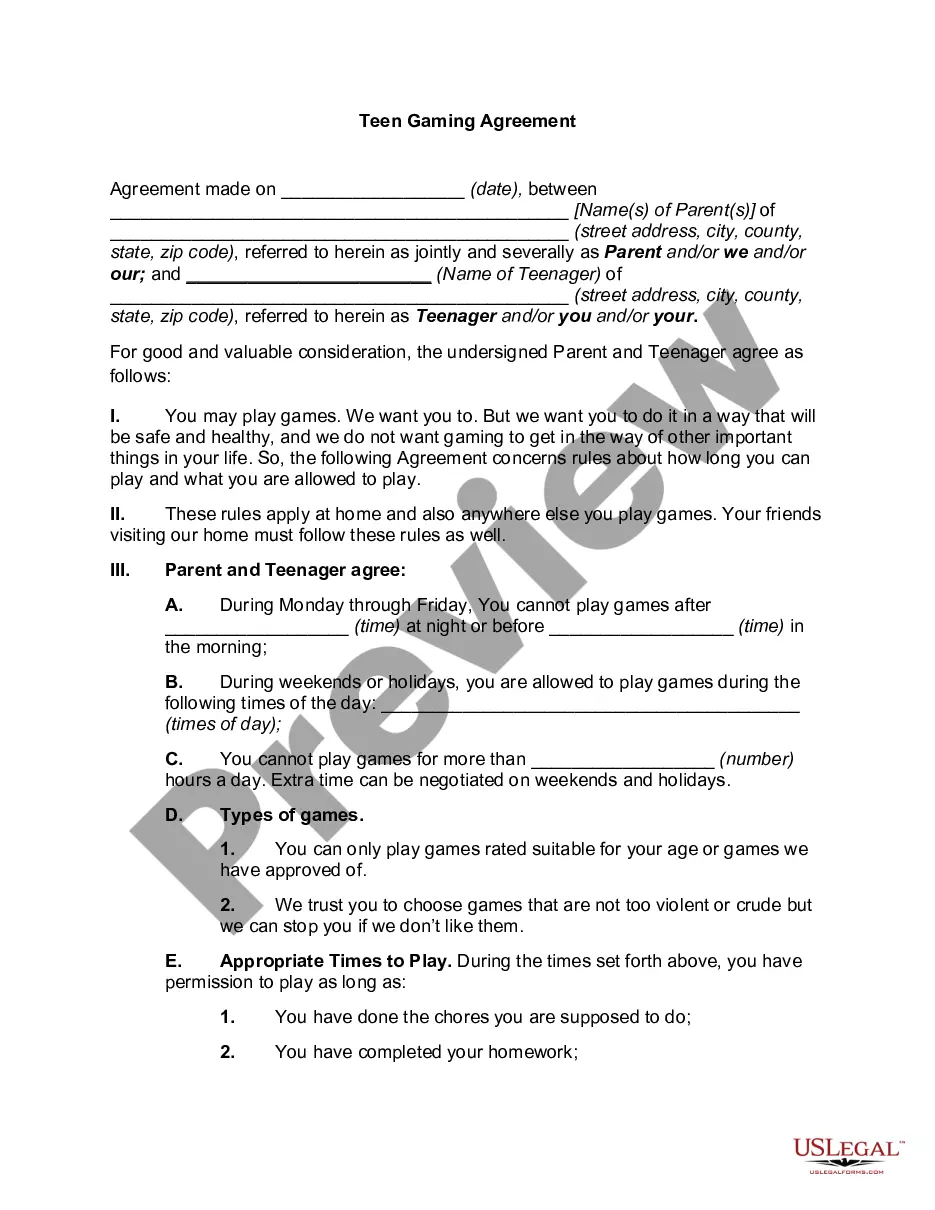
Unlimited internet access may not be suitable for children, as it can expose them to inappropriate content and online dangers. Instead, consider setting reasonable limits and using the New Hampshire Parent - Minor Child Internet Use Agreement to outline acceptable online behavior. This agreement helps parents and children discuss internet use and ensures that kids understand the importance of balance in their online activities.
Teaching students about internet safety starts with open conversations about their online activities. Encourage them to ask questions and express concerns. Use resources such as the New Hampshire Parent - Minor Child Internet Use Agreement to establish guidelines that promote safe online behavior. Additionally, emphasize the importance of privacy settings, recognizing scams, and knowing when to seek help.
New Hampshire's child support guidelines provide a formula for determining how much child support an absent parent is required to pay. Generally the amount is 25% of adjusted gross income for one child; 33% for two children; 40% for three children; and 45% for four or more children.
Fathers in the state of New Hampshire have an equal right to child support as mothers, and they also have equal access to the services provided by the Division of Child Support Services.
In law, there is no fixed age that determines when a child can express a preference as to where they want to live. However, legally, a child cannot decide who they want to live with until they are 16 years old. Once a child reaches the age of 16, they are legally allowed to choose which parent to live with.
How long does child support last? In New Hampshire, child support is payable until the child turns 18 or terminates their High School education whichever is later, or the child is married or becomes a member of the armed services. The Court has the ability to extend child support for a disabled child.
The law doesn't specify an age at which the court must take into consideration a child's preference. That's because age doesn't determine maturity level. So it's conceivable that a judge might take into account the wishes of a young, mature child, but not those of an older, less responsible one.
In special circumstances, a court may consider a child as young as 10 years old sufficiently mature enough to meaningfully contribute to decisions about her welfare.
In most states, child support ends when the child reaches age 18, goes off to college, dies, or gets married. Some states, however, allow child support to continue beyond the age of 18 in certain circumstances, such as if the child is still living at home and attending high school, or if the child has special needs.
Pursuant to RSA 461-A-14, New Hampshire Child Support orders are payable until the dependent turns 18 or is out of high school, whichever occurs later; becomes married or a member of the armed services; is declared legally dependent beyond that age due to mental or physical disability; or unless the court has otherwise