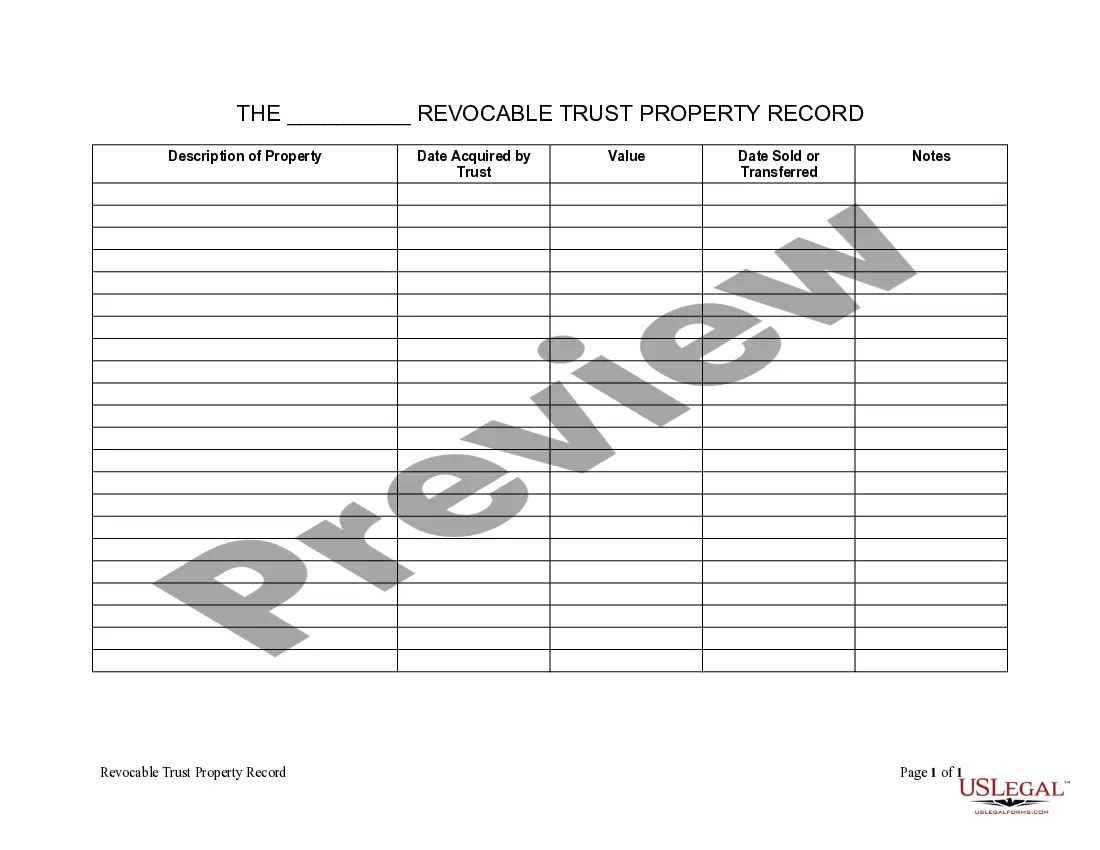
North Dakota UCC1 Financing Statement Addendum
Overview of this form
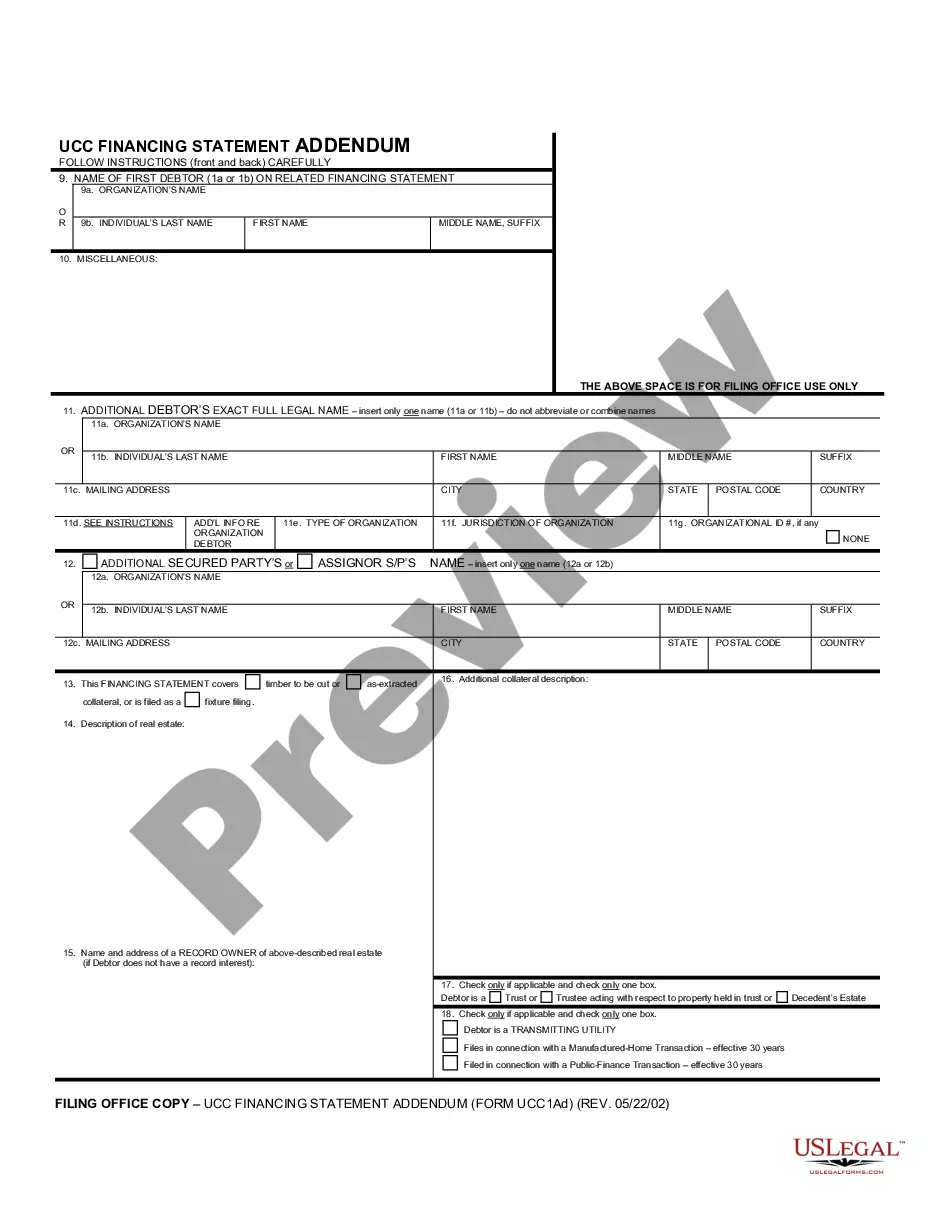
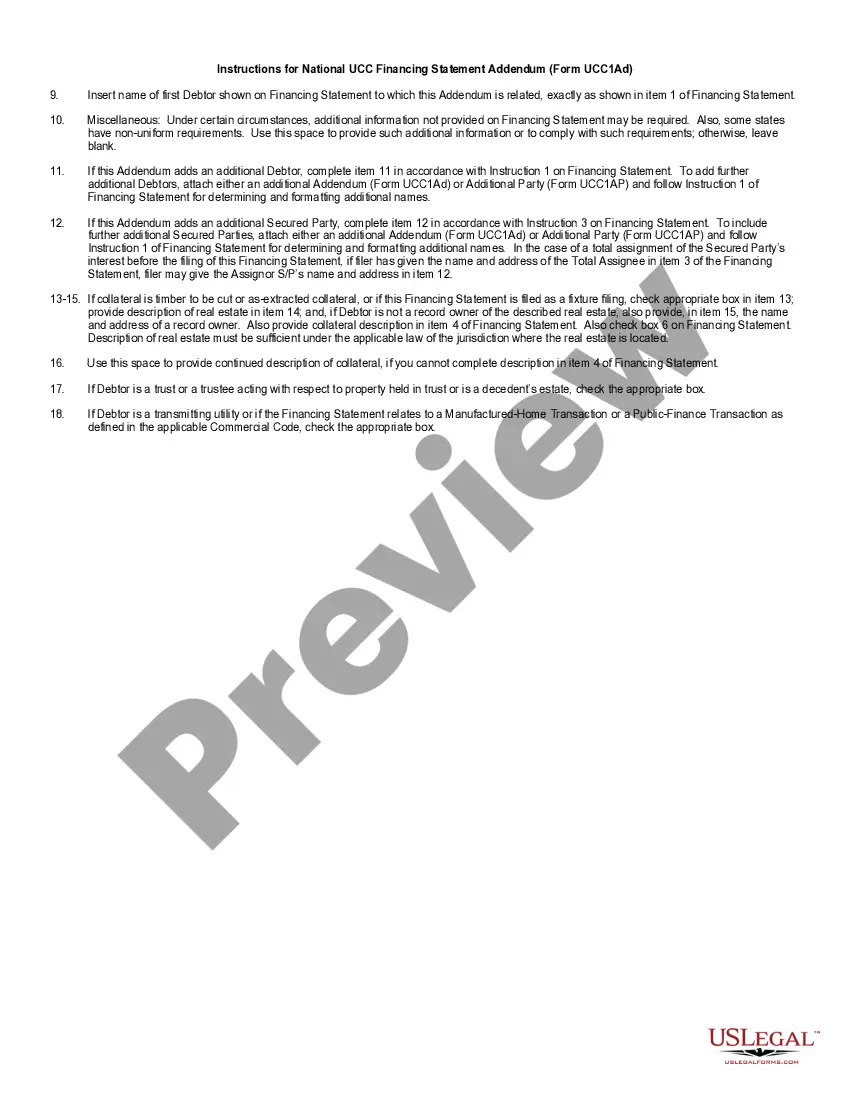
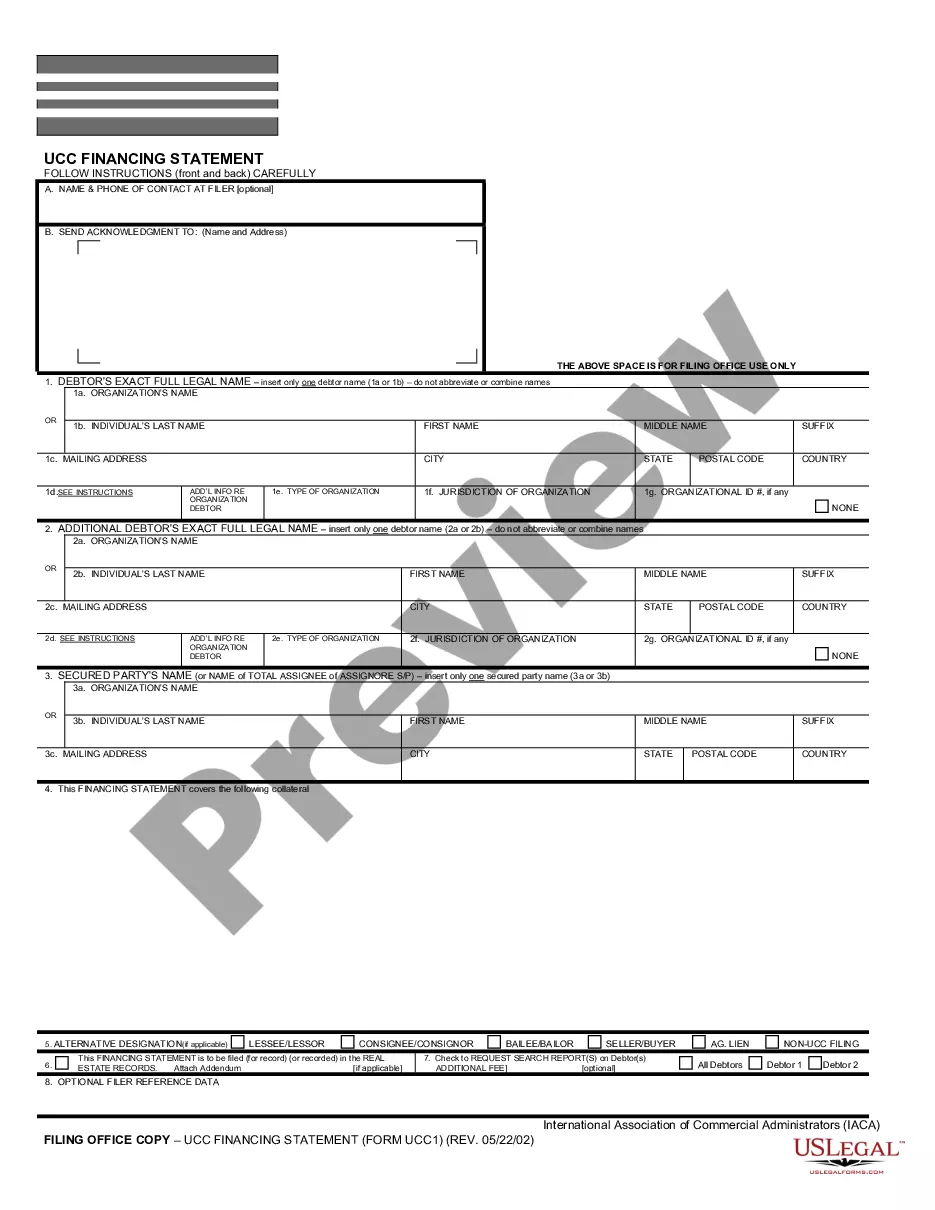
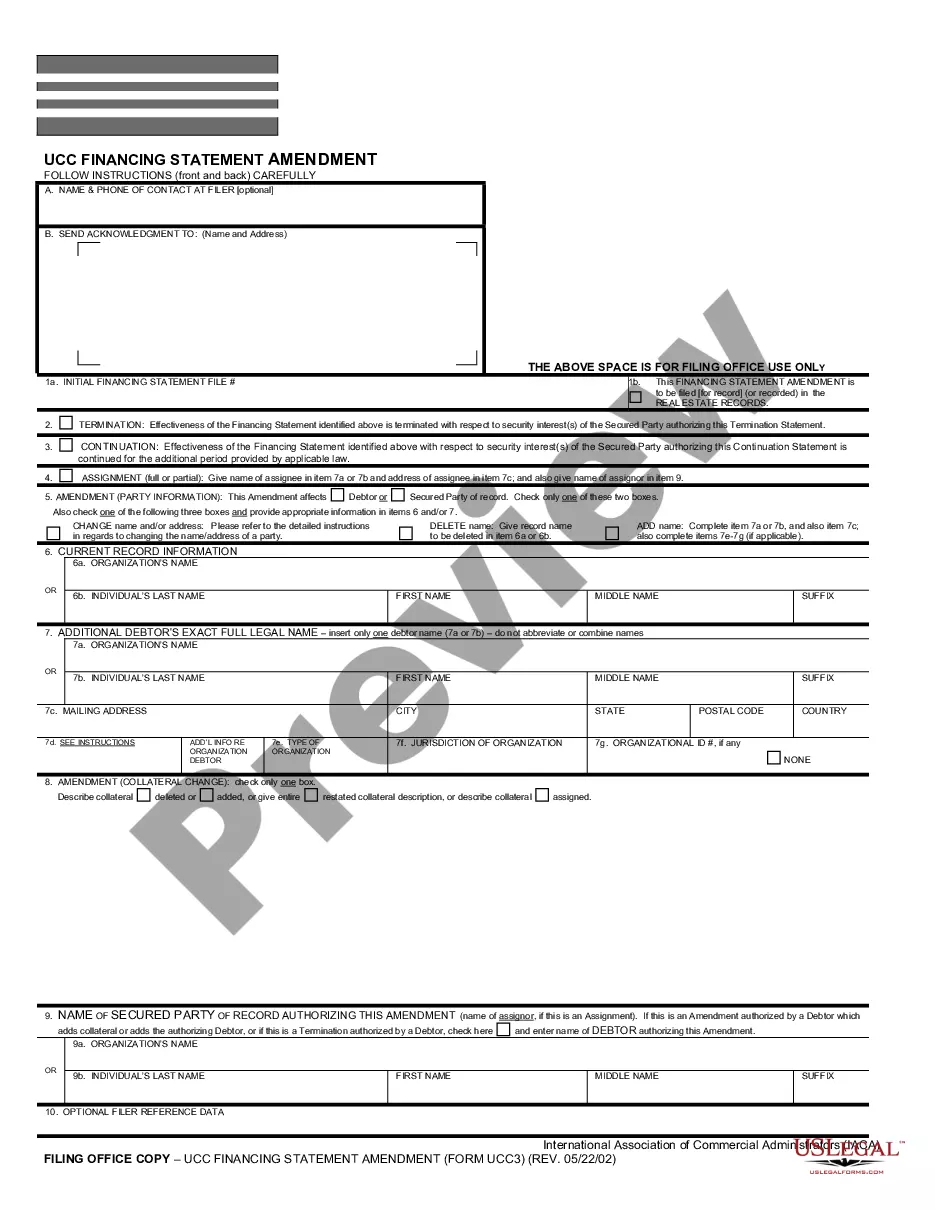
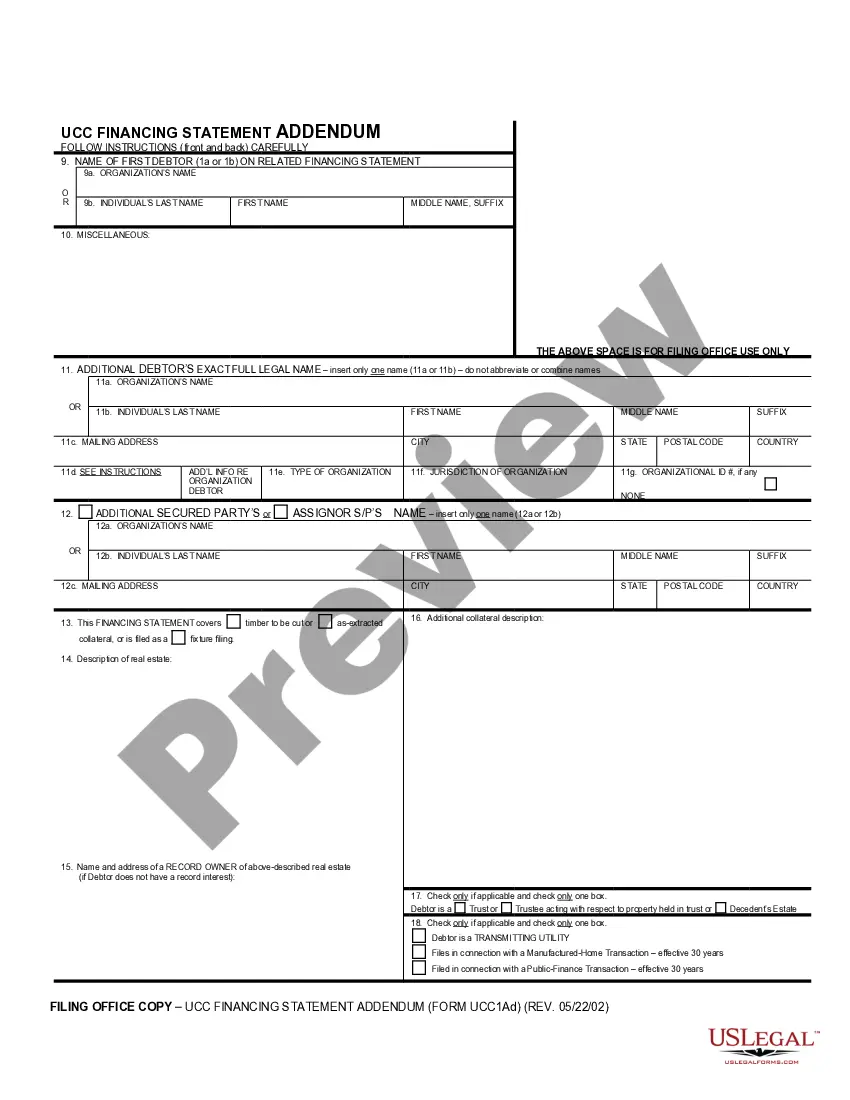
The North Dakota UCC1 Financing Statement Addendum is a legal document used to add additional debtors to a UCC financing statement, specifically in North Dakota. This addendum is crucial for securing creditor rights by indicating any new parties tied to the collateral specified in the initial financing statement. Unlike standard UCC forms, this addendum allows for modifications to existing paperwork to ensure comprehensive coverage of all relevant debtors.
Key components of this form
- Debtor Type: Identifies whether the debtor is a trust, a trustee, or a type of utility.
- Additional Debtor Fields: Sections to include new debtors in relation to current collateral.
- Miscellaneous Information: Space for additional data that may be required by specific circumstances or state regulations.
- Document Reference: A reference to the original financing statement to which this addendum is related.
- Filing Information: Details about filing this addendum in connection with different transaction types.

When to use this document
This form should be utilized when a creditor needs to add an additional debtor to an existing UCC financing statement. This is often necessary when new parties become involved in the financing arrangements or if there are changes in the collateral ownership that require updates to the documentation. It can also be critical in transactions involving trusts or estates where multiple parties may have rights to the collateral.
Who should use this form
- Creditors seeking to amend their UCC financing statements.
- Trustees handling transactions involving trust assets.
- Individuals or businesses involved in financing agreements that require documentation of additional debtors.
- Estate administrators needing to clarify debtor roles in relation to estate assets.
Completing this form step by step
- Identify the existing debtor as noted in the original financing statement.
- Mark the appropriate box to indicate the type of debtor you are adding (e.g., trust, trustee, utility).
- Provide detailed information for any new debtor, ensuring accurate name formatting as required.
- Fill in any miscellaneous information needed to meet state-specific requirements.
- Review the entire form for accuracy before submission.
Is notarization required?
This form does not typically require notarization unless specified by local law. However, always check local regulations to ensure compliance during the filing process.
Get your form ready online
Our built-in tools help you complete, sign, share, and store your documents in one place.
Make edits, fill in missing information, and update formatting in US Legal Forms—just like you would in MS Word.
Download a copy, print it, send it by email, or mail it via USPS—whatever works best for your next step.
Sign and collect signatures with our SignNow integration. Send to multiple recipients, set reminders, and more. Go Premium to unlock E-Sign.
If this form requires notarization, complete it online through a secure video call—no need to meet a notary in person or wait for an appointment.
We protect your documents and personal data by following strict security and privacy standards.

Make edits, fill in missing information, and update formatting in US Legal Forms—just like you would in MS Word.

Download a copy, print it, send it by email, or mail it via USPS—whatever works best for your next step.

Sign and collect signatures with our SignNow integration. Send to multiple recipients, set reminders, and more. Go Premium to unlock E-Sign.

If this form requires notarization, complete it online through a secure video call—no need to meet a notary in person or wait for an appointment.

We protect your documents and personal data by following strict security and privacy standards.
Typical mistakes to avoid
- Failing to clearly identify the existing debtor linked to the addendum.
- Incorrectly checking multiple debtor type boxes instead of choosing one.
- Omitting necessary additional information that may be required by specific circumstances or state laws.
- Not reviewing the addendum for consistency with the original financing statement details.
Benefits of using this form online
- Convenience: Easily complete and download from anywhere at any time.
- Editability: Modify the document as needed to ensure accuracy before finalizing.
- Reliability: Obtain forms drafted by licensed attorneys for peace of mind.
- Fast access: Quickly retrieve and submit the necessary paperwork to comply with legal requirements.
Looking for another form?
Form popularity
FAQ
It should be noted that UCC financing statements filed now generally do not contain a grant of the security interest and generally are not signed or otherwise authenticated by the Debtor and therefore would not satisfy the requirement of a security agreement.
Filer Information. Name and phone number of contact at filer. Email contact at filer. Debtor Information. Organization or individual's name. Mailing address. Secured Party Information. Organization or individual's name. Mailing address. Collateral Information. Description of collateral.
Rules vary by State around releasing a UCC lien after a borrower satisfied the debt. Primarily there are two main ways to remove them. One way is by having the lender file a UCC-3 Financing Statement Amendment. Another way to remove a UCC filing is by swearing an oath of full payment at the secretary of state office.
If you're approved for a small-business loan, a lender might file a UCC financing statement or a UCC-1 filing. This is just a legal form that allows for the lender to announce lien on a secured loan. This allows for the lender to seize, foreclose or even sell the underlying collateral if you fail to repay your loan.
Also known as a UCC-3, and, depending on the context, a UCC-3 financing statement amendment, a UCC-3 termination statement, and a UCC-3 continuation statement. Under the Uniform Commercial Code, a UCC-3 is used to continue, assign, terminate, or amend an existing UCC-1 financing statement (UCC-1).
To assign (1) some or all of Assignor's right to amend the identified financing statement, or (2) the Assignor's right to amend the identified financing statement with respect to some (but not all) of the collateral covered by the identified financing statement: Check box in item 3 and enter name of Assignee in item 7a
A UCC-1 financing statement (an abbreviation for Uniform Commercial Code-1) is a legal form that a creditor files to give notice that it has or may have an interest in the personal property of a debtor (a person who owes a debt to the creditor as typically specified in the agreement creating the debt).
Form UCC3 is used to amend (make changes to) a UCC1 filing.However, it is important to note that for a UCC1 filing a termination is only an amendment and that the UCC1 filing may be amended further, even after a termination has been filed. Box 3 Continuation A UCC1 filing is good for five years.
Section 9-503 of the UCC provides various, more specific rules regarding the sufficiency of a debtor's name on a financing statement.However, unlike with a security agreement, on a financing statement it is acceptable to use a supergeneric description of collateral.