North Dakota Notice of Assignment to Living Trust
About this form
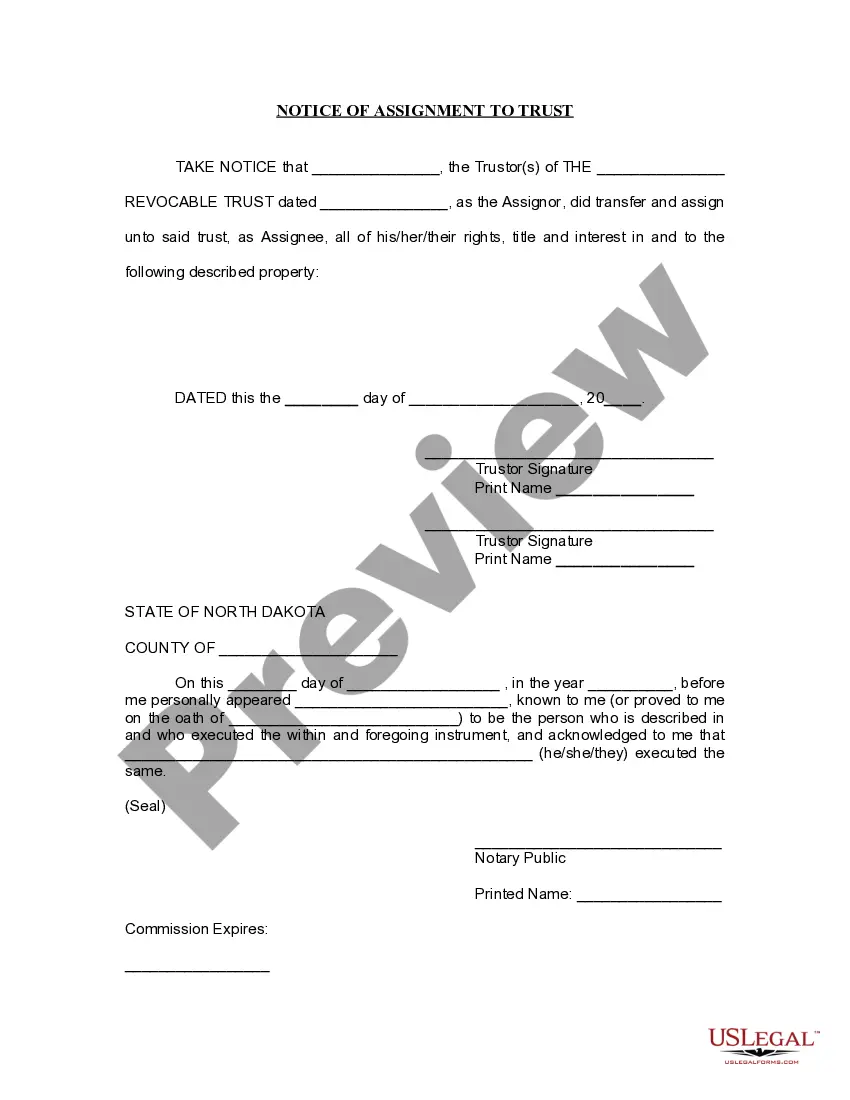
The Notice of Assignment to Living Trust is a legal document that indicates the transfer of assets into a living trust. This form is significant for individuals engaging in estate planning, as it formalizes the assignment of property rights to a trust established during the trustor's lifetime. Unlike other property transfer forms, this document specifically pertains to trust assignments and ensures clarity in the management of the trust's assets.
Main sections of this form
- Names of the Trustor(s) and the name of the revocable trust.
- Description of the property being transferred to the living trust.
- Signature of the Trustor(s) to validate the assignment.
- Notary acknowledgment to confirm the identity of the Trustor(s).
- Date of notarization and expiration of notary commission.
When to use this form
This form is used when a trustor wishes to assign specific property or assets into their living trust. It is particularly relevant during estate planning to clarify ownership and provide instructions on the management of the assets after the trustor's death. Use this form to ensure that the property is legally recognized as part of the living trust, thereby streamlining the distribution process according to the trustor's wishes.
Who needs this form
- Individuals who have established a revocable living trust.
- Trustors looking to assign property to their trust for estate planning purposes.
- Personal representatives or heirs managing the affairs of a deceased trustor.
Instructions for completing this form
- Identify the Trustor(s) and clearly state the name of the revocable trust.
- Describe the property being assigned to the trust, including any relevant details.
- Have all Trustor(s) sign the form to confirm their intentions regarding the assignment.
- Ensure the form is notarized by completing the notary section, including the date and notary details.
- Keep a copy of the completed form for your records and as part of the trust documentation.
Notarization guidance
Yes, this form must be notarized to be legally valid. Notarization verifies the identities of the Trustor(s) and confirms that the signatures were made voluntarily. With US Legal Forms, you can also utilize online notarization services that provide secure video calls with licensed notaries, ensuring convenience and legal compliance without the need for travel.
Get your form ready online
Our built-in tools help you complete, sign, share, and store your documents in one place.
Make edits, fill in missing information, and update formatting in US Legal Forms—just like you would in MS Word.
Download a copy, print it, send it by email, or mail it via USPS—whatever works best for your next step.
Sign and collect signatures with our SignNow integration. Send to multiple recipients, set reminders, and more. Go Premium to unlock E-Sign.
If this form requires notarization, complete it online through a secure video call—no need to meet a notary in person or wait for an appointment.
We protect your documents and personal data by following strict security and privacy standards.

Make edits, fill in missing information, and update formatting in US Legal Forms—just like you would in MS Word.

Download a copy, print it, send it by email, or mail it via USPS—whatever works best for your next step.

Sign and collect signatures with our SignNow integration. Send to multiple recipients, set reminders, and more. Go Premium to unlock E-Sign.

If this form requires notarization, complete it online through a secure video call—no need to meet a notary in person or wait for an appointment.

We protect your documents and personal data by following strict security and privacy standards.
Common mistakes to avoid
- Failing to include specific details about the property being assigned.
- Not obtaining the required notarization.
- Leaving out the signatures of all Trustor(s) involved.
Why complete this form online
- Convenient access to legal forms that can be downloaded instantly.
- Editable templates that allow you to customize the form according to your specific needs.
- Reliability with forms drafted by licensed attorneys ensuring legal compliance.
Looking for another form?
Form popularity
FAQ
A living trust, specifically a revocable living trust, is a legal document that places your assetsinvestments, bank accounts, real estate, vehicles and valuable personal propertyin trust for your benefit during your lifetime, and spells out where you'd like these things to go upon your death.
Although there is no hard and fast rule on how often you should update your trust, conducting an annual review of the trust and asset schedule is recommended. In most situations, updates are typically needed every 3-5 years. Circumstances change. There will always be changes in the law especially the tax laws.
When you create a DIY living trust, there are no attorneys involved in the process. You will need to choose a trustee who will be in charge of managing the trust assets and distributing them.You'll also need to choose your beneficiary or beneficiaries, the person or people who will receive the assets in your trust.
No, you don't need a lawyer to set up a trust, but it might be a good idea to seek legal advice to ensure the trust is set up correctly and that you have considered all long-term financial and estate planning aspects of the trust.Some living trusts are revocable, which means the trust can be changed at any time.
A trust is a legal entity that you transfer ownership of your assets to, perhaps in order to decrease the value of your estate or to simplify passing on assets to your intended beneficiaries after you die. An estate planning attorney may charge at least $1,000 to create a trust for you.
Pick a type of living trust. If you're married, you'll first need to decide whether you want a single or joint trust. Take stock of your property. Choose a trustee. Draw up the trust document. Sign the trust. Transfer your property to the trust.
Pick a type of living trust. If you're married, you'll first need to decide whether you want a single or joint trust. Take stock of your property. Choose a trustee. Draw up the trust document. Sign the trust. Transfer your property to the trust.
A living trust is an important part of your estate plan. Most people can create a living trust without an attorney using software or an online service.
Sure you can write your own revocable living trust. In fact, you can do it better than a lot of the attorneys. First you have to ascertain that you really want a trust.This is true whether you are preparing a revocable living trust, corporate bylaws, LLC documents, or any other legal documents.