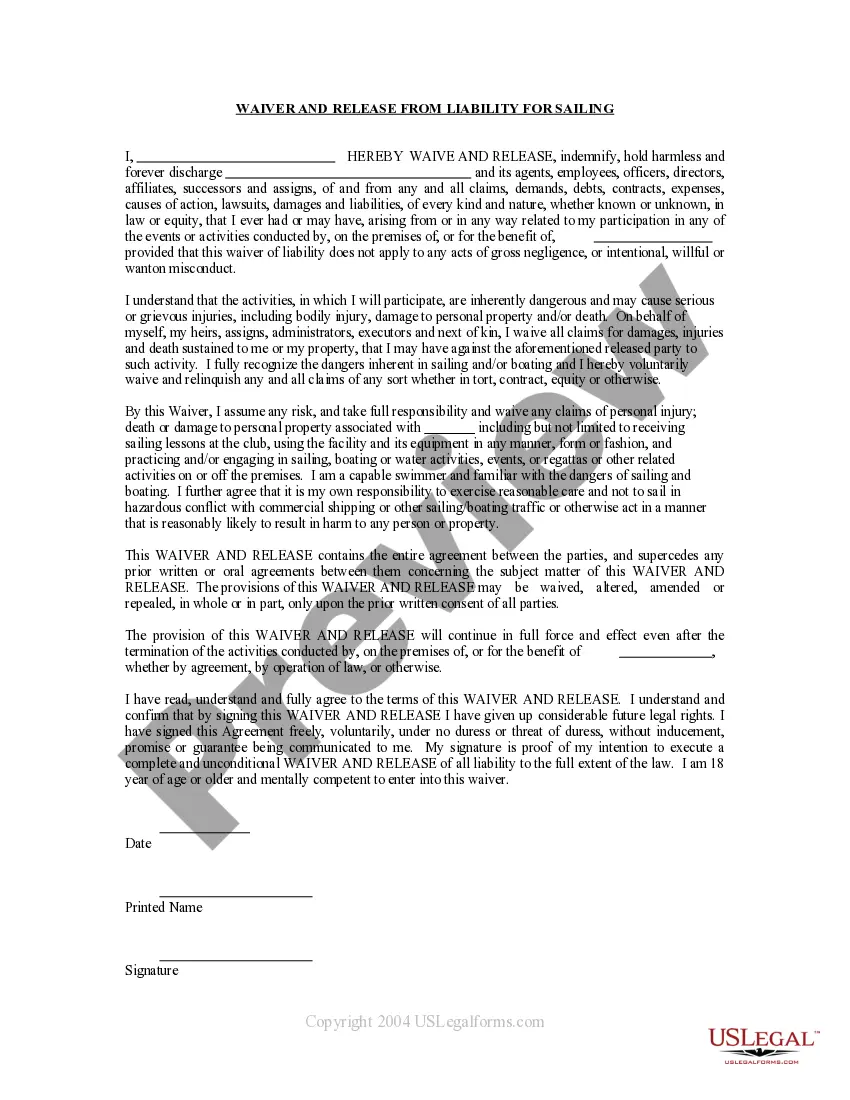
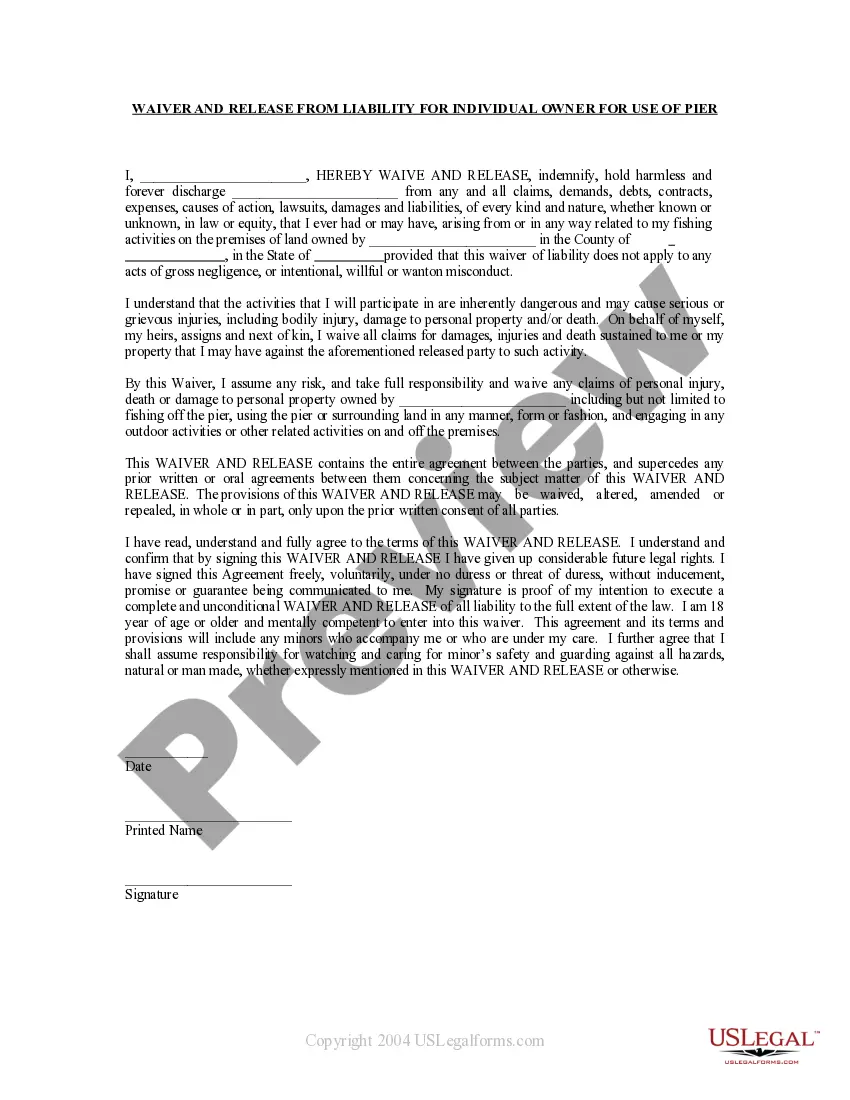
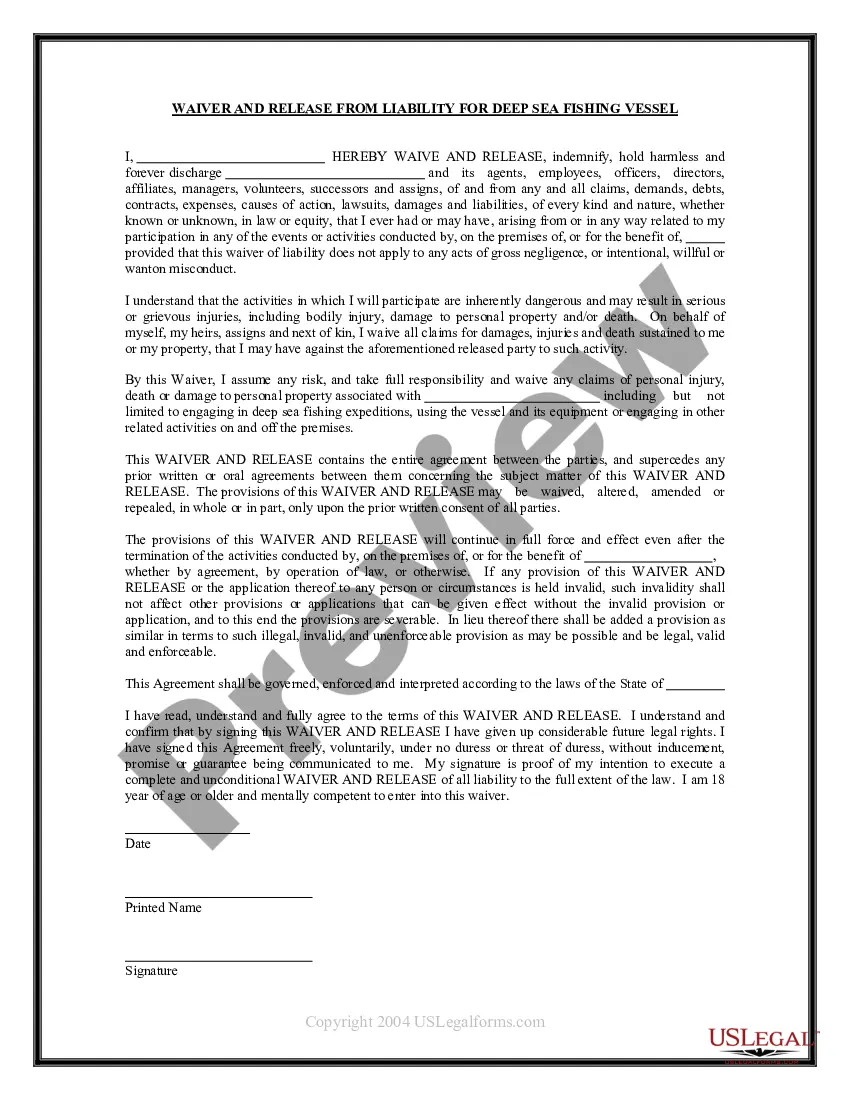
This form allows an adult to release a Sailing facility from liability for injuries which may be incurred while on the premises, taking part in activities, etc.
North Carolina Waiver and Release From Liability For Adult for Sailing
Category:
State:
Multi-State
Control #:
US-WAV-32A
Format:
Word;
Rich Text
Instant download
Description
How to fill out Waiver And Release From Liability For Adult For Sailing?
US Legal Forms - one of the most prominent collections of legal forms in the United States - offers a range of legal document templates that you can download or print. By using the site, you can access thousands of forms for business and personal purposes, organized by categories, states, or keywords.
You can obtain the latest versions of forms such as the North Carolina Waiver and Release From Liability For Adult for Sailing in just a few minutes. If you have an account, Log In and download the North Carolina Waiver and Release From Liability For Adult for Sailing from the US Legal Forms library. The Download button will be visible on every form you view. All previously acquired forms can be found in the My documents section of your profile.
If you are using US Legal Forms for the first time, here are simple steps to get started: Ensure you have selected the correct form for your city/state. Click the Preview button to examine the form’s content. Review the form details to confirm that you have selected the correct document. If the form does not meet your needs, use the Search box at the top of the screen to find one that does. If you are satisfied with the form, confirm your selection by clicking the Get now button. Then, choose your payment plan and provide your information to register for your account.
Utilize thousands of professional and state-specific templates that satisfy your business or personal needs and requirements.
- Process the payment. Use your Visa or Mastercard or PayPal account to complete the transaction.
- Select the format and download the form to your device.
- Make adjustments. Fill out, modify, print, and sign the acquired North Carolina Waiver and Release From Liability For Adult for Sailing.
- Every template you add to your account has no expiration date and is yours indefinitely.
- So, if you wish to download or print another version, simply go to the My documents section and click on the form you desire.
- Access the North Carolina Waiver and Release From Liability For Adult for Sailing with US Legal Forms, the most extensive library of legal document templates.
Form popularity
FAQ
In North Carolina, while boat insurance is not legally mandated, it is highly recommended for all boat owners. Having insurance protects you from financial loss in case of accidents, theft, or damage. Additionally, many marinas and lenders may require proof of insurance before allowing you to dock or finance your vessel. To better understand your options, consider consulting resources like USLegalForms for guidance on waivers and insurance requirements.
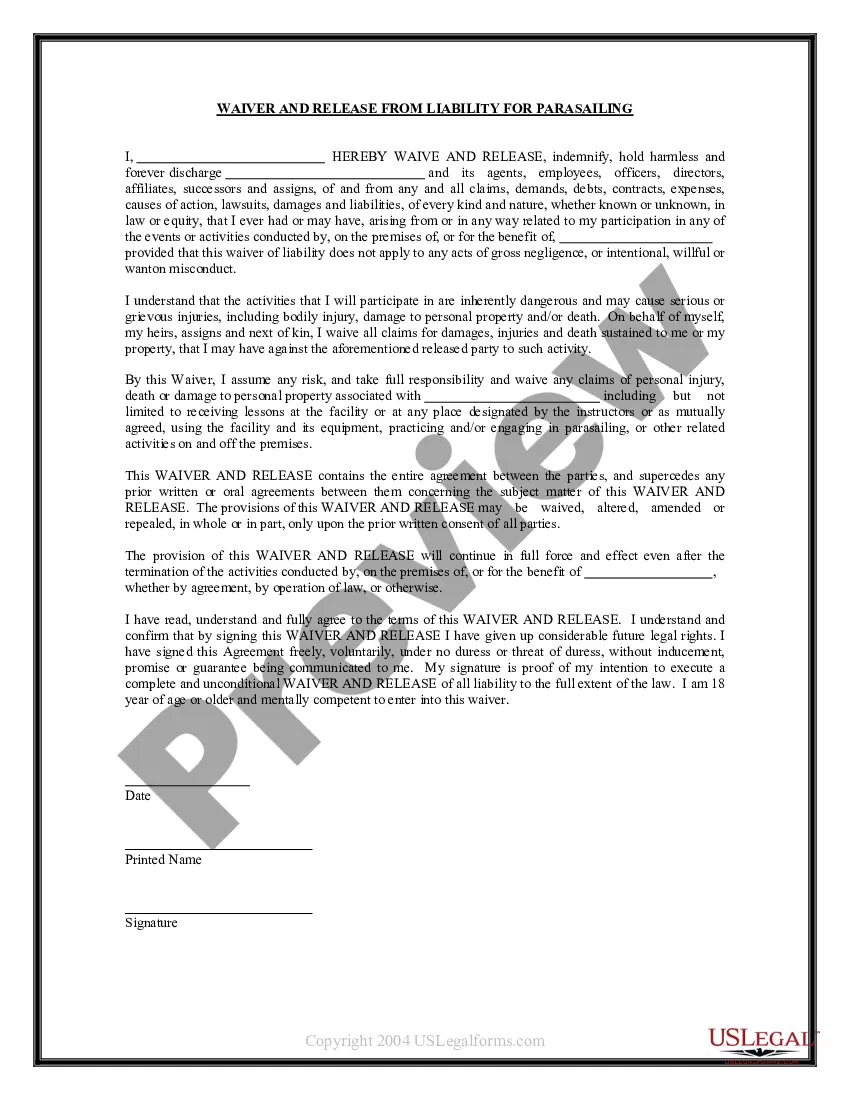
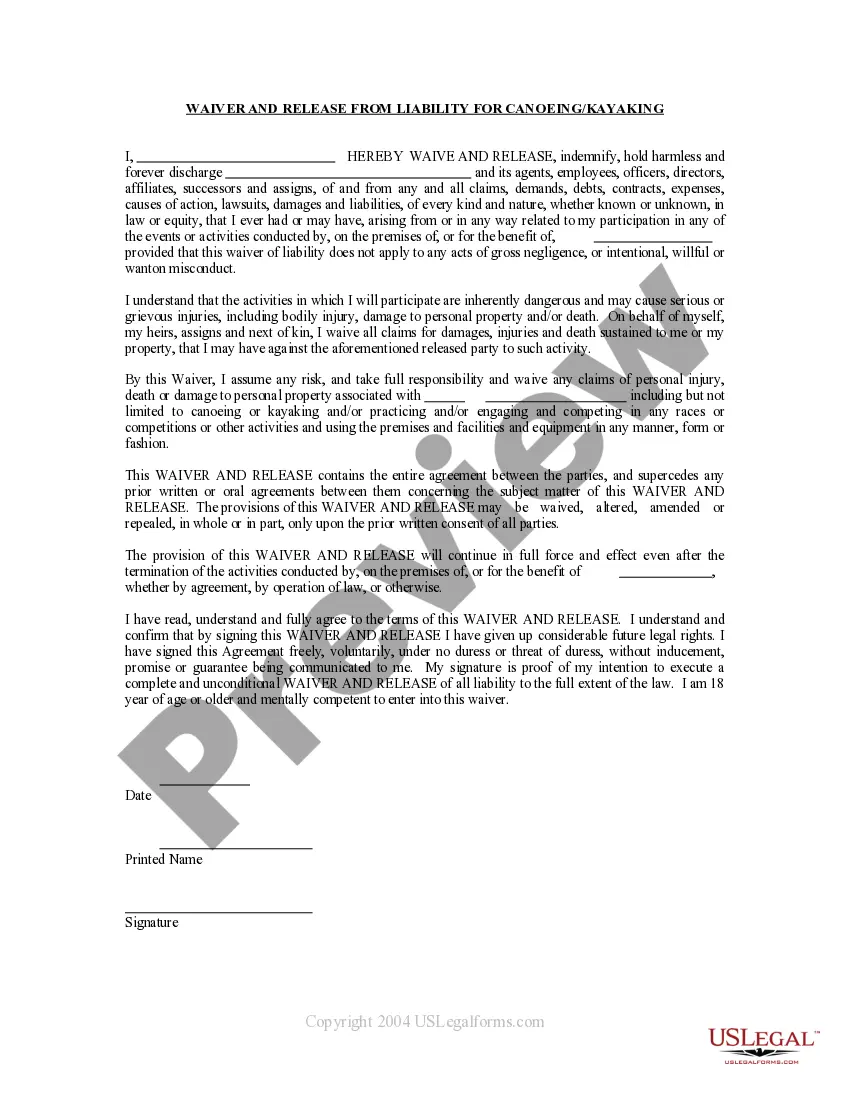
To create an effective North Carolina Waiver and Release From Liability For Adult for Sailing, three key requirements must be met. First, the waiver should clearly state the risks involved in sailing, ensuring participants understand the potential dangers. Second, the document must be signed voluntarily by the adult participant, indicating they agree to waive their rights. Lastly, the waiver should be specific and unambiguous, leaving no room for misinterpretation regarding the liability being released.
Under California law, waivers of liability may not prevent people from suing for injuries resulting from gross negligence, recklessness, intentional torts or illegal acts.
Although legal in their own right, waivers can't be used to completely shield event organisers from liability as a result of their negligence. Under the Unfair Contract Terms Act, activity providers can't exclude or restrict liability for injury or death caused as a result of their negligence.
In California, a liability waiver must be clear, unambiguous, and explicit. In other words, waivers cannot be printed in faded ink, in small font, on the back of a paper, or in an otherwise ambiguous form. If the waiver that you sign is not represented clearly, it may not hold up in the event of a lawsuit.
Liability waivers are enforceable in California solely to the extent they shift to the customer the risk of ordinary negligence. Under California law, a liability waiver cannot excuse an injury caused by a defendant's gross negligence, recklessness or intentionally wrongful act.
As tempting as it may be, you should never write your own liability waiver. Unless you're a fully qualified lawyer with experience in this area, it's likely that you'll omit critical language that puts your business at risk for lawsuits.
Remember that releases and waivers are not favored by courts and will be strictly con- strued against the party seeking to enforce them. Be as specific and as inclusive as possi- ble about what types of claims the release is intended to cover, and what persons or enti- ties the release is intended to protect.
In California, waivers of liability are generally enforceable so long as they have been drafted correctly, are explicit as to the scope of coverage, are legible and use high-visibility text, and do not illegally waive unknown or unrelated claims.
Here is all that pertains writing an effective liability waiver:Get help. Writing a waiver should not be complicated.Use the correct structure.Proper formatting.Include a subject line.Include a caution!Talk about the activity risks.Do not forget an assumption of risk.Hold harmless.More items...?