North Carolina Guarantor - Consignor Notice Required by FTC on certain Transactions

State:
Multi-State
Control #:
US-GUARANTY
Format:
Word; 
Rich Text
Instant download

Description

The Rule applies to consumer credit contracts offered by finance companies, retailers (such as auto dealers and furniture and department stores), and credit unions for any personal purpose except to buy real estate.


When you agree to be a cosigner for someone else's debt, you are guaranteeing to pay if that person fails to pay the debt. The Rule requires that you be given a notice that explains the responsibility you are undertaking. Under the Rule, the cosigner notice must say:


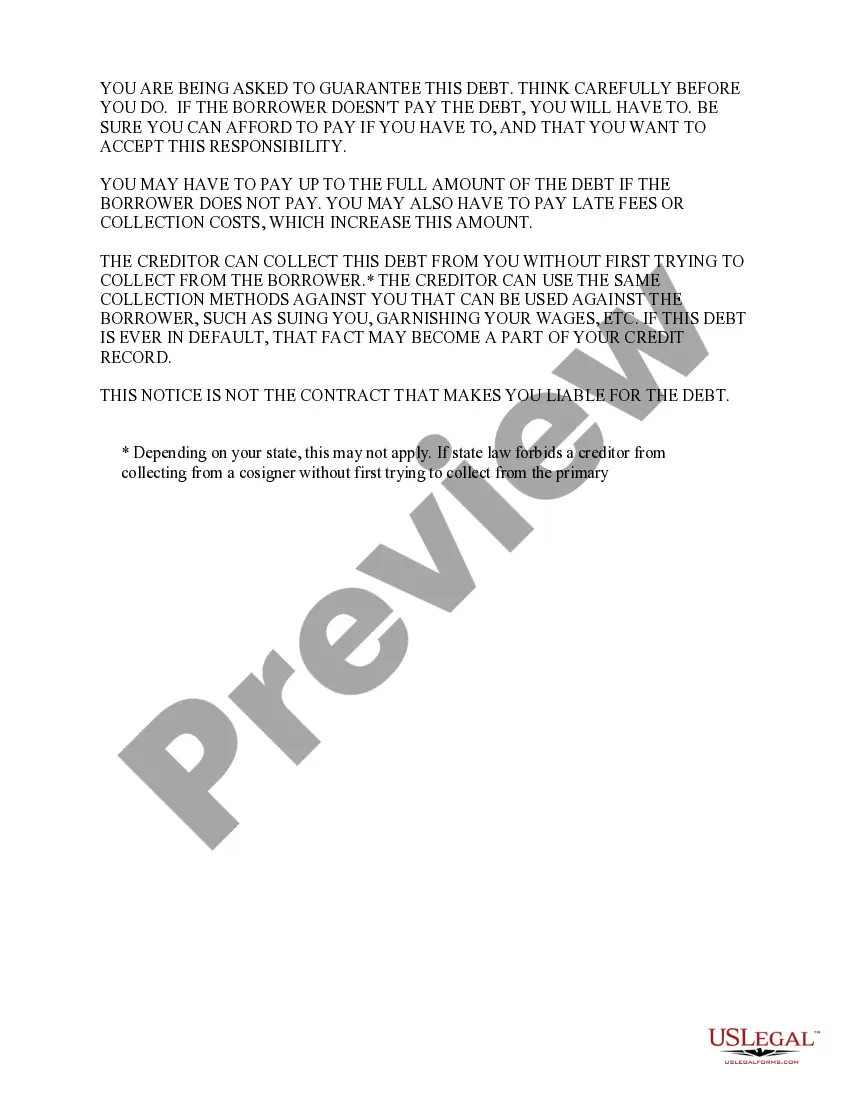
You are being asked to guarantee this debt. Think carefully before you do. If the borrower doesn't pay the debt, you will have to. Be sure you can afford to pay if you have to, and that you want to accept this responsibility.
You may have to pay up to the full amount of the debt if the borrower does not pay. You may also have to pay late fees or collection costs, which increase this amount.


The creditor can collect this debt from you without first trying to collect from the borrower.* The creditor can use the same collection methods against you that can be used against the borrower, such as suing you, garnishing your wages, etc. If this debt is ever in default, that fact may become a part of your credit record.


This notice is not the contract that makes you liable for the debt.


* Depending on your state, this may not apply. If state law forbids a creditor from collecting from a cosigner without first trying to collect from the primary debtor, this sentence may be crossed out or omitted on your cosigner notice.


This notice is not required when you receive benefits from the contract, such as when you buy goods, take out a loan, or open a joint credit-card account with another person. In these cases, you would be a co-buyer, co-borrower, or co-applicant (co-cardholder) rather than a cosigner. Therefore, the creditor would not be required to provide the notice.
How to fill out Guarantor - Consignor Notice Required By FTC On Certain Transactions?

Selecting the appropriate legal document format can be a challenge.

Naturally, there are numerous templates accessible online, but how do you locate the legal form you require.

Utilize the US Legal Forms website.

If you are a new user of US Legal Forms, here are simple steps you need to follow: First, ensure you have selected the appropriate form for your county or city. You can review the form using the Preview button and read the form description to confirm it is right for you. If the form does not meet your requirements, use the Search field to find the correct form. Once you are certain the form is suitable, select the Buy now button to purchase the form. Choose your pricing plan and enter the necessary details. Create your account and complete the transaction using your PayPal account or credit card. Select the file format and download the legal document template to your device. Complete, edit, print, and sign the acquired North Carolina Guarantor - Consignor Notice Required by FTC on certain Transactions. US Legal Forms is the largest collection of legal documents where you can find various document templates. Use the service to download professionally-crafted papers that meet state requirements.

  1. The service offers thousands of templates, including the North Carolina Guarantor - Consignor Notice Required by FTC on certain Transactions, that you can utilize for business and personal needs.
  2. All the documents are reviewed by professionals and comply with federal and state regulations.
  3. If you are already registered, Log In to your account and click the Download button to obtain the North Carolina Guarantor - Consignor Notice Required by FTC on certain Transactions.
  4. Use your account to check the legal forms you have previously ordered.
  5. Visit the My documents section of your account to retrieve an additional copy of the document you need.

Form popularity

FAQ

A North Carolina seller must disclose any past repairs or renovations that significantly impact the property. This might include roof replacements, electrical system updates, or issues related to the foundation. Being upfront about such facts aligns with the North Carolina Guarantor - Consignor Notice Required by FTC on certain Transactions, fostering a more honest buying process.

Sellers must disclose any known issues such as active leaks, a history of flooding, or prior mold problems. These facts are not just important; they are critical for the buyer’s awareness and decision-making. By following the North Carolina Guarantor - Consignor Notice Required by FTC on certain Transactions, sellers uphold their responsibility to be transparent about these issues.

In North Carolina, verbal agreements can be enforceable in specific situations, particularly when it comes to certain leases. However, it is generally advisable to have written contracts to avoid disputes. The North Carolina Guarantor - Consignor Notice Required by FTC on certain Transactions emphasizes the importance of clarity, which can help prevent misunderstandings in real estate transactions.

Sellers must disclose any relevant information that could affect the property’s value or a buyer's decision. This can include property boundary disputes, zoning variances, and neighborhood developments. By adhering to the North Carolina Guarantor - Consignor Notice Required by FTC on certain Transactions, sellers can ensure transparency and build trust with potential buyers.

When selling a house in North Carolina, the seller must disclose known material facts about the property. This includes issues such as structural problems, pest infestations, and any water damage. Additionally, it is important to provide the North Carolina Guarantor - Consignor Notice Required by FTC on certain Transactions to inform potential buyers about their rights and responsibilities.

An HSR filing is triggered by certain transactions, including mergers, acquisitions, or assets sales that exceed a specified monetary threshold. When the combined annual sales or assets of the parties involved meet or exceed these thresholds, you must file. This includes transactions related to the North Carolina Guarantor - Consignor Notice Required by FTC on certain Transactions, which often necessitate careful review. It's crucial to evaluate each potential transaction to ensure compliance and avoid possible penalties.

A premerger notification is a legal requirement under the HSR Act that mandates parties to certain transactions, like mergers or acquisitions, to notify the FTC and the Antitrust Division of the Department of Justice. This notification needs to be submitted before completing the transaction to allow regulators to review the impact on market competition. In the context of the North Carolina Guarantor - Consignor Notice Required by FTC on certain Transactions, understanding this notification helps protect your business interests. Failing to submit it can lead to significant penalties.

Practices that violate the credit practices rule include failing to provide the North Carolina Guarantor - Consignor Notice Required by FTC on certain Transactions. This rule ensures individuals are informed about their rights and responsibilities concerning credit transactions. Additionally, charging excessive fees, misleading consumers about the terms of a transaction, and engaging in deceptive advertising also fall under prohibited practices. To protect yourself, consider using US Legal Forms to ensure compliance and understand your rights.

Trusted and secure by over 3 million people of the world’s leading companies

North Carolina Guarantor - Consignor Notice Required by FTC on certain Transactions