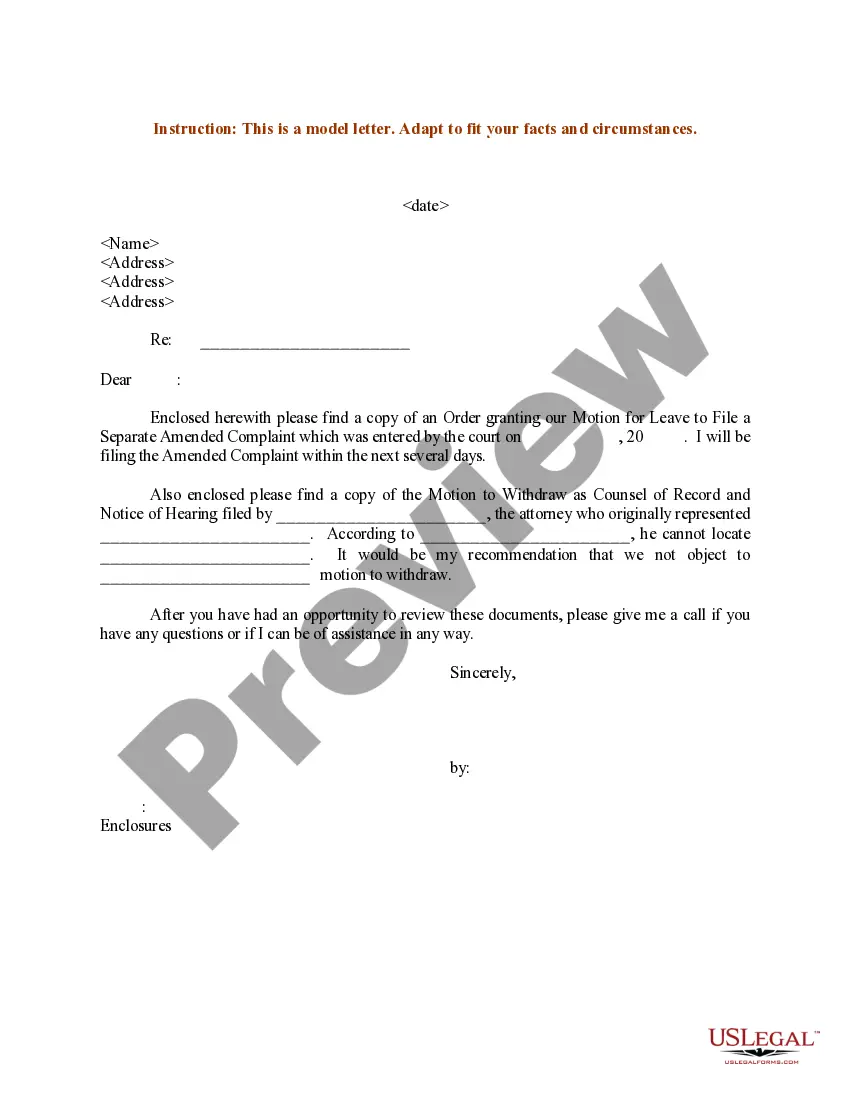
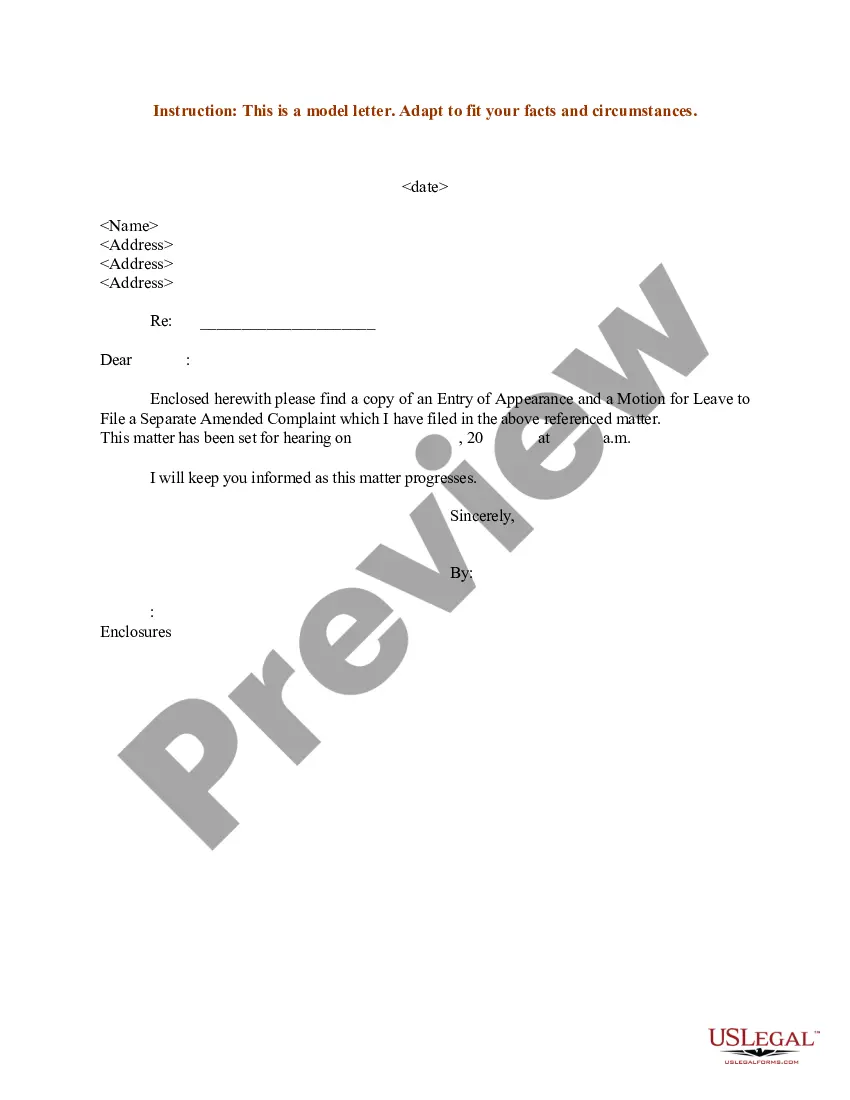
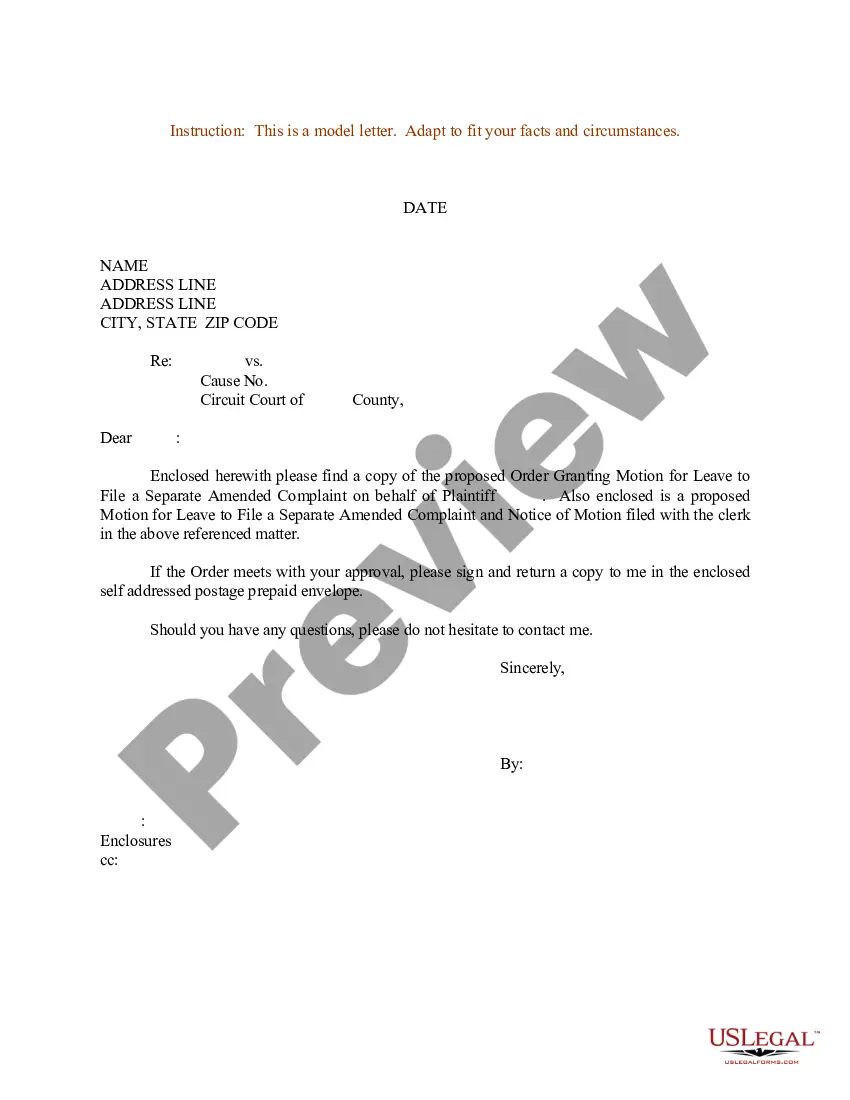
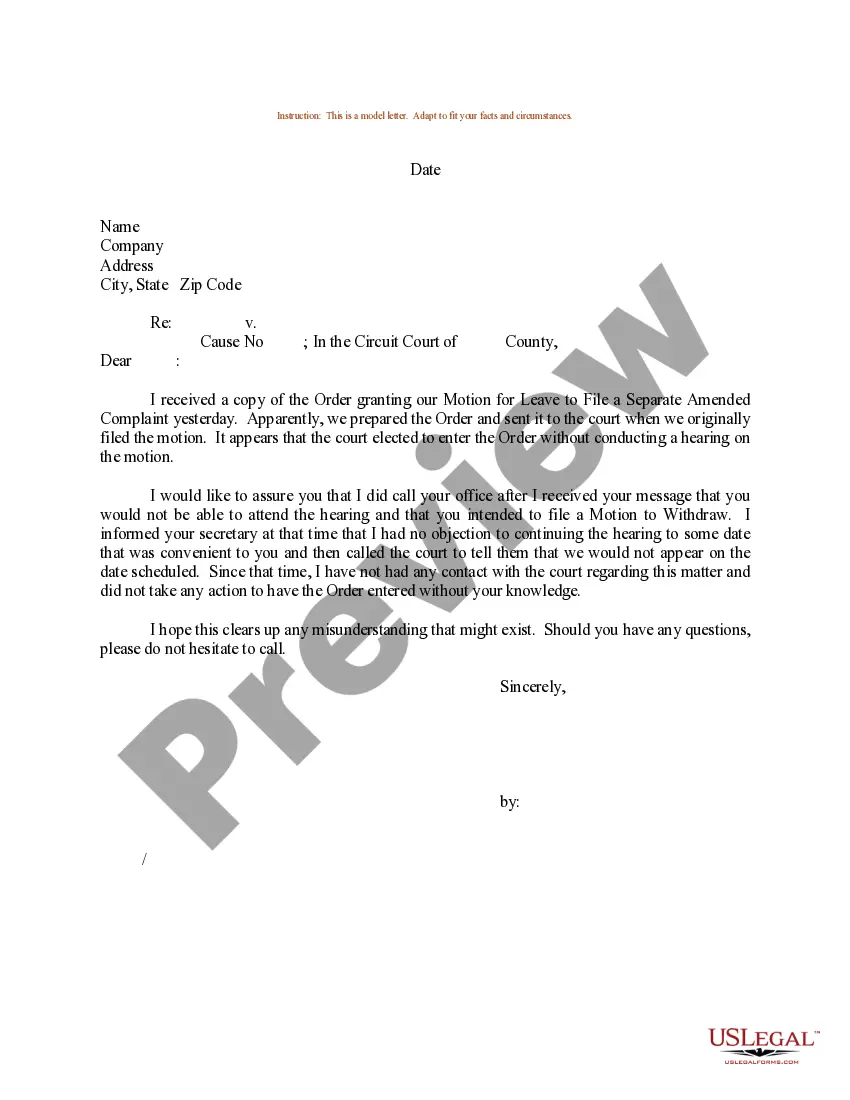
North Carolina Sample Letter regarding Order Granting Motion for Leave to File a Separate Amended Complaint
Description
Get your form ready online
Our built-in tools help you complete, sign, share, and store your documents in one place.
Make edits, fill in missing information, and update formatting in US Legal Forms—just like you would in MS Word.
Download a copy, print it, send it by email, or mail it via USPS—whatever works best for your next step.
Sign and collect signatures with our SignNow integration. Send to multiple recipients, set reminders, and more. Go Premium to unlock E-Sign.
If this form requires notarization, complete it online through a secure video call—no need to meet a notary in person or wait for an appointment.
We protect your documents and personal data by following strict security and privacy standards.

Make edits, fill in missing information, and update formatting in US Legal Forms—just like you would in MS Word.

Download a copy, print it, send it by email, or mail it via USPS—whatever works best for your next step.

Sign and collect signatures with our SignNow integration. Send to multiple recipients, set reminders, and more. Go Premium to unlock E-Sign.

If this form requires notarization, complete it online through a secure video call—no need to meet a notary in person or wait for an appointment.

We protect your documents and personal data by following strict security and privacy standards.
Looking for another form?



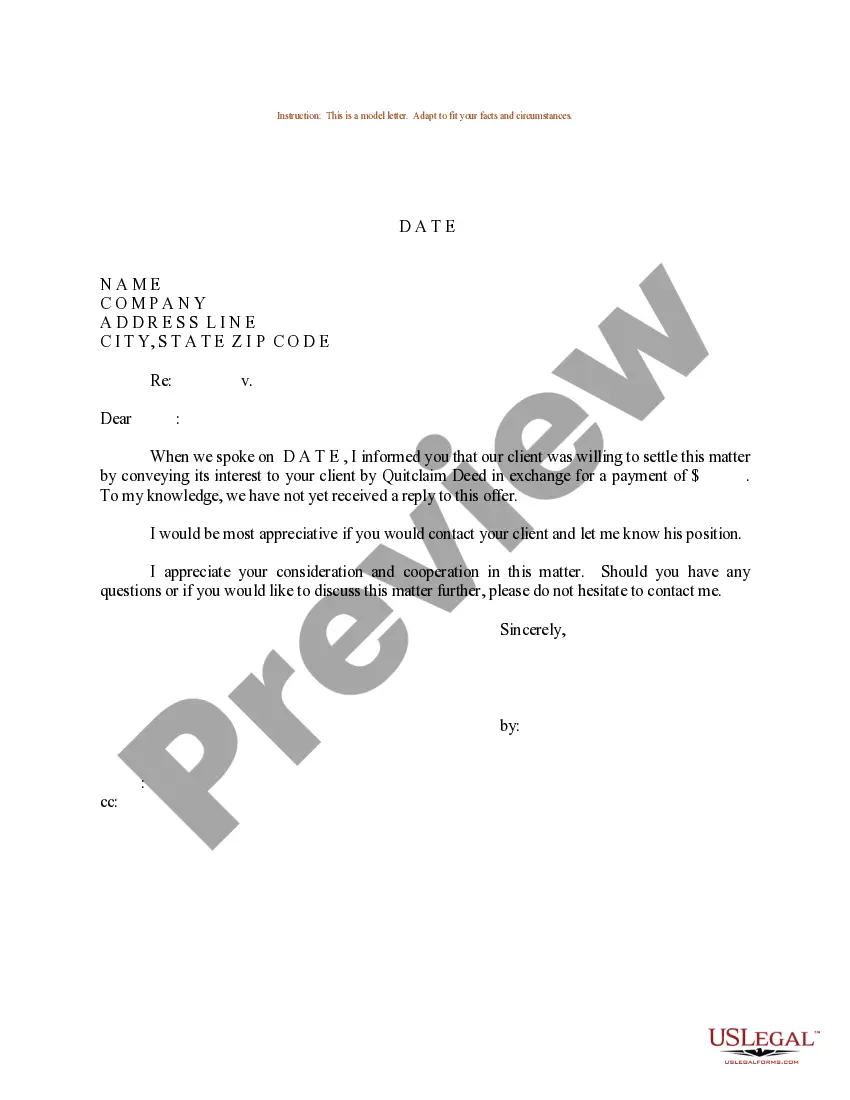
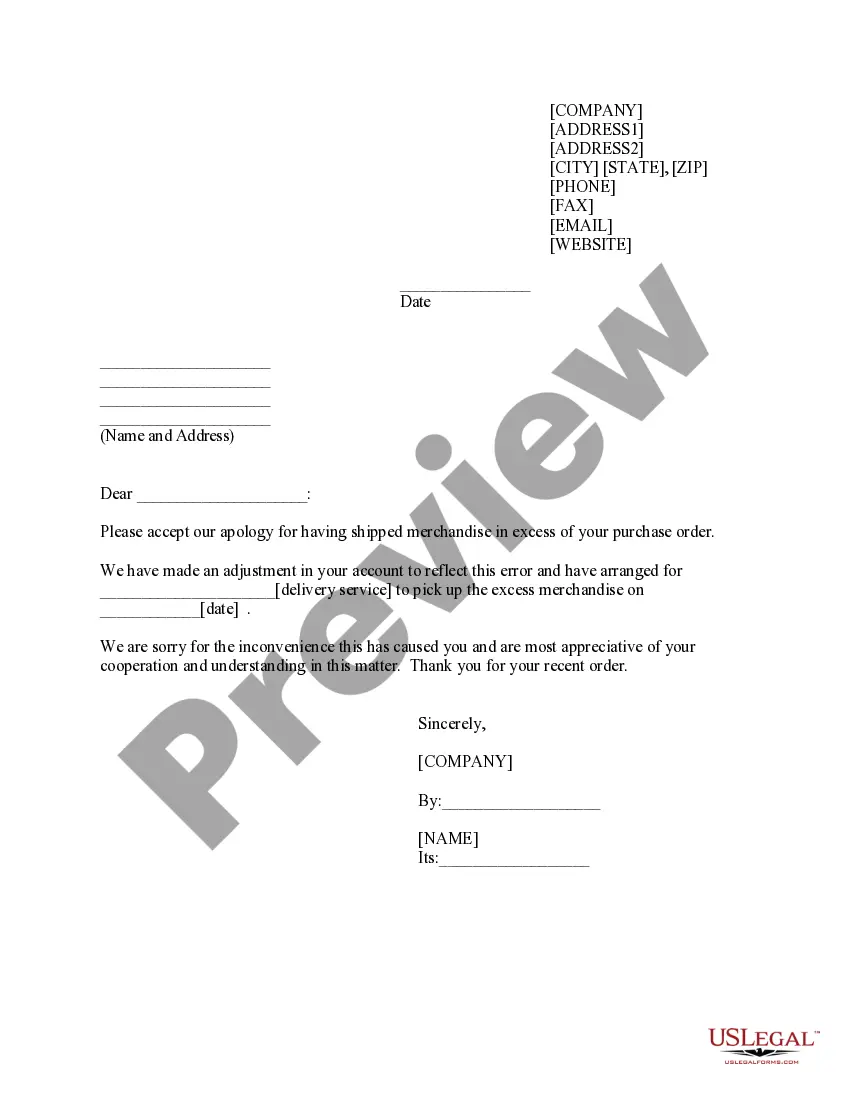
How to fill out Sample Letter Regarding Order Granting Motion For Leave To File A Separate Amended Complaint?
US Legal Forms - one of the biggest collections of authentic templates in the United States - provides a vast selection of legal document formats that you can download or print. By utilizing the website, you can access thousands of forms for commercial and personal purposes, categorized by type, state, or keywords. You can find the latest templates such as the North Carolina Sample Letter concerning Order Granting Motion for Leave to File a Separate Amended Complaint in moments.
If you already possess a subscription, Log In and download the North Carolina Sample Letter concerning Order Granting Motion for Leave to File a Separate Amended Complaint from the US Legal Forms library. The Download option will appear on every form you view. You can access all previously downloaded forms in the My documents section of your account.
If you intend to use US Legal Forms for the first time, here are simple instructions to assist you in getting started: Ensure you have selected the correct form for the city/state. Click on the Review option to examine the form's content. Read the form description to confirm that you have chosen the right form. If the form doesn’t meet your needs, utilize the Search field at the top of the screen to find one that does. If you are satisfied with the form, confirm your selection by clicking the Buy now option. Then, choose the pricing plan you desire and provide your credentials to register for an account. Process the payment. Use Visa or Mastercard or a PayPal account to complete the transaction. Select the format and download the form to your device. Make modifications. Complete, edit, print, and sign the downloaded North Carolina Sample Letter concerning Order Granting Motion for Leave to File a Separate Amended Complaint. Every template you added to your account does not expire and is yours permanently. Therefore, if you wish to download or print another copy, just navigate to the My documents section and click on the form you need.
- Access the North Carolina Sample Letter concerning Order Granting Motion for Leave to File a Separate Amended Complaint with US Legal Forms, the most extensive collection of legal document templates.
- Utilize thousands of professional and state-specific templates that fulfill your business or personal needs and requirements.
Form popularity
FAQ
? A party may amend his pleading once as a matter of course at any time before a responsive pleading is served or, if the pleading is one to which no responsive pleading is permitted and the action has not been placed upon the trial calendar, he may so amend it at any time within 30 days after it is served.
If you need to add important information to your civil complaint then you can ask for permission. This permission takes the form of a 'Motion for Leave to Amend Complaint'. There are several reasons to amend (such as new evidence, new cause of action, etc.).
Unless the court orders otherwise, any required response to an amended pleading must be made within the time remaining to respond to the original pleading or within 14 days after service of the amended pleading, whichever is later.
Explore the concept of the relation back of amendments, which allows an amended pleading to ?relate back? to the date that the original pleading was filed, which often comes up when an amended pleading is filed after the statute of limitations for a claim has passed.
Amend- ed pleadings allow the party to add claims, parties, or defenses based on facts that occurred before the original pleading was filed. Supplemental pleadings allow the party to add claims or defenses based on facts that occurred after the original plead- ing was filed.
Pleadings are amended for various reasons, including correcting facts, adding claims, adding affirmative defenses, or responding to a court's finding that a pleading is inadequate as a matter of law.
If a plaintiff files an amended complaint under Rule 15(a)(1) while a motion to dismiss is pending, the court has discretion to ?transfer? the motion to the new complaint (assuming the motion is still responsive to the amended complaint) or it can require the defendant to file a new motion (if, for example, resolving ...
An amended complaint is a written revision of the original complaint filed by a plaintiff or petitioner. Rule 15 of the federal rules of civil procedure allows the plaintiff to amend their complaint one time within 21 days of serving the original complaint or at any point before the defendant answers the complaint.