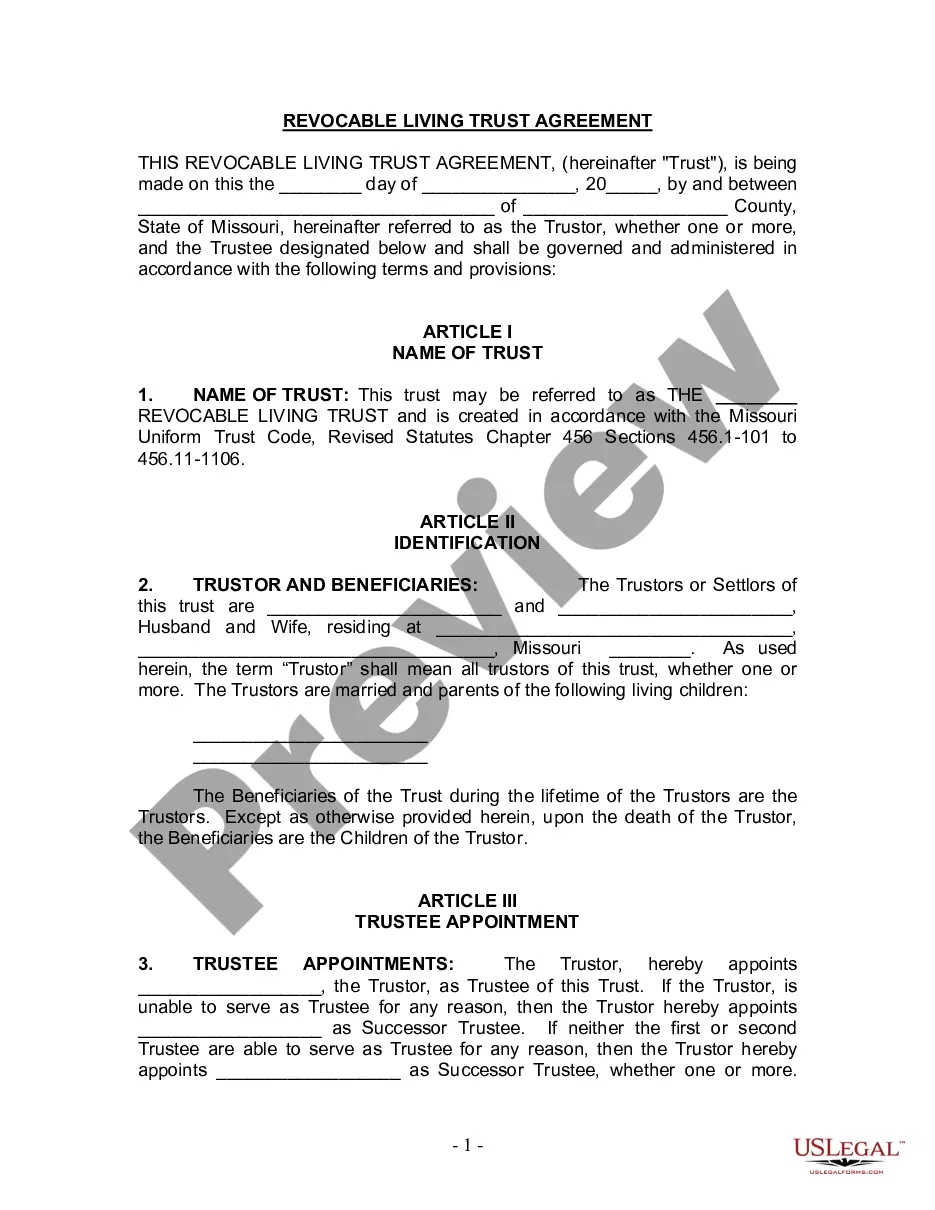
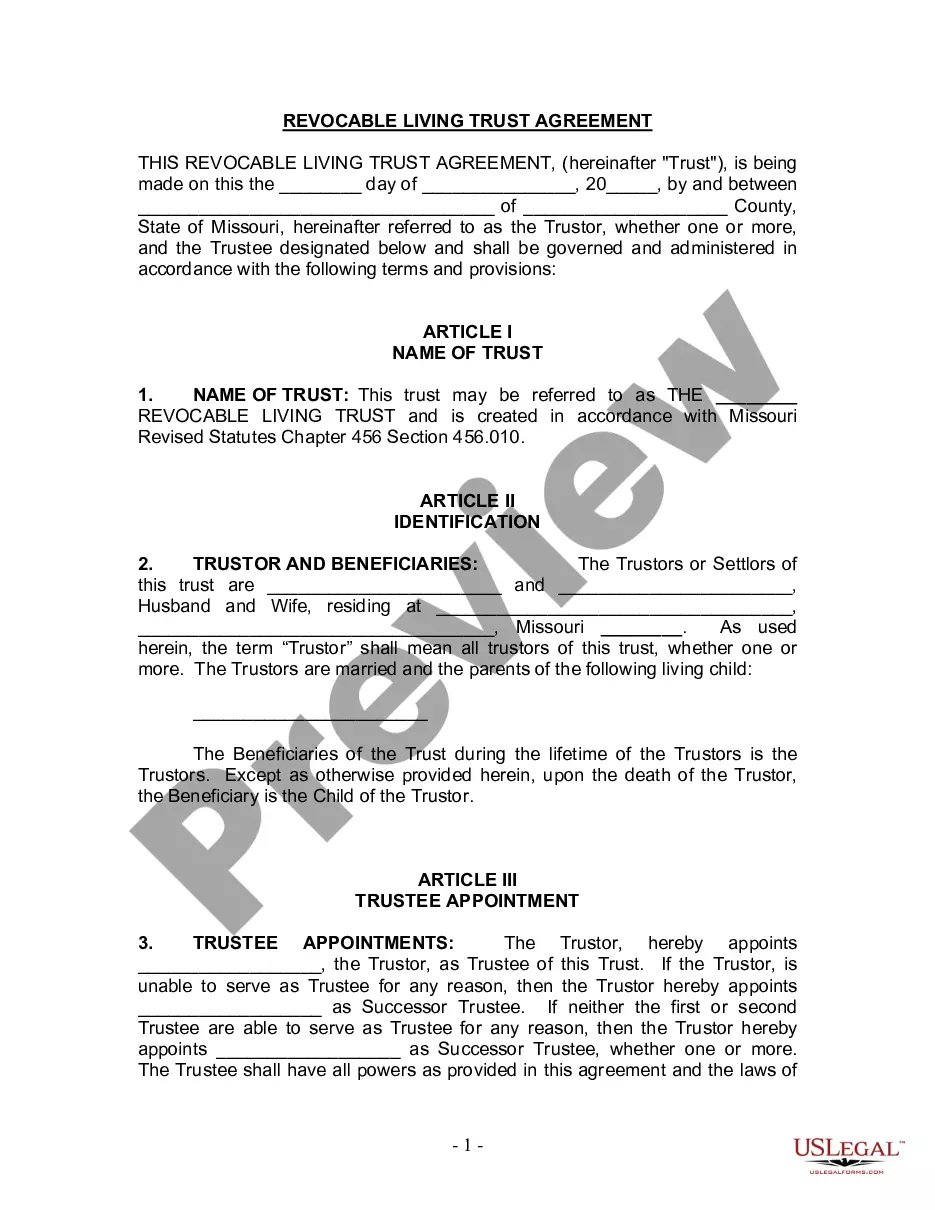
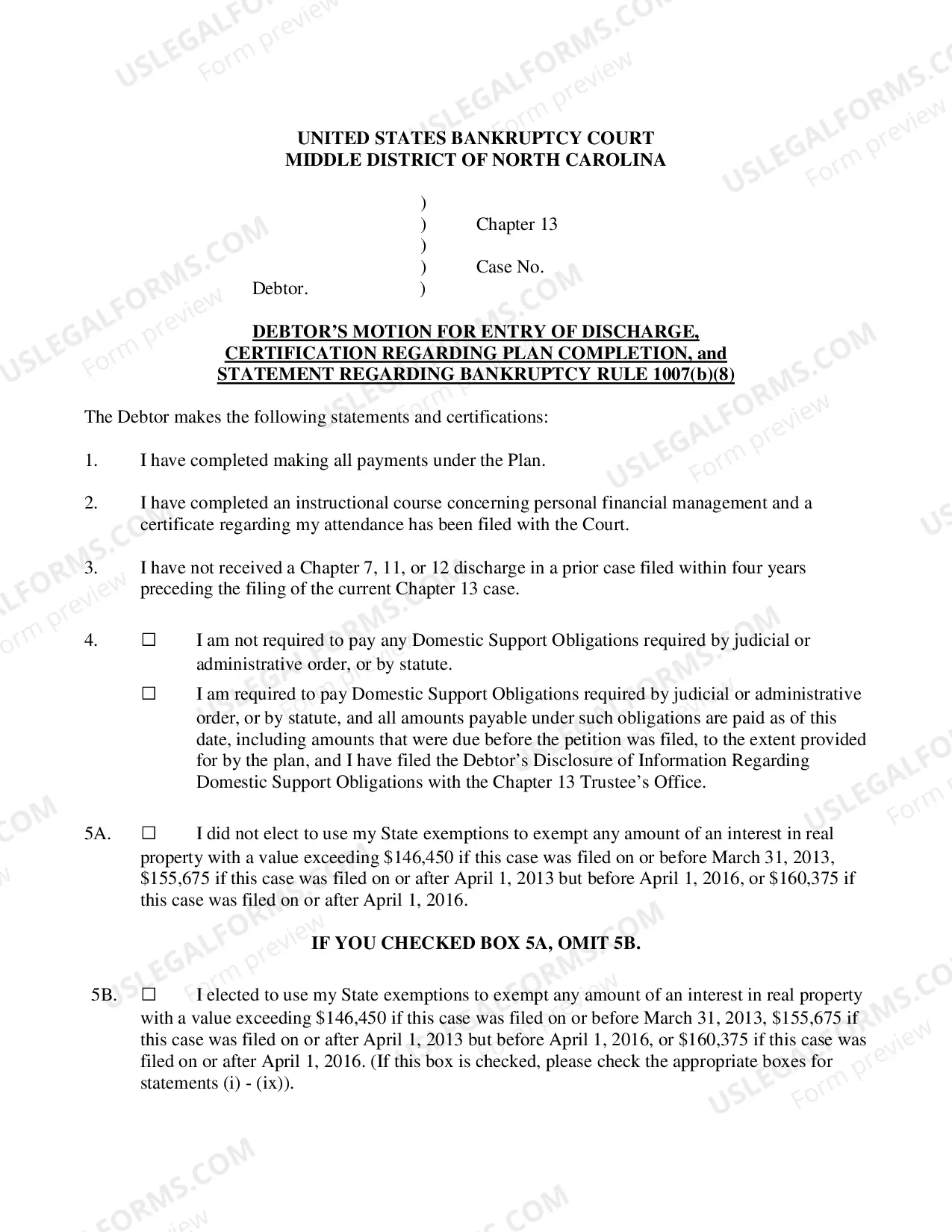
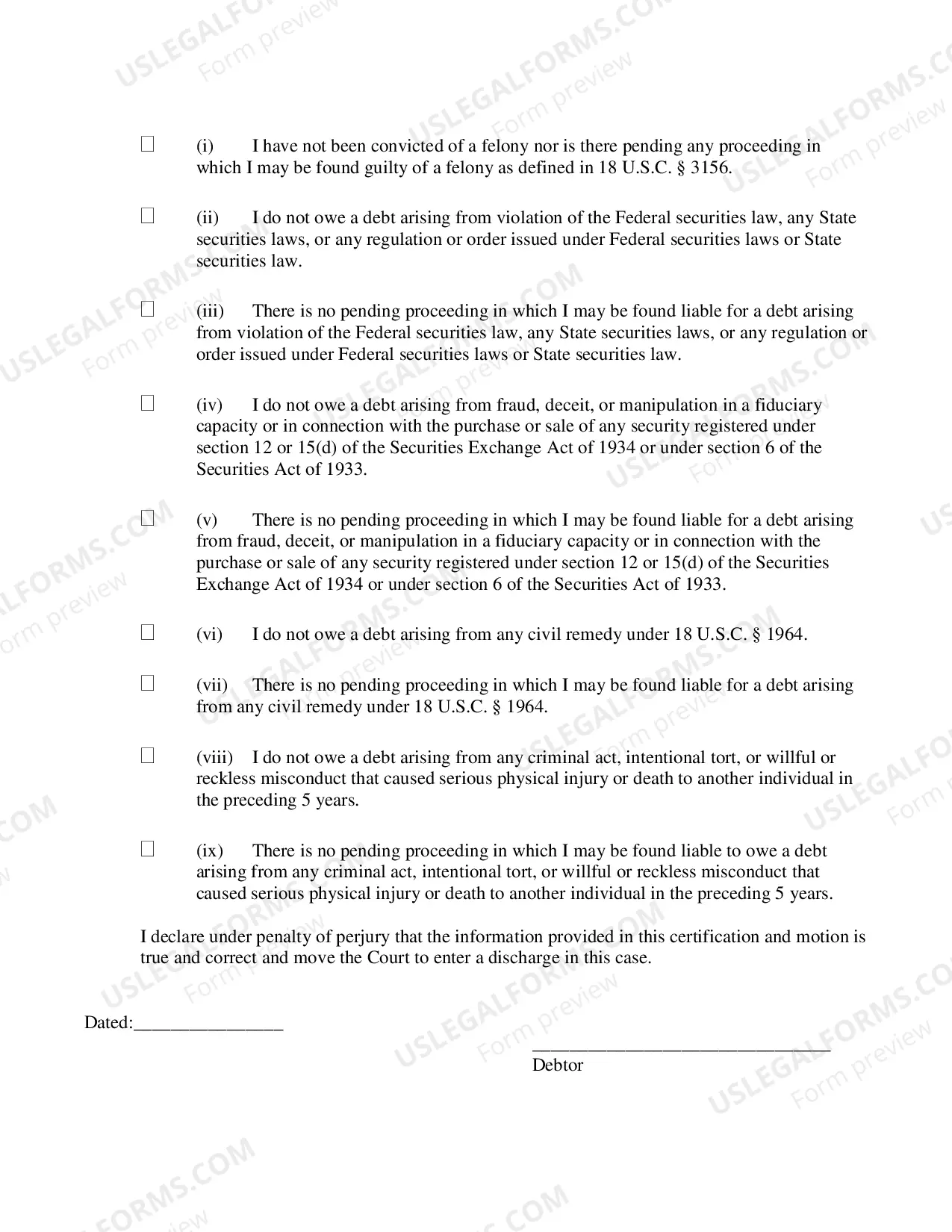
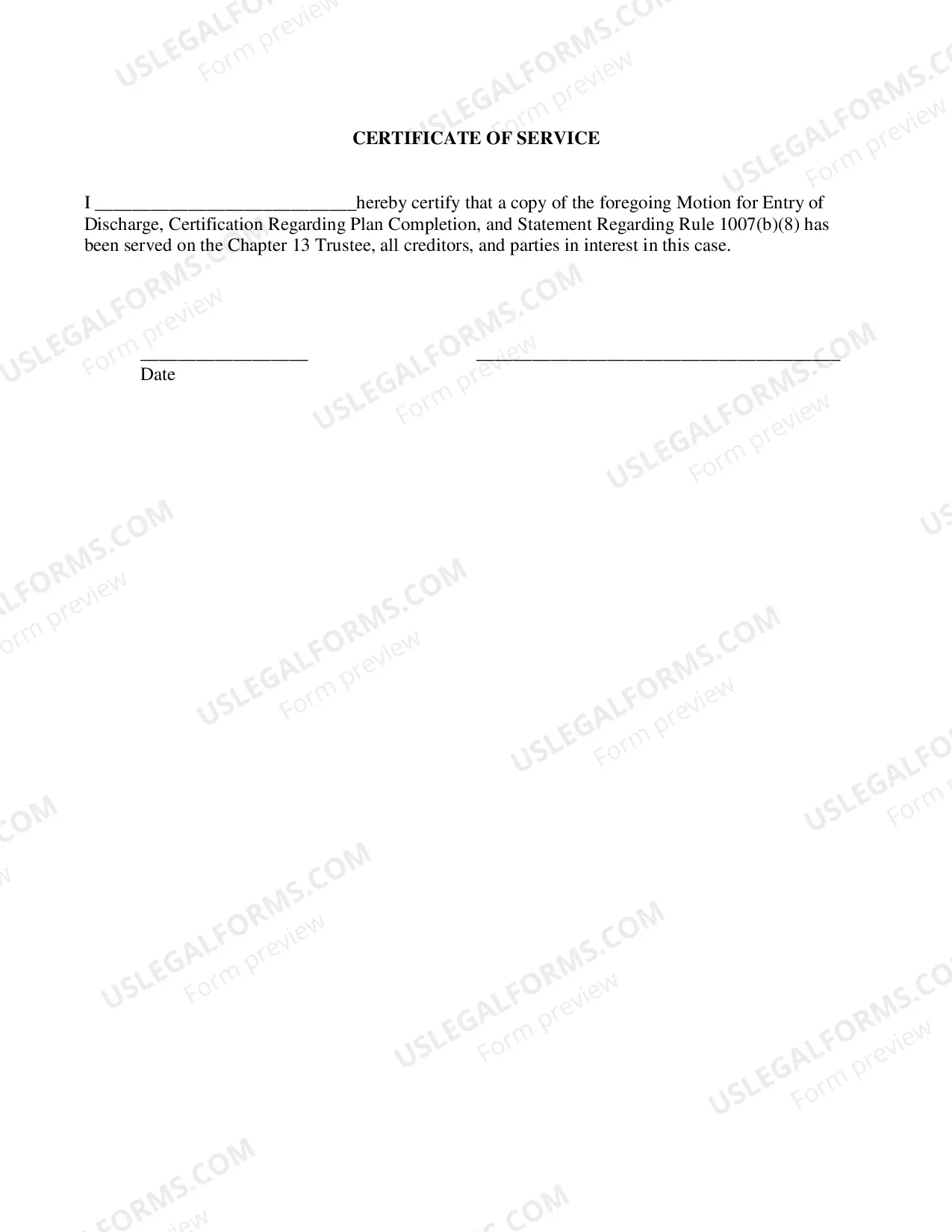
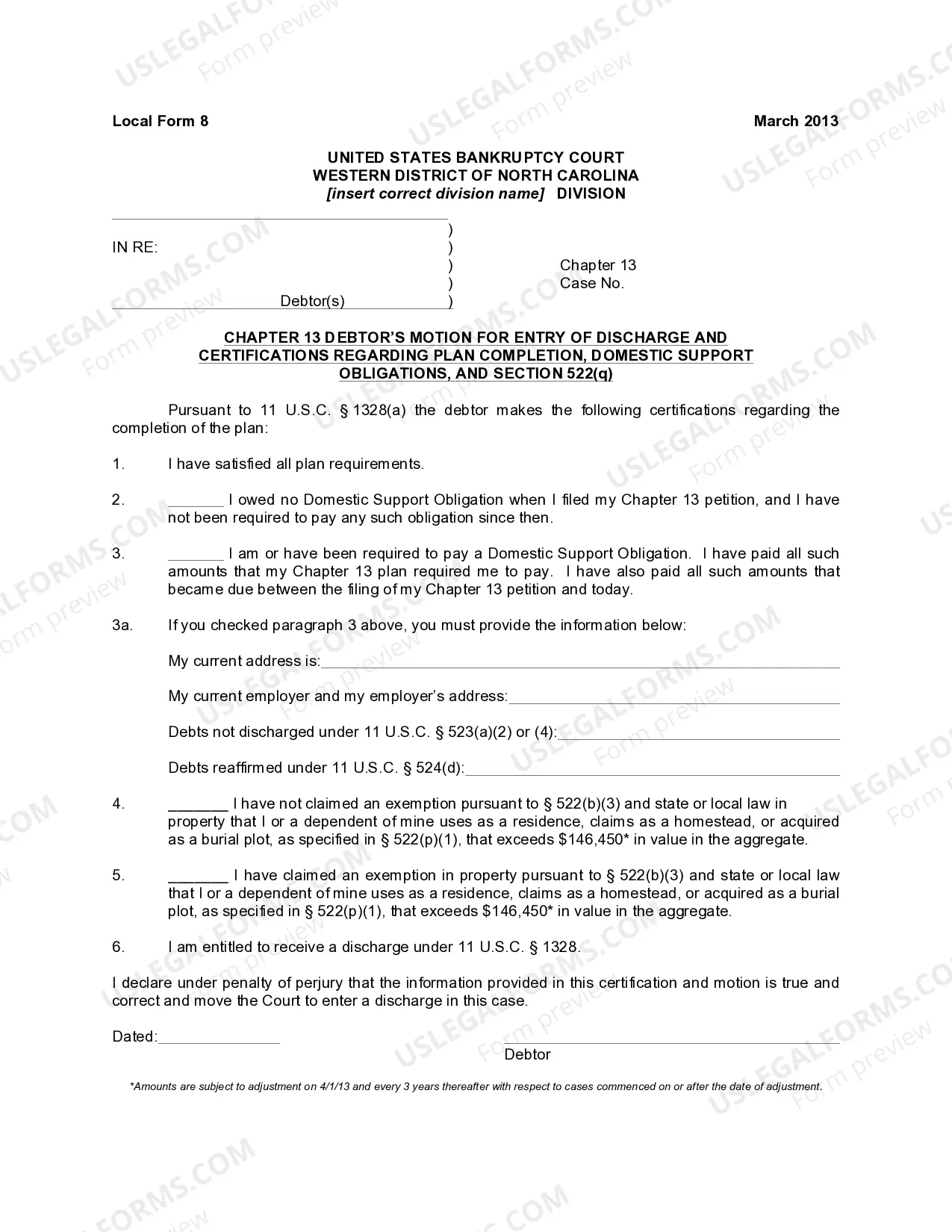
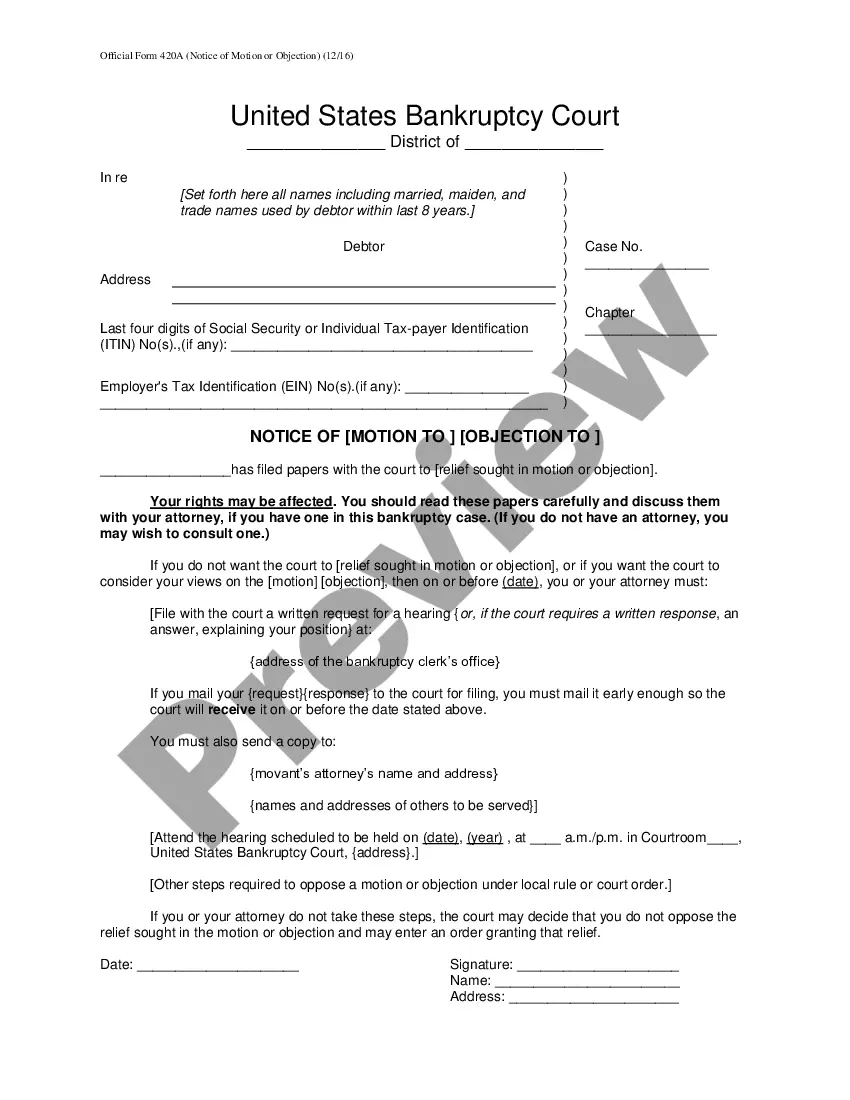
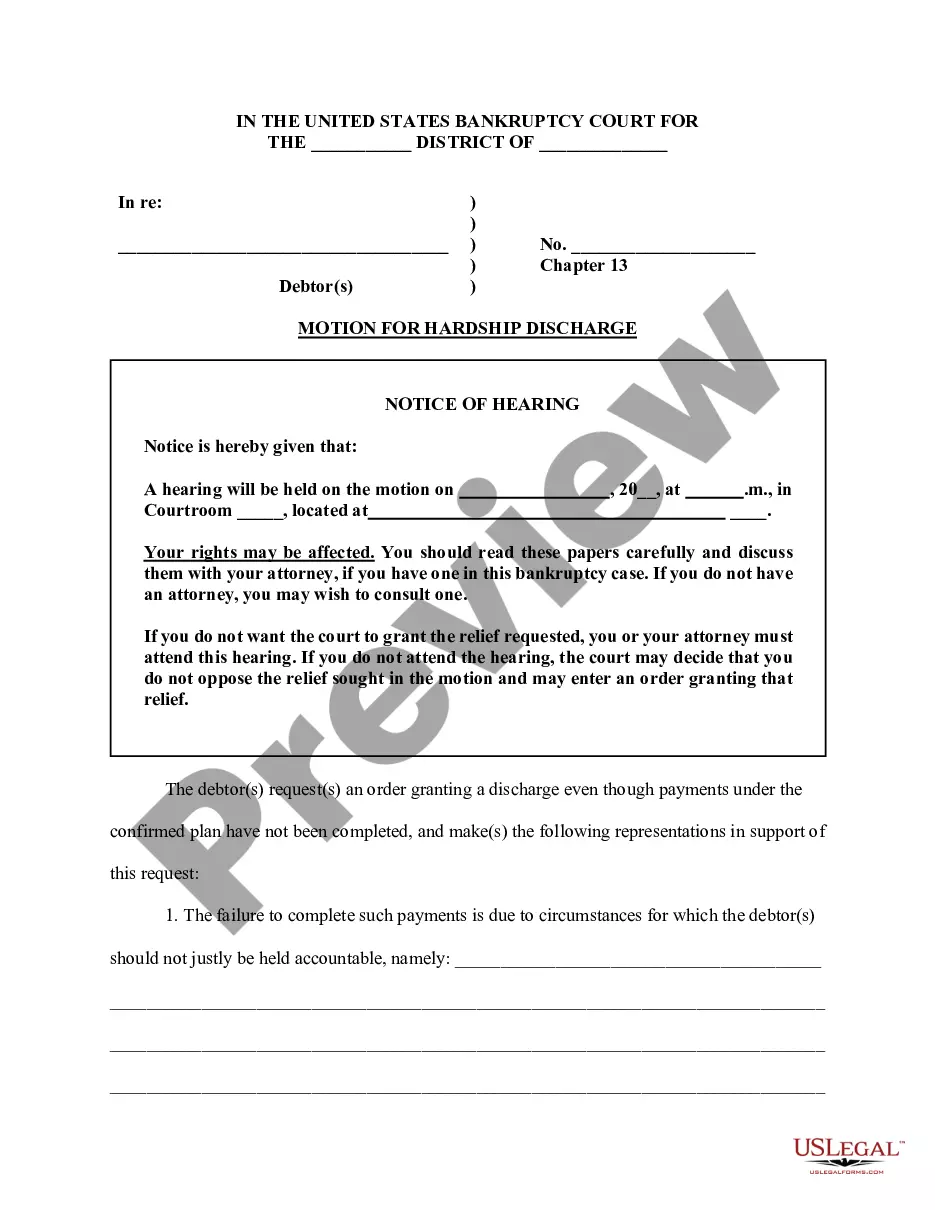
North Carolina Debtors Motion For Entry of Discharge is a legal document that allows a debtor in North Carolina to obtain a discharge of their debts. This motion is typically filed in the federal bankruptcy court where the debtor’s case was originally filed and must be accompanied by a proof of service of the motion to all creditors. The Motion seeks to have the court enter an order discharging the debtor from all debts that arose before the filing of the petition. There are two types of North Carolina Debtors Motion For Entry of Discharge: a Chapter 7 discharge and a Chapter 13 discharge. A Chapter 7 discharge eliminates all unsecured debts that are dischargeable, while a Chapter 13 discharge eliminates all unsecured debts that are not paid in full through the plan.
North Carolina Debtors Motion For Entry of Discharge
Description
Get your form ready online
Our built-in tools help you complete, sign, share, and store your documents in one place.
Make edits, fill in missing information, and update formatting in US Legal Forms—just like you would in MS Word.
Download a copy, print it, send it by email, or mail it via USPS—whatever works best for your next step.
Sign and collect signatures with our SignNow integration. Send to multiple recipients, set reminders, and more. Go Premium to unlock E-Sign.
If this form requires notarization, complete it online through a secure video call—no need to meet a notary in person or wait for an appointment.
We protect your documents and personal data by following strict security and privacy standards.

Make edits, fill in missing information, and update formatting in US Legal Forms—just like you would in MS Word.

Download a copy, print it, send it by email, or mail it via USPS—whatever works best for your next step.

Sign and collect signatures with our SignNow integration. Send to multiple recipients, set reminders, and more. Go Premium to unlock E-Sign.

If this form requires notarization, complete it online through a secure video call—no need to meet a notary in person or wait for an appointment.

We protect your documents and personal data by following strict security and privacy standards.
Looking for another form?
How to fill out North Carolina Debtors Motion For Entry Of Discharge?
Managing official documentation necessitates focus, precision, and utilizing well-prepared forms. US Legal Forms has been assisting individuals nationwide for 25 years, so when you select your North Carolina Debtors Motion For Entry of Discharge template from our platform, you can be assured it adheres to federal and state regulations.
Navigating our service is simple and efficient. To acquire the required document, all you need is an account with an active subscription. Here’s a concise guide for you to obtain your North Carolina Debtors Motion For Entry of Discharge in just minutes.
All documents are designed for multiple uses, including the North Carolina Debtors Motion For Entry of Discharge you see on this page. If you require them again, you can complete them without additional payment - just access the My documents tab in your profile and finalize your document whenever needed. Utilize US Legal Forms and prepare your business and personal documents swiftly and in complete legal compliance!
- Ensure to thoroughly review the form's content and its alignment with general and legal standards by previewing it or examining its description.
- Seek an alternative official template if the one you initially opened does not align with your circumstances or state laws (the tab for this is located in the upper page corner).
- Log in to your account and save the North Carolina Debtors Motion For Entry of Discharge in your chosen format. If it's your first visit to our site, click Buy Now to continue.
- Create an account, select your subscription option, and complete your payment using your credit card or PayPal account.
- Choose the format in which you wish to save your document and click Download. Print the form or upload it to a professional PDF editor for paperless submission.
Form popularity
FAQ
One common ground for denying a discharge is when the debtor ? with intent to hinder, delay, or defraud a creditor ? transfers, removes, destroys, mutilates, or conceals property within one year before the date of filing for bankruptcy or any time after the date of filing.
Under Federal Rules of Bankruptcy Procedure Rule 4004, a trustee or creditors have sixty (60) days after the first date set for the 341(a) Meeting of Creditors to file a complaint objecting to discharge.
To object to the debtor's discharge, a creditor must file a complaint in the bankruptcy court before the deadline set out in the notice. Filing a complaint starts a lawsuit referred to in bankruptcy as an "adversary proceeding."
A Debt Release Letter is a letter written by a creditor to a debtor when their debt has been recouped in full. It establishes that a financial obligation no longer exists between the creditor and debtor.
Once the debt is discharged by the bankruptcy court, the discharge permanently bars the creditor or debt collector from collection of the debt. Filing for bankruptcy can have long-term consequences so consult a bankruptcy attorney to learn more.
What happens when a creditor files an objection? A creditor's objection does not automatically prevent a discharge of debt. The debtor gets a chance to file an answer to the objection, and the court may hold a hearing to decide the issue. This is called an adversary proceeding, and it works much like any other lawsuit.
Debt collectors cannot try to collect on debts that were discharged in bankruptcy. Also, if you file for bankruptcy, debt collectors are not allowed to continue collection activities while the bankruptcy case is pending in court.
A creditor will usually object to the discharge of its particular debt when fraud or an intentional wrongful act occurs before the bankruptcy case. For instance, examples of nondischargeable debts, if proven, could include: The costs and damages caused by intentional and spiteful conduct.