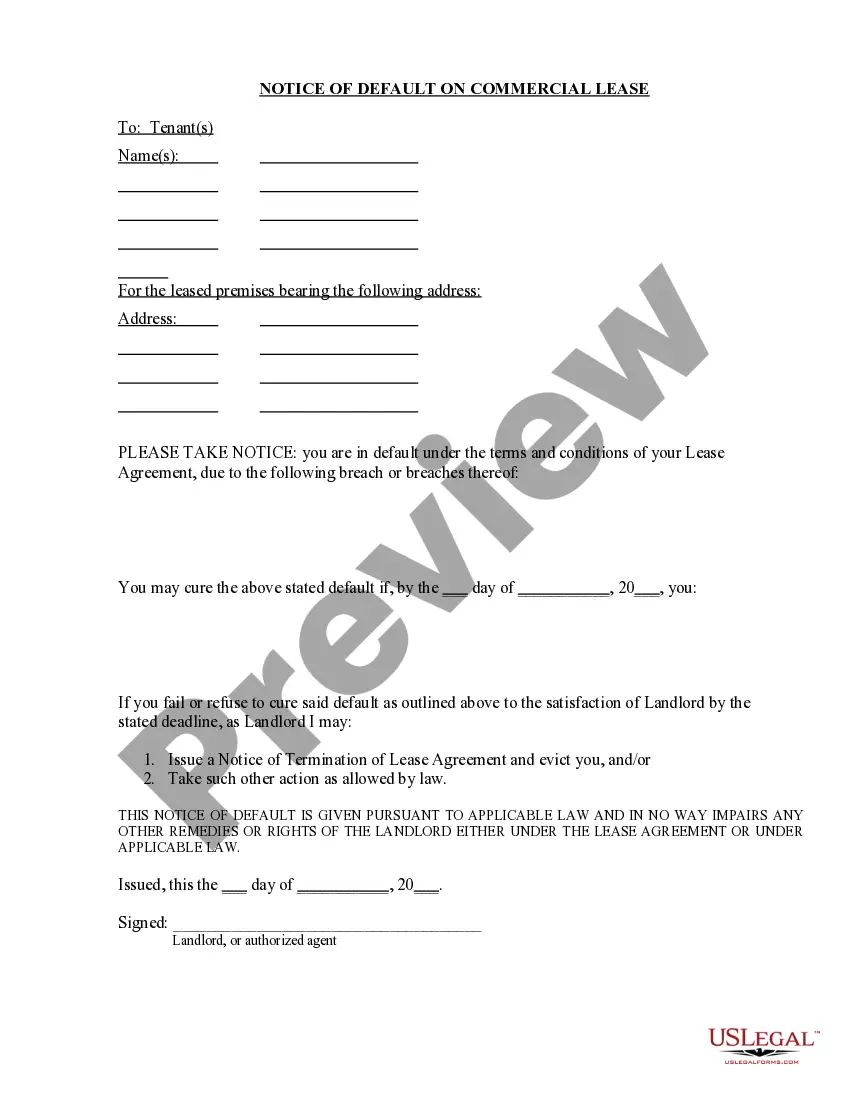
In landlord-tenant law, default refers to the failure of a tenant to timely pay rent due. In anticipation of such an occurence, landlords commonly require a new tenant to pay a security deposit, which may be used to remedy defaults in payment of rent and other monetary obligations under the rental agreement. In general, the landlord is required to give the tenant notice of the default before bringing eviction proceedings or applying security deposit proceeds to the payment in default. The fixing of a definite default date for payment of rent can be critical if it becomes necessary to evict a tenant for a default in the payment of rent. Landlords often require a background and/or reference check on prospective tenants in an attempt to minimize defaults in rent payments.
North Carolina Letter from Landlord to Tenant as Notice of Default on Commercial Lease
Description
How to fill out North Carolina Letter From Landlord To Tenant As Notice Of Default On Commercial Lease?
Avoid pricey attorneys and find the North Carolina Letter from Landlord to Tenant as Notice of Default on Commercial Lease you want at a reasonable price on the US Legal Forms website. Use our simple categories function to search for and obtain legal and tax documents. Go through their descriptions and preview them before downloading. In addition, US Legal Forms provides users with step-by-step instructions on how to obtain and complete each template.
US Legal Forms clients basically need to log in and get the specific document they need to their My Forms tab. Those, who haven’t obtained a subscription yet need to follow the guidelines below:
- Make sure the North Carolina Letter from Landlord to Tenant as Notice of Default on Commercial Lease is eligible for use in your state.
- If available, read the description and make use of the Preview option just before downloading the sample.
- If you’re confident the template fits your needs, click Buy Now.
- In case the form is incorrect, use the search field to get the right one.
- Next, create your account and choose a subscription plan.
- Pay out by card or PayPal.
- Choose to download the form in PDF or DOCX.
- Just click Download and find your form in the My Forms tab. Feel free to save the form to your device or print it out.
After downloading, you may complete the North Carolina Letter from Landlord to Tenant as Notice of Default on Commercial Lease manually or with the help of an editing software program. Print it out and reuse the template many times. Do more for less with US Legal Forms!
Form popularity
FAQ
Anyone renting a building, whether for commercial or personal use, has the right to privacy. You are entitled to do anything on the property that you wish, so long as whatever you are doing is legal. The landlord cannot prevent you from operating your business nor from allowing guests or patrons on the property.
For example, the lease may provide that in case of default, the landlord can recover late fees and interest. If the lease is a net lease, it may provide for the landlord to recover such things as property taxes, insurance, utilities, maintenance and repairs.
-Landlords shall not, for reason of late payment or nonpayment, initiate or take any action to further summary ejectment or other eviction proceedings against a Commercial Tenant for reason caused by the COVID-19 pandemic, perform self-help eviction of a Commercial Tenant, require Commercial Tenants to vacate their
If you're an assured tenant or a protected tenant Your landlord will have to give you notice if they want you to leave. They have to give the reasons why they want to evict you - for example, if you have rent arrears or you've damaged the property. Your landlord will have to go to court and get a court order.
If the commercial tenant is a shell corporation and/or does not have any assets of value, the commercial tenant may choose to walk away from its commercial lease obligations.Often the landlord will require guarantees in order to prevent a commercial tenant from walking away from its lease obligations.
A break-early fee is a lump sum payment. The amount of the break-early fee will vary greatly depending upon the commercial tenant's specific circumstances. In exchange for the break-early fee, the landlord will agree to release the commercial tenant from all of its obligations under the commercial lease.
Look for a clause: Re-read your lease and look for either a bailout clause or a co-tenancy clause. Ask: If you are in a good space in a popular area, your landlord will be more inclined to an early termination of the lease than if you are in a bad space in a hard-to-rent location.
Landlords can try and forfeit a lease if a tenant is in breach of their obligations (this assumes that the lease document includes a right to forfeit).If a commercial lease contains a break clause, either or both parties to the agreement may seek to terminate the lease before its fixed period has ended.