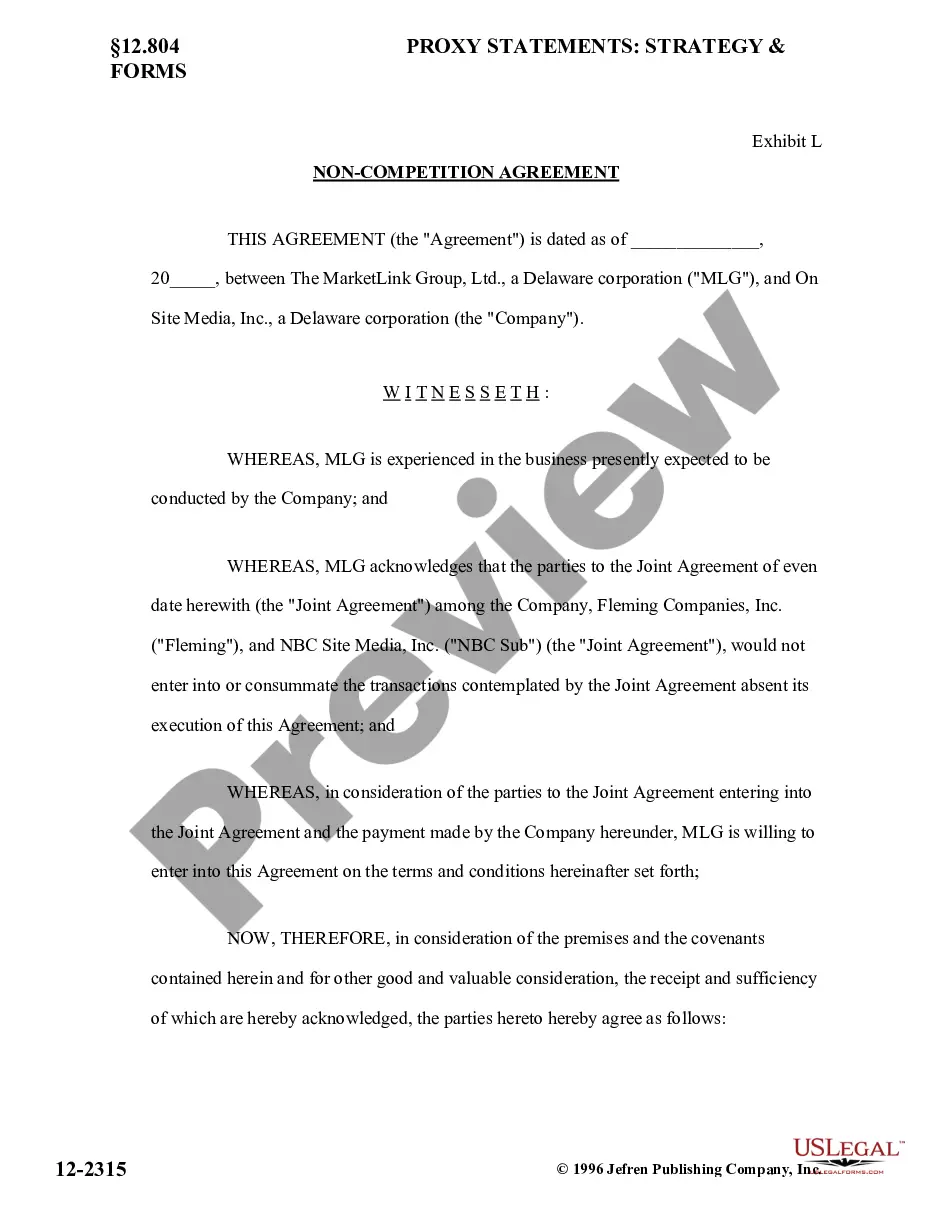
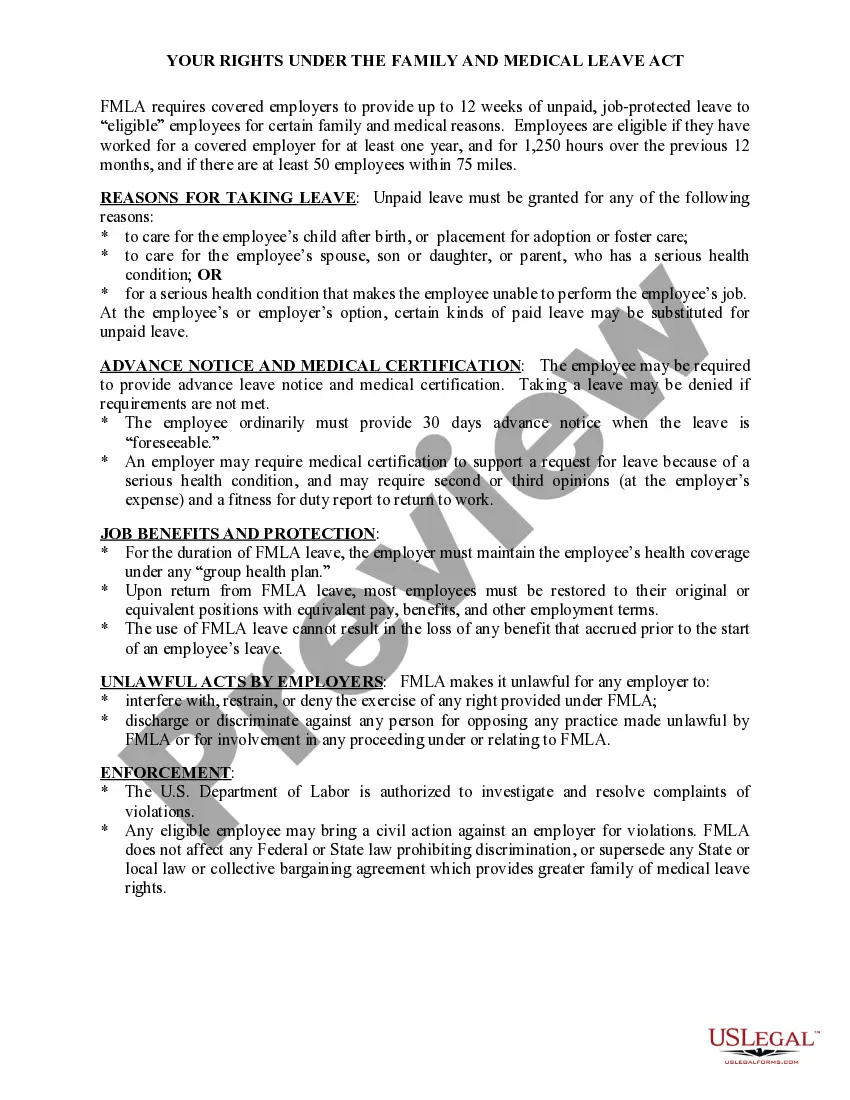
Montana Employee Rights Under the Family and Medical Leave Act
Description

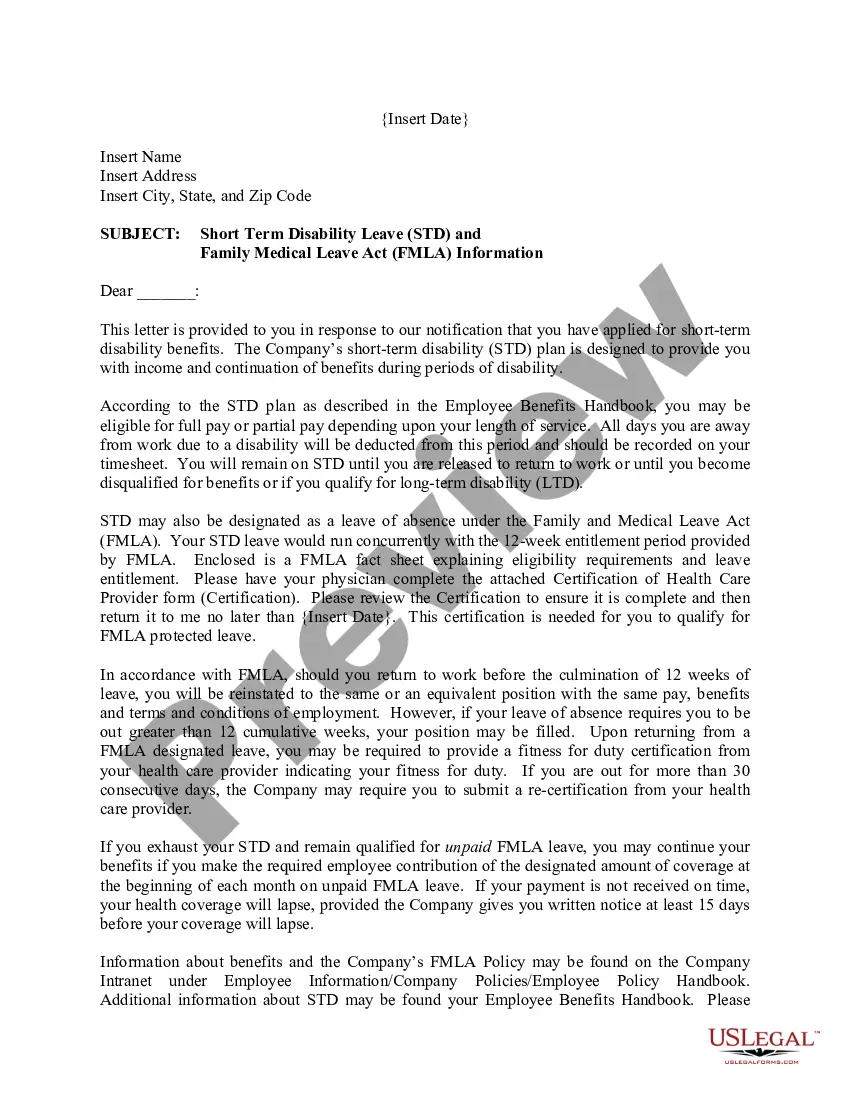
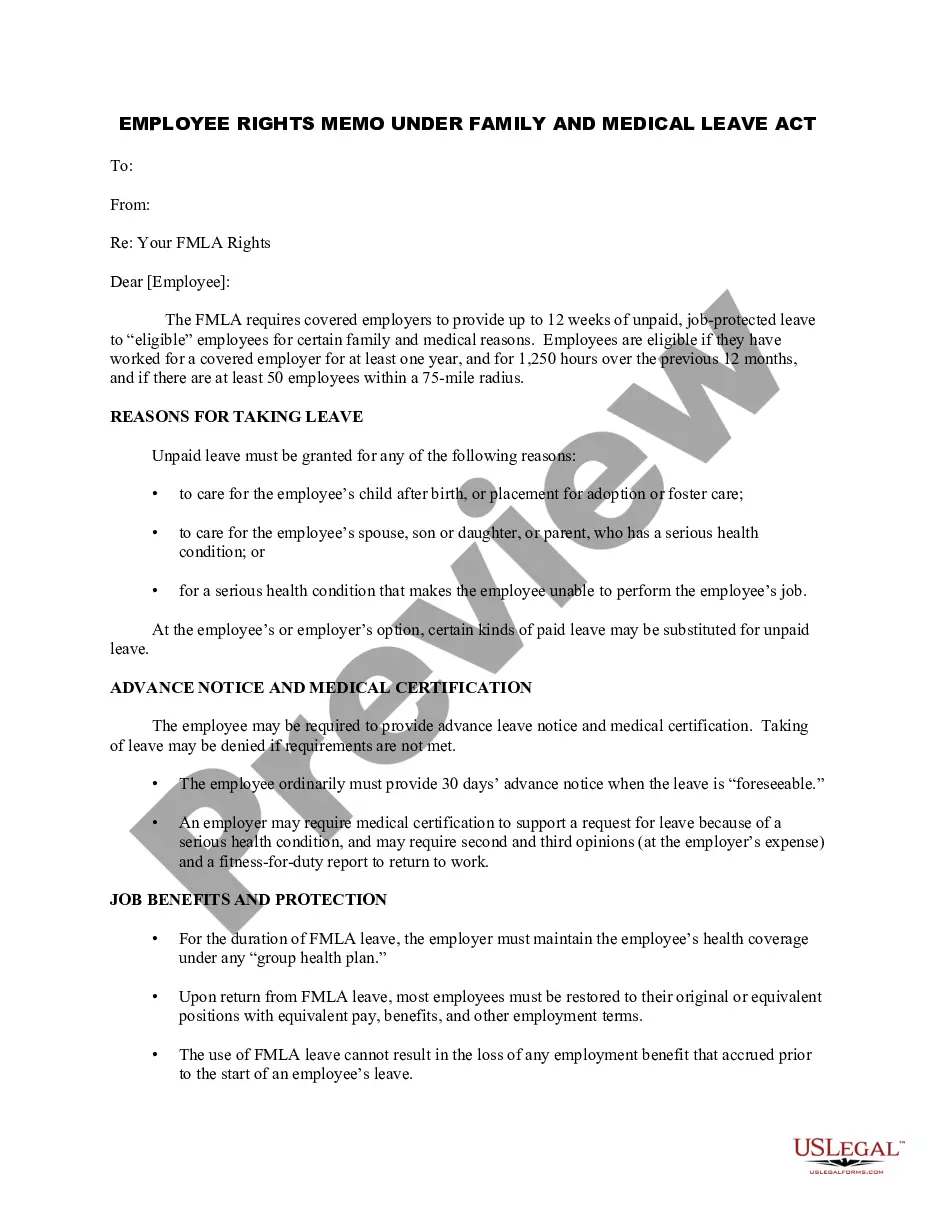

How to fill out Employee Rights Under The Family And Medical Leave Act?
US Legal Forms - one of the most prominent collections of legal documents in the USA - offers a broad selection of legal template types that you can download or create.
By utilizing the website, you can access thousands of forms for business and personal purposes, categorized by groups, states, or keywords. You can find the latest forms such as the Montana Employee Rights Under the Family and Medical Leave Act in a matter of seconds.
If you are a member, Log In and download the Montana Employee Rights Under the Family and Medical Leave Act from the US Legal Forms library. The Download button will appear on each form you preview. You can access all previously saved forms within the My documents section of your account.
Every template you added to your account has no expiration date and is yours indefinitely. So, if you want to download or print another copy, just go to the My documents section and click on the form you need.
Access the Montana Employee Rights Under the Family and Medical Leave Act with US Legal Forms, one of the largest collections of legal document templates. Utilize a vast array of professional and state-specific templates that cater to your business or personal needs.
- Ensure you have selected the correct form for your city/state. Click the Preview button to review the content of the form. Check the form summary to confirm that you have chosen the correct form.
- If the form does not meet your requirements, use the Search area at the top of the screen to locate one that does.
- Once you are satisfied with the form, confirm your choice by clicking the Get now button. Then, select your preferred pricing plan and provide your credentials to register for the account.
- Process the transaction. Use your credit card or PayPal account to complete the transaction.
- Select the format and download the form to your device.
- Edit. Fill out, amend, and print and sign the saved Montana Employee Rights Under the Family and Medical Leave Act.
Form popularity
FAQ
The Family Act in Montana refers to the Family and Medical Leave Act (FMLA), which allows eligible employees to take unpaid leave for specific family and medical reasons. Under Montana Employee Rights Under the Family and Medical Leave Act, individuals can protect their jobs while addressing personal health issues or caring for family members. This act is vital for ensuring that employees do not have to choose between their job and their personal or family health needs.
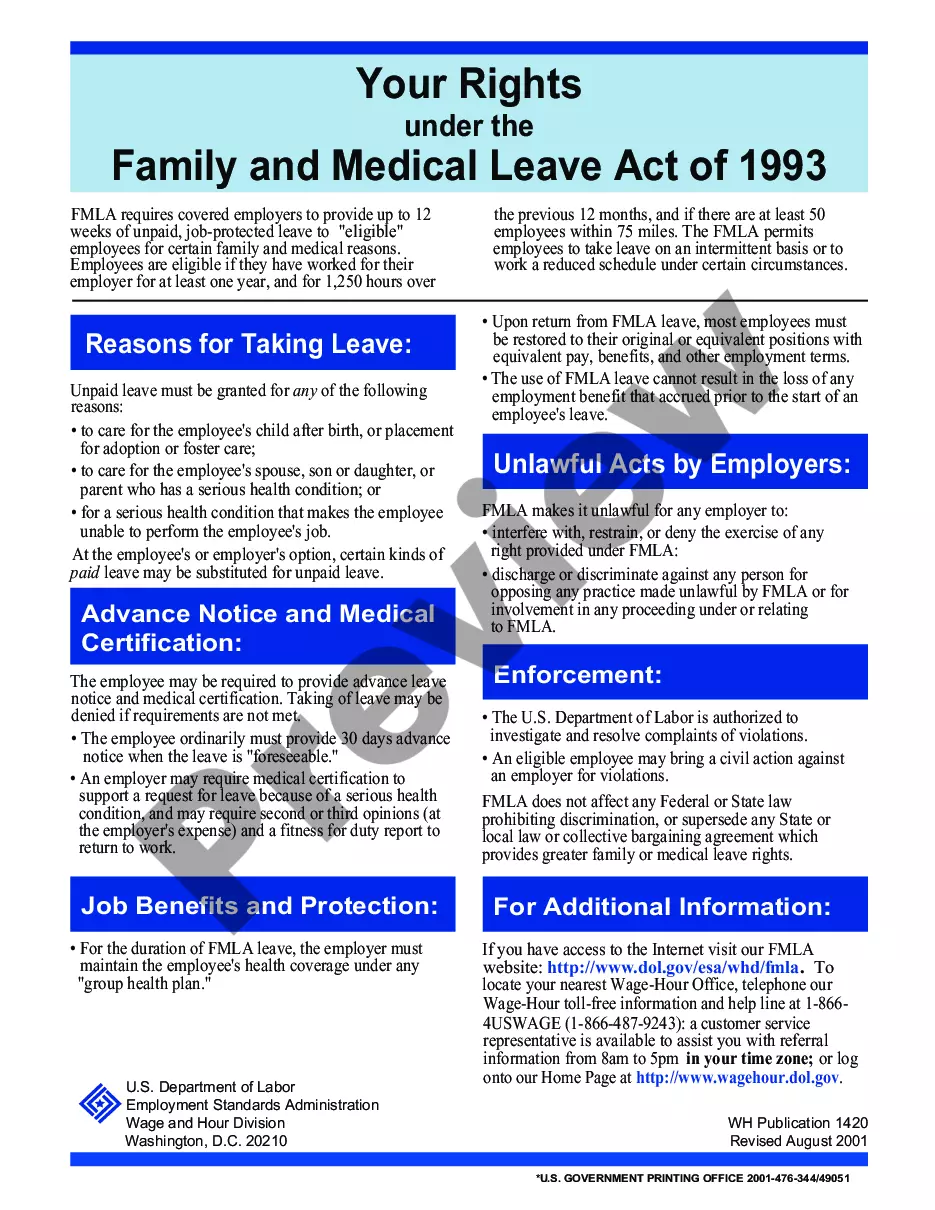
Colorado employers must comply with the FMLA if they have at least 50 employees for at least 20 weeks in the current or previous year. Employees are eligible for FMLA leave if: they have worked for the company for at least a year. they worked at least 1,250 hours during the previous year, and.
The FAMLI Act Provides Paid Leave for Montanans The FAMLI Act functions similarly to how unemployment insurance work. Employers and employees would both contribute a small amount less than one half of 1 percent of a workers' wages to the FAMLI fund.
In order to be eligible to take leave under the FMLA, an employee must (1) work for a covered employer, (2) work 1,250 hours during the 12 months prior to the start of leave, (3) work at a location where 50 or more employees work at that location or within 75 miles of it, and (4) have worked for the employer for 12
The FMLA was signed into law by President Bill Clinton in 1993. It allows workers to take up to 12 weeks of unpaid leave to bond with a newborn, newly adopted or newly placed child; care for a seriously ill child, spouse or parent; or care for their own serious health condition without fear of losing their jobs.
The Family and Medical Leave Act supports families' caregiving responsibilities for new or ill immediate family members. Because of the legislation, employees who qualify for leave no longer have to make the difficult decision between losing their jobs to care for family members or finding alternative care.
The employee must: Have worked for the employer for at least 12 months; 2022 Have at least 1,250 hours of service in the 12 months before taking leave; and 2022 Work at a location where the employer has at least 50 employees within 75 miles of the employee's worksite.
The 1993 Family and Medical Leave Act (FMLA) allows parents to take time from work for births and adoptions. -- The Family and Medical Leave Act (FMLA), allows parents to take up to 3 months of unpaid leave. Which of the following best describes job sharing? Job sharing is when two workers split a single full-time job.
The Family and Medical Leave Act (FMLA) provides certain employees with up to 12 weeks of unpaid, job-protected leave per year. It also requires that their group health benefits be maintained during the leave.
Below is a summary and descriptions of reasons that qualify for FMLA leave under current FMLA regulations.Parental Leave after the Birth of a Child.Pregnancy Leave.Adoption or Foster Care.Medical Leave to Care for a Family Member with a Serious Health Condition.Medical Leave for Your Own Serious Health Condition.More items...?