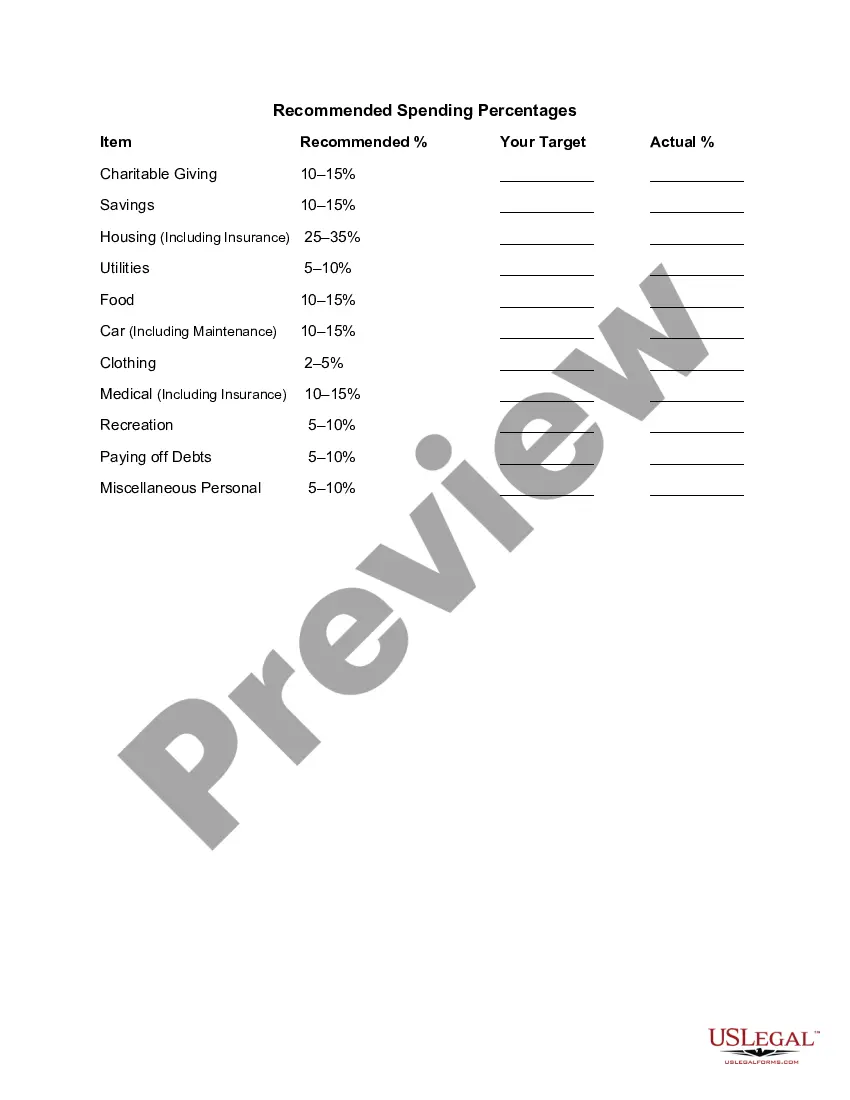
Montana Recommended Spending Percentages
Description
Get your form ready online
Our built-in tools help you complete, sign, share, and store your documents in one place.
Make edits, fill in missing information, and update formatting in US Legal Forms—just like you would in MS Word.
Download a copy, print it, send it by email, or mail it via USPS—whatever works best for your next step.
Sign and collect signatures with our SignNow integration. Send to multiple recipients, set reminders, and more. Go Premium to unlock E-Sign.
If this form requires notarization, complete it online through a secure video call—no need to meet a notary in person or wait for an appointment.
We protect your documents and personal data by following strict security and privacy standards.

Make edits, fill in missing information, and update formatting in US Legal Forms—just like you would in MS Word.

Download a copy, print it, send it by email, or mail it via USPS—whatever works best for your next step.

Sign and collect signatures with our SignNow integration. Send to multiple recipients, set reminders, and more. Go Premium to unlock E-Sign.

If this form requires notarization, complete it online through a secure video call—no need to meet a notary in person or wait for an appointment.

We protect your documents and personal data by following strict security and privacy standards.
Looking for another form?





How to fill out Recommended Spending Percentages?
You might spend hours online looking for the appropriate file format that meets both state and federal requirements you will require.
US Legal Forms provides thousands of authentic templates that can be reviewed by professionals.
You can actually obtain or print the Montana Recommended Spending Percentages from my assistance.
If available, utilize the Preview button to view the format as well.
- If you already possess a US Legal Forms account, you can Log In and click the Download button.
- Subsequently, you can complete, modify, print, or sign the Montana Recommended Spending Percentages.
- Every authentic template you purchase is yours indefinitely.
- To acquire another copy of any purchased document, navigate to the My documents section and click the corresponding button.
- If you are accessing the US Legal Forms site for the first time, follow the simple instructions below.
- First, ensure that you have selected the correct template for the area/city of your preference.
- Check the document description to confirm that you have chosen the right template.
Form popularity
FAQ
Montana's budget basics According to the National Association of State Budget Officers (NASBO), Montana's total expenditures in fiscal year (FY) 2021 were $11.1 billion, including general funds, other state funds, bonds, and federal funds.
Taxes collected from both direct tax and indirect tax are the government's tax revenue. It includes collections from income tax, corporation tax, customs, wealth tax, tax on land revenue, etc. Direct tax is the tax that is paid directly to the government by the person or company on whom it is levied.
Terms in this set (14) The main revenue sources for state and local governments are sales taxes, property taxes, and revenue passed along from the federal government. State and local governments collect taxes imposed on business firms.
State and local governments collect tax revenues from three primary sources: income, sales, and property taxes. Income and sales taxes make up the majority of combined state tax revenue, while property taxes are the largest source of tax revenue for local governments, including school districts.
Why Do We Pay Taxes? Taxes are the primary source of revenue for most governments. Among other things, this money is spent to improve and maintain public infrastructure, including the roads we travel on, and fund public services, such as schools, emergency services, and welfare programs.
Expenditures generally include spending on government salaries, infrastructure, education, public pensions, public assistance, corrections, Medicaid, and transportation.
What do state and local governments spend money on? State and local governments spend most of their resources on education, health, and social service programs. In 2019, about one-third of state and local spending went toward combined elementary and secondary education (22 percent) and higher education (9 percent).
Montana's economy is dominated by the primary sectoragriculture, forestry, mining, and energy productionand by services. About one-third of the state's workforce is employed in the service sector. The outdoor recreation industry has become important, and some high-technology industries have come to the state.
Taxes on Goods and Services. The sales tax is most often used as a method for states and local governments to raise revenue. Purchases made at the retail level are assessed a percentage of the sales price of a particular item. Rates vary widely between jurisdictions with 45 state collecting sales tax.