Montana Beneficiary Deed
What this document covers
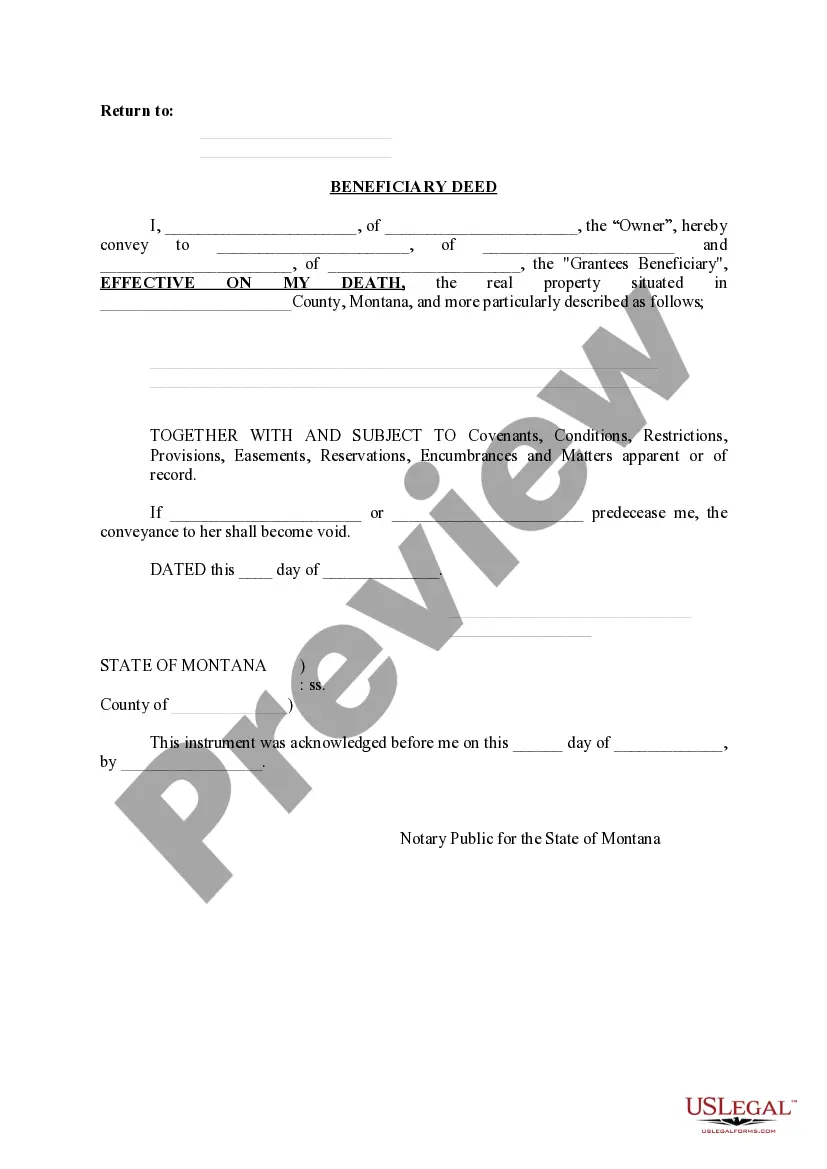
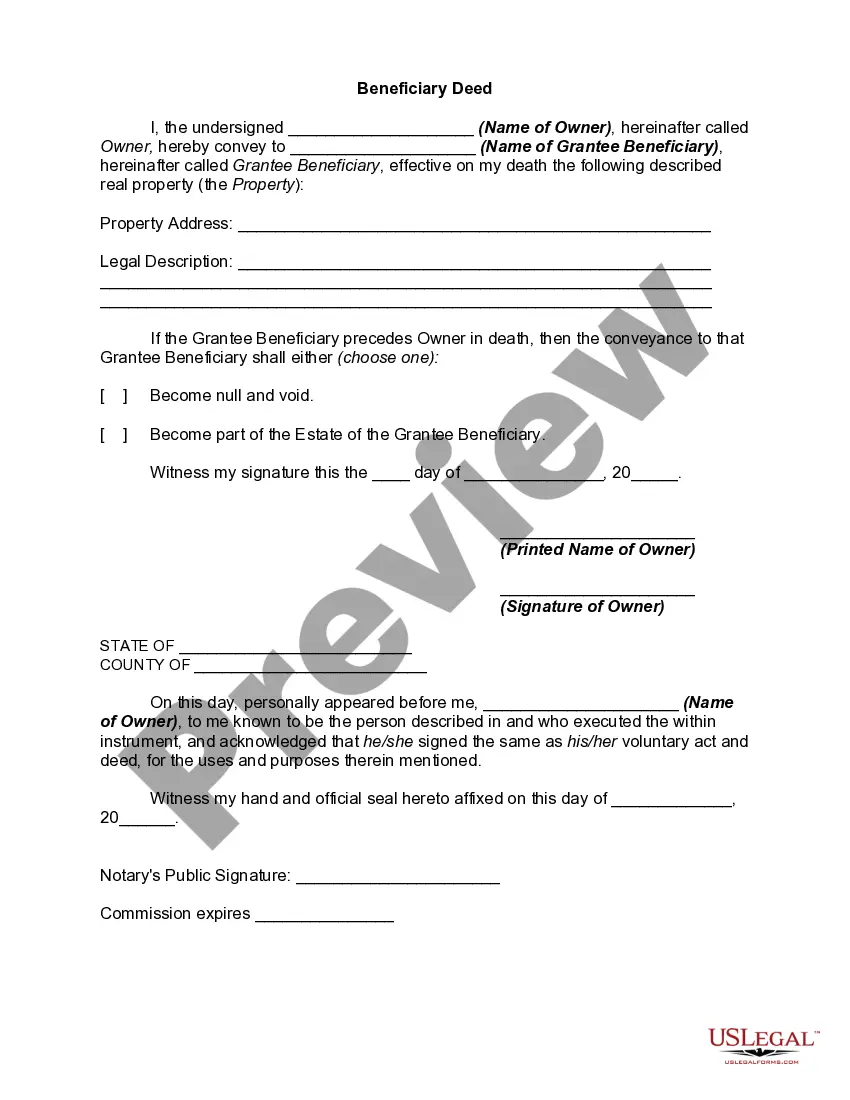
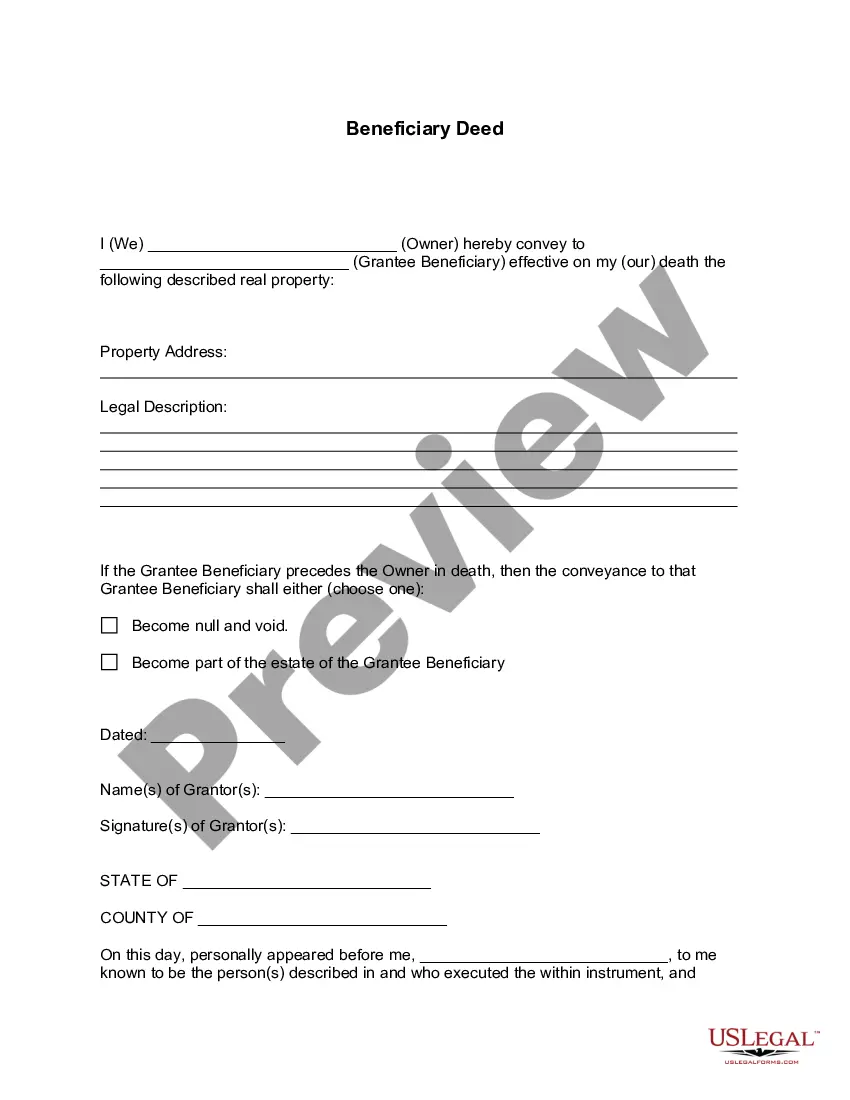
A beneficiary deed is a type of real property deed designed to transfer property upon the owner's death. Unlike traditional deeds, which transfer ownership immediately, a beneficiary deed allows the owner to maintain control during their lifetime. This form specifies the individuals or entities who will receive the property once the owner passes away, making it an essential tool for estate planning.
Form components explained
- Owner's name and address: Identification of the property owner.
- Grantees' names and addresses: Identification of the beneficiaries who will receive the property.
- Property description: Detailed legal description of the real property being transferred.
- Conditions of transfer: Terms that may void the transfer if certain events occur, like predeceasing the owner.
- Date and signatures: Date of execution and necessary signatures for validation.
- Notary acknowledgment: Required to confirm the identity of the signatory and the voluntary nature of the deed.

When this form is needed
This form is useful in several real-world situations, including:
- If you wish to transfer property to heirs without going through probate.
- If you want to retain control of your property during your lifetime while ensuring it passes to your chosen beneficiaries after your death.
- If you are involved in estate planning and want to simplify the distribution of your real estate assets.
- If you have specific conditions under which the property should be transferred upon your death.
Intended users of this form
- Property owners who want to designate beneficiaries for their real estate assets.
- Individuals engaging in estate planning, especially those looking to avoid probate for real property.
- Property owners with clear intentions on how their assets should be allocated after death.
- People seeking a straightforward method to transfer ownership of property without complications.
Instructions for completing this form
- Identify the parties: Fill in the names and addresses of the property owner and the beneficiaries.
- Specify the property: Provide a detailed description of the real property being conveyed.
- List conditions: State any conditions that apply to the transfer, such as if a beneficiary predeceases the owner.
- Enter the date: Fill in the date when the deed is executed.
- Sign the deed: The property owner must sign the deed in front of a notary.
- Get it notarized: Ensure that the deed is notarized for legal validity.
Does this document require notarization?
Yes, this form must be notarized to be legally valid. Notarization ensures that the signatures are authentic and that the document was executed under proper circumstances. US Legal Forms offers an integrated online notarization service that is available 24/7 via secure video calls, allowing you to finalize your form without any travel requirements.
Get your form ready online
Our built-in tools help you complete, sign, share, and store your documents in one place.
Make edits, fill in missing information, and update formatting in US Legal Forms—just like you would in MS Word.
Download a copy, print it, send it by email, or mail it via USPS—whatever works best for your next step.
Sign and collect signatures with our SignNow integration. Send to multiple recipients, set reminders, and more. Go Premium to unlock E-Sign.
If this form requires notarization, complete it online through a secure video call—no need to meet a notary in person or wait for an appointment.
We protect your documents and personal data by following strict security and privacy standards.

Make edits, fill in missing information, and update formatting in US Legal Forms—just like you would in MS Word.

Download a copy, print it, send it by email, or mail it via USPS—whatever works best for your next step.

Sign and collect signatures with our SignNow integration. Send to multiple recipients, set reminders, and more. Go Premium to unlock E-Sign.

If this form requires notarization, complete it online through a secure video call—no need to meet a notary in person or wait for an appointment.

We protect your documents and personal data by following strict security and privacy standards.
Avoid these common issues
- Failing to accurately describe the property.
- Not specifying conditions that could void the conveyance.
- Neglecting to have the deed notarized.
- Not updating the form if beneficiary details change.
- Filling out the form without consulting with an attorney in complex situations.
Why use this form online
- Convenience: Downloadable format allows for easy access at any time.
- Editability: Customize the form to suit specific needs before printing.
- Reliability: Forms are created by licensed attorneys, ensuring legal accuracy.
- Time-saving: Quickly complete necessary information without visiting a law office.
Looking for another form?
Form popularity
FAQ
As of September 2019, the District of Columbia and the following states allow some form of TOD deed: Alaska, Arizona, Arkansas, California, Colorado, Hawaii, Illinois, Indiana, Kansas, Maine, Minnesota, Missouri, Montana, Nebraska, Nevada, New Mexico, North Dakota, Oklahoma, Oregon, South Dakota, Texas, Utah, Virginia,
When a person dies, beneficiaries might learn that the decedent made a deed that conflicts with the specific wording in his will. Generally, a deed will override the will. However, which legal document prevails also depends on state property laws and whether the state has adopted the Uniform Probate Code.
States that allow TOD deeds are Alaska, Arizona, Arkansas, California, Colorado, District of Columbia, Hawaii, Illinois, Indiana, Kansas, Maine, Minnesota, Mississippi, Missouri, Montana, Nebraska, Nevada, New Mexico, North Dakota, Ohio, Oklahoma, Oregon, South Dakota, Texas, Utah, Virginia, Washington, West Virginia,
A beneficiary deed is one in which an owner conveys an interest in Montana real property to a grantee beneficiary effective upon the owner's death. In other words, real property is transferred from the deceased person to the person(s) listed on the deed.
If you'd like to avoid having your property going through the probate process, it's a good idea to look into a transfer on death deed. A transfer on death deed allows you to select a beneficiary who will receive your property, but only when you've passed away.
A beneficiary deed is generally used for avoidance of probate, although it may be used to remove a particular property from a probate estate.
The beneficiary deed does for real estate what the payable on death or POD designation does for a bank account. It allows the owner to designate a beneficiary for that asset and creates a method by which ownership of the asset will transfer directly to the beneficiary upon the owner's death.
Using a beneficiary deed may reduce or eliminate fees for probating the estate or managing a trust. Liens and loans. After a beneficiary deed is signed, grantors may still do what they want with the property, including selling it or mortgaging it.