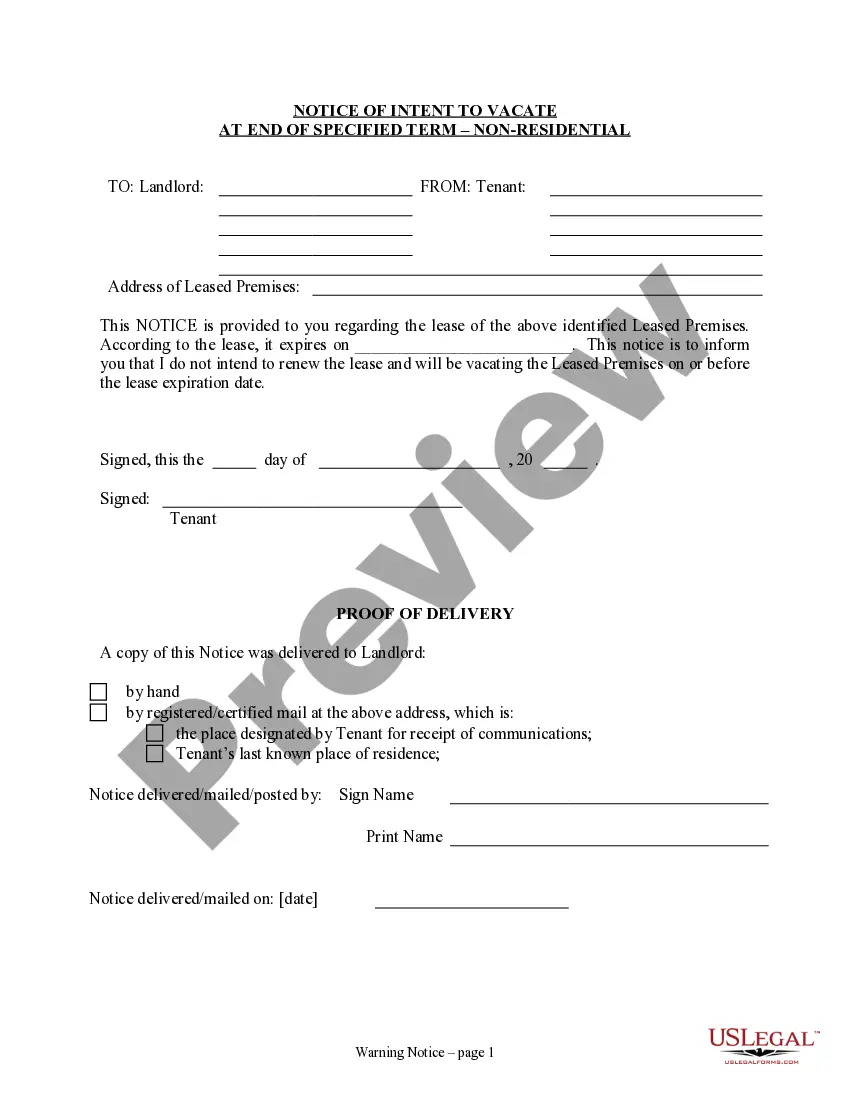
Montana Marital Domestic Separation and Property Settlement Agreement no children
What is this form?
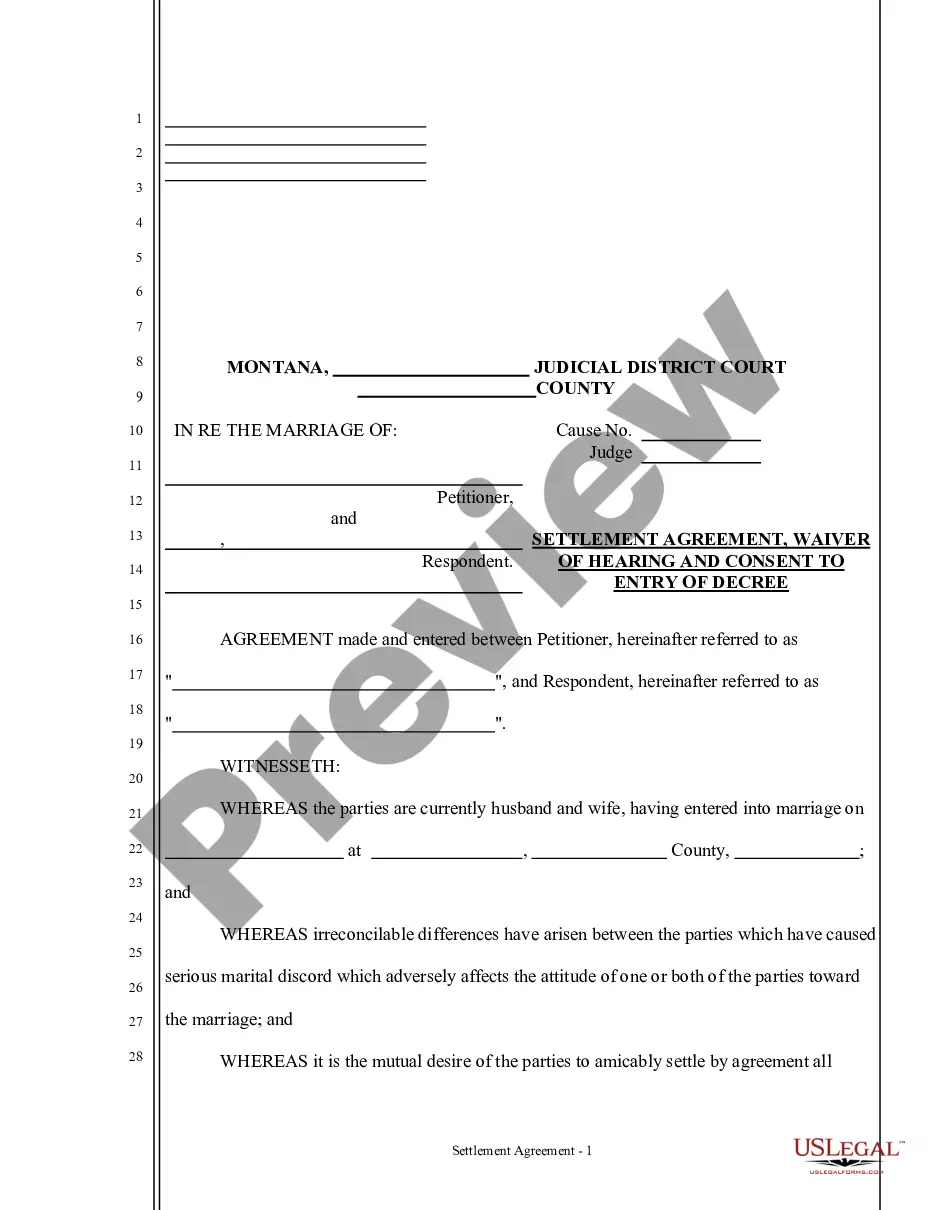
The Marital Domestic Separation and Property Settlement Agreement is a legal document that outlines the division of assets and debts between spouses ending their marriage, when there are no children involved. Unlike other divorce agreements, this form specifically caters to couples without children, focusing solely on property and financial matters, ensuring clarity and fairness in the settlement process.
Main sections of this form
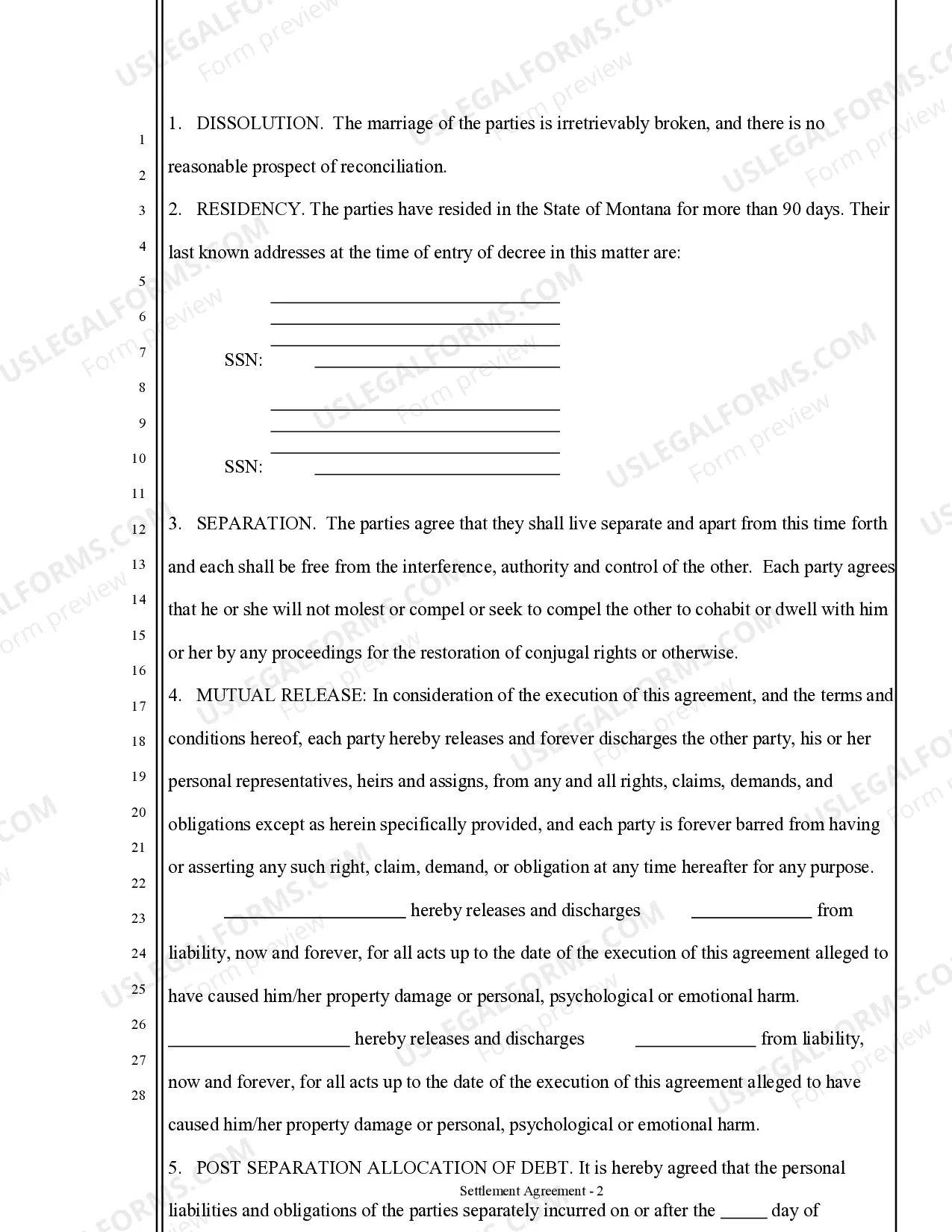
- Dissolution clause confirming the marriage is irretrievably broken.
- Residency requirement stating the length of time in the state.
- Inheritance claims waiving any rights to inherit from one another.
- Explicit acknowledgment that there are no children or pregnancy.
- Consent for immediate entry of judgment without a hearing.
- Enforcement clause outlining that the agreement is binding and enforceable.


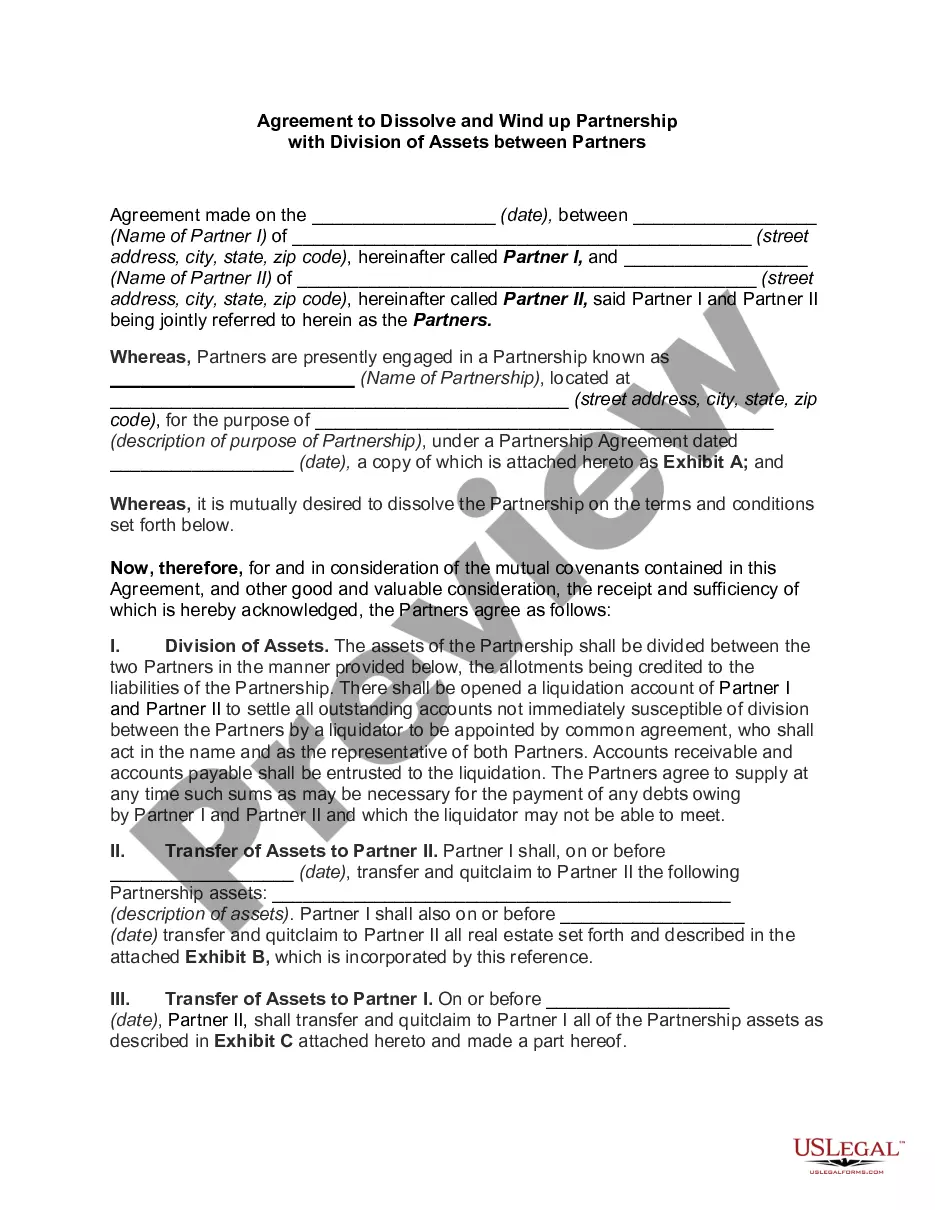
Situations where this form applies
This form is appropriate when a married couple decides to separate and reach an agreement on how to divide their shared assets and debts. It is specifically designed for couples who do not have children together and want to formalize their settlement without court intervention regarding custody or child support. Use this document when both parties agree on the terms of their separation and wish to avoid potential disputes in the future.
Who should use this form
- Married couples seeking a divorce without children.
- Spouses who amicably wish to divide their property and settle debts.
- Individuals wanting a structured, legally binding agreement for their separation.
- Parties with mutual understanding of their financial situation, wishing to avoid court hearings.
How to prepare this document
- Identify the parties involved in the marriage by providing full names and current addresses.
- Clearly state the terms of dissolution, affirming that the marriage is irretrievably broken.
- Detail the division of assets and debts, ensuring both parties disclose all financial information.
- Sign the agreement in the presence of a notary public, if required.
- Submit the signed form to the appropriate district court for approval.
Notarization requirements for this form
This document requires notarization to meet legal standards. US Legal Forms provides secure online notarization powered by Notarize, allowing you to complete the process through a verified video call, available 24/7.
Get your form ready online
Our built-in tools help you complete, sign, share, and store your documents in one place.
Make edits, fill in missing information, and update formatting in US Legal Forms—just like you would in MS Word.
Download a copy, print it, send it by email, or mail it via USPS—whatever works best for your next step.
Sign and collect signatures with our SignNow integration. Send to multiple recipients, set reminders, and more. Go Premium to unlock E-Sign.
If this form requires notarization, complete it online through a secure video call—no need to meet a notary in person or wait for an appointment.
We protect your documents and personal data by following strict security and privacy standards.

Make edits, fill in missing information, and update formatting in US Legal Forms—just like you would in MS Word.

Download a copy, print it, send it by email, or mail it via USPS—whatever works best for your next step.

Sign and collect signatures with our SignNow integration. Send to multiple recipients, set reminders, and more. Go Premium to unlock E-Sign.

If this form requires notarization, complete it online through a secure video call—no need to meet a notary in person or wait for an appointment.

We protect your documents and personal data by following strict security and privacy standards.
Typical mistakes to avoid
- Failing to disclose all assets and liabilities to the other party.
- Neglecting to have the form notarized when required.
- Missing crucial signatures or dates on the agreement.
- Assuming that the agreement is binding without court approval.
- Not clearly stating the terms of any inheritance waivers.
Benefits of completing this form online
- Convenient access to ready-made legal templates without the need for appointments.
- Editability allows customization to fit individual circumstances.
- Secure and reliable, offering peace of mind for sensitive legal matters.
- Immediate download and use, saving time compared to traditional methods.
Legal use & context
- The agreement is enforceable in court once approved by the District Court.
- Each party must fully understand and agree to the terms before signing.
- Use of this form can prevent future disputes regarding asset division.
- Compliance with state laws is crucial for the agreement to be valid.
Summary of main points
- The form is intended for married couples without children seeking property and debt separation.
- Full disclosure of assets is essential for a fair settlement.
- Notarization may enhance legal standing, though not always required.
- The agreement must be submitted to a district court for approval to be enforceable.
Looking for another form?




Form popularity
FAQ
Know the law that applies to you. Unless you're a trained family lawyer, or have hours to devote to studying, this means getting good legal advice. Set your expectations high. That's right, not on what's fair, or even what your lawyer says is your likely outcome, but HIGH. Be patient.
A detailed parenting-time scheduleincluding holidays!Specifics about support.Life insurance.Retirement accounts and how they will be divided.A plan for the sale of the house.
A fair settlement should include ample parenting time for each parent. An equitable visitation agreement may not give parents equal custodial time, but it should provide for frequent and continuing contact with each parent.
#1. Start with the Basics. #2. Include the Details. #3. Confirm Your Agreement. #4. Identify and Divide Assets and Debts. #5. Create a Parenting Plan for Custody and Visitation. #6. Agree on Child Support and Spousal Support (Alimony) #7. Polishing Your Agreement. Conclusion.
1Make sure you have all of the basic information and divorce forms you need according to the divorce laws in your state.2Make sure you have all of the personal information you need.3Include a statement that you and the other party are in agreement with the contents of the document.Free Divorce Settlement Agreement Template PDF Sample\n.com > divorce-settlement-agreement
There are many factors to consider, including assets, incomes, living expenses, inflation, alimony, child support, taxes, retirement plans, investments, medical expenses and health insurance costs, and child-related expenses such as education.
When the court grants a divorce, property will be divided equitably (not always equally) between the two spouses. This is decided under the Equitable Distribution Law. During the divorce both spouses have to tell the court about their income and any debts they owe.
Discuss your family finances regularly as a couple. Look ahead to tackle the potential 'what ifs' in the relationship. Seek support from friends but engage a financial adviser early on too. Don't let emotions cloud your judgement on the family home.