Mississippi Quitclaim Deed for Individual to Individual with Reserved Life Estate
Overview of this form
The Quitclaim Deed for Individual to Individual with Reserved Life Estate is a legal document used to transfer ownership of real property from one individual to another. Unlike warranty deeds, quitclaim deeds do not guarantee the title's validity, which means the grantor only relinquishes their interest without any warranties. This form is especially useful when the parties involved know each other well and wish to facilitate a straightforward property transfer while reserving a life estate for the grantor.
Key components of this form
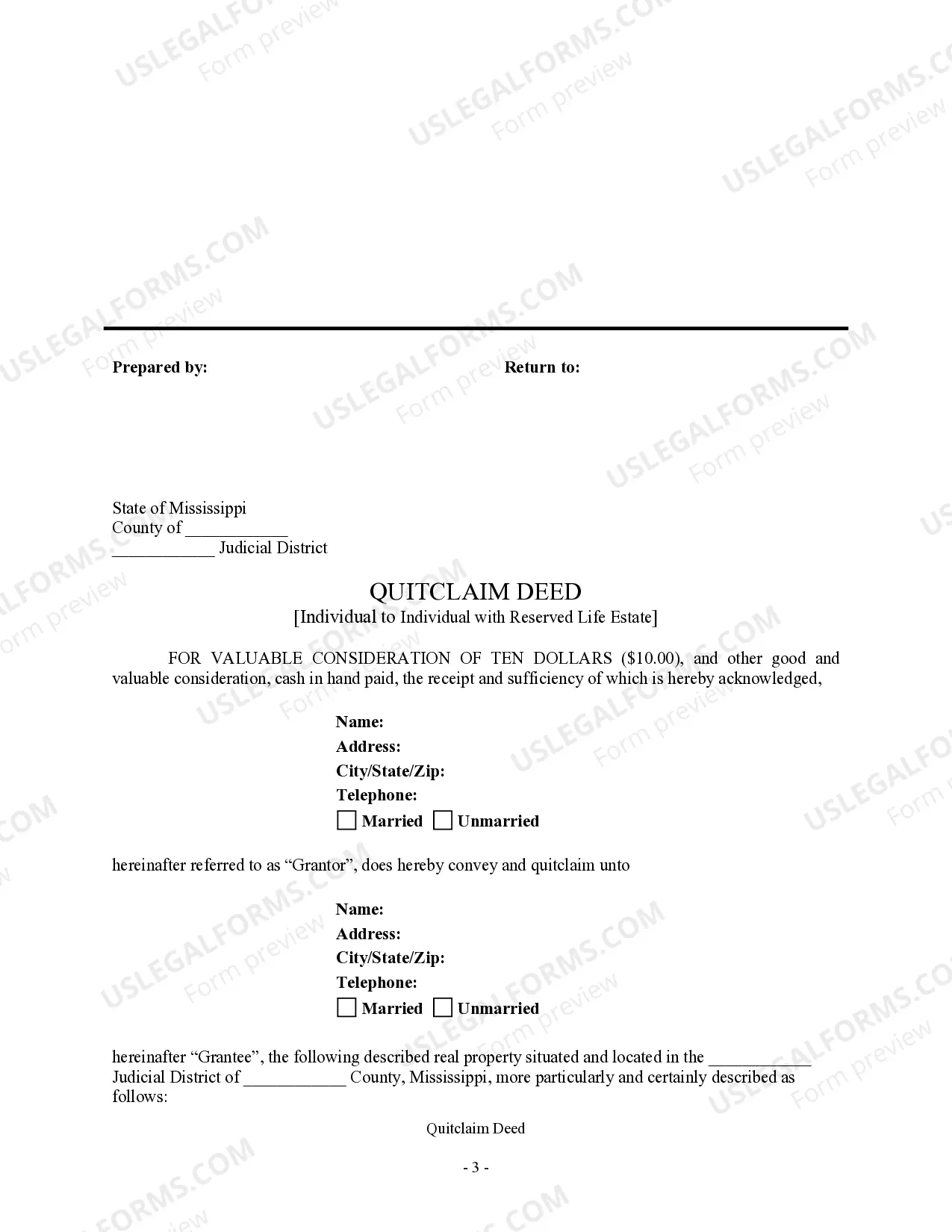
- Identification of the grantor and grantee: This section includes the names and addresses of the individuals involved in the property transfer.
- Legal description of the property: The form requires including a detailed description of the property, such as its address and boundaries.
- Statement of consideration: This section specifies what is being exchanged for the property, often a nominal amount, such as ten dollars.
- Reserved life estate: This clause indicates that the grantor is retaining the right to occupy and use the property for their lifetime.
- Signatures and dates: Both parties must sign and date the document to make it valid.






Situations where this form applies
This form is typically used in situations where an individual intends to transfer property ownership to another person, while also retaining the right to live in the property for the duration of their life. Common scenarios include transferring family property, estate planning between parents and children, or personal arrangements among friends.
Who should use this form
- Individuals wishing to convey property ownership to another individual.
- Grantors who want to retain the right to live on the property for their lifetime.
- Persons involved in informal or family transactions where warranties are not required.
Completing this form step by step
- Identify the parties: Fill in the names and addresses of both the grantor and grantee.
- Specify the property: Insert a comprehensive legal description of the property being transferred.
- Enter the consideration: Clearly state the amount being exchanged for the property.
- Include the reserved life estate: Indicate that the grantor retains occupancy rights for their lifetime.
- Obtain signatures: Ensure any required witnesses also sign, along with the date of signing.
Does this document require notarization?
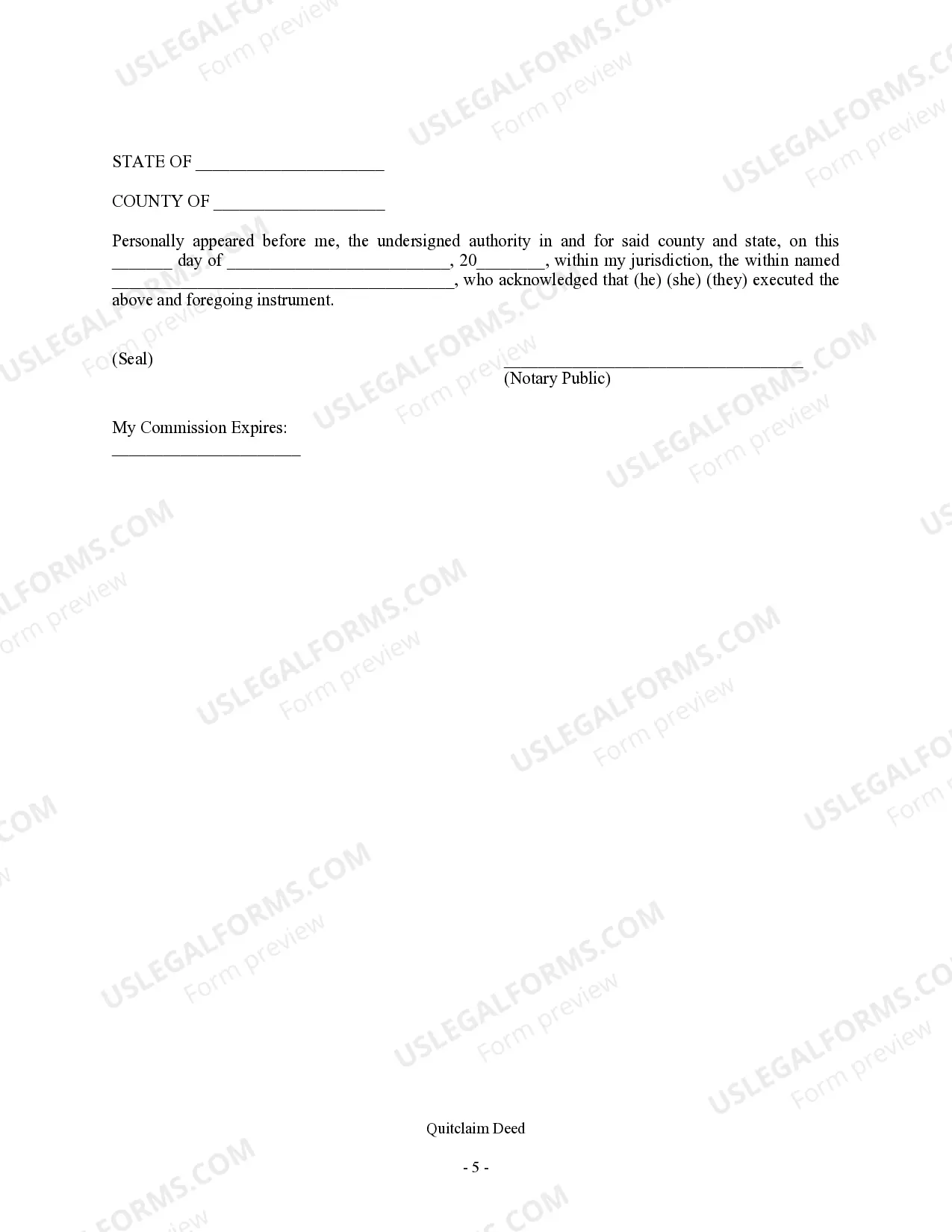
This form needs to be notarized to ensure legal validity. US Legal Forms provides secure online notarization powered by Notarize, allowing you to complete the process through a verified video call, available anytime.
Get your form ready online
Our built-in tools help you complete, sign, share, and store your documents in one place.
Make edits, fill in missing information, and update formatting in US Legal Forms—just like you would in MS Word.
Download a copy, print it, send it by email, or mail it via USPS—whatever works best for your next step.
Sign and collect signatures with our SignNow integration. Send to multiple recipients, set reminders, and more. Go Premium to unlock E-Sign.
If this form requires notarization, complete it online through a secure video call—no need to meet a notary in person or wait for an appointment.
We protect your documents and personal data by following strict security and privacy standards.

Make edits, fill in missing information, and update formatting in US Legal Forms—just like you would in MS Word.

Download a copy, print it, send it by email, or mail it via USPS—whatever works best for your next step.

Sign and collect signatures with our SignNow integration. Send to multiple recipients, set reminders, and more. Go Premium to unlock E-Sign.

If this form requires notarization, complete it online through a secure video call—no need to meet a notary in person or wait for an appointment.

We protect your documents and personal data by following strict security and privacy standards.
Common mistakes to avoid
- Failing to include a full legal description of the property.
- Not having the grantor and grantee sign the deed.
- Leaving out the consideration amount, which can lead to disputes.
Benefits of completing this form online
- Convenient access: Download and complete the form from anywhere at any time.
- Editability: Easily fill out the form on your computer before printing.
- Reliability: Forms provided by licensed attorneys tailored to specific legal standards.
Looking for another form?

Form popularity
FAQ
Yes, you can use a Quitclaim Deed to transfer a gift of property to someone. You must still include consideration when filing your Quitclaim Deed with the County Recorder's Office to show that title has been transferred, so you would use $10.00 as the consideration for the property.
Before a quitclaim deed can be recorded with a county recorder in Mississippi, the grantor must sign and acknowledge it. The names, addresses, and telephone numbers of the grantors and grantees to the quit claim deed, along with a legal description of the real property should be provided on the first page (89-5-24).
In general, a person with dementia can sign a power of attorney designation if they have the capacity to understand what the document is, what it does, and what they are approving. Most seniors living with early stage dementia are able to make this designation.
But you might be wondering if an owner can transfer a deed to another person without a real estate lawyer. The answer is yes. Parties to a transaction are always free to prepare their own deeds.A quitclaim deed, for example, is far simpler than a warranty deed.
Legal Documents These documents can authorize another person to make health care and financial decisions, including plans for long-term care. As much as possible, the person with Alzheimer's should participate in legal planning, as long as they are mentally able to sign official documents.
A certain level of capacity is necessary in order to sign legal documents. Someone who is in the end stages of Alzheimer's disease probably does not have the requisite capacity to sign legal documents. However, a person with a diagnosis of dementia may very well be able to sign legal documents.
1 attorney answer Your mother's dementia does not, as a matter of law, make her incapable of executing a quitclaim deed. However, if your Power of Attorney was duly recorded and is a General Power of Attorney, you are the person who is the attorney in fact for...
Fill out the quit claim deed form, which can be obtained online, or write your own using the form as a guide. The person giving up the interest in the property is the grantor, and the person receiving the interest is the grantee.
If the quitclaim deed requires the signature of all co-owners, the deed is invalid unless all co-owners have signed it and the deed is then delivered to the grantee.If one individual owns real estate and desires to add a co-owner such as a spouse, a quitclaim deed might be used.