Mississippi Motion to Consolidate
Overview of this form
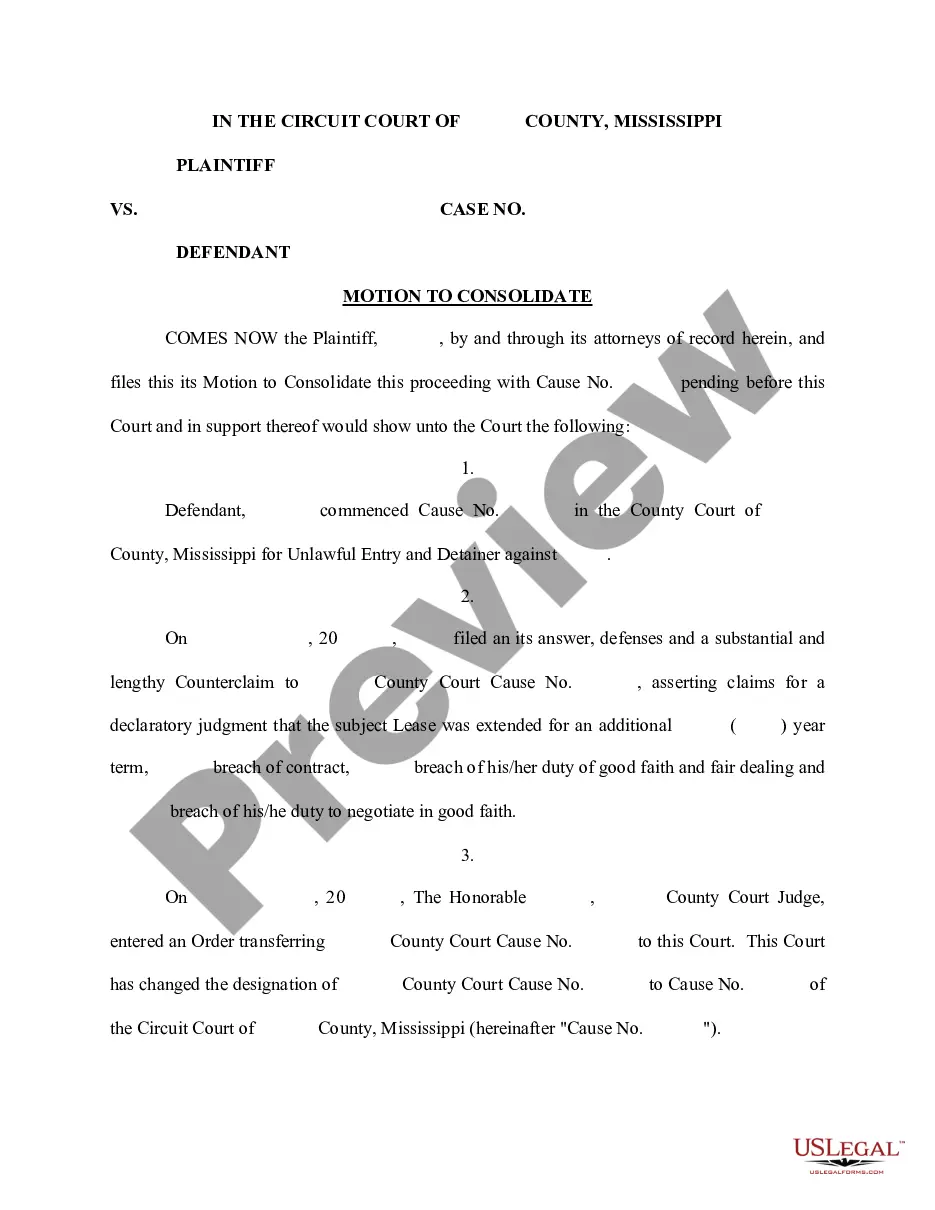
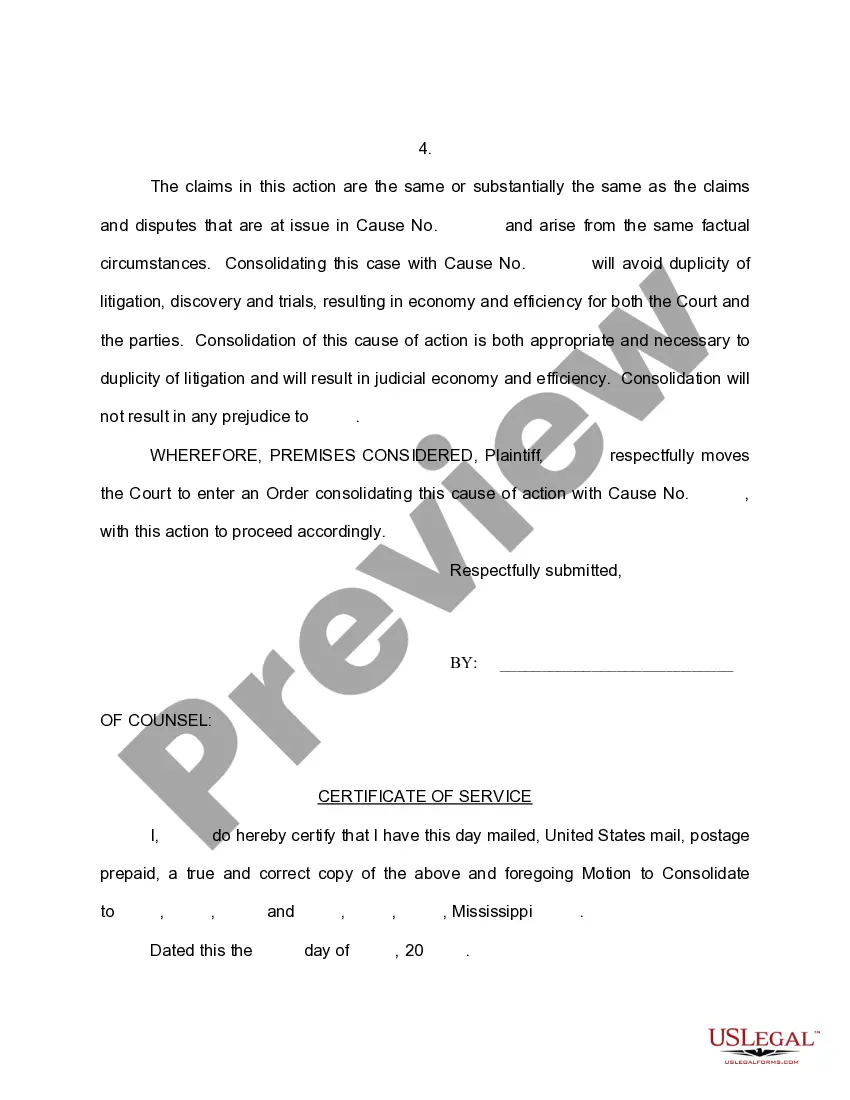
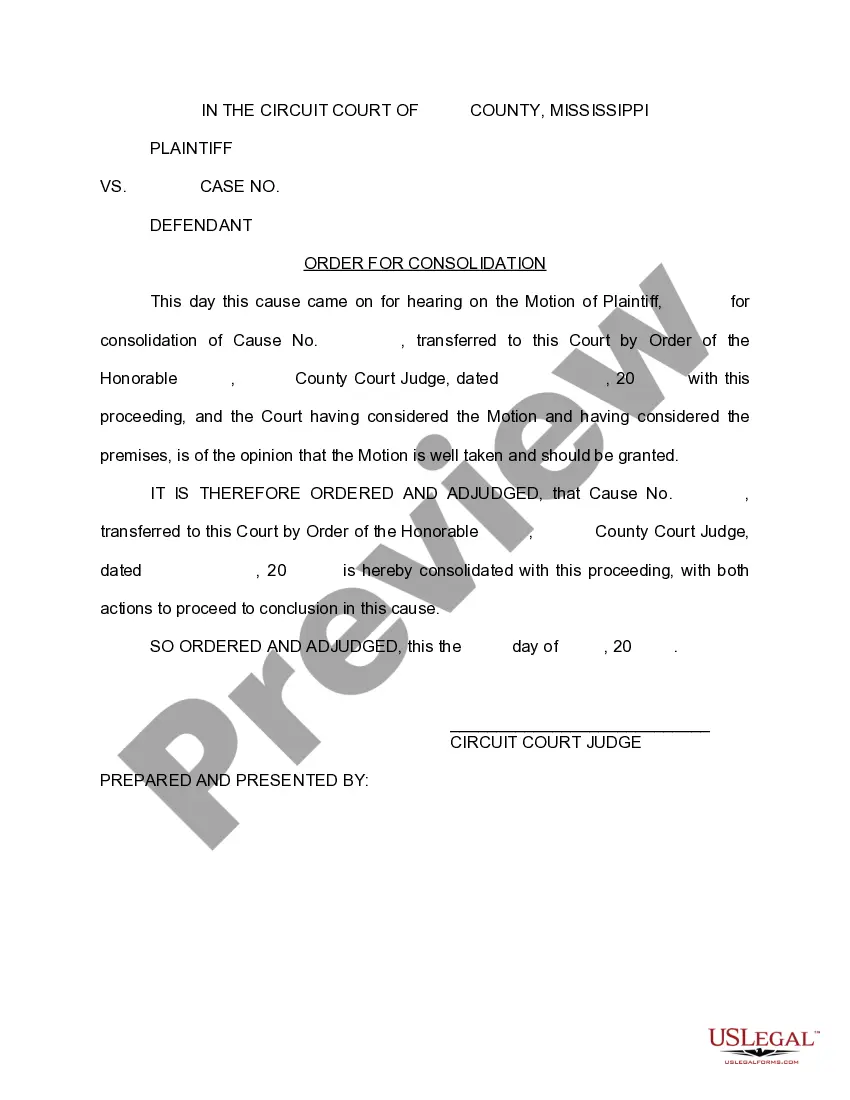
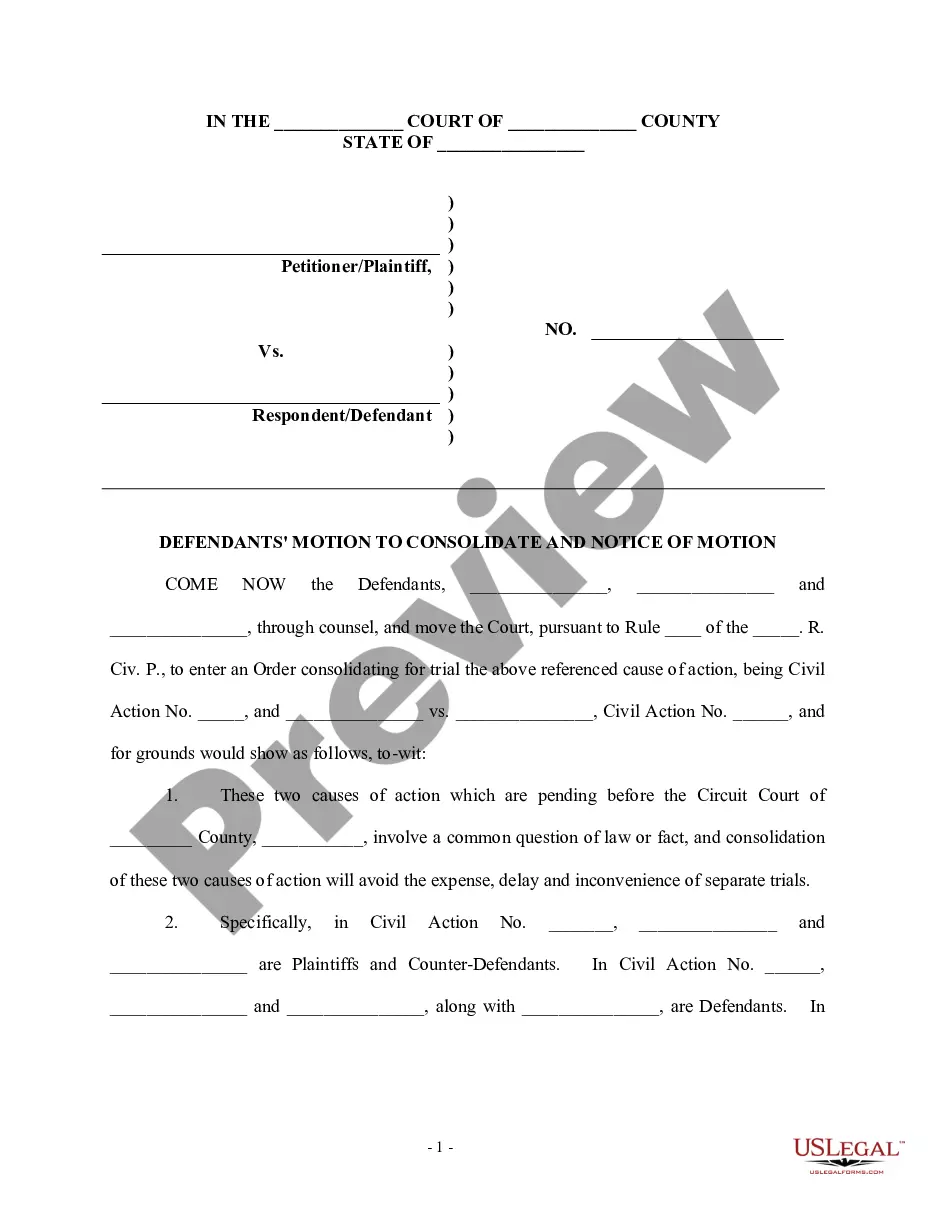
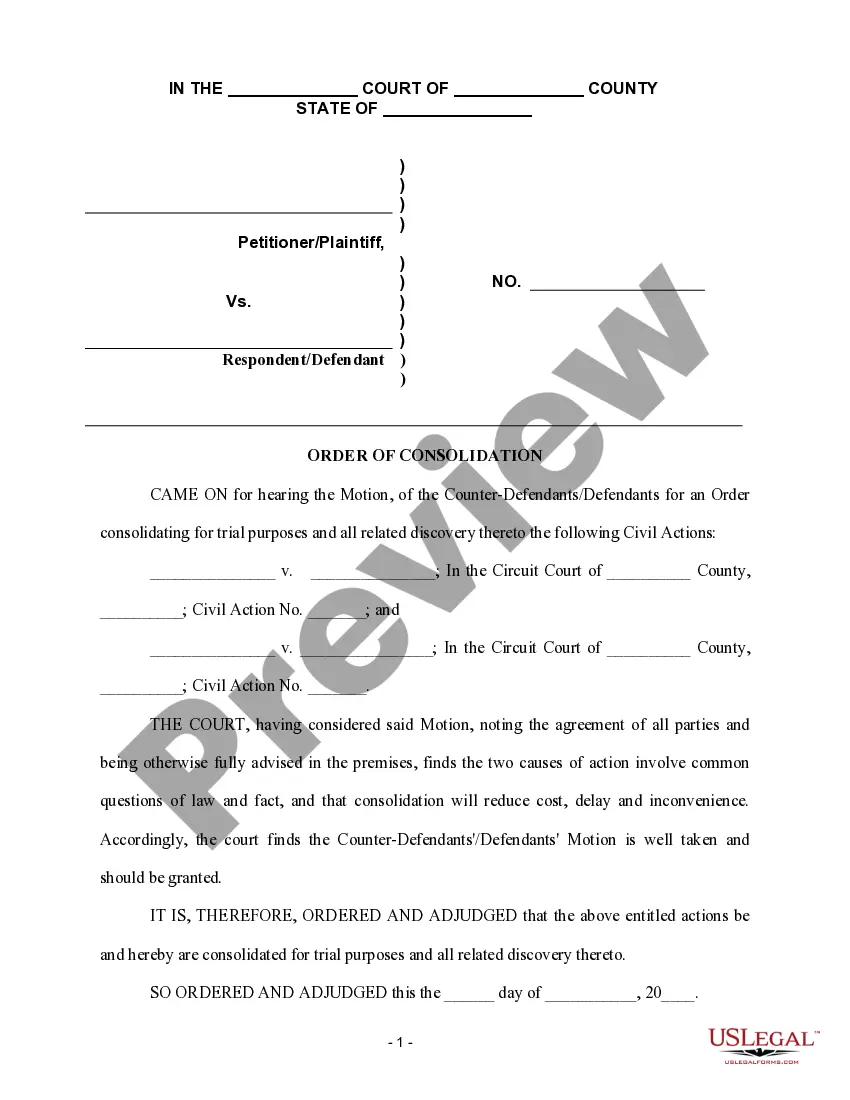
A Motion to Consolidate is a legal document that requests the court to combine two or more cases into one. This form is crucial for streamlining legal proceedings, especially when cases involve related issues or parties. By using this motion, you can ensure that the court handles your cases more efficiently rather than treating them separately.
Key parts of this document
- Case caption: Identifies the parties involved and the court handling the cases.
- Statement of facts: Outlines the background and reasons for consolidation.
- Legal arguments: Provides reasons under the law for why the motion should be granted.
- Relief sought: Specifies the exact action you are requesting from the court.
- Signature block: Contains fields for necessary signatures to validate the motion.

When to use this form
This form is used when you have multiple legal cases that share common questions of law or fact. For instance, if two lawsuits involve the same parties or similar circumstances, submitting a Motion to Consolidate can help manage the cases together, saving time and resources for all involved. It's especially beneficial in civil litigation scenarios.
Who should use this form
- Litigants involved in multiple cases with overlapping issues.
- Attorneys representing clients in civil litigation.
- Individuals seeking to streamline their legal proceedings for efficiency.
Instructions for completing this form
- Identify the case names and numbers for each case you wish to consolidate.
- Clearly state the reasons for consolidation in the statement of facts.
- Provide legal arguments supporting your motion based on the applicable laws.
- Specify the relief sought, detailing what you want the court to do.
- Sign and date the document, ensuring all necessary parties have signed where required.
Is notarization required?
This form does not typically require notarization unless specified by local law. However, it's important to check your stateâs specific requirements to ensure compliance.
Get your form ready online
Our built-in tools help you complete, sign, share, and store your documents in one place.
Make edits, fill in missing information, and update formatting in US Legal Forms—just like you would in MS Word.
Download a copy, print it, send it by email, or mail it via USPS—whatever works best for your next step.
Sign and collect signatures with our SignNow integration. Send to multiple recipients, set reminders, and more. Go Premium to unlock E-Sign.
If this form requires notarization, complete it online through a secure video call—no need to meet a notary in person or wait for an appointment.
We protect your documents and personal data by following strict security and privacy standards.

Make edits, fill in missing information, and update formatting in US Legal Forms—just like you would in MS Word.

Download a copy, print it, send it by email, or mail it via USPS—whatever works best for your next step.

Sign and collect signatures with our SignNow integration. Send to multiple recipients, set reminders, and more. Go Premium to unlock E-Sign.

If this form requires notarization, complete it online through a secure video call—no need to meet a notary in person or wait for an appointment.

We protect your documents and personal data by following strict security and privacy standards.
Common mistakes to avoid
- Failing to adequately explain why consolidation is necessary.
- Not including all relevant cases in the motion.
- Ignoring local court rules regarding the format or filing process.
Benefits of using this form online
- Convenience of downloading and completing the form at your own pace.
- Editability allows for customization to fit your specific legal situation.
- Reliability of having a document prepared by licensed attorneys.
What to keep in mind
- A Motion to Consolidate combines related legal cases for efficiency.
- It is essential for minimizing court congestion and ensuring consistent rulings.
- Customize the form to meet your local courtâs requirements and standards.
Looking for another form?



Form popularity
FAQ
In Civil law, it refers to combining of two or more actions involving the same parties or issues into a single action through court order. When the cases involve similar or related questions to be decided, the court may consolidate the cases in order to promote the efficient use of judicial resources.
A motion to consolidate is a motion to join two or more cases together into one action, where the issues are basically the same. Code of Civil Procedure Section 1048 states: "When actions involving a common question of law or fact are...
Consolidation Order means an order by an arbitral tribunal that a First-filed Dispute and a Later Dispute or Disputes be resolved in the same arbitral proceedings.
Consolidation of suits is ordered for meeting the ends of justice as it saves the parties from multiplicity of proceedings, delay and expenses. Complete or even substantially and sufficient similarity of the issues arising for decision in two suits enables the two suits being consolidated for trial and decision.
Consolidation of suits is ordered for meeting the ends of justice as it saves the parties from multiplicity of proceedings, delay and expenses. Complete or even substantially and sufficient similarity of the issues arising for decision in two suits enables the two suits being consolidated for trial and decision.
Courts have the power to consolidate cases that raise common questions of fact or issues of law for many purposes, including to hold a single trial. But consolidating cases, no matter the purpose, does not destroy the independent cases for appeal, according to a decision by the U.S. Supreme Court.