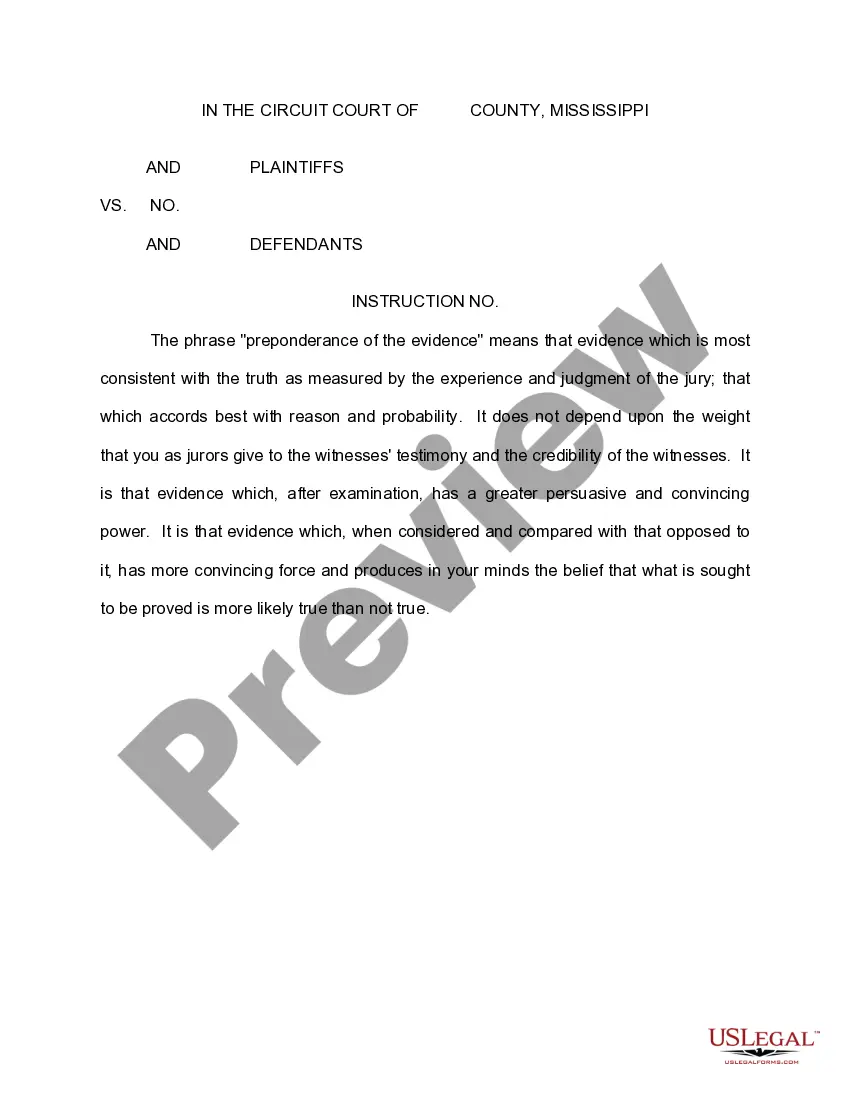
Mississippi Jury Instruction - Preponderance of Evidence Defined
Understanding this form
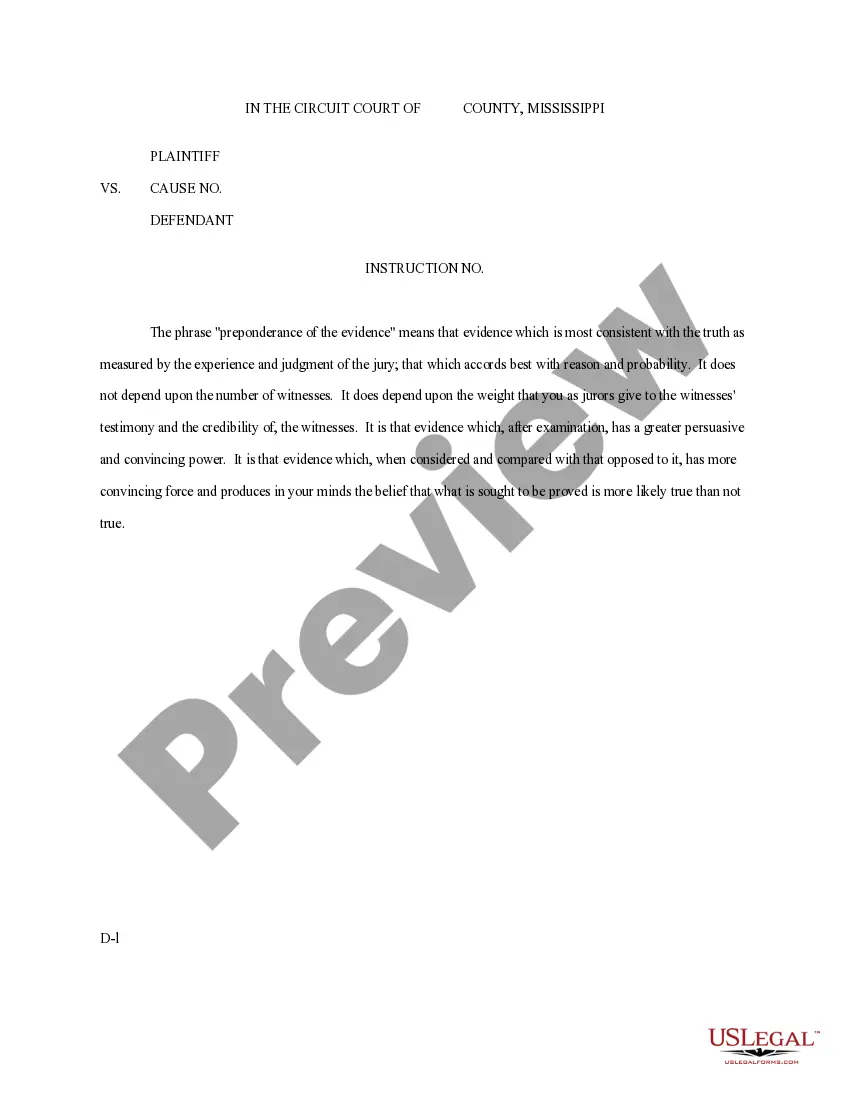
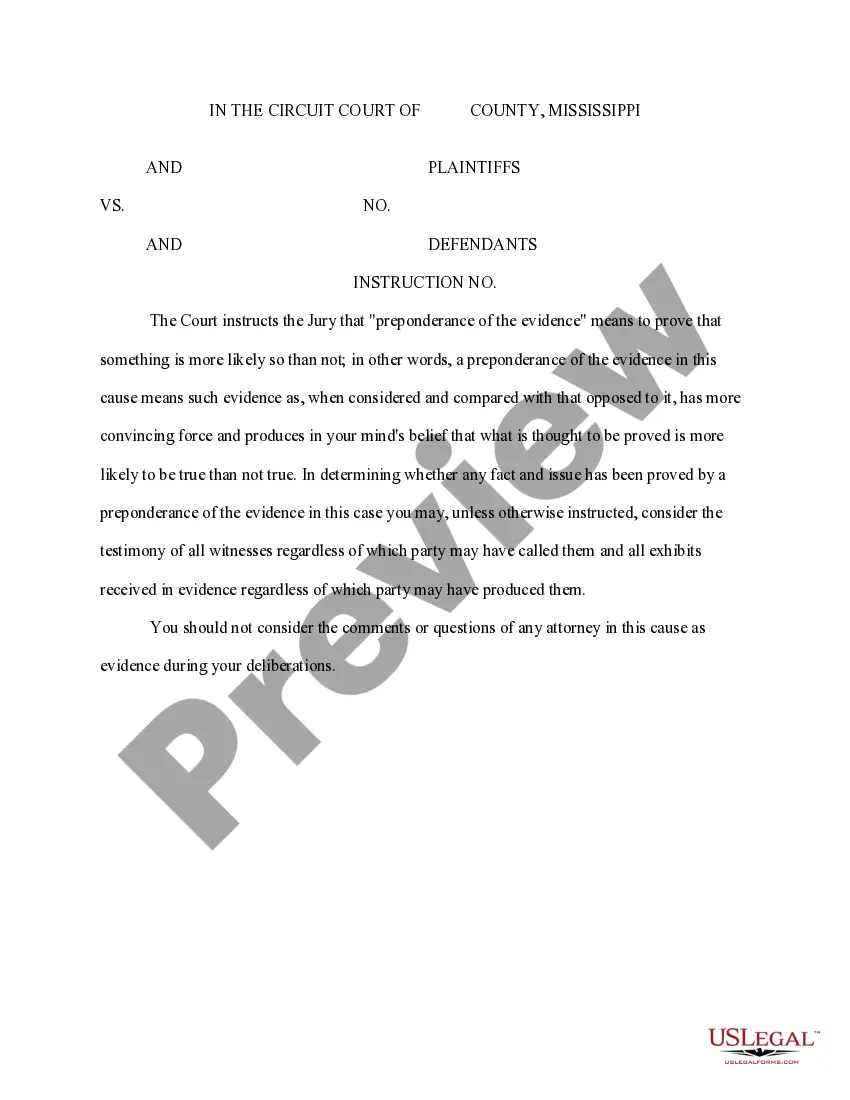
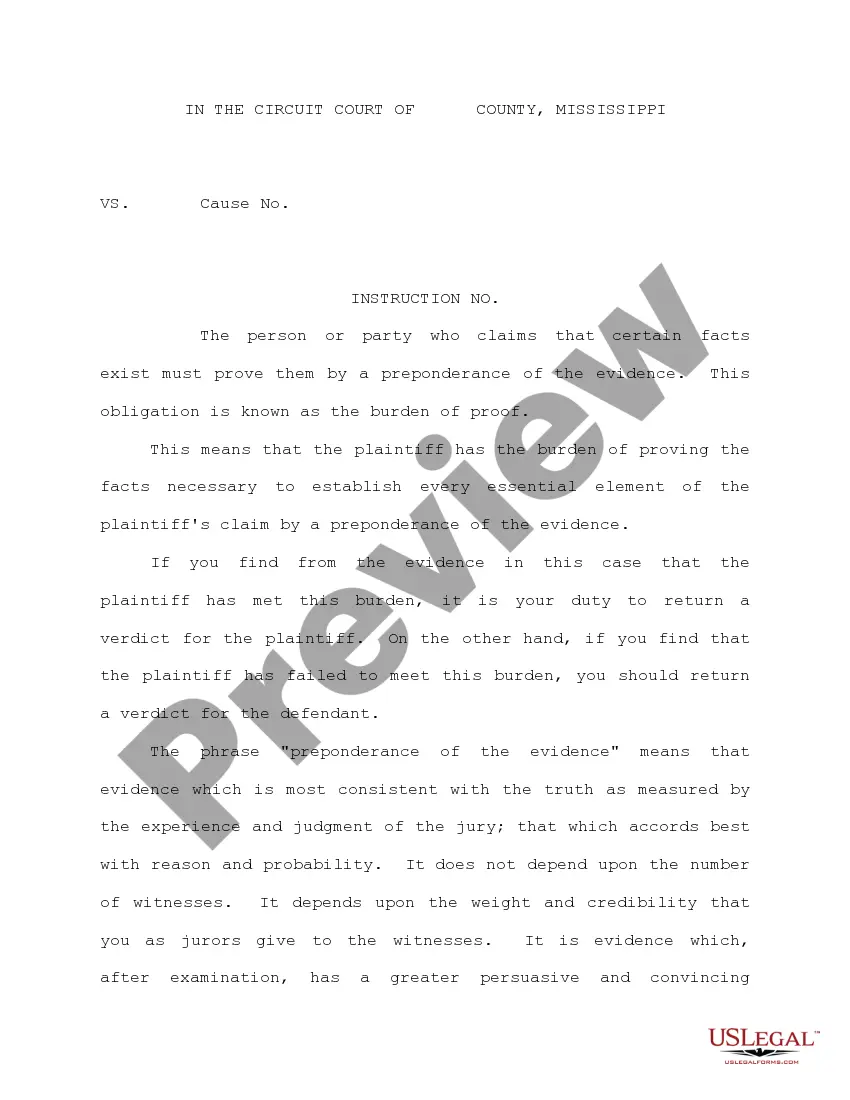
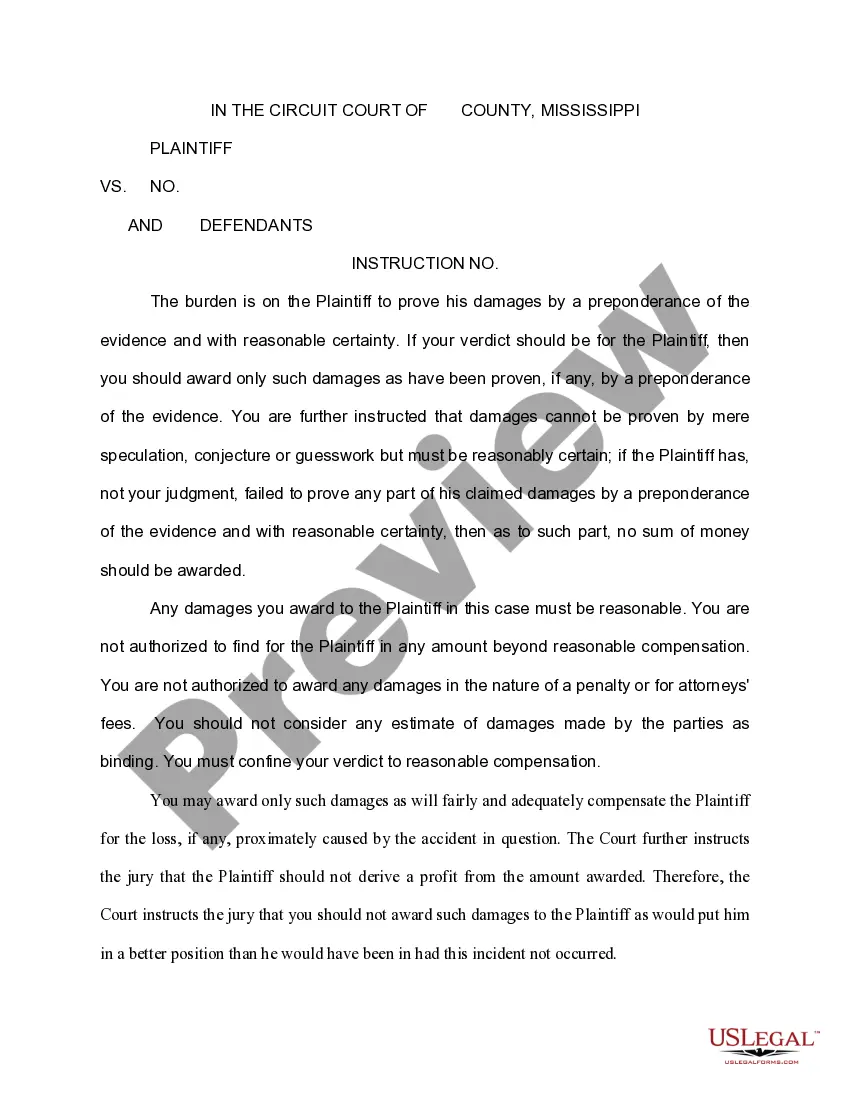
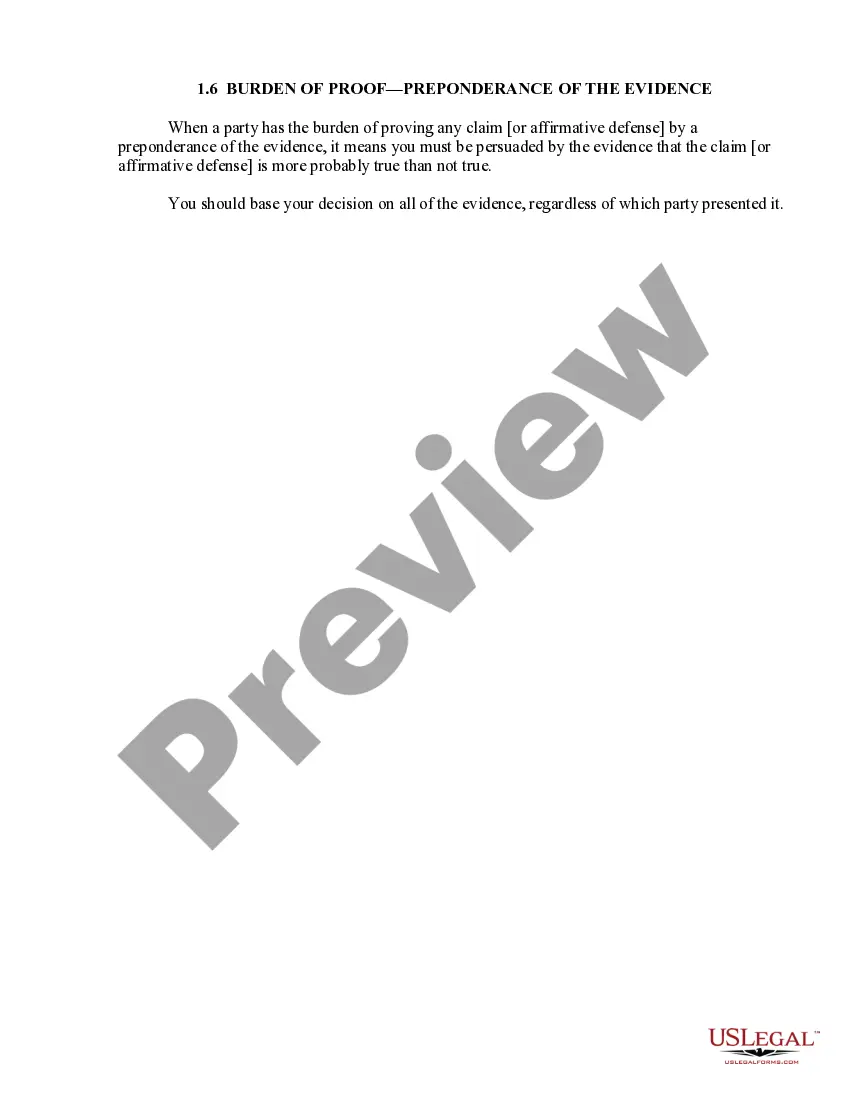
The Jury Instruction - Preponderance of Evidence Defined form provides jurors with a clear understanding of the legal standard of proof known as "preponderance of evidence." This instruction is particularly relevant in civil cases, as it determines how jurors weigh evidence when making their decisions. Unlike criminal cases that require proof beyond a reasonable doubt, civil cases typically rely on this standard to establish that something is more likely true than not. This form is a sample from Mississippi law, and it may not reflect all necessary legal requirements or updates.
Key parts of this document
- Definition of preponderance of evidence
- Explanation of how jurors should evaluate evidence
- Guidance on the burden of proof in civil cases
- Clarification on the difference between civil and criminal standards of proof
When to use this document
This form should be used during civil trials to guide jurors on how to assess the evidence presented in court. It is essential when a case requires jurors to determine whether the evidence leads them to believe that a claim is more likely true than not. This instruction helps ensure jurors understand their role and the standard they must apply when deliberating on cases where the preponderance of evidence is the relevant standard.
Who this form is for
- Judges who need to instruct juries on legal standards during civil cases
- Attorneys preparing jury instructions for court proceedings
- Legal educators teaching about jury instructions and standards of proof
Completing this form step by step
- Review the definition provided for the preponderance of evidence.
- Ensure the language is clear and aligns with current Mississippi law.
- Instruct jurors to consider all evidence presented in the case.
- Make adjustments as necessary based on trial specifics or case law updates.
- Present the finalized instruction to the judge for approval before use in court.
Does this document require notarization?
This form does not typically require notarization to be legally valid. However, some jurisdictions or document types may still require it. US Legal Forms provides secure online notarization powered by Notarize, available 24/7 for added convenience.
Get your form ready online
Our built-in tools help you complete, sign, share, and store your documents in one place.
Make edits, fill in missing information, and update formatting in US Legal Forms—just like you would in MS Word.
Download a copy, print it, send it by email, or mail it via USPS—whatever works best for your next step.
Sign and collect signatures with our SignNow integration. Send to multiple recipients, set reminders, and more. Go Premium to unlock E-Sign.
If this form requires notarization, complete it online through a secure video call—no need to meet a notary in person or wait for an appointment.
We protect your documents and personal data by following strict security and privacy standards.

Make edits, fill in missing information, and update formatting in US Legal Forms—just like you would in MS Word.

Download a copy, print it, send it by email, or mail it via USPS—whatever works best for your next step.

Sign and collect signatures with our SignNow integration. Send to multiple recipients, set reminders, and more. Go Premium to unlock E-Sign.

If this form requires notarization, complete it online through a secure video call—no need to meet a notary in person or wait for an appointment.

We protect your documents and personal data by following strict security and privacy standards.
Common mistakes
- Using ambiguous language that could confuse jurors.
- Neglecting to update the instruction based on recent legal developments.
- Failing to distinguish between civil and criminal standards of proof adequately.
Advantages of online completion
- Convenience of immediate access to legal forms tailored for Mississippi law.
- Editability to customize the instruction to fit specific case needs.
- Reliability from a source that provides forms drafted by licensed attorneys.
Legal use & context
- This jury instruction form is essential for ensuring jurors understand the preponderance of evidence standard.
- It aids in the lawful conduct of civil trials by providing necessary guidance to jury members.
- Improper or unclear jury instructions can lead to appeals or mistrials, making adherence crucial.
Key takeaways
- The form defines what preponderance of evidence means in legal terms.
- It is specifically designed for use in civil cases within Mississippi.
- Clear instructions assist jurors in making informed decisions based on the evidence presented.
Looking for another form?
Form popularity
FAQ
Preponderance of the evidence is one type of evidentiary standard used in a burden of proof analysis. Under the preponderance standard, the burden of proof is met when the party with the burden convinces the fact finder that there is a greater than 50% chance that the claim is true.
The criminal statute of limitations requires prosecutors to file criminal charges against a suspect within two years for misdemeanors and within five years for certain felonies, but there is no time limit in Mississippi for charges of murder, kidnapping, rape, burglary, robbery, larceny, and several other serious
Jury instructions, directions to the jury, or judge's charge are legal rules that jurors should follow when deciding a case.
If you are selected to serve on this Grand jury panel, you will serve approximately one to three days every month for an eighteen (18) month period.
A jury instruction is given by the judge to the jury to explain what is happening in the court, to explain the points of law relevant to the case, to explain certain aspects of the evidence presented and to assist the jurors in understanding their duties in reaching a verdict.
"Preponderance of the evidence means evidence that has more convincing force than that opposed to it. If the evidence is so evenly balanced that you are unable to say that the evidence on either side of the issue preponderates, your finding on that issue must be against the party who had the burden of proving it.
The lowest standard of proof is known as the 'preponderance of evidence. ' The preponderance of evidence standard comes into play when the plaintiff satisfies the burden of proof by offering evidence that demonstrates their claims have a greater than 50% chance to be true.
These are civil or criminal jury instructions approved by a state court, bench committee, or bar association. They are commonly used by courts in the relevant jurisdiction, as they ease the process of drafting fair jury instructions and theoretically do not have errors.
The judge instructs the jury about the relevant laws that should guide its deliberations. (In some jurisdictions, the court may instruct the jury at any time after the close of evidence.The judge reads the instructions to the jury. This is commonly referred to as the judge's charge to the jury.