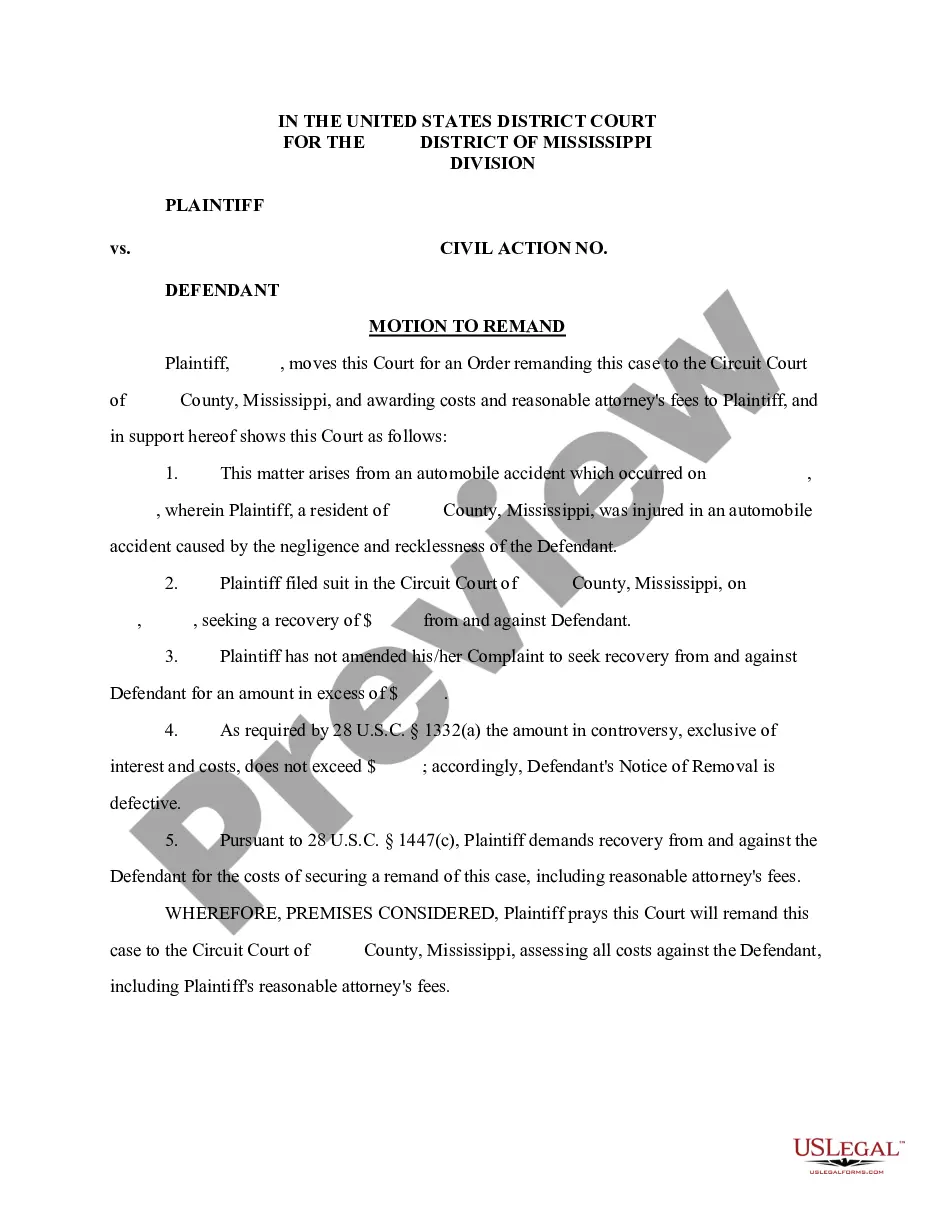
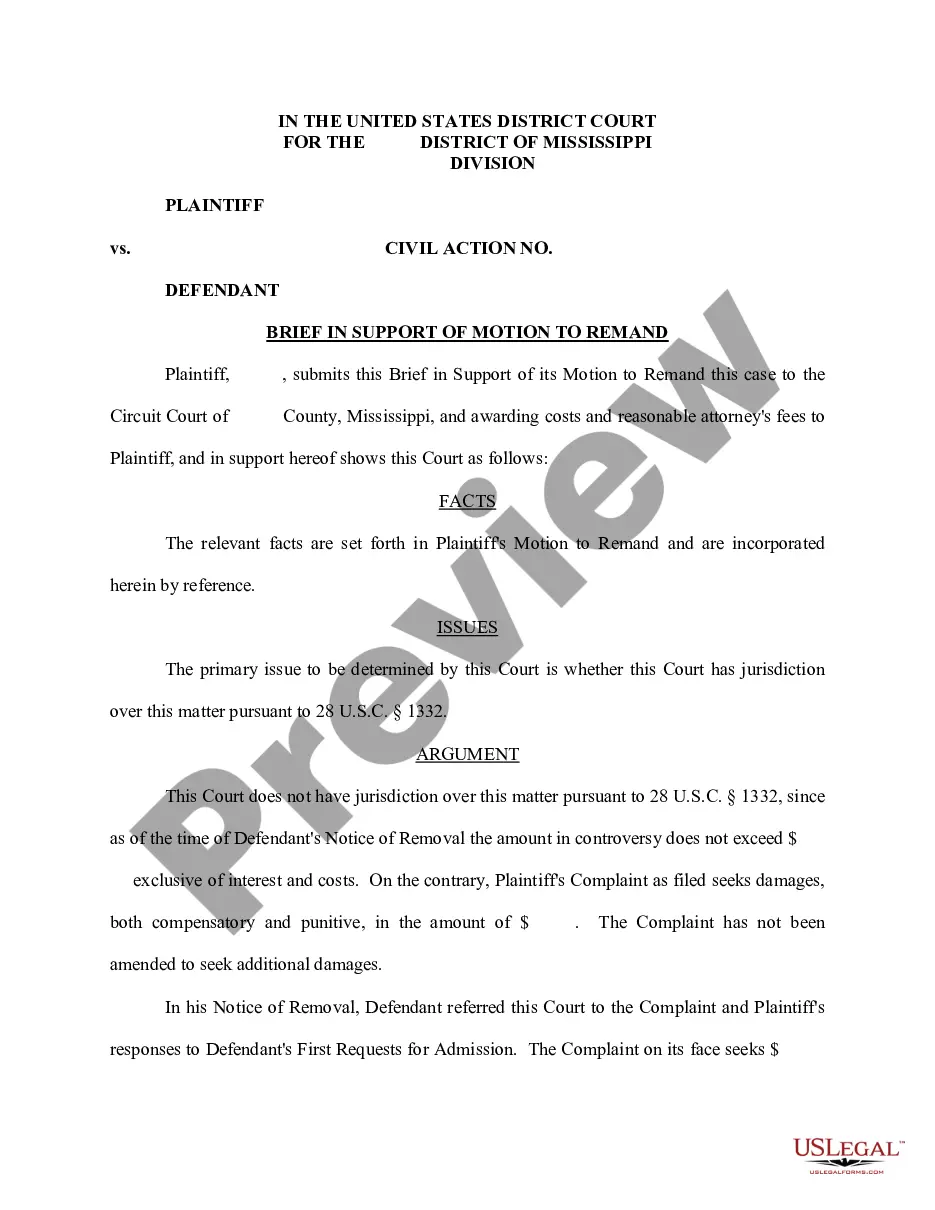
Mississippi Motion to Remand
Overview of this form
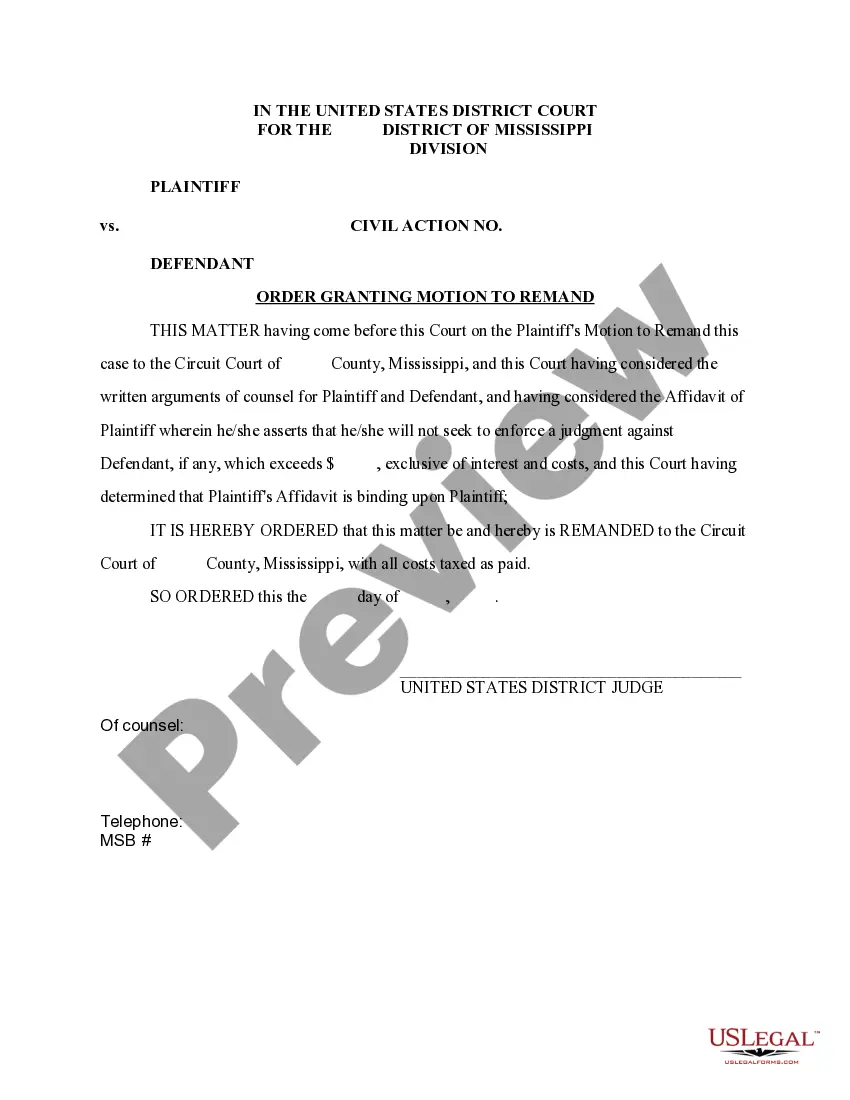
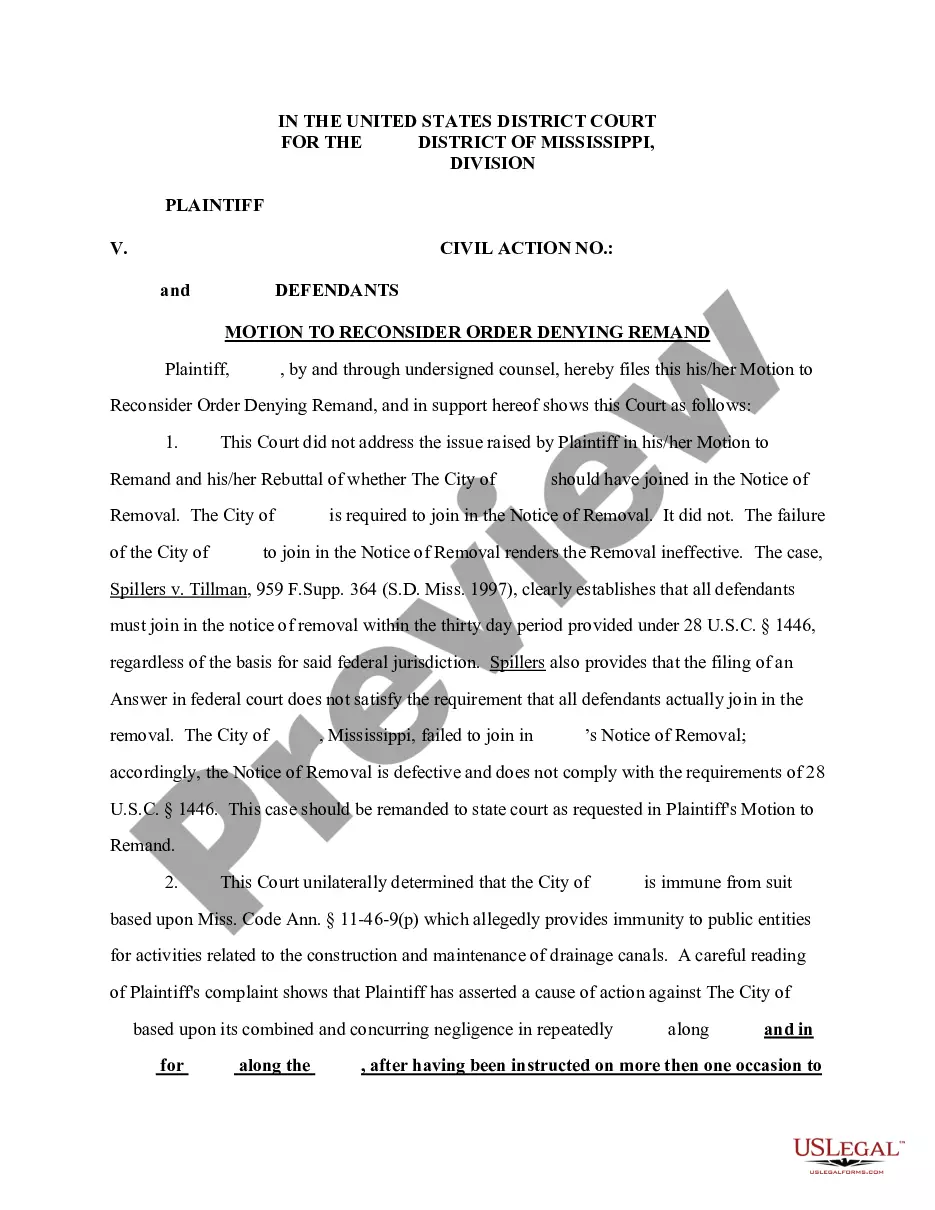
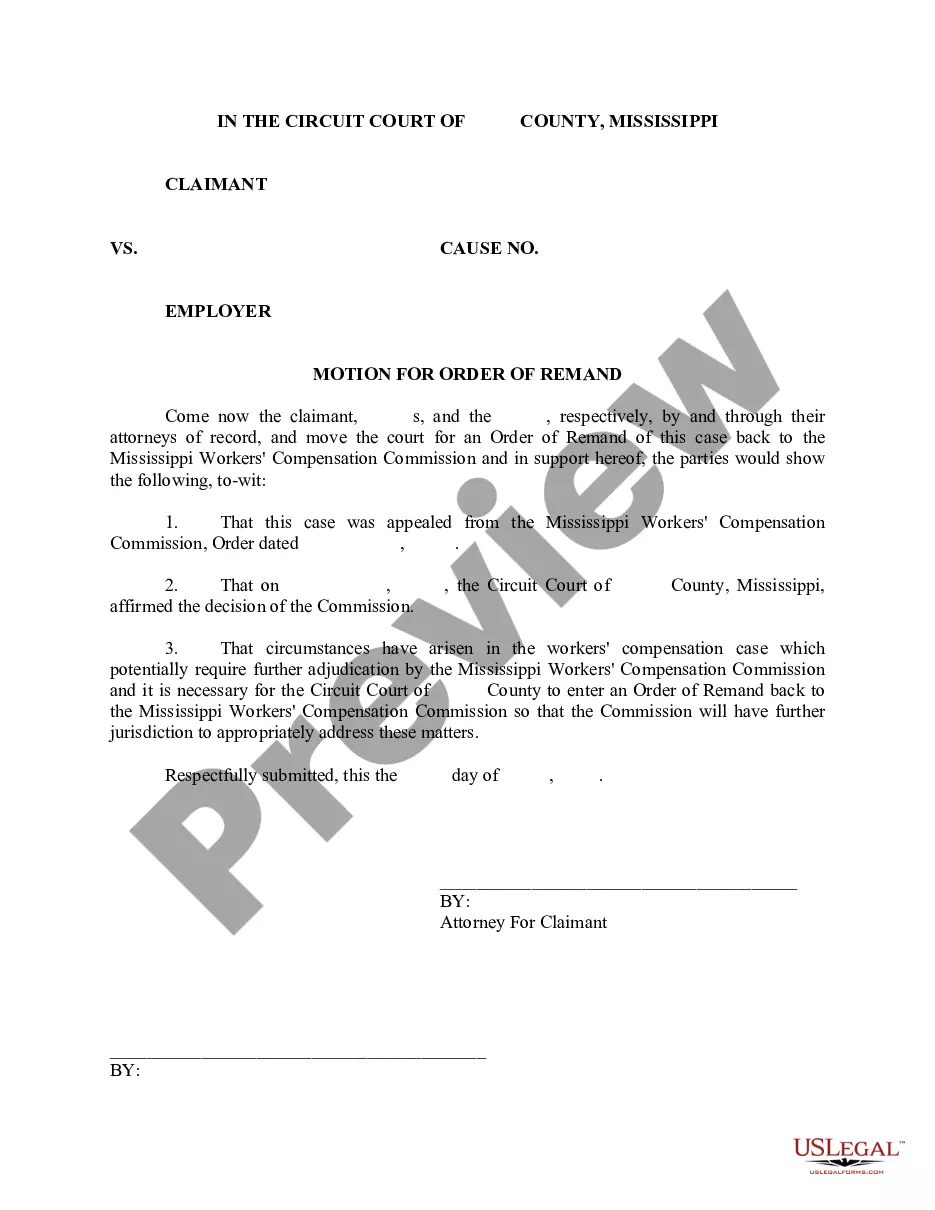
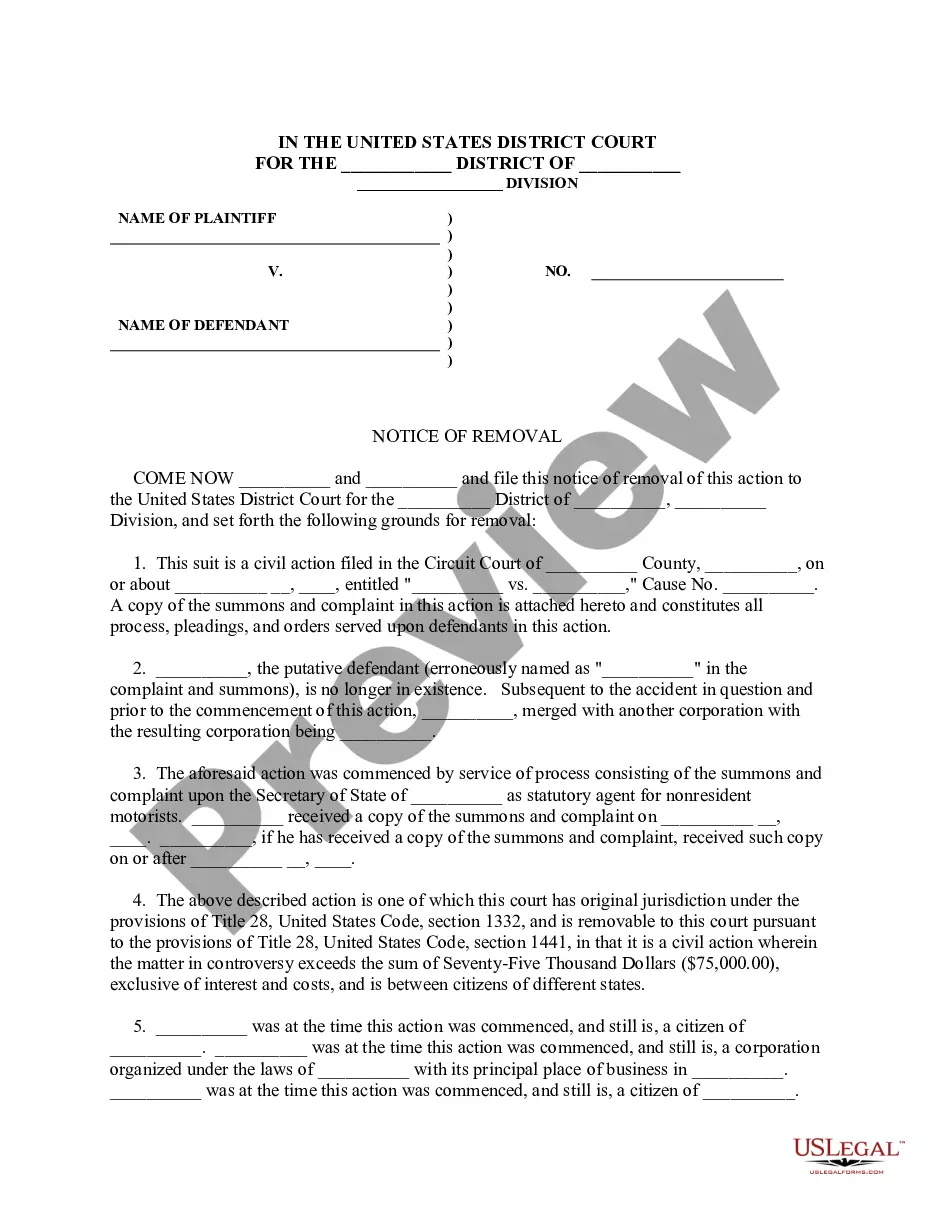
A Motion to Remand is a legal document that requests the court to send a case back to a lower court from which it was removed. This form serves as a formal request, allowing parties to challenge the removal of their case and seek resolution in a different jurisdiction. It is important to note that a Motion to Remand differs from other court motions, as it specifically addresses jurisdictional issues related to where a case is being heard.
Form components explained
- Identification of the case and parties involved.
- Clear statement of the reasons for requesting remand.
- Reference to legal statutes or rules supporting the motion.
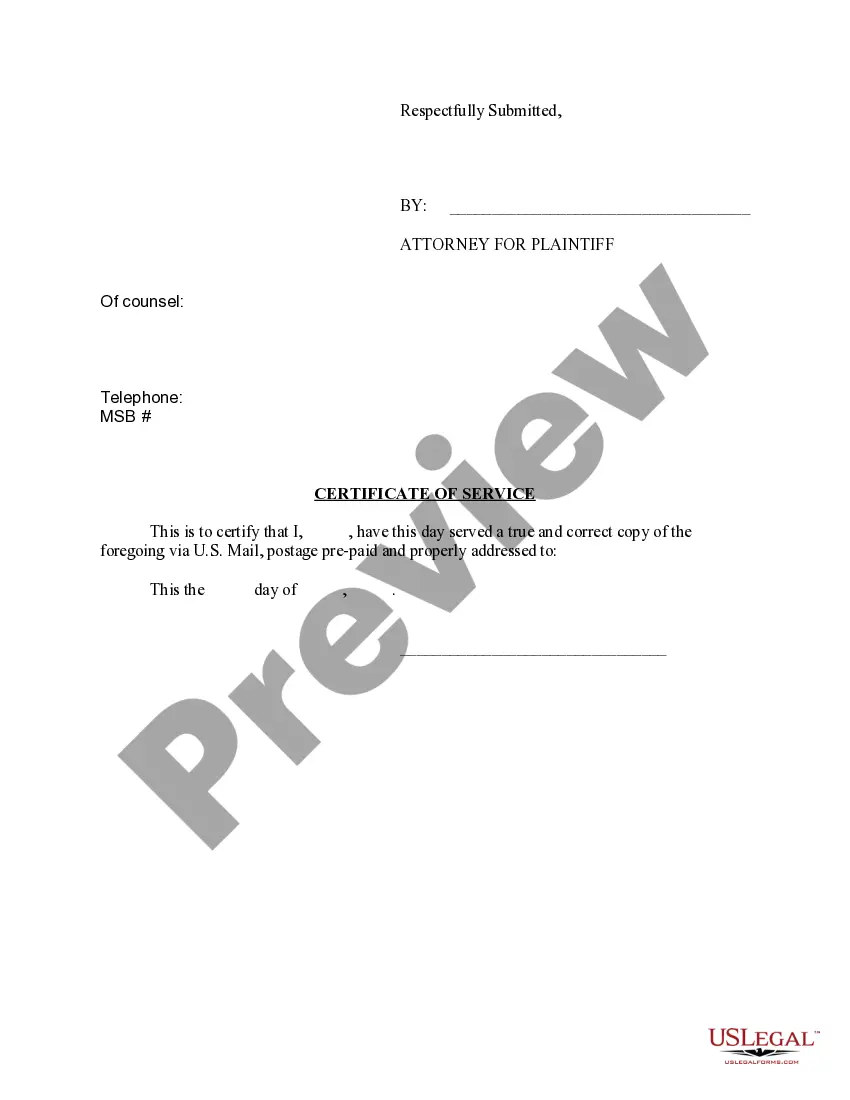
- Signature and date from the moving party or their attorney.
- Certificate of service indicating that copies were sent to all parties.
When to use this document
This form is needed in situations where a party believes that their case has been improperly removed from state court to federal court or between different jurisdictions. Common scenarios include when the parties are residents of the same state and there is no basis for federal jurisdiction or when issues related to jurisdiction arise after a case has been filed.
Who should use this form
- Individuals or parties whose cases have been removed to a court that does not have jurisdiction.
- Attorneys representing clients in jurisdictional disputes.
- Parties seeking to return their case to a more favorable court.
How to complete this form
- Clearly identify all parties involved in the case at the top of the document.
- State the precise reasons for requesting the remand, citing any relevant laws.
- Ensure that all information is accurate and complete, including case numbers.
- Sign and date the form where indicated.
- Provide a certificate of service to verify that all parties received a copy of the motion.
Notarization requirements for this form
Notarization is generally not required for this form. However, certain states or situations might demand it. You can complete notarization online through US Legal Forms, powered by Notarize, using a verified video call available anytime.
Get your form ready online
Our built-in tools help you complete, sign, share, and store your documents in one place.
Make edits, fill in missing information, and update formatting in US Legal Forms—just like you would in MS Word.
Download a copy, print it, send it by email, or mail it via USPS—whatever works best for your next step.
Sign and collect signatures with our SignNow integration. Send to multiple recipients, set reminders, and more. Go Premium to unlock E-Sign.
If this form requires notarization, complete it online through a secure video call—no need to meet a notary in person or wait for an appointment.
We protect your documents and personal data by following strict security and privacy standards.

Make edits, fill in missing information, and update formatting in US Legal Forms—just like you would in MS Word.

Download a copy, print it, send it by email, or mail it via USPS—whatever works best for your next step.

Sign and collect signatures with our SignNow integration. Send to multiple recipients, set reminders, and more. Go Premium to unlock E-Sign.

If this form requires notarization, complete it online through a secure video call—no need to meet a notary in person or wait for an appointment.

We protect your documents and personal data by following strict security and privacy standards.
Common mistakes
- Failing to correctly identify the parties involved in the case.
- Omitting legal citations that support the request for remand.
- Not signing the document before submission.
- Neglecting to serve all parties with a copy of the motion.
Benefits of completing this form online
- Convenient access to downloadable forms at any time.
- Editable forms allow you to customize content based on your case specifics.
- Prepared by licensed attorneys, ensuring reliability and legal accuracy.
Looking for another form?
Form popularity
FAQ
To remand something is to send it back. Remand implies a return.When an appellate court reverses the decision of a lower court, the written decision often contains an instruction to remand the case to the lower court to be reconsidered in light of the appellate court's ruling.
Remanded Appeals A remanded appeal simply means that the case is sent back to the lower courts.Improper rulings, errors in procedure, or the exclusion of admissible evidence may result in a lower court's decision being overturned and sent back for further action.
If the Court of Appeals reversed and remanded the trial court's orders on the issues that you've appealed, then it means that it has found that the trial judge was wrong on that issue, by either misapplying the law or in failing to have sufficient evidence to support their decision based on the testimony and evidence
A remand under rule 8.528(c) is not a decision final on filing because it is not a separately filed order; rather, as part of its appellate judgment at the end of its opinion in such cases the Supreme Court simply orders the cause remanded to the Court of Appeal for disposition of the remaining issues in the appeal.
In certain serious cases, an individual held on remand awaiting trial has the right to appeal directly to a judge. Each prison that holds prisoners on remand must provide a Bail Information Scheme (Prison Service Regulations PSO 6101).
An order to the sheriff to hold a defendant in custody until his or her next court appearance, or until bail is posted.
Remand means that a higher court sends back, or returns a case to the lower court. Our law firm will frequently file a motion to remand a case back to state court. If the federal court decides that the case was not one in which removal was appropriate, it will remand the case back to the state court.
Ruling protects state jurisdiction over remanded cases Share: Just as a remand order is not appealable, a motion for reconsideration of that remand order also is not appealable. That was the holding on an issue of first impression for the U.S. Court of Appeals for the Third Circuit. Relying on 28 U.S.C.