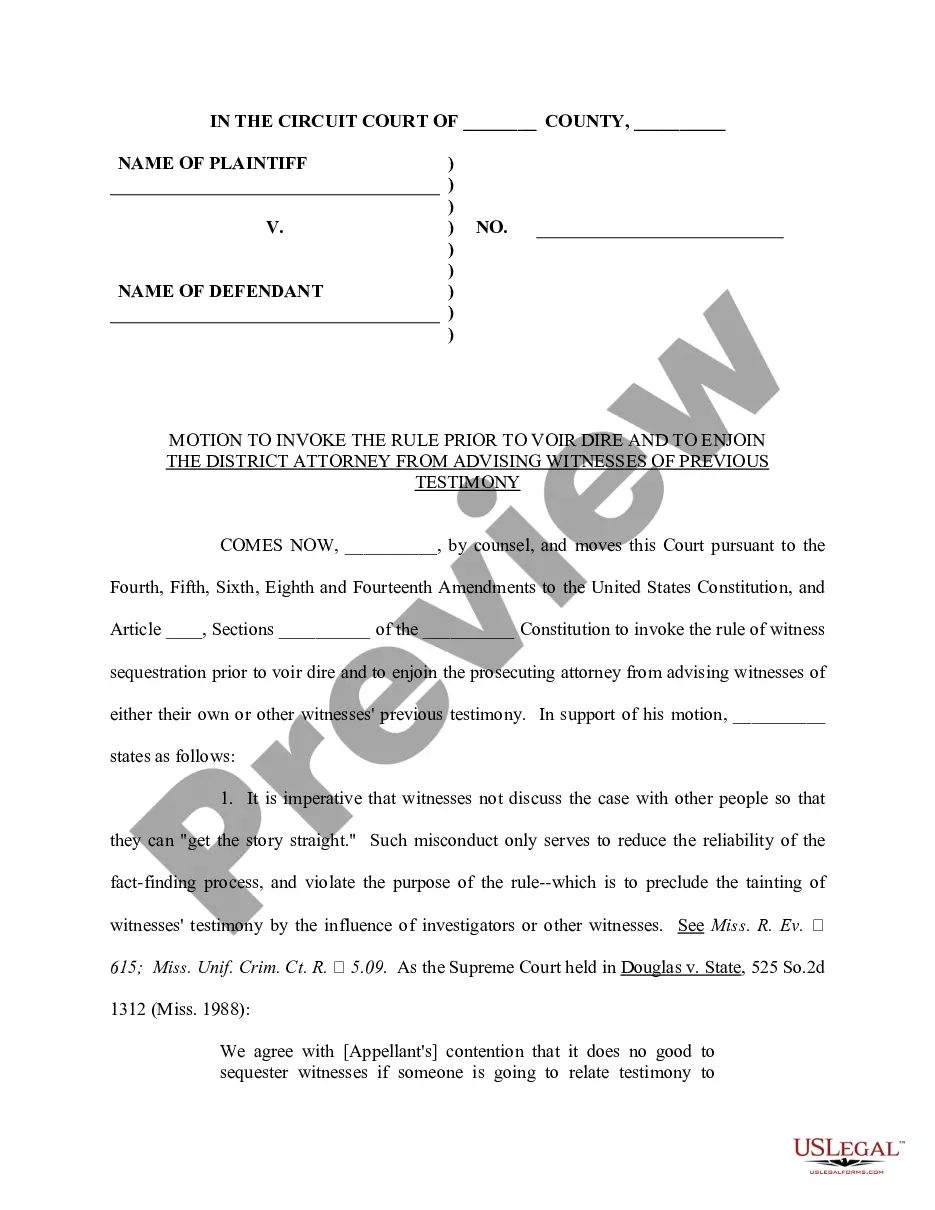
Mississippi Motion to Invoke the Rule Prior to Voir Dire and To Enjoin the District Attorney From Advising Witnesses of Previous Testimony
What this document covers
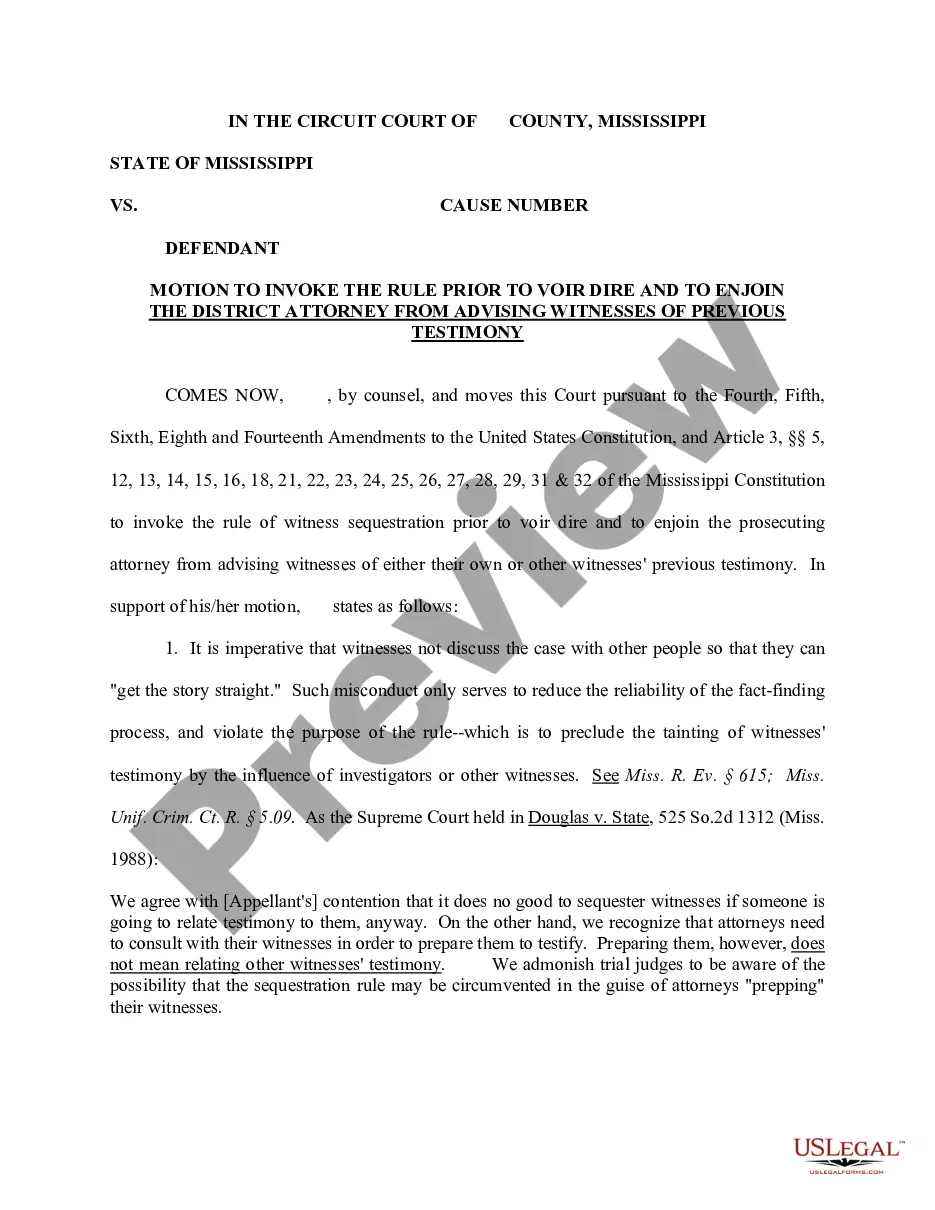
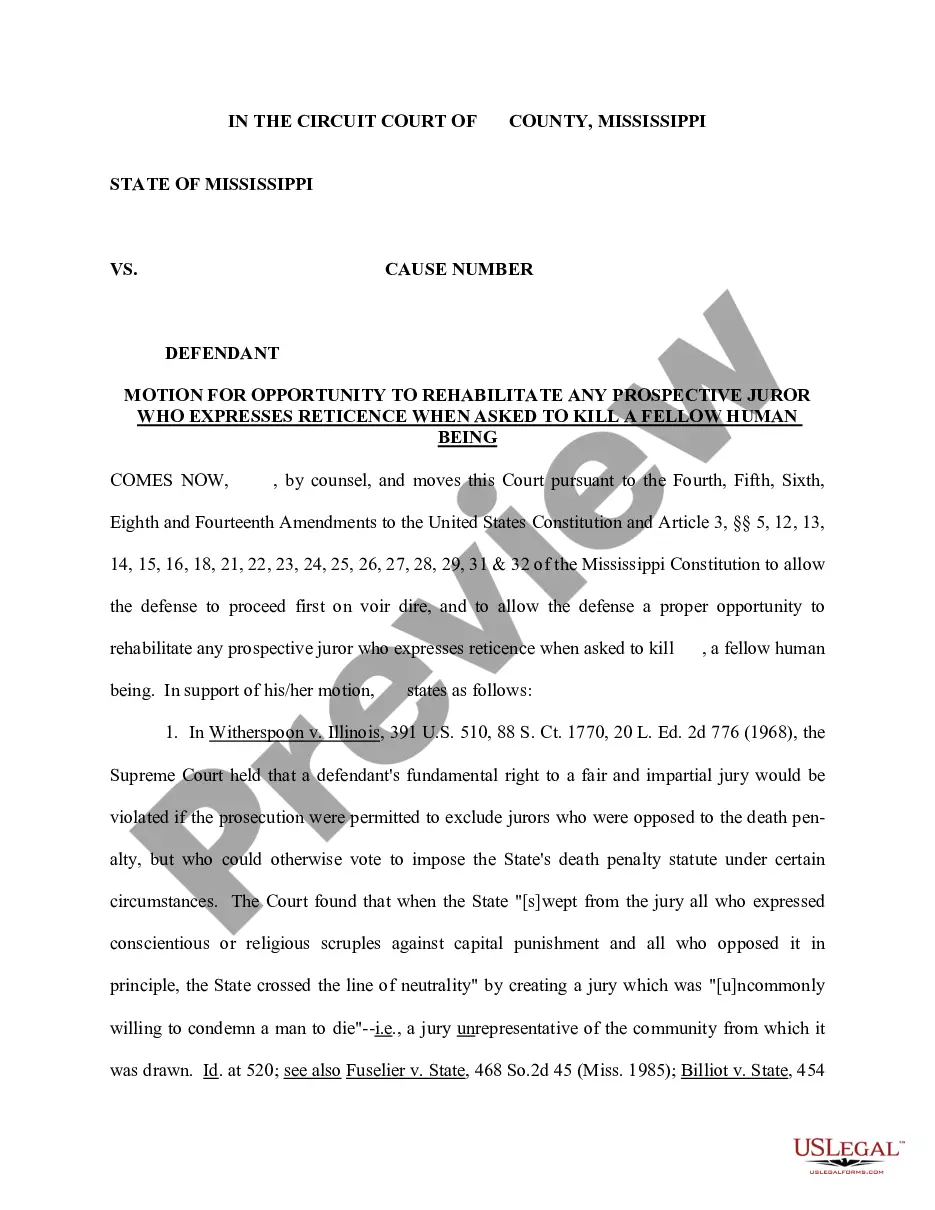
The Motion to Invoke the Rule Prior to Voir Dire and To Enjoin the District Attorney From Advising Witnesses of Previous Testimony is a legal document that requests the court to apply witness sequestration before jury selection. This motion aims to prevent witnesses from discussing the case with others and to protect the integrity of their testimony. It is essential in ensuring that the witness testimony remains unbiased and is not influenced by prior statements or testimonies. Unlike general motions, this specific request addresses crucial constitutional rights and the fairness of capital prosecutions.
Key components of this form
- Identification of the case and parties involved.
- Legal grounds for the motion, referencing constitutional amendments.
- Statement of the necessity for witness sequestration.
- Supporting arguments for preventing discussion of prior testimonies.
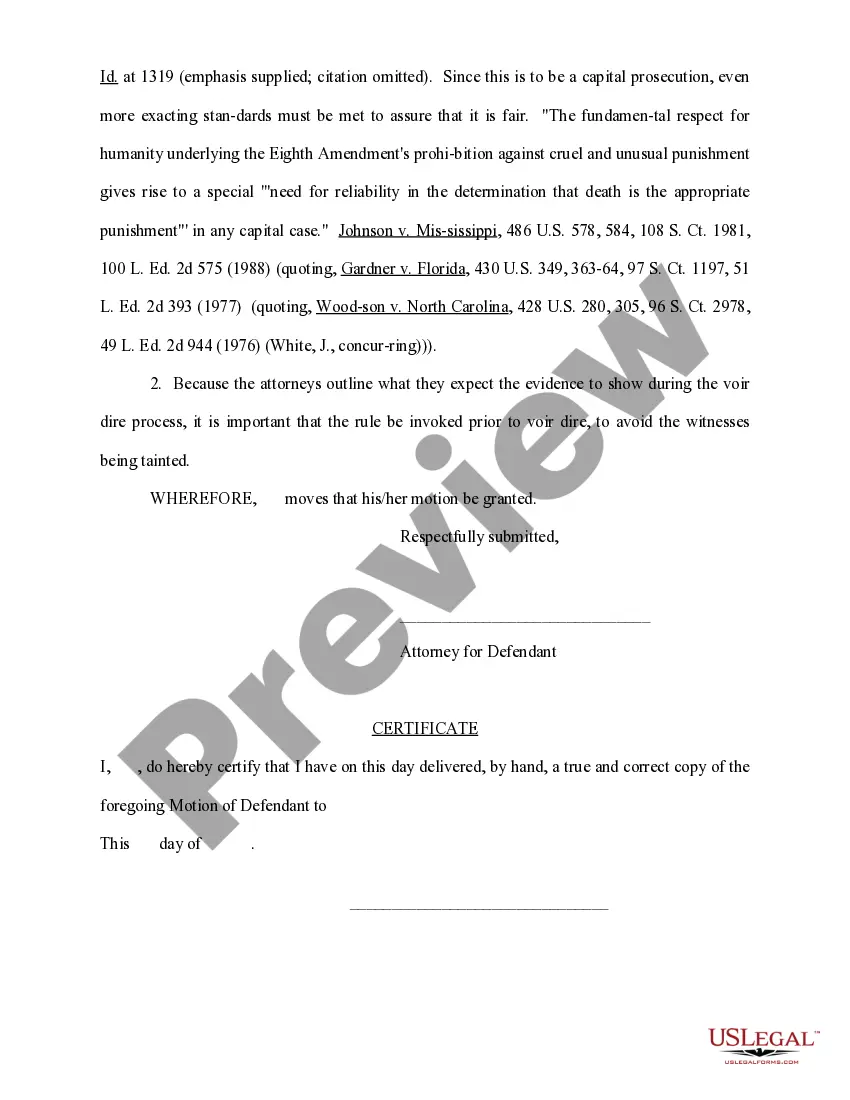
- Request for the court to grant the motion.
- Certification of service to the opposing counsel.
Situations where this form applies
This motion should be used prior to the jury selection process known as voir dire. It is particularly important in capital cases where the stakes are high, and the accuracy of witness testimonies must be safeguarded. This motion is appropriate when there is a concern that witnesses might be influenced by discussions about previous testimonies, which could compromise the fairness of the trial.
Intended users of this form
- Defendants facing criminal charges, especially in capital cases.
- Defense attorneys representing individuals in trial.
- Parties involved in a case where witness integrity is a concern.
How to prepare this document
- Identify the parties involved and the case number at the beginning of the document.
- State the grounds for your motion, referencing applicable constitutional amendments.
- Clearly explain the importance of witness sequestration prior to voir dire.
- Include a conclusion requesting the court to grant the motion.
- Sign and date the motion, and ensure a certificate of service is included.
Does this document require notarization?
This form does not typically require notarization to be legally valid. However, some jurisdictions or document types may still require it. US Legal Forms provides secure online notarization powered by Notarize, available 24/7 for added convenience.
Get your form ready online
Our built-in tools help you complete, sign, share, and store your documents in one place.
Make edits, fill in missing information, and update formatting in US Legal Forms—just like you would in MS Word.
Download a copy, print it, send it by email, or mail it via USPS—whatever works best for your next step.
Sign and collect signatures with our SignNow integration. Send to multiple recipients, set reminders, and more. Go Premium to unlock E-Sign.
If this form requires notarization, complete it online through a secure video call—no need to meet a notary in person or wait for an appointment.
We protect your documents and personal data by following strict security and privacy standards.

Make edits, fill in missing information, and update formatting in US Legal Forms—just like you would in MS Word.

Download a copy, print it, send it by email, or mail it via USPS—whatever works best for your next step.

Sign and collect signatures with our SignNow integration. Send to multiple recipients, set reminders, and more. Go Premium to unlock E-Sign.

If this form requires notarization, complete it online through a secure video call—no need to meet a notary in person or wait for an appointment.

We protect your documents and personal data by following strict security and privacy standards.
Mistakes to watch out for
- Failing to provide sufficient legal grounds or justification for the motion.
- Not properly identifying the parties or including the case number.
- Neglecting to include the certificate of service to opposing counsel.
Advantages of online completion
- Convenience of downloading and completing at your own pace.
- Reliability of having templates drafted by licensed attorneys.
- Ability to easily edit the form to suit specific legal needs.
Legal use & context
- This form is legally binding when filed correctly in court.
- It serves to protect the rights of the defendant by preventing potential witness tampering.
- Proper use of this motion enhances the integrity of the trial process, especially in serious criminal cases.
Looking for another form?
Form popularity
FAQ
A Telling French Verb. Dire is one of the most common and useful French verbs and has irregular conjugations. Dire literally means "to say" or "to tell," and is also found in many idiomatic expressions.
Aller to go. Je vais. Tu vas. Il/Elle va. avoir to have. J'ai. Tu as. Il/Elle a. dire to say, to tell. Je dis. Tu dis. Il/Elle dit. etre to be. Je suis. Tu es. faire to make, to do. Je fais. Tu fais. pouvoir to be able to do. Je peux. Tu peux. savoir to know, to know how to. Je sais. Tu sais. voir to see. Je vois. Tu vois.
A Telling French Verb. Dire is one of the most common and useful French verbs and has irregular conjugations. Dire literally means "to say" or "to tell," and is also found in many idiomatic expressions.
Dire is an irregular -re verb.
Rire may be a short word, but it's also an irregular verb.
For example, regular verbs ending in -er all change their endings the same way when conjugated. Regular -ir and -re verbs follow their own sets of rules as well. Irregular verbs don't follow these normal rules of conjugation and must be learned individually. Don't become overwhelmed, though.
Dire is one of the most important French verbs here's how to conjugate it into every tense and mood. Dire is an irregular -re verb. Je te dis la veritA© !
The Spanish verb recordar means 'to remember ' and is an irregular Spanish AR verb. To remember this, imagine to remember things it is useful to RECORD them on a RECORDER! Recordar changes the stem in the Present, Present Subjunctive and Imperative tenses.
Se dire. Se dire can be reflexive, reciprocal, or passive. Il s'est dit de se tenir tranquille. He told himself to keep quiet.