Mississippi Amended Motion in Limine
What is this form?
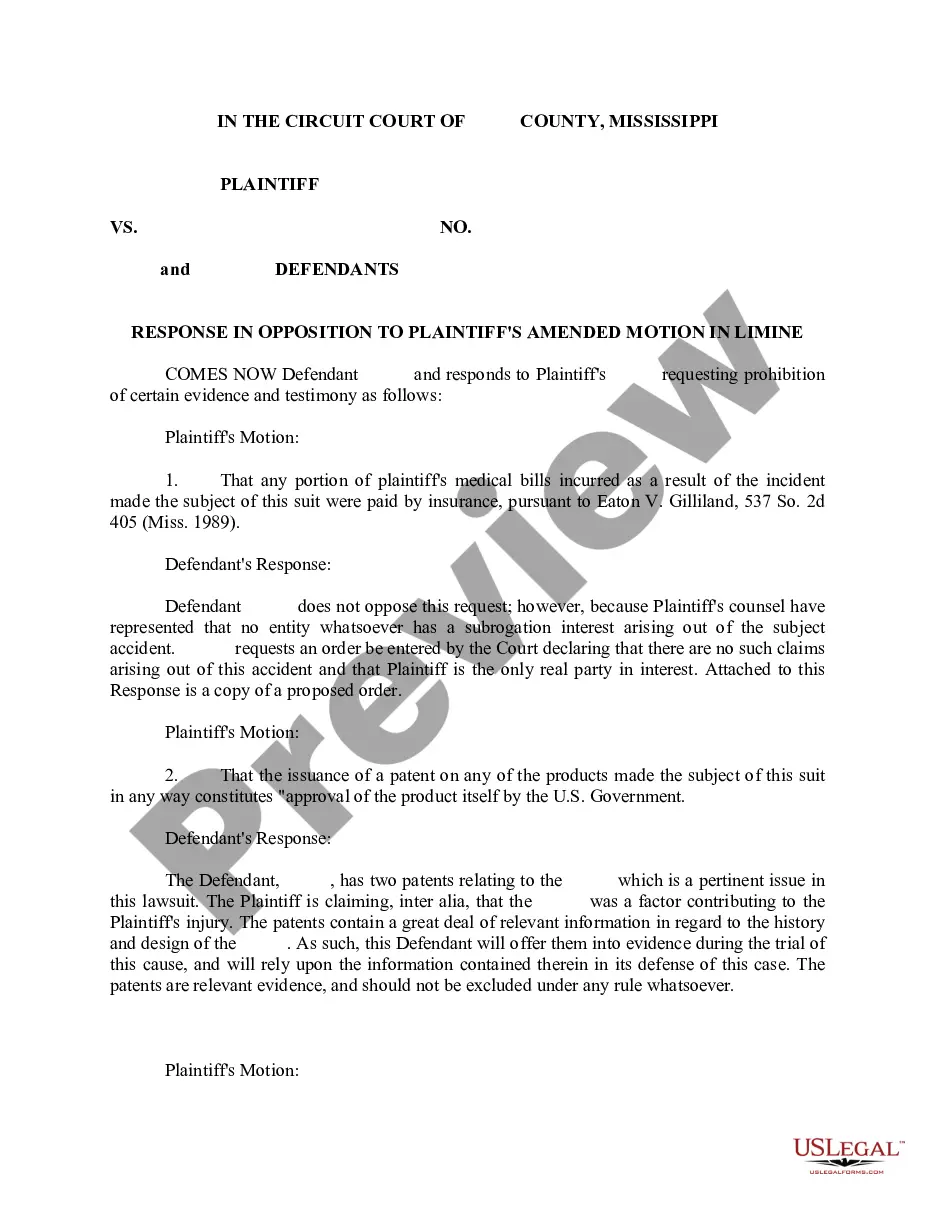
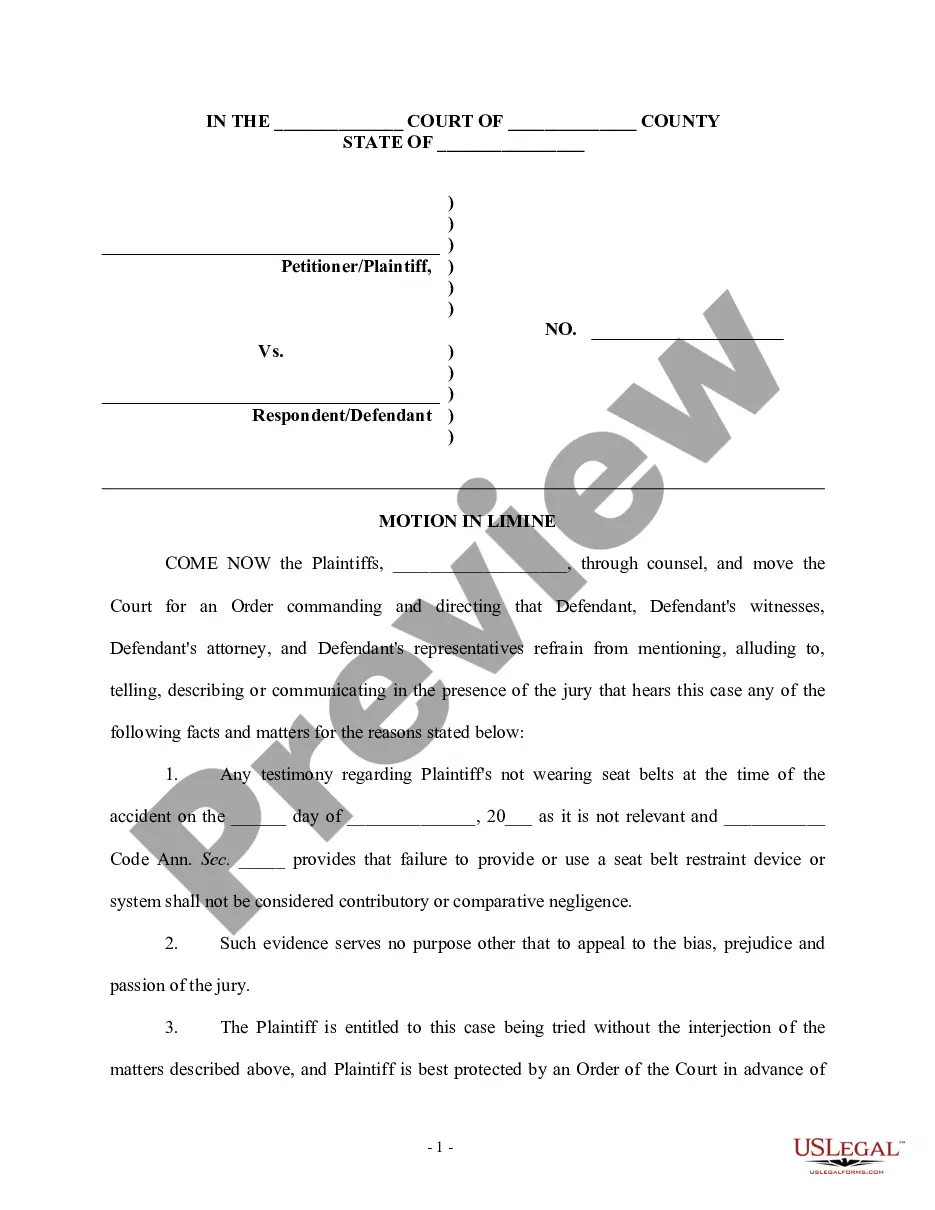
An Amended Motion in Limine is a formal written request to the court seeking specific action regarding evidence that may be introduced during legal proceedings. Unlike a standard motion in limine, this amended version allows for revisions or updates to original requests, ensuring that the court is clearly informed of the relevant legal arguments and evidence expected to be presented. This document is essential for maintaining a fair trial by preemptively addressing potentially prejudicial evidence.
What’s included in this form
- Title of the motion specifying it as an amended request.
- Clear introduction outlining the purpose and legal basis for the motion.
- Detailed arguments supporting the request for action.
- Specific evidence referenced with citations to relevant laws or case precedents.
- Signature line for the submitting party or their attorney.
Situations where this form applies
This form should be used when a party wishes to amend a previous motion in limine that has already been filed. Situations may include new evidence that has come to light, changes in the legal argument, or adjustments in the evidence's admissibility. Utilizing this amended form ensures that the court receives the most current and pertinent information regarding the case.
Who this form is for
- Litigants involved in civil or criminal cases who have already submitted a motion in limine.
- Attorneys representing clients who need to update or adjust previous filings.
- Individuals seeking to clarify the evidence to prevent potential bias during a trial.
Completing this form step by step
- Identify the parties involved in the case at the top of the document.
- Clearly state the title of the motion as "Amended Motion in Limine."
- Provide a detailed introduction that summarizes the purpose of the amendment.
- List the specific evidence or arguments that necessitate the amendment.
- Sign and date the motion, including your printed name and title, if applicable.
Does this form need to be notarized?
Notarization is generally not required for this form. However, certain states or situations might demand it. You can complete notarization online through US Legal Forms, powered by Notarize, using a verified video call available anytime.
Get your form ready online
Our built-in tools help you complete, sign, share, and store your documents in one place.
Make edits, fill in missing information, and update formatting in US Legal Forms—just like you would in MS Word.
Download a copy, print it, send it by email, or mail it via USPS—whatever works best for your next step.
Sign and collect signatures with our SignNow integration. Send to multiple recipients, set reminders, and more. Go Premium to unlock E-Sign.
If this form requires notarization, complete it online through a secure video call—no need to meet a notary in person or wait for an appointment.
We protect your documents and personal data by following strict security and privacy standards.

Make edits, fill in missing information, and update formatting in US Legal Forms—just like you would in MS Word.

Download a copy, print it, send it by email, or mail it via USPS—whatever works best for your next step.

Sign and collect signatures with our SignNow integration. Send to multiple recipients, set reminders, and more. Go Premium to unlock E-Sign.

If this form requires notarization, complete it online through a secure video call—no need to meet a notary in person or wait for an appointment.

We protect your documents and personal data by following strict security and privacy standards.
Common mistakes
- Failing to clearly distinguish the amendments made from the original motion.
- Not citing the correct laws or case precedents that support the amended request.
- Submitting the motion after the court-set deadlines.
Benefits of completing this form online
- Immediate access to a professionally drafted template suited for your needs.
- Edit and customize the document from the convenience of your home or office.
- Reliable, accurate legal content prepared by licensed attorneys.
Legal use & context
- This form serves as a critical tool for ensuring that only relevant evidence is presented to the court.
- Using an amended motion in limine can help prevent improper evidence from influencing the outcome of a trial.
- Filing this motion is governed by court rules, necessitating careful adherence to procedures to ensure its acceptance.
Key takeaways
- An Amended Motion in Limine updates a previous motion to ensure accurate representation of evidence.
- It is essential to follow the specific procedural rules of the court.
- Utilizing this form effectively can help maintain a fair trial environment.
Looking for another form?
Form popularity
FAQ
Amend something previously adopted - is a change motion that can be made only if no action has been taken on the original motion. It is used to strike out only a part of the text or make a change to the wording. It must be seconded, is debatable and requires 2/3 of the members to vote in the affirmative to pass.
There is also authority for the proposition that if a motion in limine is denied, the party opposing the evidence can be the first to offer the objectionable evidence without waiving the merits of the evidentiary objection on appeal.
Motions in limine should be used only for their original purpose to challenge evidence that is so inadmissible and prejudicial that its mere mention in the presence of the jury would lead to an unfair trial.On appeal this ruling of the trial court was affirmed.
A motion in limine is distinct from a motion for a protective order, which is a request to prevent the discovery of evidence, and a motion to suppress, which can be raised by the defense in American criminal trials to prevent the admission of evidence that was obtained unconstitutionally.
Stated in the most general terms, a proper motion in limine is an evidentiary motion that seeks a determination as to whether to exclude (or admit) evidence before it is offered at trial.
Generally, a party in a lawsuit files a motion in limine to exclude evidence from a trial because the evidence isn't relevant or because its prejudicial effect substantially outweighs its probative value. You can oppose the motion in limine by drafting and filing your own motion in opposition.
Something is not right. Motions in Limine are generally filed shortly before trial and not months prior. Also, the terms used here ("amend" and "modify") are confusing and not generally used with motions but are used in connections with...