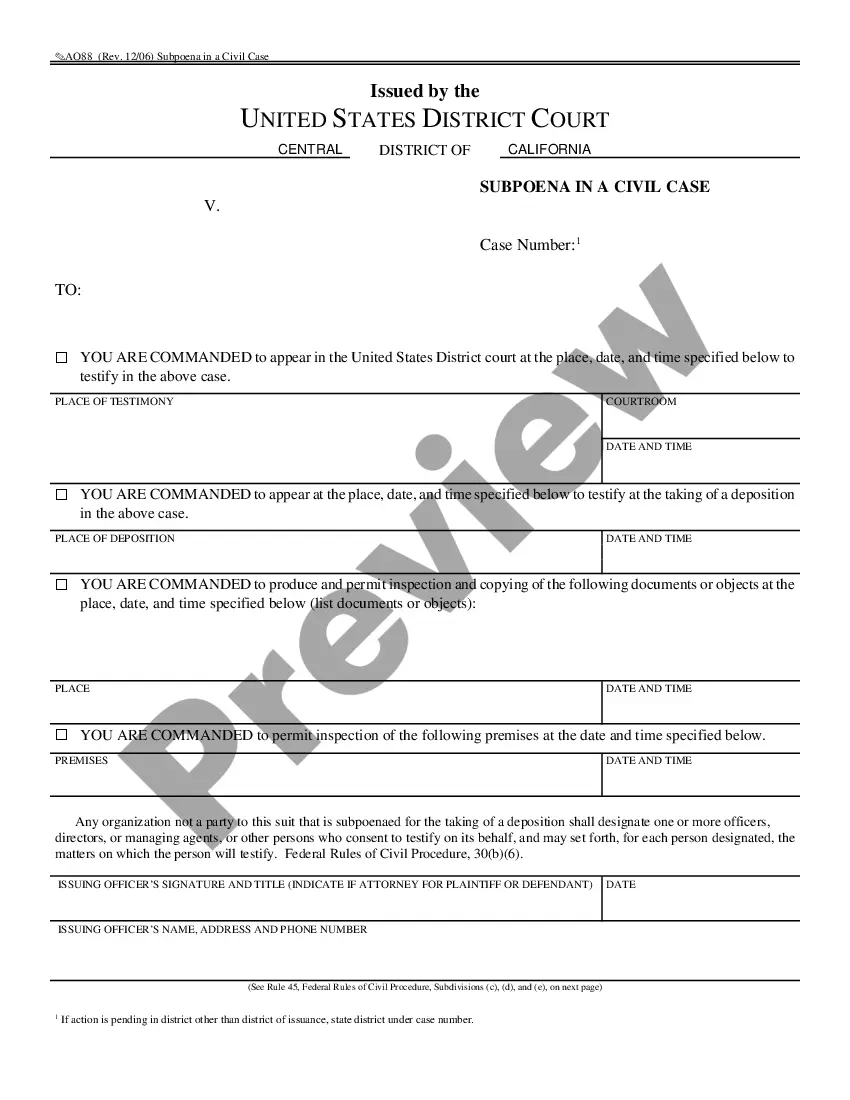
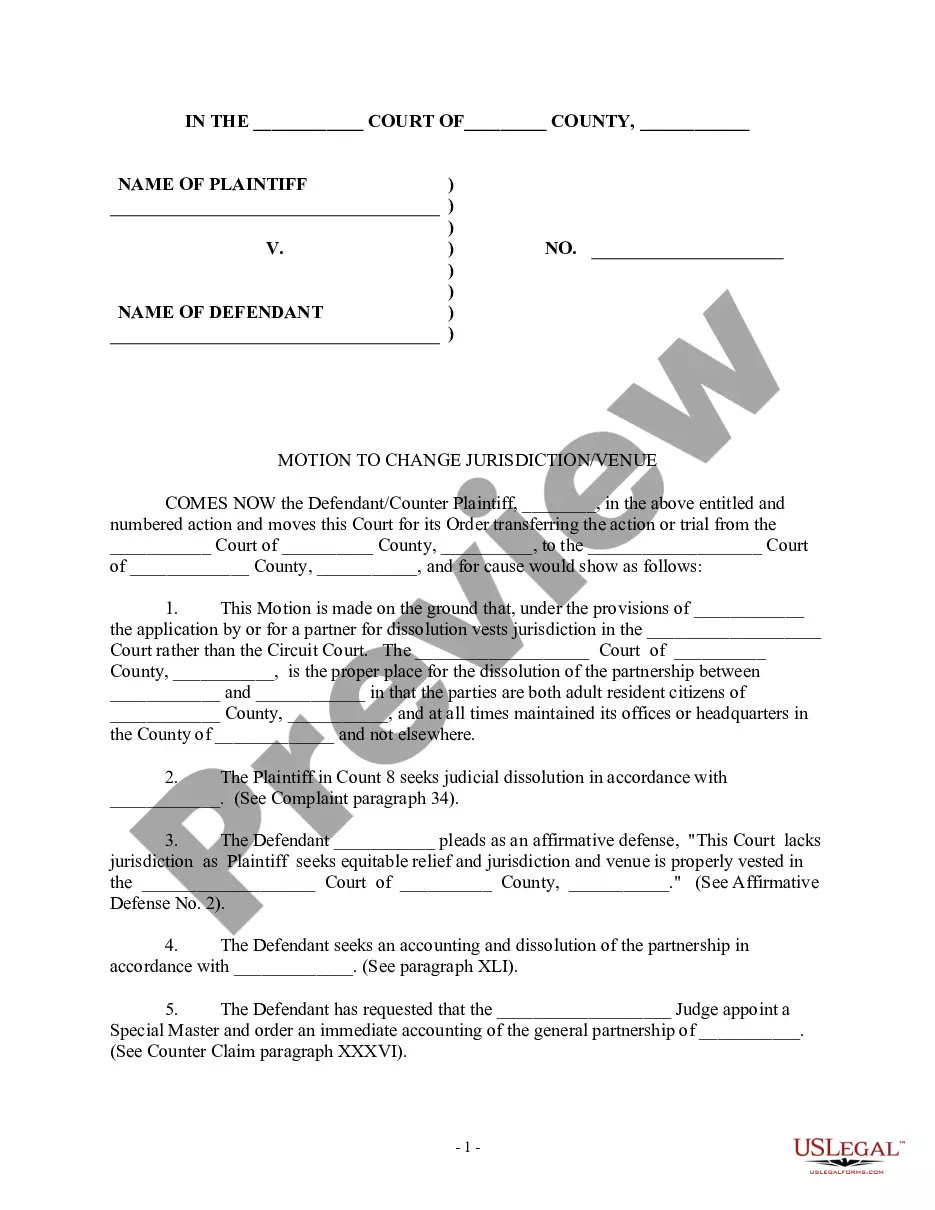
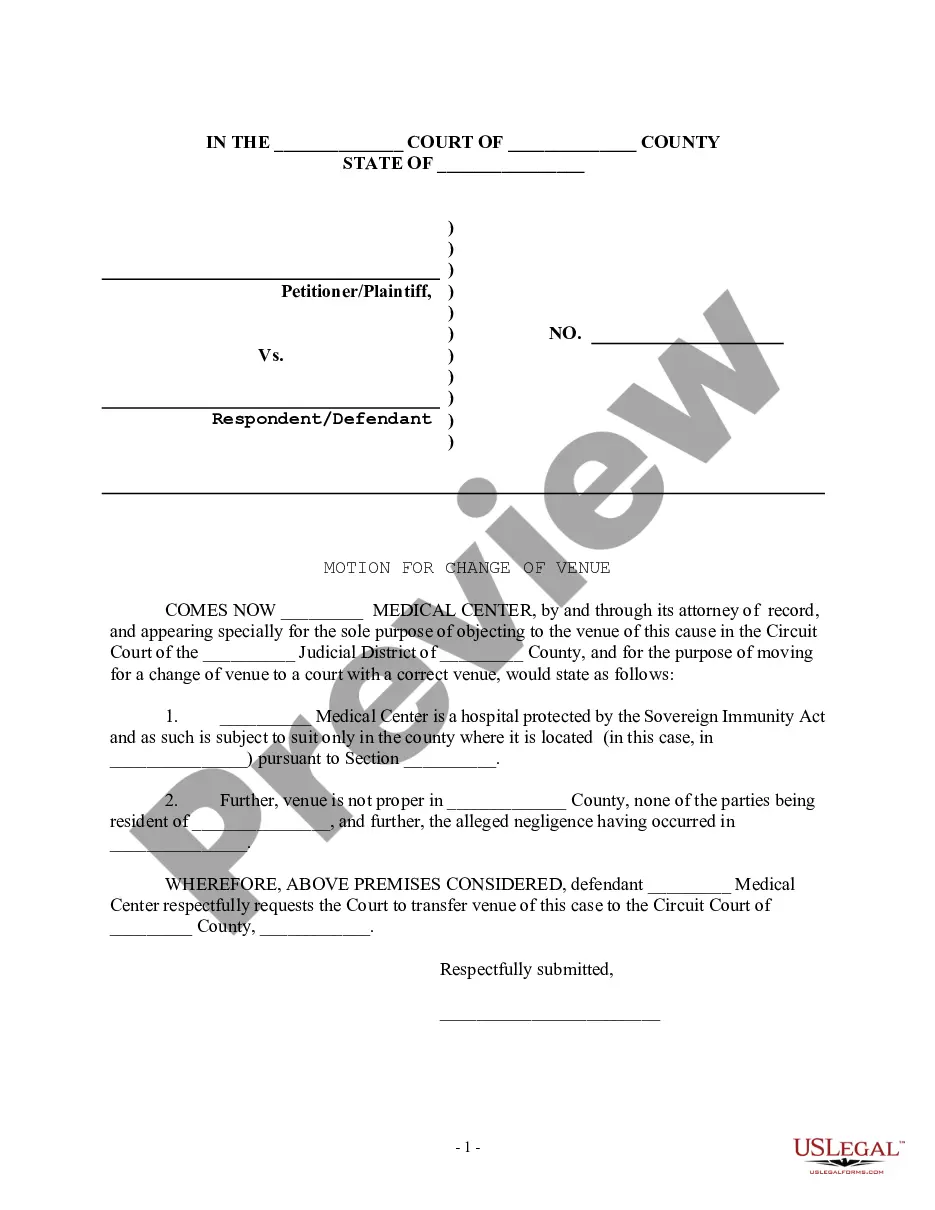
Mississippi Defendant's Motion for Change of Venue
What is this form?
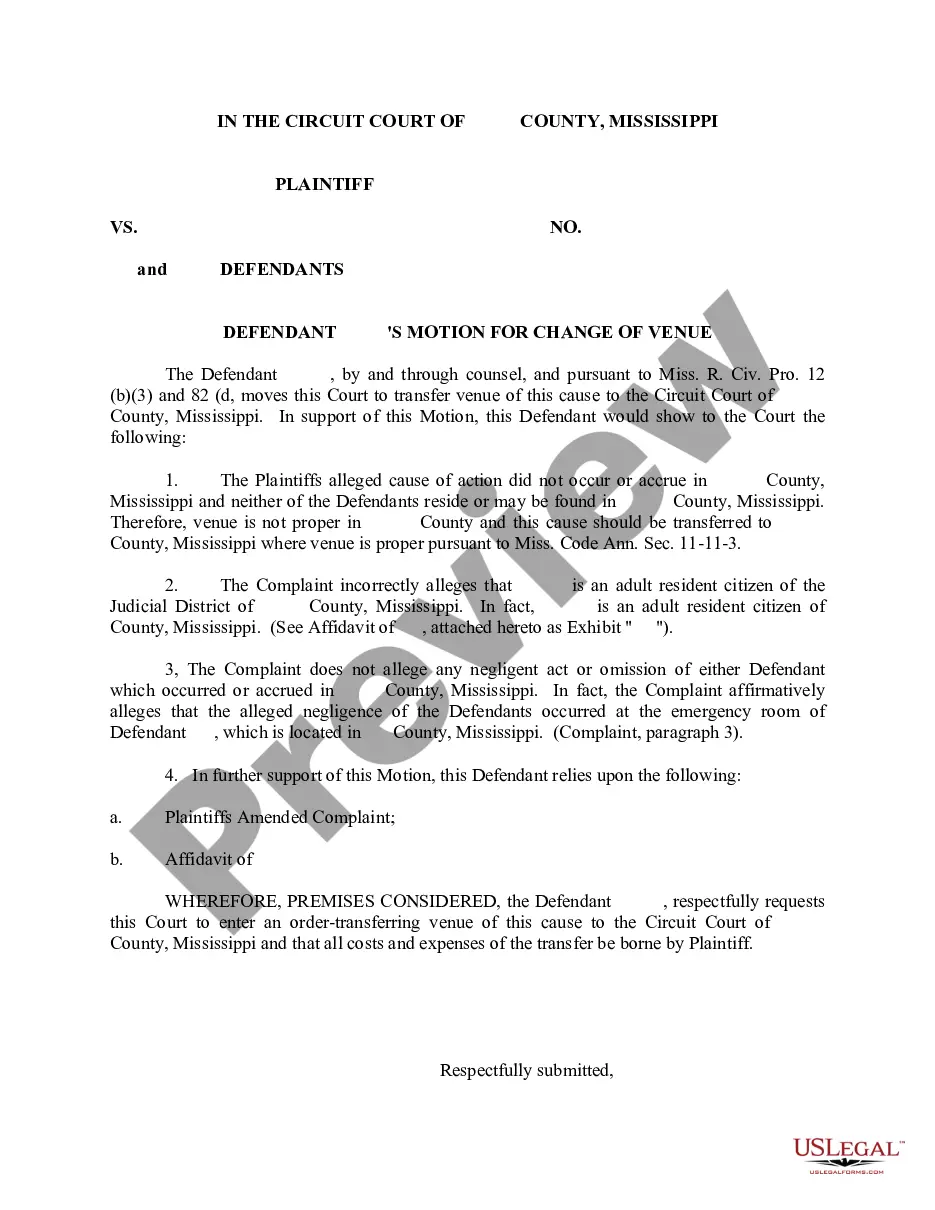
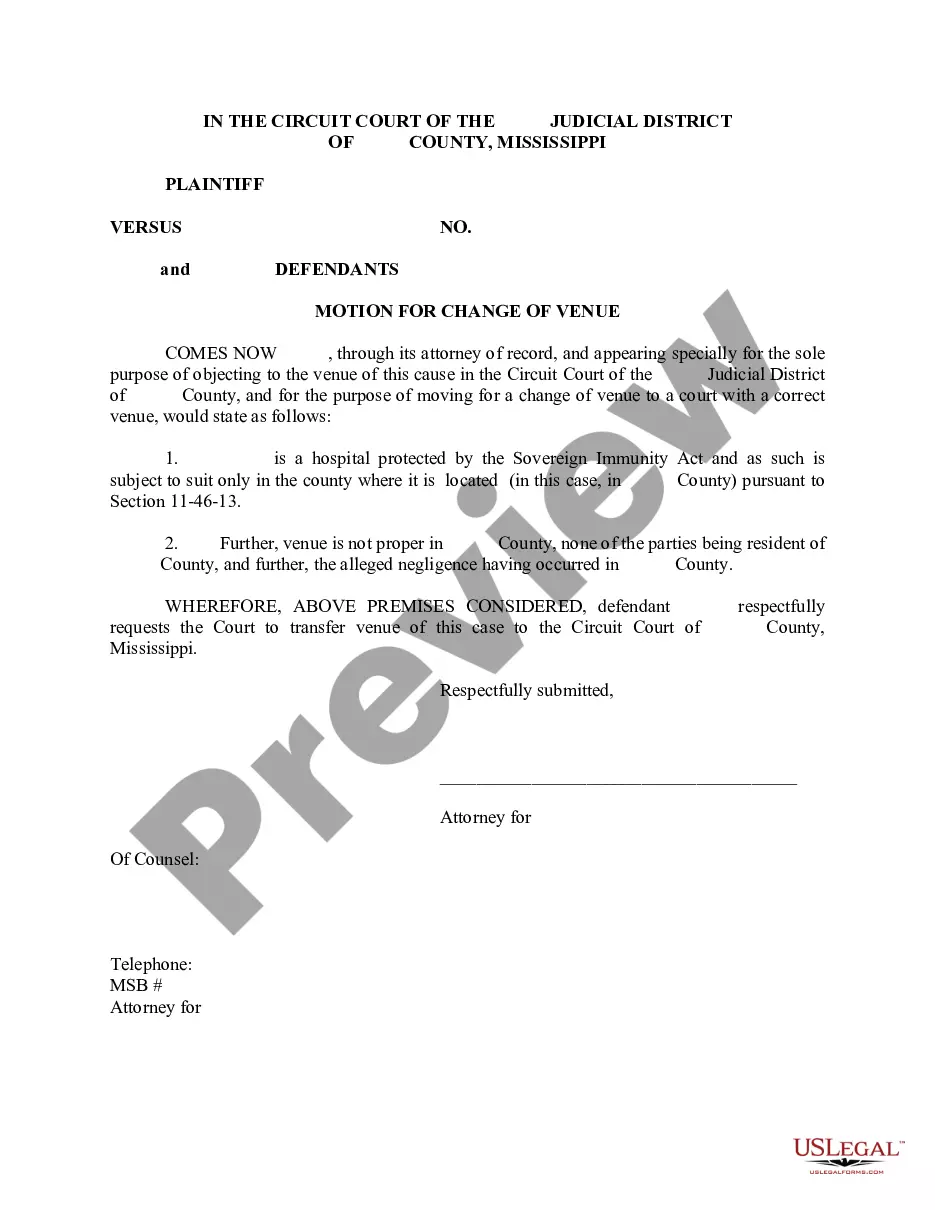
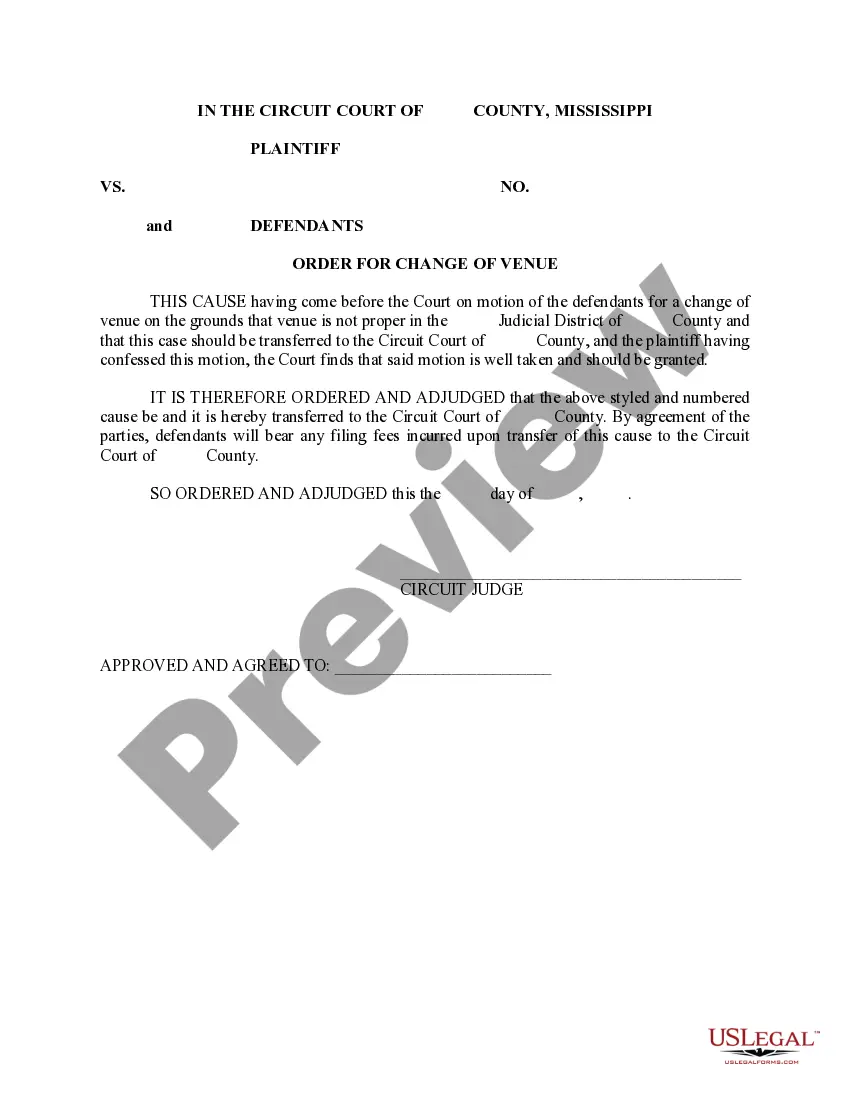
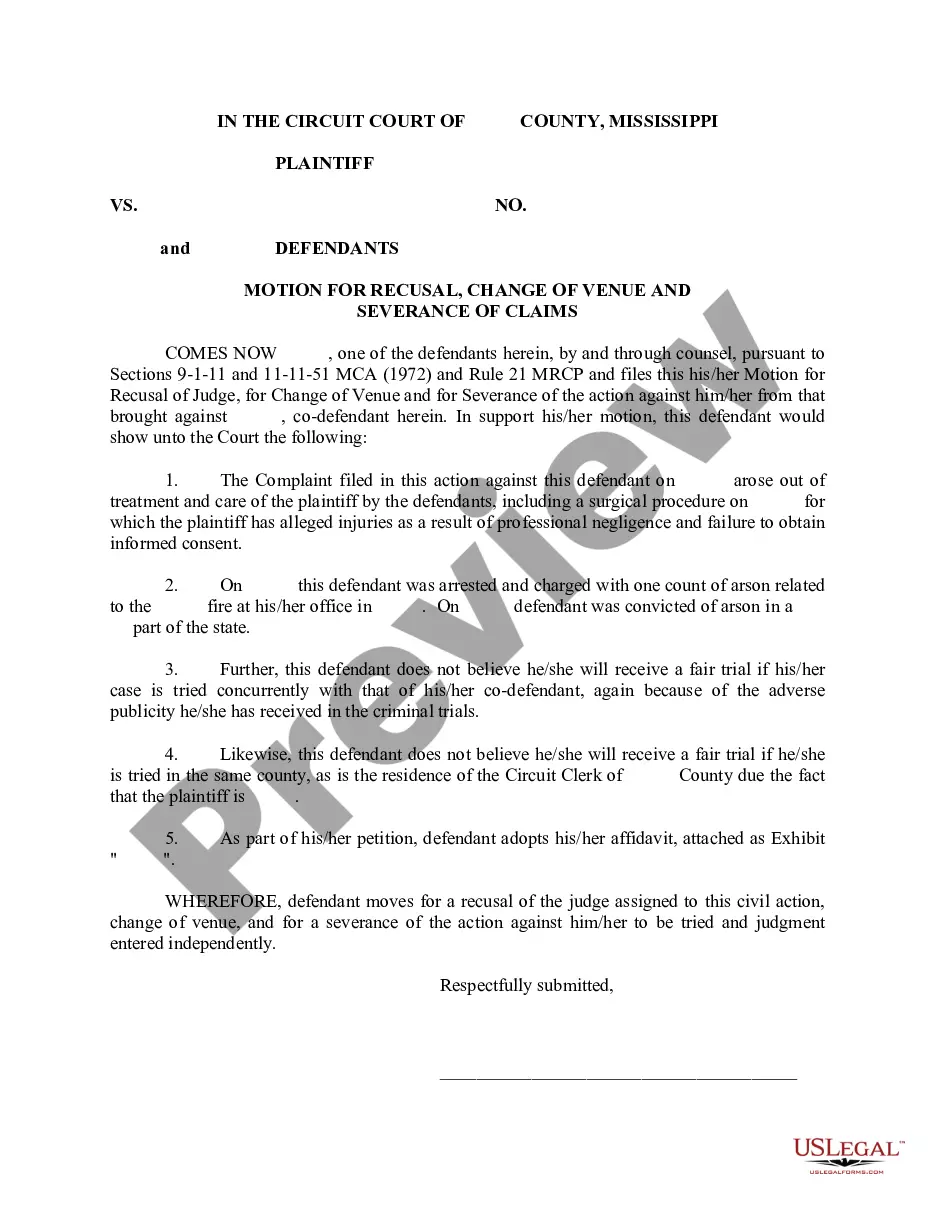
A Defendant's Motion for Change of Venue is a formal request made to the court seeking to move a case to a different jurisdiction. This motion is essential when a defendant believes that a fair trial cannot be conducted in the current location due to various reasons, such as biased local public opinion or convenience of witnesses. Unlike other motions, this document specifically addresses the need to change the trial location, making it crucial in legal proceedings where impartiality is key.
Key parts of this document
- Caption: Identifies the court, case number, and parties involved.
- Statement of facts: Outlines the reasons for the requested change of venue.
- Legal grounds: References the laws or rules that support the motion.
- Signature block: Includes the signature of the party or their attorney submitting the motion.

Common use cases
This form is useful in scenarios where a defendant feels that they cannot receive a fair trial in the current venue. Reasons for using this form may include a prejudiced jury pool, the convenience of witnesses located in another jurisdiction, or significant media coverage in the current venue that may influence the jury's impartiality.
Who this form is for
This form is intended for:
- Defendants in civil and criminal cases who wish to request a venue change.
- Attorneys representing clients seeking to ensure a fair trial.
- Parties involved in legal proceedings who believe the current jurisdiction is unsuitable.
Completing this form step by step
- Identify the parties involved: Fill in the names of the plaintiff and defendants, along with any case numbers.
- State the grounds for the motion: Provide a detailed explanation of why the venue should change.
- Reference relevant laws: Include any legal statutes that support your request for a venue change.
- Sign the motion: Ensure the document is signed by the attorney or party making the request.
- File with the court: Submit the completed motion to the appropriate court along with any required fees.
Notarization guidance
This form does not typically require notarization unless specified by local law. However, checking with the court may provide additional requirements based on local rules.
Get your form ready online
Our built-in tools help you complete, sign, share, and store your documents in one place.
Make edits, fill in missing information, and update formatting in US Legal Forms—just like you would in MS Word.
Download a copy, print it, send it by email, or mail it via USPS—whatever works best for your next step.
Sign and collect signatures with our SignNow integration. Send to multiple recipients, set reminders, and more. Go Premium to unlock E-Sign.
If this form requires notarization, complete it online through a secure video call—no need to meet a notary in person or wait for an appointment.
We protect your documents and personal data by following strict security and privacy standards.

Make edits, fill in missing information, and update formatting in US Legal Forms—just like you would in MS Word.

Download a copy, print it, send it by email, or mail it via USPS—whatever works best for your next step.

Sign and collect signatures with our SignNow integration. Send to multiple recipients, set reminders, and more. Go Premium to unlock E-Sign.

If this form requires notarization, complete it online through a secure video call—no need to meet a notary in person or wait for an appointment.

We protect your documents and personal data by following strict security and privacy standards.
Avoid these common issues
- Failing to provide adequate reasons for the venue change.
- Neglecting to reference the correct legal statutes.
- Not signing the motion before submission.
- Submitting the motion in the wrong jurisdiction.
Why use this form online
- Convenience of downloading and filling out the form at your own pace.
- Editability allows you to customize the form to fit your specific circumstances.
- Access to professionally drafted templates, ensuring legal compliance.
- The motion must be substantiated with adequate legal grounds recommending the venue change.
- Evidence supporting the claim of an unfair trial should be clearly documented.
- Each request is subject to the court's approval based on local jurisdictional laws.
What to keep in mind
- The Defendant's Motion for Change of Venue is crucial for ensuring a fair trial.
- Complete the form with detailed reasons and evidence for relocation.
- Consult state-specific rules to adhere to local court requirements.
- Utilizing online resources simplifies the process of obtaining legal forms.
Looking for another form?

Form popularity
FAQ
To achieve a change of venue, defendants typically have to show a reasonable likelihood that they can't receive a fair trial.Other reasons for a change of venue include: a judge who is prejudiced against the defendant, and. in capital cases, a jury pool that's predisposed for or against the death penalty.
Reasons for changes of venue include pretrial publicity, bias, political atmosphere, and any other circumstance that the parties believe would prevent them from obtaining a fair trial in the county in which the case was originally filed.
The criminal statute of limitations requires prosecutors to file criminal charges against a suspect within two years for misdemeanors and within five years for certain felonies, but there is no time limit in Mississippi for charges of murder, kidnapping, rape, burglary, robbery, larceny, and several other serious
A change of venue is the legal term for moving a trial to a new location.A change of venue request because venue is improper means that the removing defendant believes that the case may not be in that venue because it is improper under procedural rules.
If you are selected to serve on this Grand jury panel, you will serve approximately one to three days every month for an eighteen (18) month period.
A change of venue may be ordered by the Supreme Court where it is shown that the accused might be liquidated by his enemies in the place where the trial was originally scheduled to be held.
A motion for change of venue ensures that a case is heard in the best location. There are two basic requirements that must be met before a court can hear a case. The first is jurisdiction, which means that the court has the authority to decide the legal issues which affect the rights of the parties in the case.
Sixteen-year-old William Haymon has spent more than 500 days in an adult jail in rural Lexington, Mississippi. There are no state rules governing how long a person can be incarcerated without being formally charged with a crime.
Section 1404(a) of Title 28 provides that: "for the convenience of parties and witnesses, in the interest of justice, a district may transfer any civil action to any other district where it might have been brought." Any party, including plaintiff, may move for a transfer under 28 U.S.C. § 1404(a).