Mississippi Notice of Dismissal
About this form
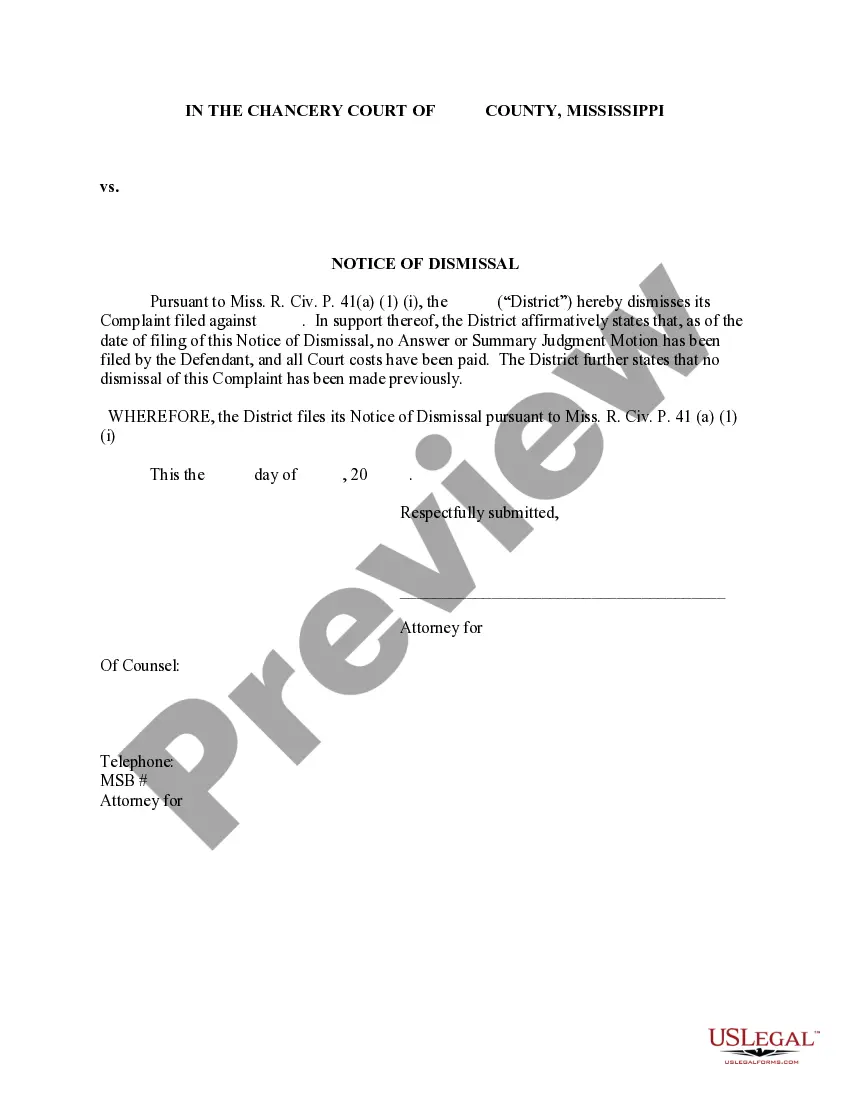
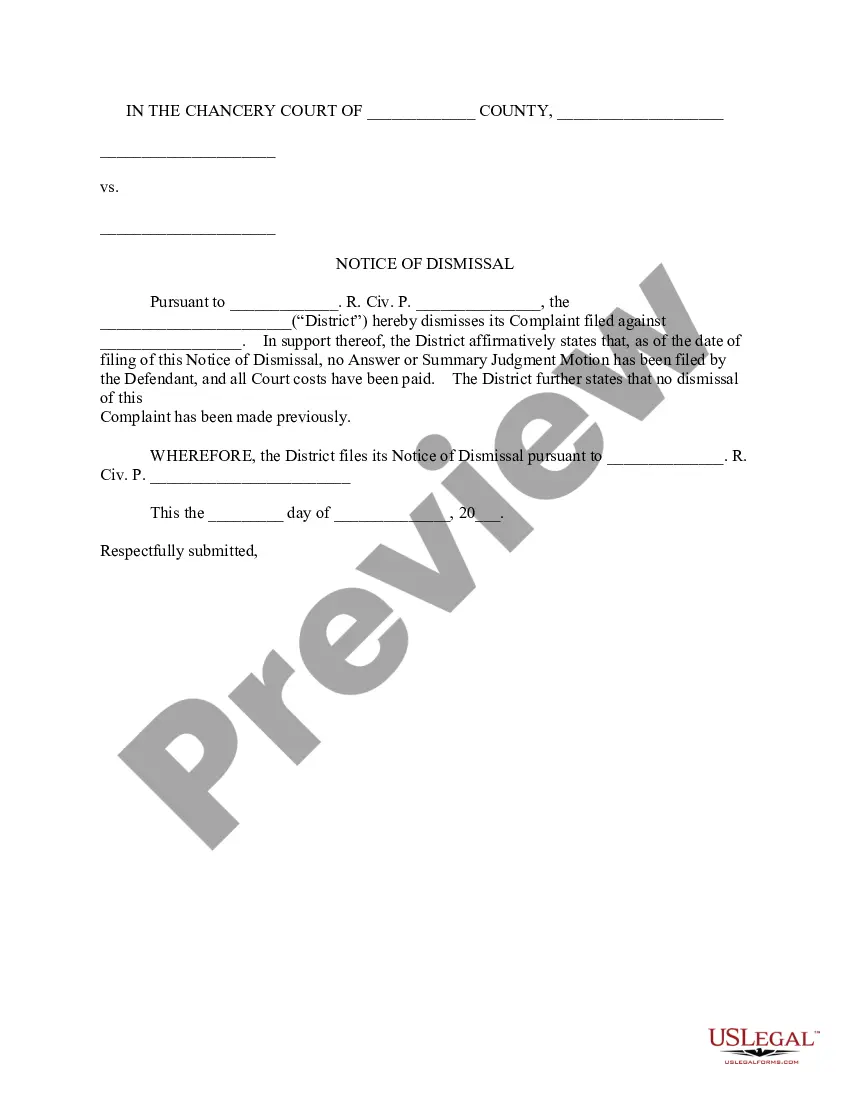
A Notice of Dismissal is a legal document that provides formal notification to a party regarding the dismissal of a legal matter. This form ensures that all relevant parties are informed about the progress of a lawsuit or legal proceeding, which helps avoid delays and confusion. Unlike similar forms, the Notice of Dismissal specifically communicates that a case or claim has been formally dismissed.
Key components of this form
- Identification of the parties involved.
- A clear statement indicating the dismissal of the case.
- The date of the dismissal.
- Signature fields for relevant parties to acknowledge the notice.

When to use this form
This form is necessary when a party wishes to officially notify others that a legal case or claim has been dismissed. It is commonly used in situations such as withdrawing a lawsuit, resolving a dispute out of court, or if the plaintiff decides not to pursue the case further. Properly notifying all parties helps ensure that legal proceedings come to a clear and finalized conclusion.
Who needs this form
- Individuals or parties involved in a legal dispute who wish to withdraw their claim.
- Attorneys representing clients in civil cases.
- Organizations that need to formally end a legal action.
Completing this form step by step
- Identify all parties involved in the case.
- Clearly state the specific legal matter being dismissed.
- Indicate the date when the dismissal is effective.
- Have the relevant parties sign the document to acknowledge receipt of the notice.
- File the Notice of Dismissal with the appropriate court if required by local procedure.
Notarization guidance
This form does not typically require notarization unless specified by local law. However, it is good practice to consider having it notarized to provide additional legal assurance of the authenticity of the signatures.
Get your form ready online
Our built-in tools help you complete, sign, share, and store your documents in one place.
Make edits, fill in missing information, and update formatting in US Legal Forms—just like you would in MS Word.
Download a copy, print it, send it by email, or mail it via USPS—whatever works best for your next step.
Sign and collect signatures with our SignNow integration. Send to multiple recipients, set reminders, and more. Go Premium to unlock E-Sign.
If this form requires notarization, complete it online through a secure video call—no need to meet a notary in person or wait for an appointment.
We protect your documents and personal data by following strict security and privacy standards.

Make edits, fill in missing information, and update formatting in US Legal Forms—just like you would in MS Word.

Download a copy, print it, send it by email, or mail it via USPS—whatever works best for your next step.

Sign and collect signatures with our SignNow integration. Send to multiple recipients, set reminders, and more. Go Premium to unlock E-Sign.

If this form requires notarization, complete it online through a secure video call—no need to meet a notary in person or wait for an appointment.

We protect your documents and personal data by following strict security and privacy standards.
Common mistakes to avoid
- Not including all parties in the notification.
- Failing to sign the document before submission.
- Omitting the date of the dismissal, which can lead to confusion.
Why complete this form online
- Convenience of downloading the form from anywhere at any time.
- Editable templates that allow for customization to fit specific circumstances.
- Access to attorney-drafted forms ensures legal reliability and accuracy.
Legal use & context
- A Notice of Dismissal provides clear communication that a lawsuit has ended, preventing potential future disputes.
- Using this form correctly ensures that all parties are aware of their rights and responsibilities post-dismissal.
Summary of main points
- This form is essential for formally notifying parties about the dismissal of a legal case.
- Ensure all parties are included and acknowledge receipt to avoid potential disputes.
- Complete the form correctly to comply with legal procedures and guidelines.
Looking for another form?
Form popularity
FAQ
When a small claims case is dismissed, the court terminates the case without a trial and prior to the case's completion. A dismissal, in effect, denies the plaintiff's claim to the money requested in the Small Claims Complaint (or a counterclaim), even though the merits of the case have never been heard by the court.
If prosecutors dismissed the case without prejudice, they can refile charges any time before the statute of limitations has expired that is, they can reopen it if they are able to overcome whatever caused the dismissal in the first place. If the case is dismissed with prejudice, the case is over permanently.
N. application by a defendant in a lawsuit or criminal prosecution asking the judge to rule that the plaintiff (the party who filed the lawsuit) or the prosecution has not and cannot prove its case.
In the formal legal world, a court case that is dismissed with prejudice means that it is dismissed permanently. A case dismissed with prejudice is over and done with, once and for all, and can't be brought back to court. A case dismissed without prejudice means the opposite.
When a defendant files a motion to dismiss, he asks the Court to throw out all or part of the plaintiff's case.The parties (well, their lawyers) will come to court, explain their positions on the motion to dismiss, and answer any questions posed by the judge. Finally, the judge will decide to grant or deny the motion.
An order to dismiss a case can occur when the appellate court, having reversed the conviction on the grounds of a bad search or arrest, examines what's left of the case and determines that there is not enough evidence to warrant another trial.
A dismissed case means that a lawsuit is closed with no finding of guilt and no conviction for the defendant in a criminal case by a court of law. Even though the defendant was not convicted, a dismissed case does not prove that the defendant is factually innocent for the crime for which he or she was arrested.
The ruling by a judge that all or a portion (one or more of the causes of action) of the plaintiff's lawsuit is terminated (thrown out) at that point without further evidence or testimony.A defendant may be "dismissed" from a lawsuit, meaning the suit is dropped against that party.
A request for involuntary dismissal can be made by a defendant through a motion for dismissal, on grounds that the other party is not prosecuting the case, is not complying with a court order, or to comply with the Federal Rules of Civil Procedure.