Mississippi Authority to Cancel Judgment for Corporation
Overview of this form
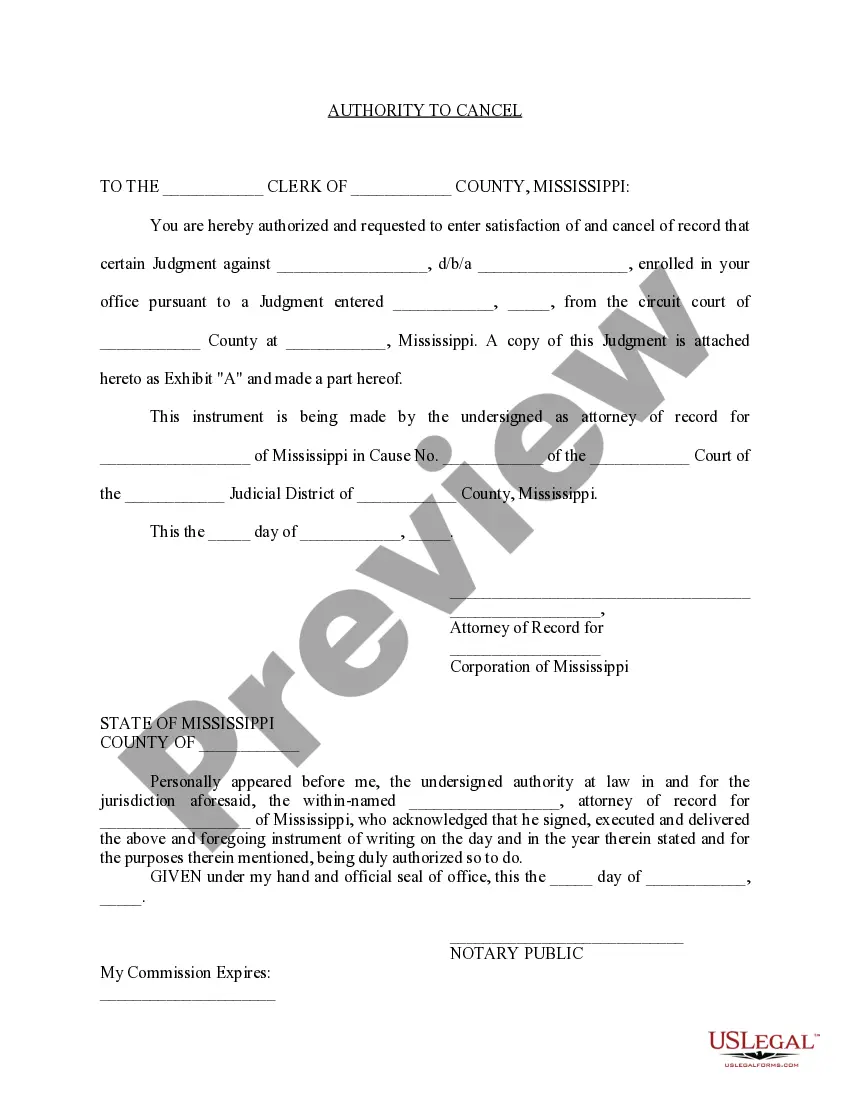
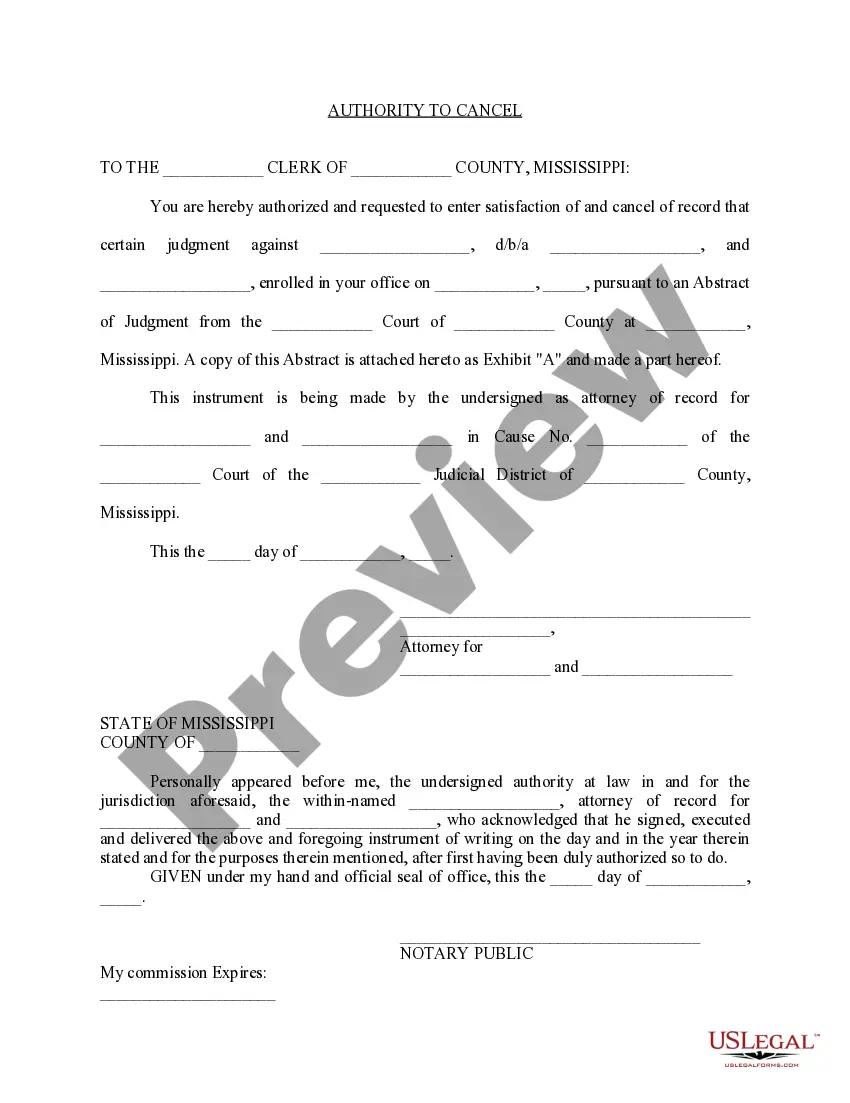
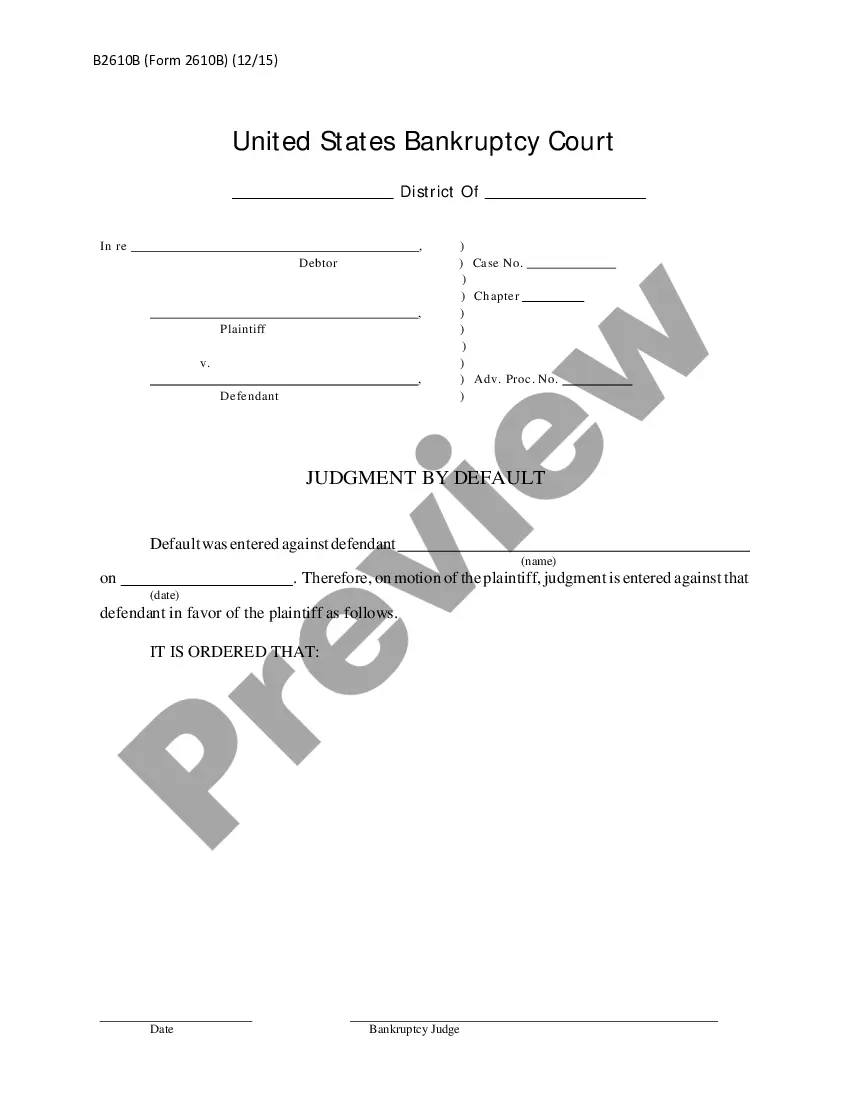
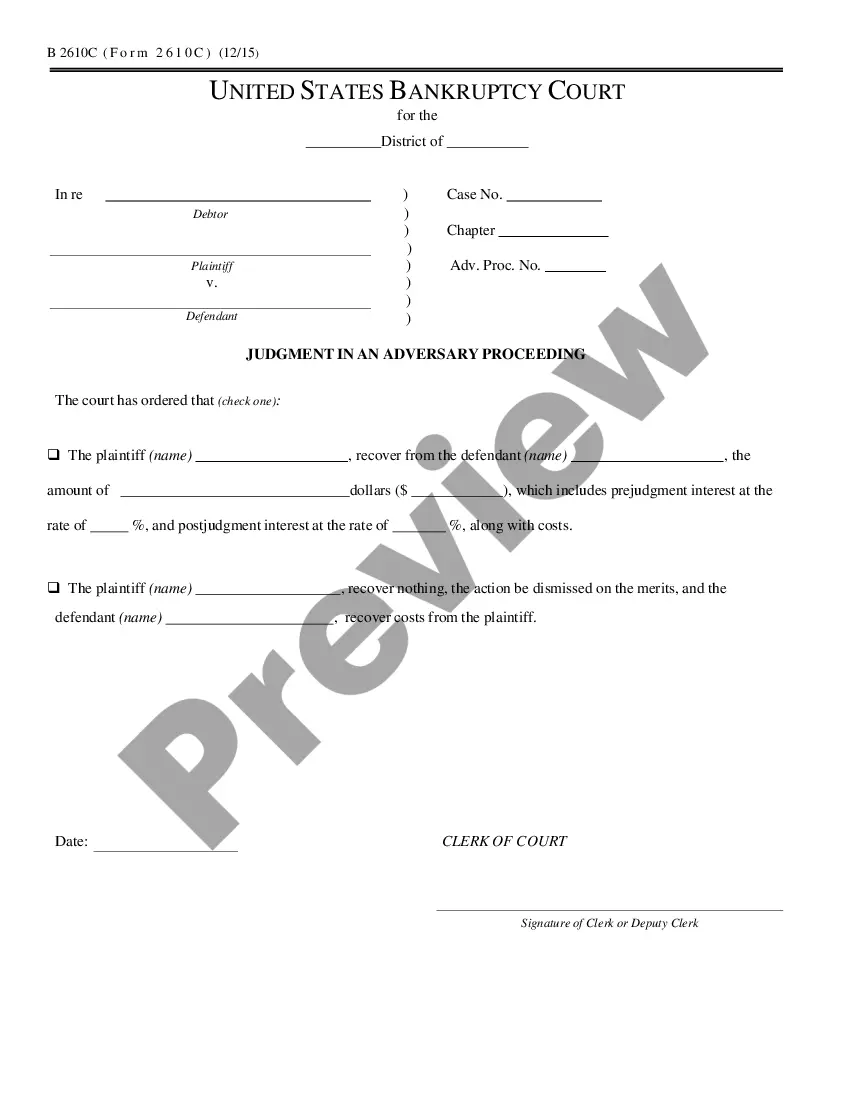
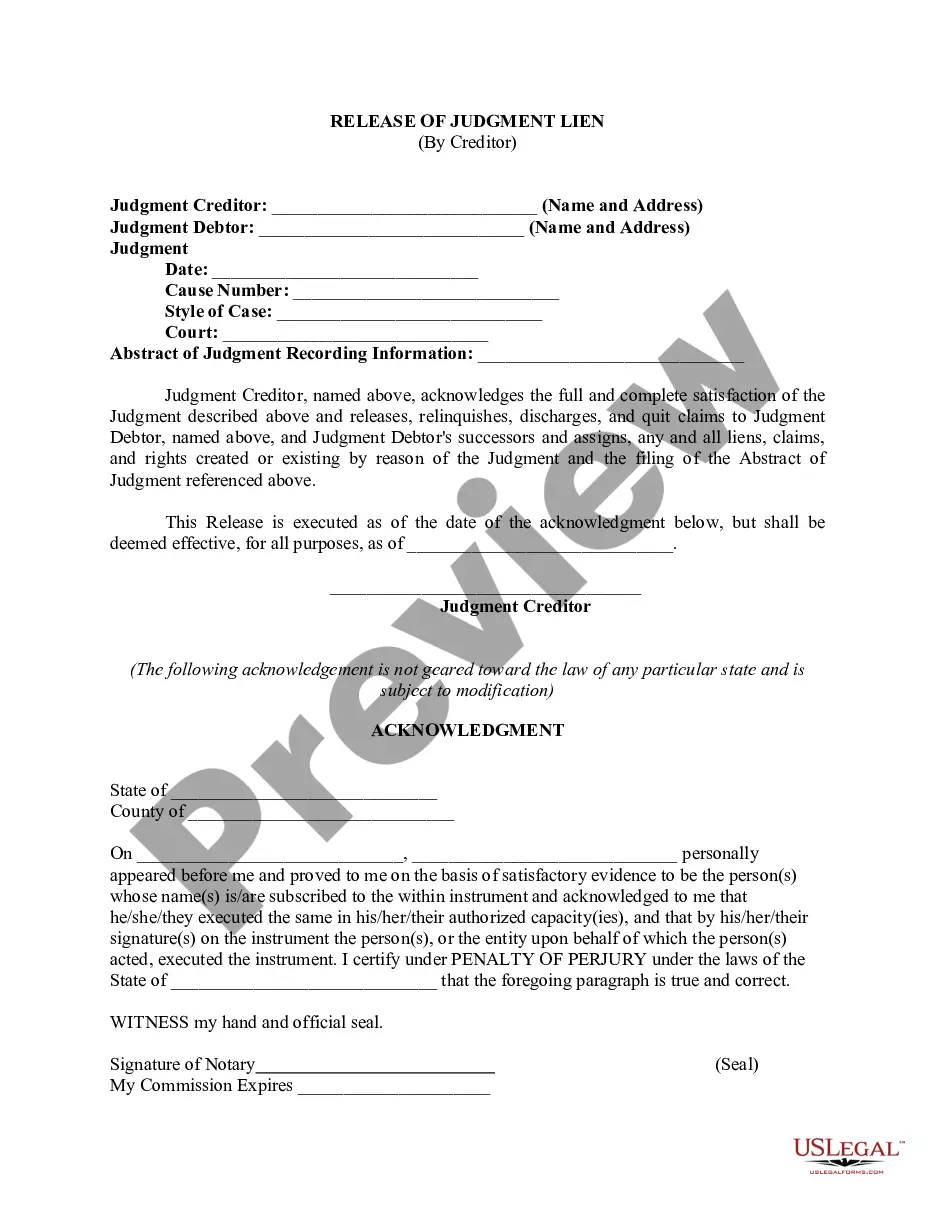
This Authority to Cancel Judgment for Corporation form enables a corporation in Mississippi to officially request the cancellation of a judgment recorded against it. This form serves the purpose of notifying the court that the judgment has been satisfied and must be removed from the official records, distinguishing it from other legal documents that may not fulfill this specific need.
Main sections of this form
- Clerk's designation and county in Mississippi
- Judgment details, including the date and case information
- Identification of the corporation involved
- Attorney of record affirmation and signature
- Notary public acknowledgment and seal
Common use cases
You should use this form when a corporation has settled its debts or obligations related to a judgment and seeks to have that judgment canceled from the public record in Mississippi. It is applicable in scenarios such as resolving a lawsuit or a credit dispute, where a favorable outcome has occurred that warrants the removal of the judgment.
Who should use this form
This form is intended for:
- Corporation representatives who have been named in a judgment
- Attorneys acting on behalf of corporations in Mississippi
- Legal professionals involved in resolving outstanding corporate judgments
Steps to complete this form
- Identify the appropriate clerk and county in Mississippi.
- Fill in the details of the judgment, including the date and case number.
- Enter the name of the corporation and any doing-business-as (d/b/a) names.
- Ensure the attorney of record signs and dates the form.
- Obtain notarization to validate the document.
Is notarization required?
To make this form legally binding, it must be notarized. Our online notarization service, powered by Notarize, lets you verify and sign documents remotely through an encrypted video session.
Get your form ready online
Our built-in tools help you complete, sign, share, and store your documents in one place.
Make edits, fill in missing information, and update formatting in US Legal Forms—just like you would in MS Word.
Download a copy, print it, send it by email, or mail it via USPS—whatever works best for your next step.
Sign and collect signatures with our SignNow integration. Send to multiple recipients, set reminders, and more. Go Premium to unlock E-Sign.
If this form requires notarization, complete it online through a secure video call—no need to meet a notary in person or wait for an appointment.
We protect your documents and personal data by following strict security and privacy standards.

Make edits, fill in missing information, and update formatting in US Legal Forms—just like you would in MS Word.

Download a copy, print it, send it by email, or mail it via USPS—whatever works best for your next step.

Sign and collect signatures with our SignNow integration. Send to multiple recipients, set reminders, and more. Go Premium to unlock E-Sign.

If this form requires notarization, complete it online through a secure video call—no need to meet a notary in person or wait for an appointment.

We protect your documents and personal data by following strict security and privacy standards.
Typical mistakes to avoid
- Failing to identify the correct clerk and county.
- Omitting the date of the original judgment.
- Not having the form notarized before submission.
Why complete this form online
- Convenient access to essential legal forms from anywhere.
- Editable templates that can be customized to fit specific needs.
- Immediate download for faster processing of legal documentation.
Summary of main points
- The Authority to Cancel Judgment for Corporation form is essential for corporations in Mississippi wishing to officially have judgments removed from their records.
- Make sure to complete all required fields accurately, especially those concerning the judgment and corporation details.
- Notarization is mandatory to ensure the form's legality.
Looking for another form?

Form popularity
FAQ
The supreme court can overrule a Court of Appeals decision. Trials are heard with a 12-member jury and usually one or two alternate jurors. But a judge may preside without a jury if the dispute is a question of law rather than fact.
Prescribed debt refers to the debt that has not been recognised by the creditor or been paid towards for more than 36 months. This is considered old debt by creditors and may then be written off.
A creditor may agree to settle the judgment for less than you owe. This typically happens when the creditor thinks you might file bankruptcy and wipe out the debt that way. Settling can be a win-win. The creditor gets at least partial payment for the debt although it usually will require it as a lump sum.
PLAINTIFF'S MOTION TO VACATE THE JUDGMENT: If you are the plaintiff and you did not go to court, you can ask the court to "vacate" (cancel) the judgment if the court ordered a judgment in favor of the defendant.
Judgments are no longer factored into credit scores, though they are still public record and can still impact your ability to qualify for credit or loans.You should pay legitimate judgments and dispute inaccurate judgments to ensure these do not affect your finances unduly.
In order to vacate a judgment in California, You must file a motion with the court asking the judge to vacate or set aside the judgment. Among other things, you must tell the judge why you did not respond to the lawsuit (this can be done by written declaration).
Renew the judgment Money judgments automatically expire (run out) after 10 years.If the judgment is not renewed, it will not be enforceable any longer and you will not have to pay any remaining amount of the debt. Once a judgment has been renewed, it cannot be renewed again until 5 years later.
A judgment is public information and remains on your credit report for 5 years or until the judgment is rescinded by a court or paid in full.
In most cases, judgments can stay on your credit reports for up to seven years. This means that the judgment will continue to have a negative effect on your credit score for a period of seven years. In some states, judgments can stay on as long as ten years, or indefinitely if they remain unpaid.