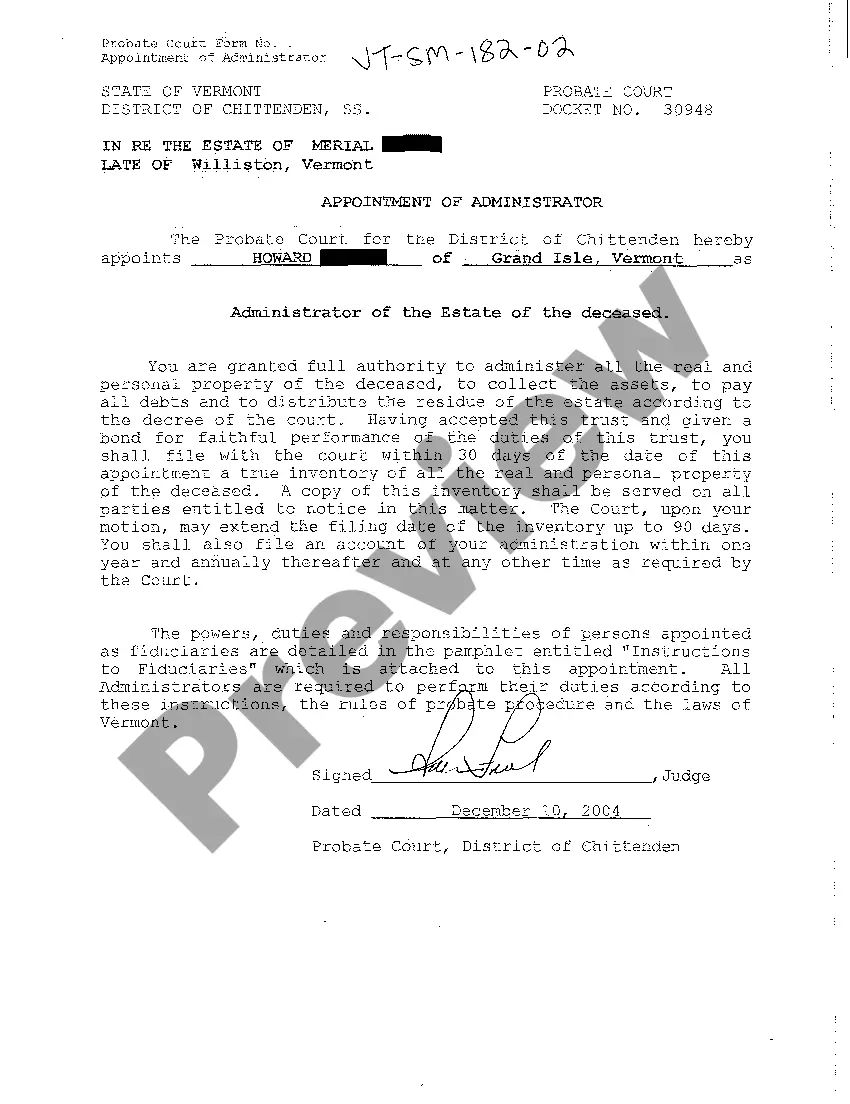
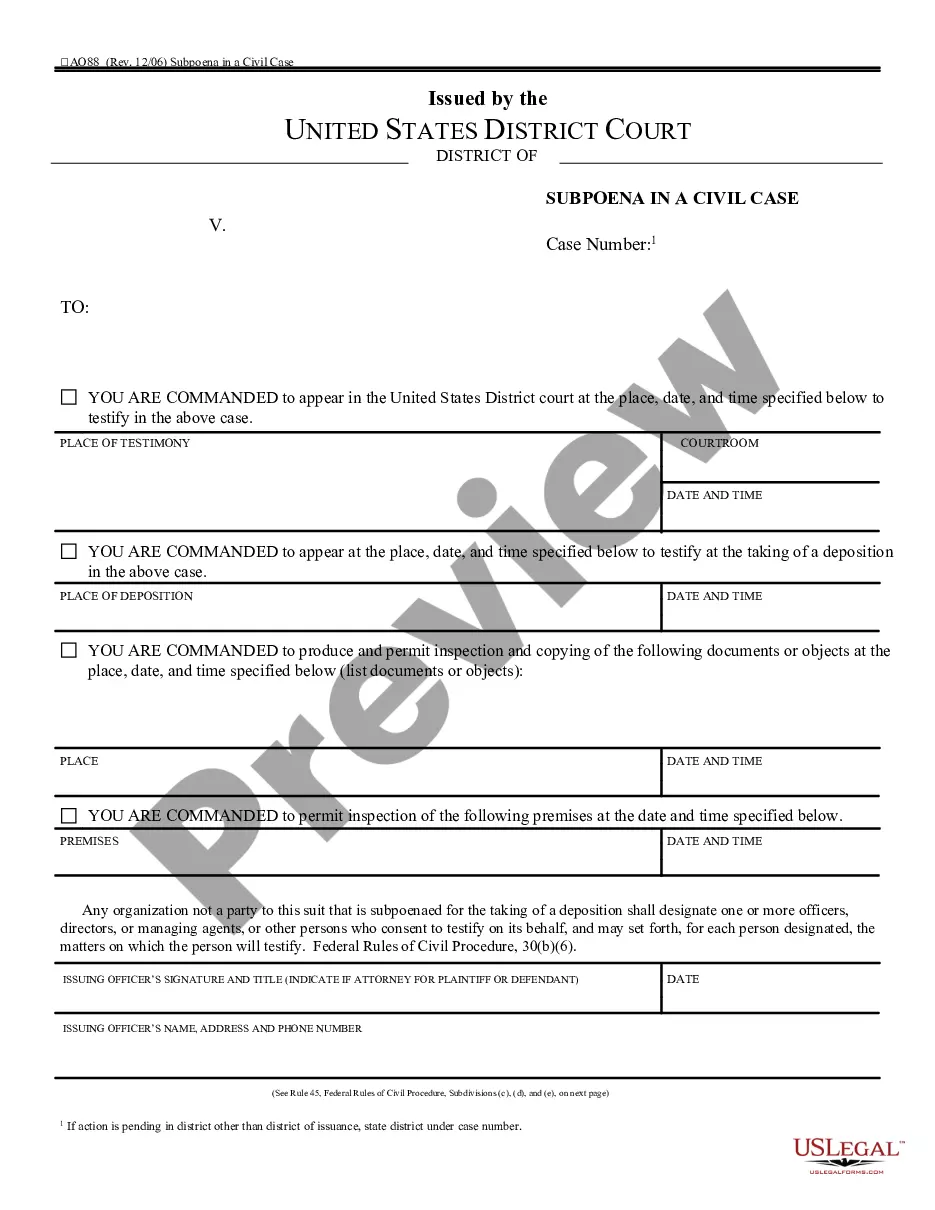
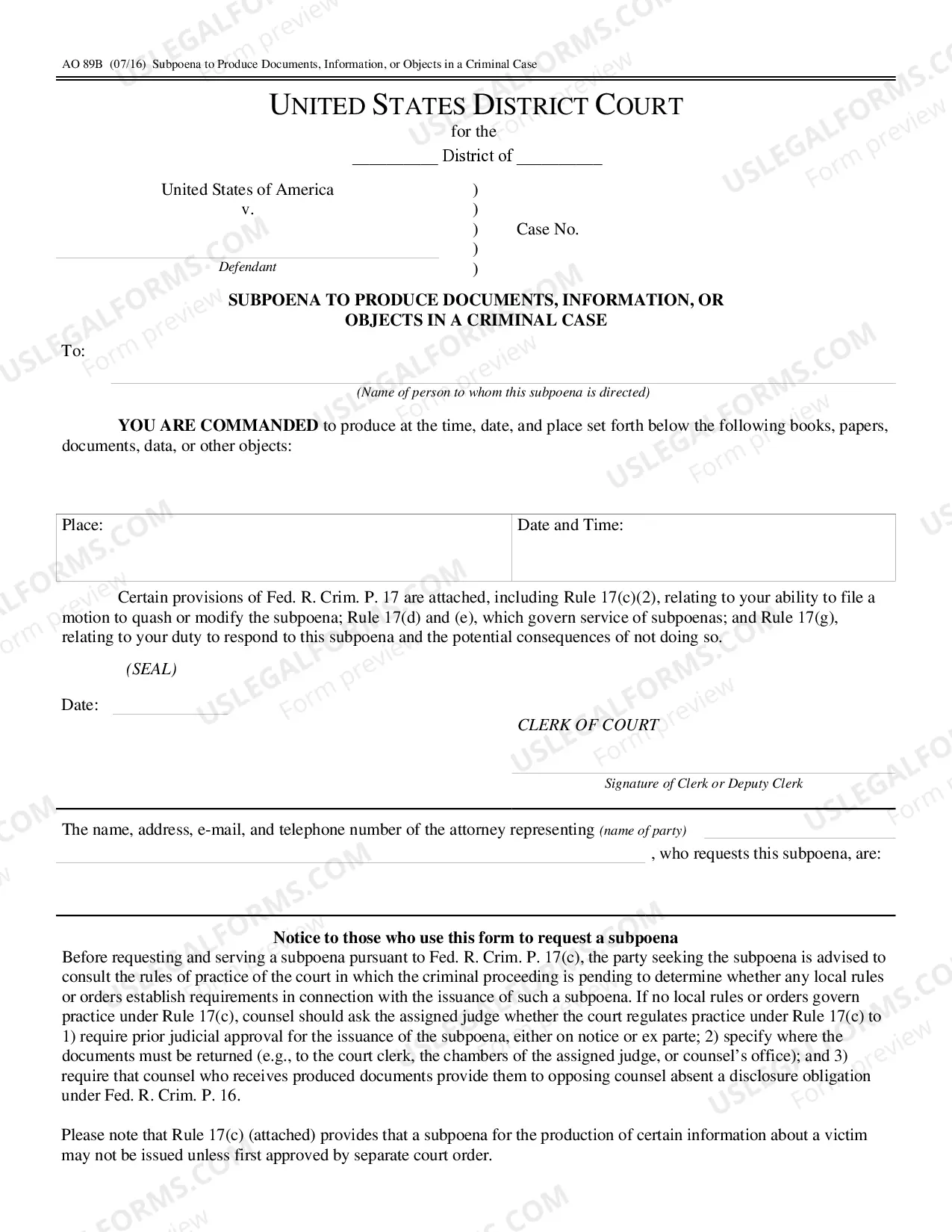
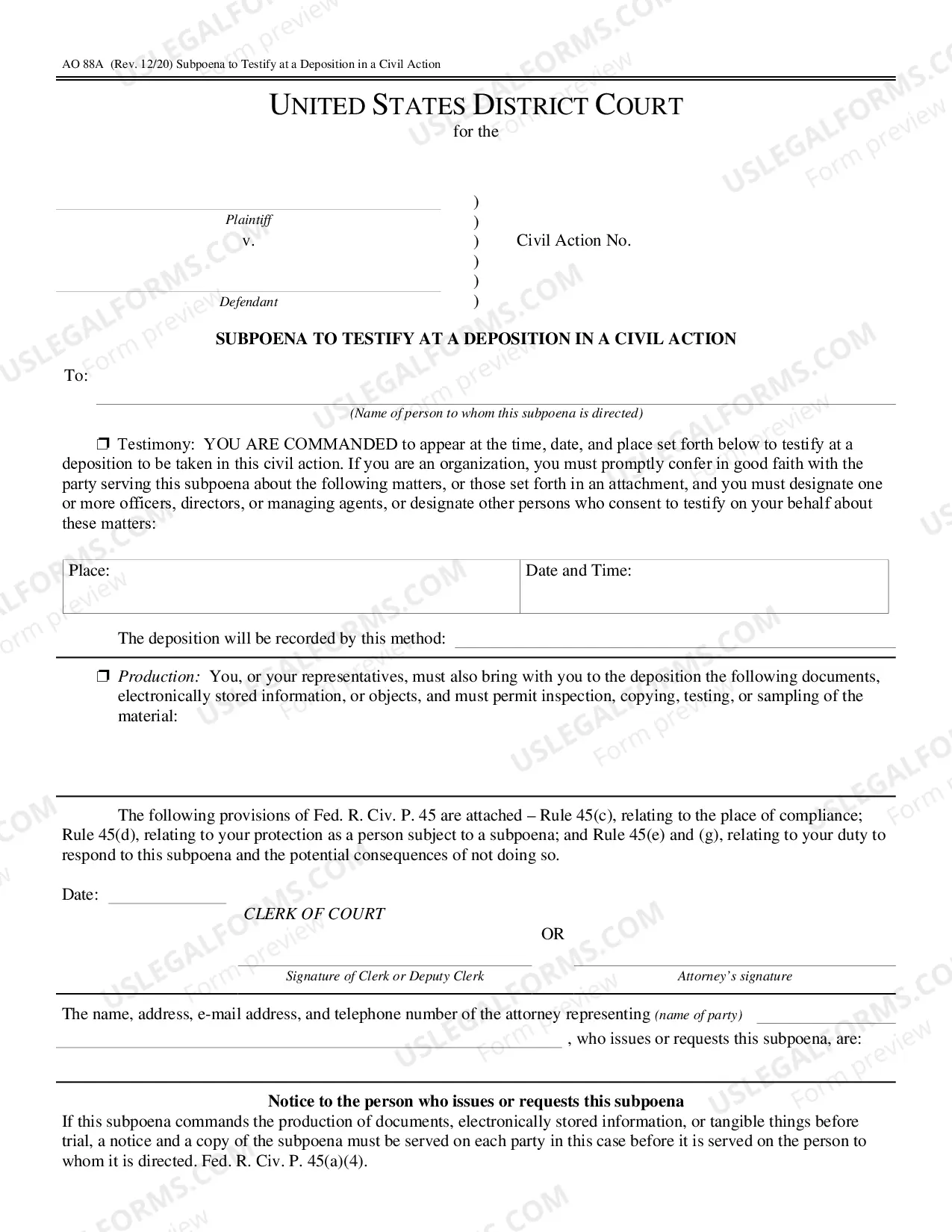
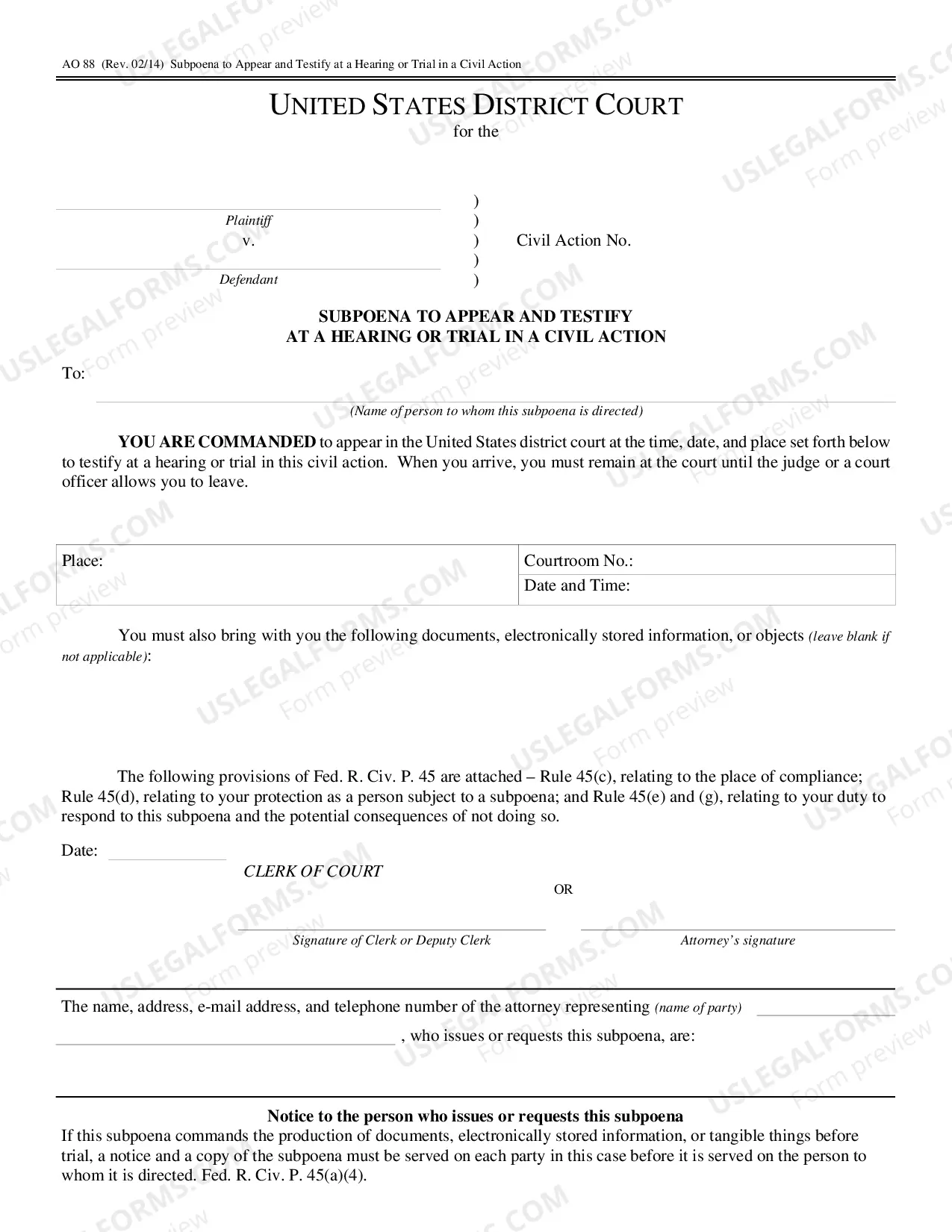
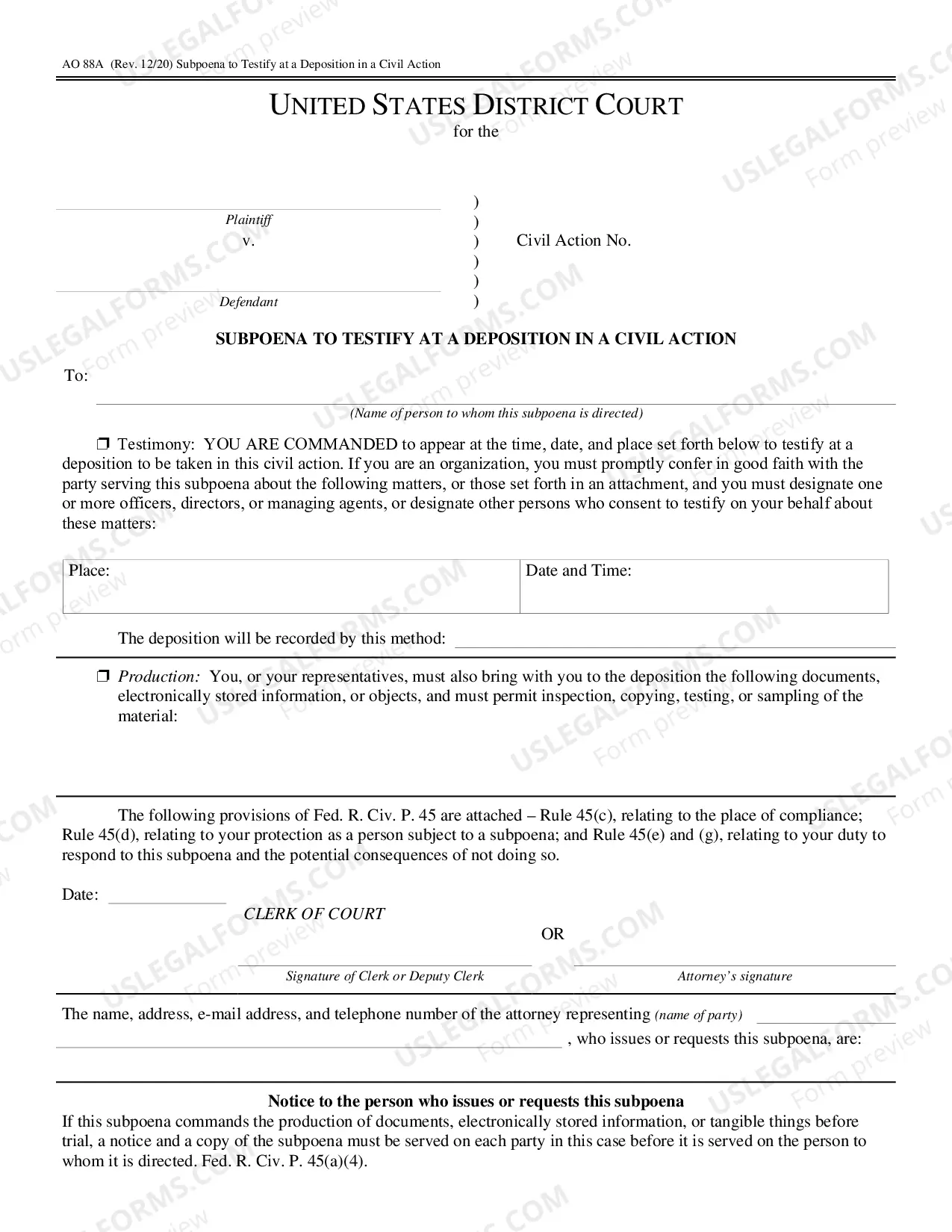
This is a form addressing a procedural aspect of a federal court case. Note the district in which this form is for use.
Missouri Subpoena in a Civil Case
State:
Missouri
Control #:
MO-AO-88-WD
Format:
PDF
Instant download
This website is not affiliated with any governmental entity
Public form
Description
Free preview
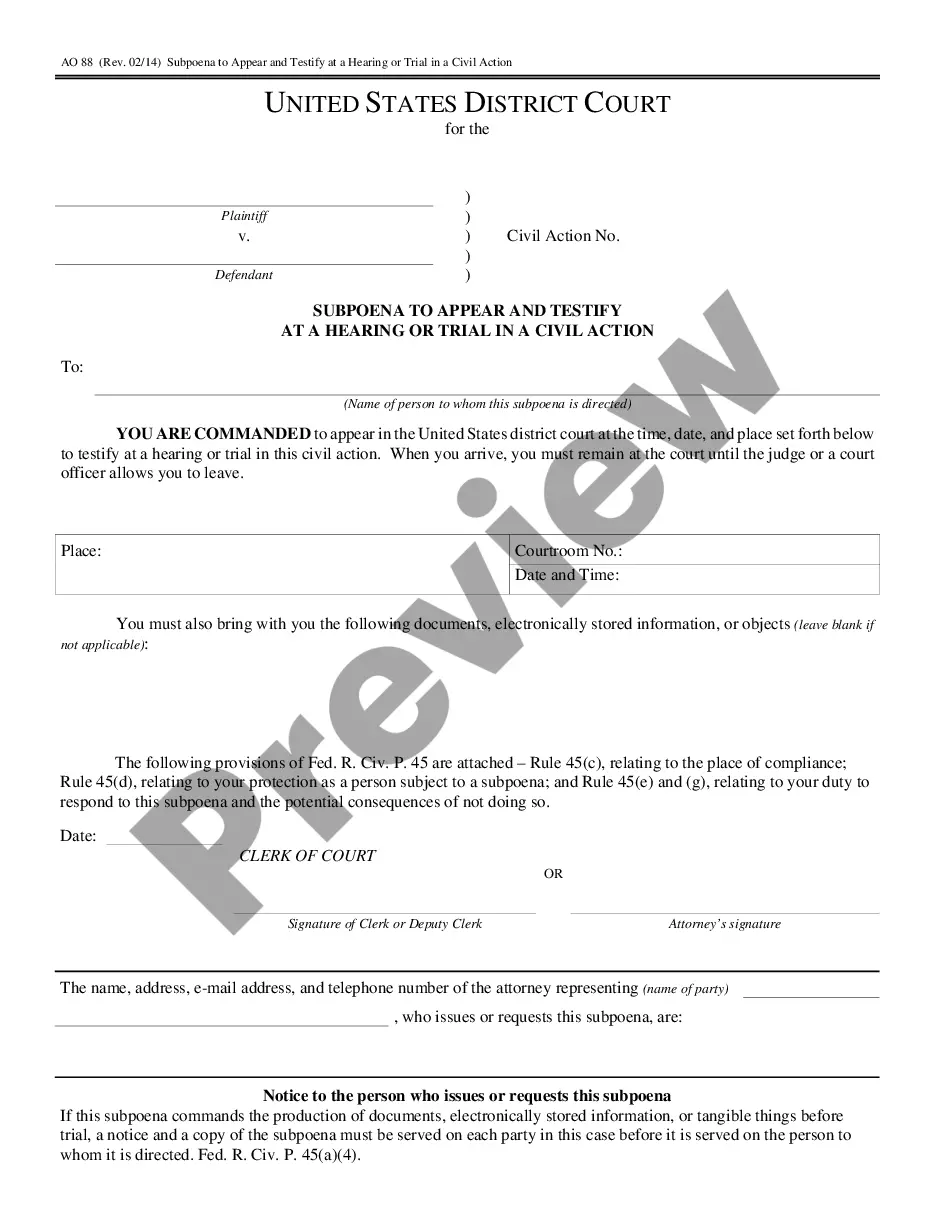
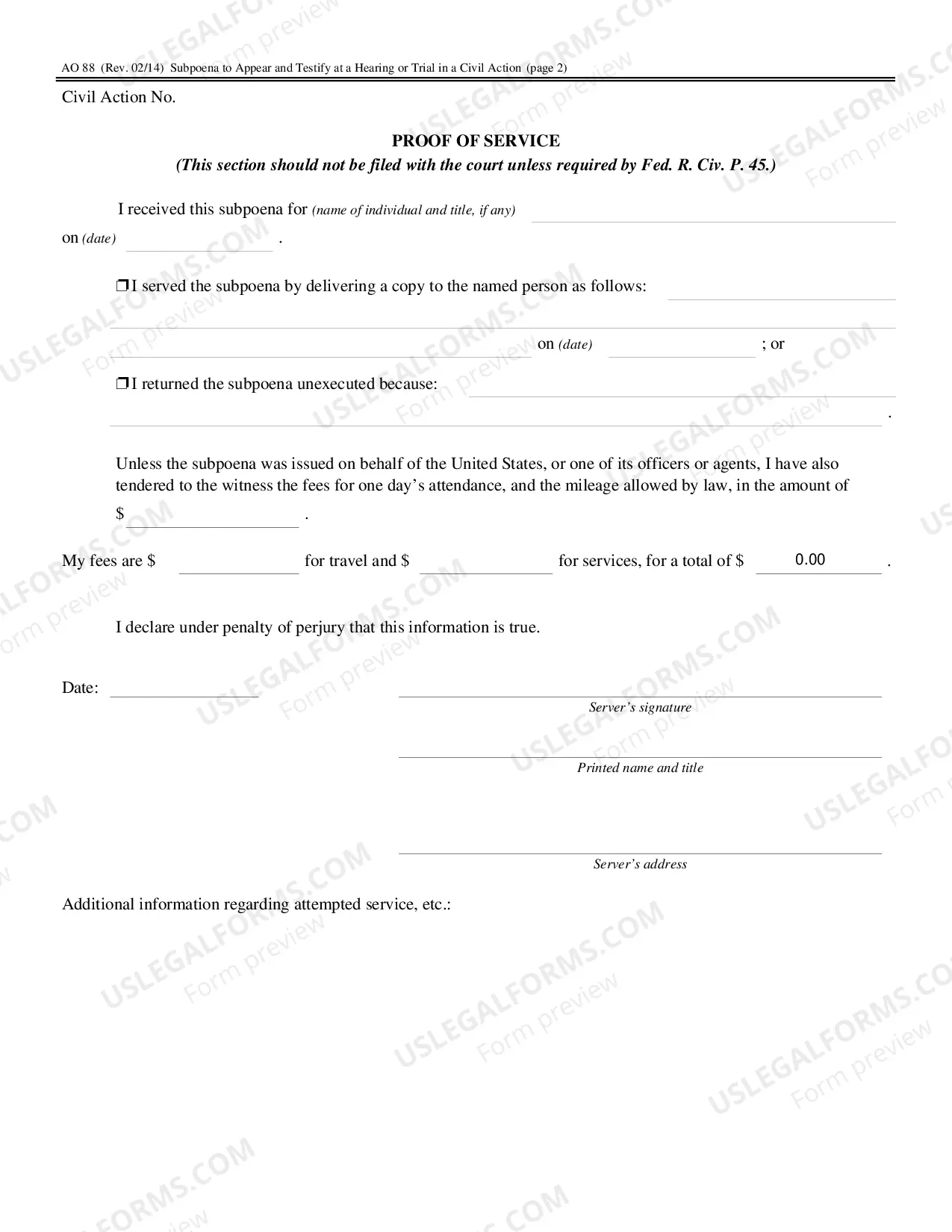
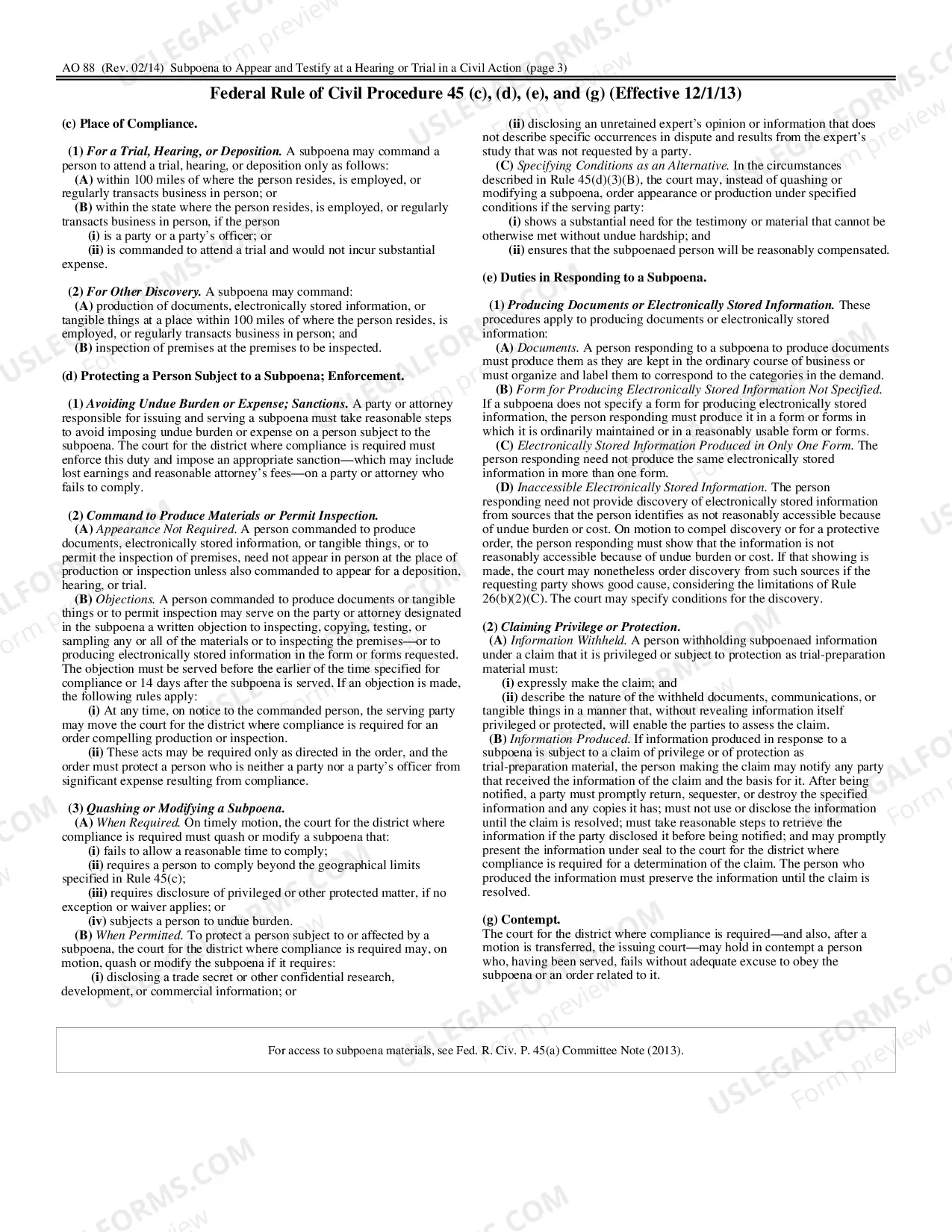
Get your form ready online
Our built-in tools help you complete, sign, share, and store your documents in one place.
Built-in online Word editor
Make edits, fill in missing information, and update formatting in US Legal Forms—just like you would in MS Word.
Export easily
Download a copy, print it, send it by email, or mail it via USPS—whatever works best for your next step.
E-sign your document
Sign and collect signatures with our SignNow integration. Send to multiple recipients, set reminders, and more. Go Premium to unlock E-Sign.
Notarize online 24/7
If this form requires notarization, complete it online through a secure video call—no need to meet a notary in person or wait for an appointment.
Store your document securely
We protect your documents and personal data by following strict security and privacy standards.

Make edits, fill in missing information, and update formatting in US Legal Forms—just like you would in MS Word.

Download a copy, print it, send it by email, or mail it via USPS—whatever works best for your next step.

Sign and collect signatures with our SignNow integration. Send to multiple recipients, set reminders, and more. Go Premium to unlock E-Sign.

If this form requires notarization, complete it online through a secure video call—no need to meet a notary in person or wait for an appointment.

We protect your documents and personal data by following strict security and privacy standards.
Looking for another form?


How to fill out Missouri Subpoena In A Civil Case?
Obtain any template from 85,000 legal documents such as Missouri Subpoena in a Civil Case online with US Legal Forms. Each template is crafted and refreshed by state-certified legal experts.
If you already possess a subscription, Log In. Once you reach the form’s page, click on the Download button and navigate to My documents to gain access to it.
If you haven’t subscribed yet, follow the guidance below.
With US Legal Forms, you will consistently have immediate access to the correct downloadable template. The service provides you with access to documents and categorizes them to simplify your search. Utilize US Legal Forms to acquire your Missouri Subpoena in a Civil Case quickly and effortlessly.
- Review the state-specific prerequisites for the Missouri Subpoena in a Civil Case you intend to utilize.
- Examine the description and preview the template.
- Once you’re assured the sample meets your needs, simply click Buy Now.
- Choose a subscription plan that truly fits your budget.
- Establish a personal account.
- Make a payment in one of two suitable methods: by card or through PayPal.
- Select a format to download the document in; two alternatives are available (PDF or Word).
- Download the file to the My documents section.
- When your reusable template is prepared, print it or save it to your device.
Form popularity
FAQ
Lawyers who are licensed in the state usually have the power to issue a subpoena. However, individuals who are a party to a lawsuit and other individuals may also be able to issue a subpoena, depending on the rules of civil or criminal procedure in the court that has jurisdiction of the case.
You must engage legal counsel to file a motion to quash in the appropriate court, and you must also be prepared for the possibility that the agency or party that sought or issued the subpoena will simply seek to have it re-served by authorized means.
In a civil case, you may be subpoenaed for out-of-court testimony as well. In either kind of case, a subpoena may order you to provide documents. A subpoena must be delivered in person. In most cases this can be done by one of the parties in the case or by anyone who is at least 18 years old.
As a subpoena is a court order, failing to respond to a subpoena without lawful excuse is a contempt of court. There may be civil or criminal penalties. A subpoena must be served by giving it to an individual, or delivering it to the registered office of a company (including by post).
A refusal to testify is considered civil contempt. But even civil contempt is considered quasi-criminal in nature. That means that a person is entitled to certain constitutional procedures. For example, the witness is entitled to consult with a lawyer.
Contact the lawyer who subpoenaed you and ask him/her to let you off the hook or alternatively postpone the trial. If you have a good excuse and the lawyer will not relent, get an attorney you know to contact the judge to get the case postponed.
If you refuse after being ordered by the court to give a deposition, you would likely be found in contempt of court, leading to dire consequences. On top of that, you would still be forced into the deposition.
If you ignore the order, the court will hold you in contempt. You could go to jail or face a large fine for ignoring the Subpoena. Subpoenas are used in both criminal and civil cases.If you get a Subpoena and do not want to testify or turn over documents, do not just ignore it.
You can Subpoena the witness, which requires them to come to court. You can also use a Subpoena during discovery.Fill in the name of the case, the name and address of the witness, and the courtroom for the case. When you Subpoena a witness, you must pay them a witness fee and travel costs.