Missouri Request for Property Information from Owner - Individual Claimant
About this form
The Request for Property Information from Owner - Individual Claimant is a legal form used by individuals to obtain property information, specifically the legal description of a property, from the owner or the owner's registered agent. This form is crucial for claimants who need accurate property details for legal or personal reasons, distinguishing it from other property-related forms that may not specifically focus on the claim process.
What’s included in this form
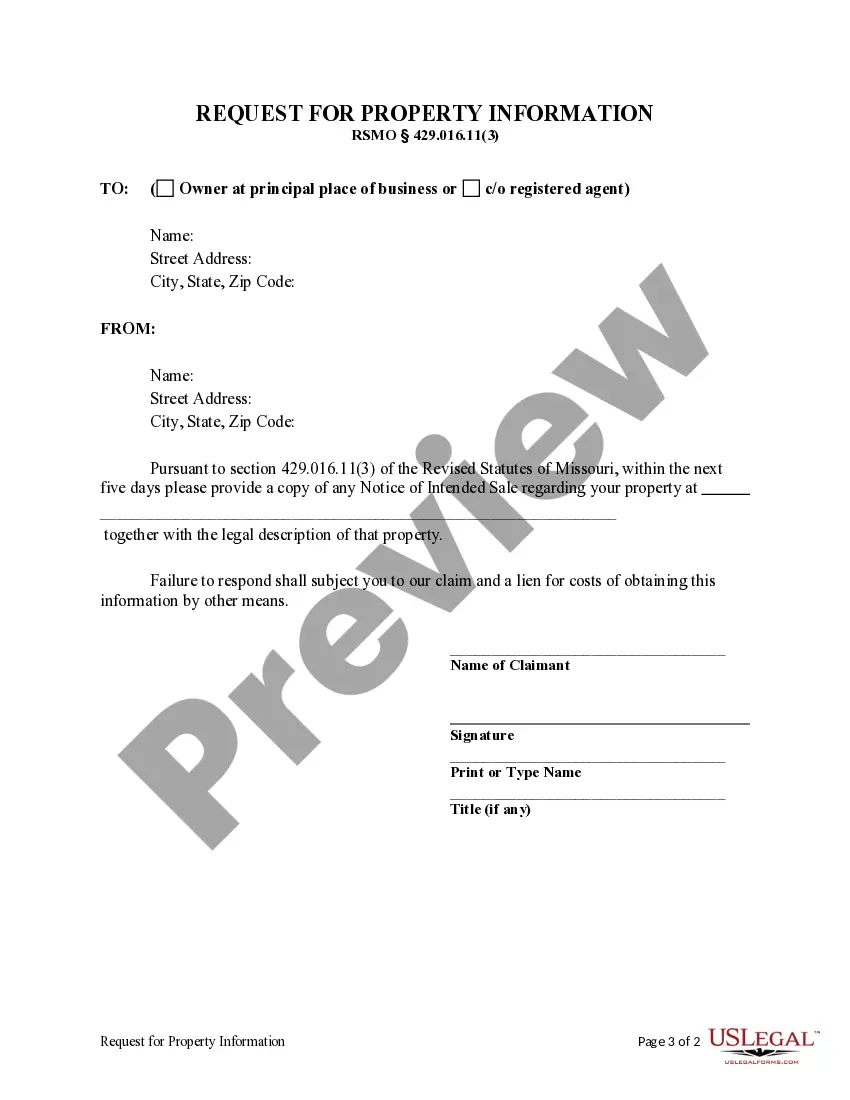
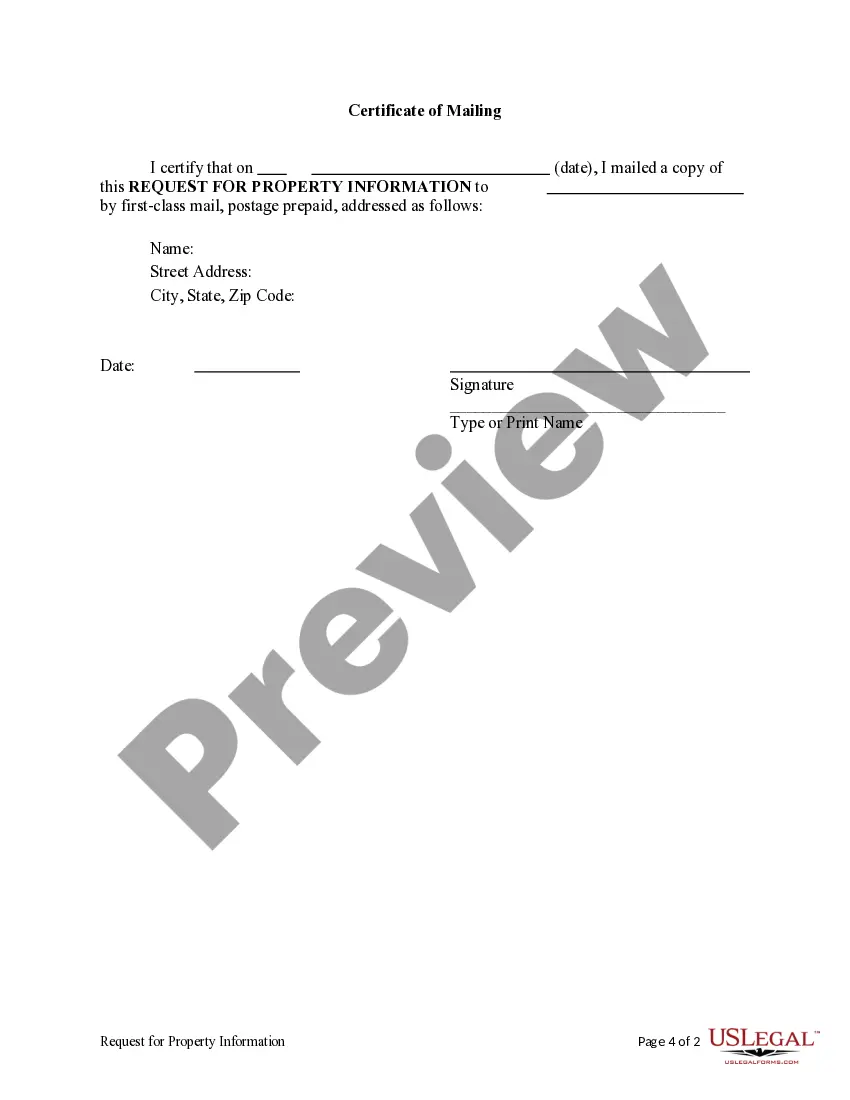
- Claimant's information section, where the individual claimant provides their name and contact details.
- Property owner details, requiring the input of the property owner's name and contact information.
- Legal description request field, where the claimant specifies the property address or legal description of the property in question.
- Date of request, indicating when the request is being made.
- Signature line for the claimant to sign, validating the request.
When to use this form
This form is needed when an individual claimant wishes to acquire specific property information from the owner or their agent. Scenarios include instances where a claimant is preparing for a legal claim related to property ownership, dispute resolution, or assessment purposes, ensuring they have the necessary legal details to proceed with their case.
Who can use this document
This form is intended for:
- Individuals who are claimants regarding property ownership disputes.
- Those who need to gather legal property descriptions for personal, legal, or financial reasons.
- Claimants seeking information from property owners or their registered agents.
How to complete this form
- Identify the claimant and provide their contact details in the designated fields.
- Fill in the property owner's information, ensuring accuracy in the name and contact details.
- Specify the legal description or address of the property for which the information is requested.
- Enter the date on which the request is made to establish a timeline.
- Sign the form to formally validate the request.
Does this form need to be notarized?
This form does not typically require notarization unless specified by local law.
Get your form ready online
Our built-in tools help you complete, sign, share, and store your documents in one place.
Make edits, fill in missing information, and update formatting in US Legal Forms—just like you would in MS Word.
Download a copy, print it, send it by email, or mail it via USPS—whatever works best for your next step.
Sign and collect signatures with our SignNow integration. Send to multiple recipients, set reminders, and more. Go Premium to unlock E-Sign.
If this form requires notarization, complete it online through a secure video call—no need to meet a notary in person or wait for an appointment.
We protect your documents and personal data by following strict security and privacy standards.

Make edits, fill in missing information, and update formatting in US Legal Forms—just like you would in MS Word.

Download a copy, print it, send it by email, or mail it via USPS—whatever works best for your next step.

Sign and collect signatures with our SignNow integration. Send to multiple recipients, set reminders, and more. Go Premium to unlock E-Sign.

If this form requires notarization, complete it online through a secure video call—no need to meet a notary in person or wait for an appointment.

We protect your documents and personal data by following strict security and privacy standards.
Mistakes to watch out for
- Failing to include complete contact information for either the claimant or the property owner.
- Omitting the legal description of the property, which is essential for the request's validity.
- Not signing the form, which can result in the request being considered invalid.
- Providing inaccurate or outdated information regarding the property.
Benefits of using this form online
- Convenient access to download and complete the form from home.
- Editable fields allow for quick corrections and updates to information.
- Instant retrieval of the form reduces waiting time associated with physical paperwork.
Quick recap
- The form is essential for individual claimants requesting property information.
- Filling out the form accurately is crucial to ensure prompt responses from property owners.
- Utilizing the form online offers benefits like convenience and reliability.
- Always ensure compliance with state-specific laws related to property requests.
Looking for another form?
Form popularity
FAQ
How to Apply for a Tax Waiver (Statement of Non-Assessment) Application for a tax waiver can be made in person, by mail, fax, or email. If applying by fax or email, please allow 24 hour process time.
In Missouri, the assessed value of property may not exceed 33.3 percent of its true value in money.Most personal property is assessed at 33.3 percent of its true value in money. Assessment Date or Tax Date January 1st of each year. Real property is assessed as of January 1st of each odd-numbered year.
A Tax Waiver can normally only be obtained in person at the Assessor's Office. In light of the COVID-19 emergency, the Assessor's Office has implemented a procedure to request it online.
A Tax Waiver can normally only be obtained in person at the Assessor's Office. In light of the COVID-19 emergency, the Assessor's Office has implemented a procedure to request it online.
Personal property tax is a tax based upon the value of taxable personal property.The Market Value of an item is established by the County Assessor using a standard rate book provided by the Missouri State Tax Commission. The Assessed Value is a percentage of the Market Value.
Personal property tax is a tax which is based upon the value of taxable personal property.Your tax is calculated by dividing the assessed value of your property by 100 and then multiplying that result by the tax levy.
When a homeowner doesn't pay the property taxes, the overdue amount becomes a lien on the home. In Missouri, all real estate taxes become delinquent on January 1 of the year following their assessment.
Missouri homestead law allows for a $15,000 exemption, which is applicable to "a dwelling house and appurtenances, and the land used in connection therewith." In other words, the state's homestead law is limited to homes, corresponding buildings, and the land on which they stand.