Missouri Disclaimer of Warranties - Horse Equine Forms
What this document covers
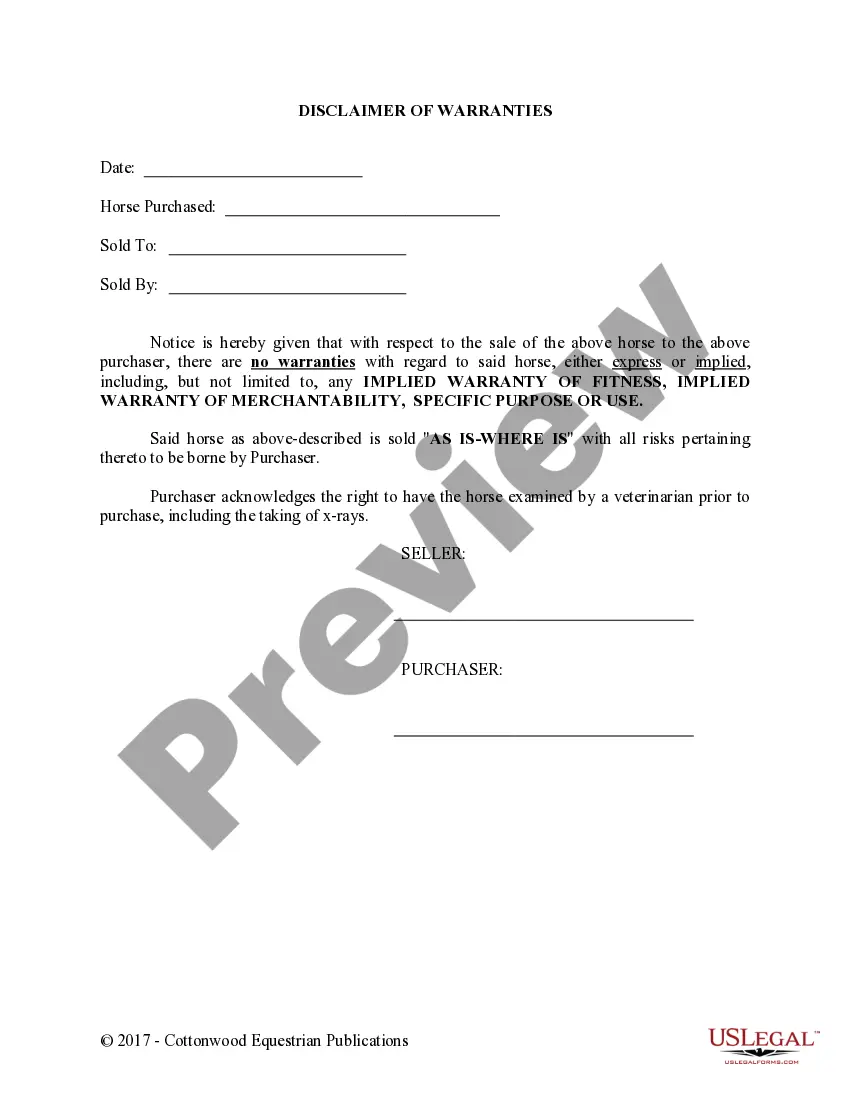
The Disclaimer of Warranties - Horse Equine form is a legal document used during the sale of a horse. This form explicitly states that there are no warranties, express or implied, concerning the horse being sold. It serves to protect the seller from potential claims about the horse's condition or suitability for a specific purpose. By using this form, both the seller and purchaser acknowledge that the horse is sold "as is," which is essential in equine transactions where the risk lies primarily with the buyer. This disclaimer is particularly crucial in distinguishing it from other horse sale agreements that may include warranties or guarantees.
Form components explained
- Date of horse purchase
- Name of seller and purchaser
- Notice of no warranties, including implied warranties of fitness or merchantability
- Statement that the horse is sold "as is - where is"
- Acknowledgment of the right to veterinary examination before purchase
When this form is needed
This form should be used whenever a horse is sold without any warranties about its condition or performance. It is particularly relevant for private sales, where the seller wants to avoid legal liability for potential issues that the horse may have post-purchase. This form is also beneficial when the buyer has the opportunity to conduct a thorough inspection or veterinary evaluation before completing the sale.
Who should use this form
- Horse sellers who wish to limit their liability regarding the horse's condition
- Horse purchasers looking to acknowledge the risks associated with buying "as is"
- Equine professionals involved in horse sales and transactions
Steps to complete this form
- Enter the date of the transaction.
- Fill in the name of the purchaser and the seller.
- Review the notice about warranties included in the form.
- Ensure both parties understand that the horse is sold "as is - where is."
- Sign and date the document to complete the transaction.
Notarization guidance
This form usually doesn’t need to be notarized. However, local laws or specific transactions may require it. Our online notarization service, powered by Notarize, lets you complete it remotely through a secure video session, available 24/7.
Get your form ready online
Our built-in tools help you complete, sign, share, and store your documents in one place.
Make edits, fill in missing information, and update formatting in US Legal Forms—just like you would in MS Word.
Download a copy, print it, send it by email, or mail it via USPS—whatever works best for your next step.
Sign and collect signatures with our SignNow integration. Send to multiple recipients, set reminders, and more. Go Premium to unlock E-Sign.
If this form requires notarization, complete it online through a secure video call—no need to meet a notary in person or wait for an appointment.
We protect your documents and personal data by following strict security and privacy standards.

Make edits, fill in missing information, and update formatting in US Legal Forms—just like you would in MS Word.

Download a copy, print it, send it by email, or mail it via USPS—whatever works best for your next step.

Sign and collect signatures with our SignNow integration. Send to multiple recipients, set reminders, and more. Go Premium to unlock E-Sign.

If this form requires notarization, complete it online through a secure video call—no need to meet a notary in person or wait for an appointment.

We protect your documents and personal data by following strict security and privacy standards.
Typical mistakes to avoid
- Failing to fill out the date or the names of the buyer and seller.
- Not discussing the condition of the horse and the implications of the "as is" clause with the buyer.
- Signing the form without fully understanding its terms and implications.
Advantages of online completion
- Easy access to a professionally drafted legal form.
- Convenience of downloading and printing from home.
- Ability to edit and customize the form to meet specific needs.
- Ensures that the form is compliant with standard legal requirements.
Legal use & context
- This form provides a clear record of the agreement and the terms of sale, which can be important in any legal disputes.
- It reinforces the principle of "caveat emptor," or "buyer beware," which protects sellers from future claims.
- Users should ensure that they are compliant with any specific state laws or regulations that may affect the sale of horses.
Main things to remember
- The Disclaimer of Warranties - Horse Equine form is crucial for equine sales without warranties.
- Both parties must understand they are entering an "as is" transaction.
- Proper completion and understanding of this form can help prevent future disputes.
Looking for another form?
Form popularity
FAQ
The Horse Protection Act is a federal law designed to prevent the cruel practice of soring horses, which is often used to enhance their performance. In Missouri, this act helps ensure that horses are treated humanely, promoting their welfare. Compliance with the act is crucial for horse sellers and buyers alike to maintain ethical standards. For those navigating legal requirements, using the Missouri Disclaimer of Warranties - Horse Equine Forms can simplify the process.
A release of liability form for equine activities is designed to limit the legal liability of horse owners and event organizers. It outlines the risks involved in horseback riding and other horse-related activities, ensuring participants are aware of these dangers. By incorporating the Missouri Disclaimer of Warranties - Horse Equine Forms, you can establish a comprehensive legal framework that protects your business. This form helps maintain a safe environment while allowing everyone to enjoy equine activities with confidence.
A release of liability for horses is a legal document that protects horse owners and operators from claims arising from accidents or injuries. This form informs participants of the inherent risks associated with horse activities, emphasizing that they assume these risks. Utilizing the Missouri Disclaimer of Warranties - Horse Equine Forms allows you to create clear agreements that safeguard your interests. This way, participants acknowledge their understanding and acceptance of potential hazards while enjoying their time with horses.
Horse liability insurance typically covers injuries or damages that may occur during horse-related activities. This includes accidents involving your horse that result in injury to another person or damage to their property. It's important to understand that the Missouri Disclaimer of Warranties - Horse Equine Forms can help clarify the limits and responsibilities involved. By having this insurance, you can protect yourself and ensure peace of mind while engaging in equine activities.
Disclaimer of interest, in the law of inheritance, wills and trusts, is a term that describes an attempt by a person to renounce their legal right to benefit from an inheritance (either under a will or through intestacy) or through a trust. A disclaimer of interest is irrevocable.
A disclaimer is essentially a refusal of a gift or bequest.Disclaimers typically arise in the context of postmortem estate planning where a beneficiary may desire to make a qualified disclaimer under Sec. 2518 to achieve certain tax results such as qualifying for a marital deduction.
Disclaim, in a legal sense, refers to the renunciation of an interest in, or an acceptance of, inherited assets, such as property, by way of a legal instrument. A person disclaiming an interest, right, or obligation is known as a disclaimant.
A qualified disclaimer is a part of the U.S. tax code that allows estate assets to pass to a beneficiary without being subject to income tax. Legally, the disclaimer portrays the transfer of assets as if the intended beneficiary never actually received them.
In law, a disclaimer is a statement denying responsibility intended to prevent civil liability arising for particular acts or omissions. Disclaimers are frequently made to escape the effects of the torts of negligence and of occupiers' liability towards visitors.
A "Disclaimer Will", sometimes referred to as a "Disclaimer Trust", is a flexible estate planning tool that can be implemented to benefit married couples whose combined estates are approaching or exceed the lifetime exemption amount for federal estate tax, resulting in substantial tax savings to the estate of the