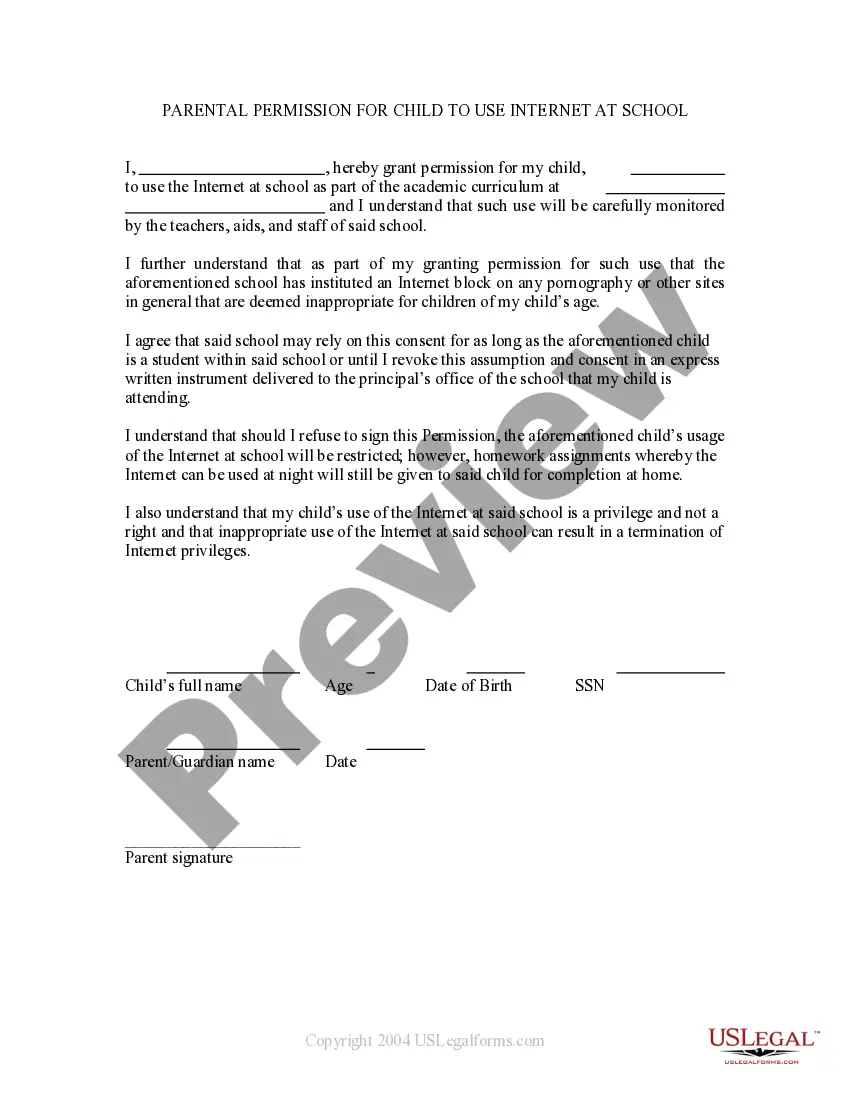
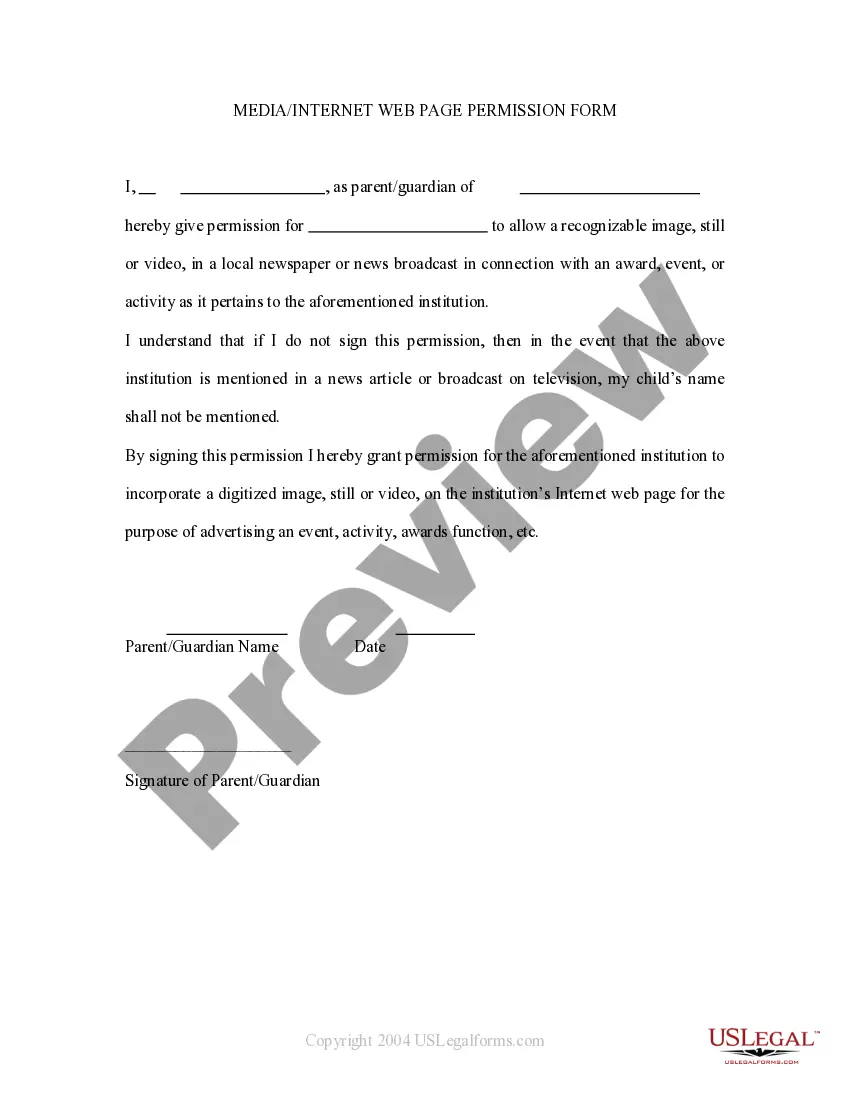
This form is signed by a parent who is granting permission for his/her child to use the Internet at school as part of the academic curriculum, and under the supervision of a teacher, aid, administrator etc.
Minnesota Parental Permission For Child To Use Internet At School
Category:
State:
Multi-State
Control #:
US-PRM-28
Format:
Word;
Rich Text
Instant download
Description
How to fill out Parental Permission For Child To Use Internet At School?
If you want to be thorough, acquire, or print legal document templates, utilize US Legal Forms, the largest selection of legal forms available online. Take advantage of the website’s simple and user-friendly search to find the documents you require. Various templates for business and personal purposes are categorized by types and jurisdictions, or keywords. Utilize US Legal Forms to obtain the Minnesota Parental Consent For Child To Access Internet At School in just a few clicks.
If you are already a US Legal Forms user, Log In to your account and click the Download button to retrieve the Minnesota Parental Consent For Child To Access Internet At School. You can also access forms you have previously downloaded in the My documents section of your account.
If you are using US Legal Forms for the first time, follow these steps: Step 1. Ensure you have chosen the form for the correct city/state. Step 2. Utilize the Preview option to review the form’s content. Don’t forget to read the details. Step 3. If you are not satisfied with the form, use the Search area at the top of the screen to find other versions of the legal form template. Step 4. Once you have located the form you need, click the Get now button. Select the pricing plan you prefer and enter your credentials to register for the account. Step 5. Complete the payment process. You can use your Visa or MasterCard or PayPal account to finalize the transaction. Step 6. Choose the format of the legal form and download it to your device. Step 7. Fill out, modify, and print or sign the Minnesota Parental Consent For Child To Access Internet At School.
- Every legal document template you obtain is yours indefinitely.
- You will have access to each form you have acquired in your account.
- Visit the My documents section and select a form to print or download again.
- Complete and download, and print the Minnesota Parental Consent For Child To Access Internet At School with US Legal Forms.
- There are thousands of professional and state-specific templates available for your business or personal needs.
Form popularity
FAQ
Minnesota law on informed consent requires that schools inform parents about how their child's data will be used and shared. Specifically, schools must obtain Minnesota Parental Permission For Child To Use Internet At School before students can engage in online activities that involve personal data. This law emphasizes the importance of transparency and parental involvement in a child's education. By understanding this law, parents can ensure their child's information remains protected.
Examples of violations of student privacy include sharing personal information without consent or using student data for purposes unrelated to education. For instance, if a school allows a third party to access student data without obtaining Minnesota Parental Permission For Child To Use Internet At School, it constitutes a breach of privacy. Such actions can lead to misuse of information and undermine trust between parents and educational institutions. Awareness of these violations helps parents advocate for their children's rights.
The Student Data Privacy Act is legislation designed to secure student information within educational settings. It outlines how schools must handle data and mandates that they seek Minnesota Parental Permission For Child To Use Internet At School. This act empowers parents by giving them a voice in decisions about their child's online activities and data exposure. By complying with these regulations, schools can foster a secure learning environment.
The Student Data Privacy Act in Minnesota protects students' personal information collected by educational institutions. This law requires schools to obtain Minnesota Parental Permission For Child To Use Internet At School before sharing student data with third parties. It aims to ensure that parents have control over their child's information and that schools maintain transparency regarding data usage. Understanding this act is crucial for parents who want to safeguard their children's privacy.
To control your child's internet access, consider using built-in settings on devices, third-party applications, or router controls that limit online time and content. Establish rules for internet use, including designated times and appropriate websites. Regular discussions about internet safety can empower your child to make wise decisions online. Utilizing Minnesota Parental Permission For Child To Use Internet At School can help you create a structured approach.
Parents can control their child's internet access by using parental control software, setting device restrictions, and creating a family media plan. Open communication about online behavior is essential for effective monitoring. Encourage children to discuss their online activities to build trust. Implementing Minnesota Parental Permission For Child To Use Internet At School can further enhance these controls.
Yes, the Child Internet Protection Act requires schools and libraries in the United States to implement internet safety policies, which include filtering content. This law aims to protect children from harmful online material while using the internet at school. Schools must take steps to ensure a safe online environment for students. Parents can advocate for Minnesota Parental Permission For Child To Use Internet At School to support these initiatives.
Parents can limit their children's internet exposure by using parental controls, discussing safe browsing habits, and monitoring online activities. Setting clear rules about internet use, such as time limits and appropriate content, fosters a safer online environment. Additionally, parents should regularly communicate with their children about the importance of online safety. Consider using Minnesota Parental Permission For Child To Use Internet At School as a tool to reinforce these rules.
The 70 30 rule in parenting emphasizes that 70% of a child's time should be spent on active, hands-on learning, while 30% can be allocated to screen time. This balance helps children develop critical thinking and social skills. Parents should actively engage with their children during both types of activities. Utilizing Minnesota Parental Permission For Child To Use Internet At School can help establish these guidelines effectively.
The 7 7 7 rule in parenting suggests that for every hour a child spends on screens, they should have at least seven hours of non-screen time. This approach encourages a healthy balance between digital and real-world experiences. By promoting diverse activities, parents can help children develop skills beyond the screen. Remember, Minnesota Parental Permission For Child To Use Internet At School can assist you in setting appropriate boundaries.