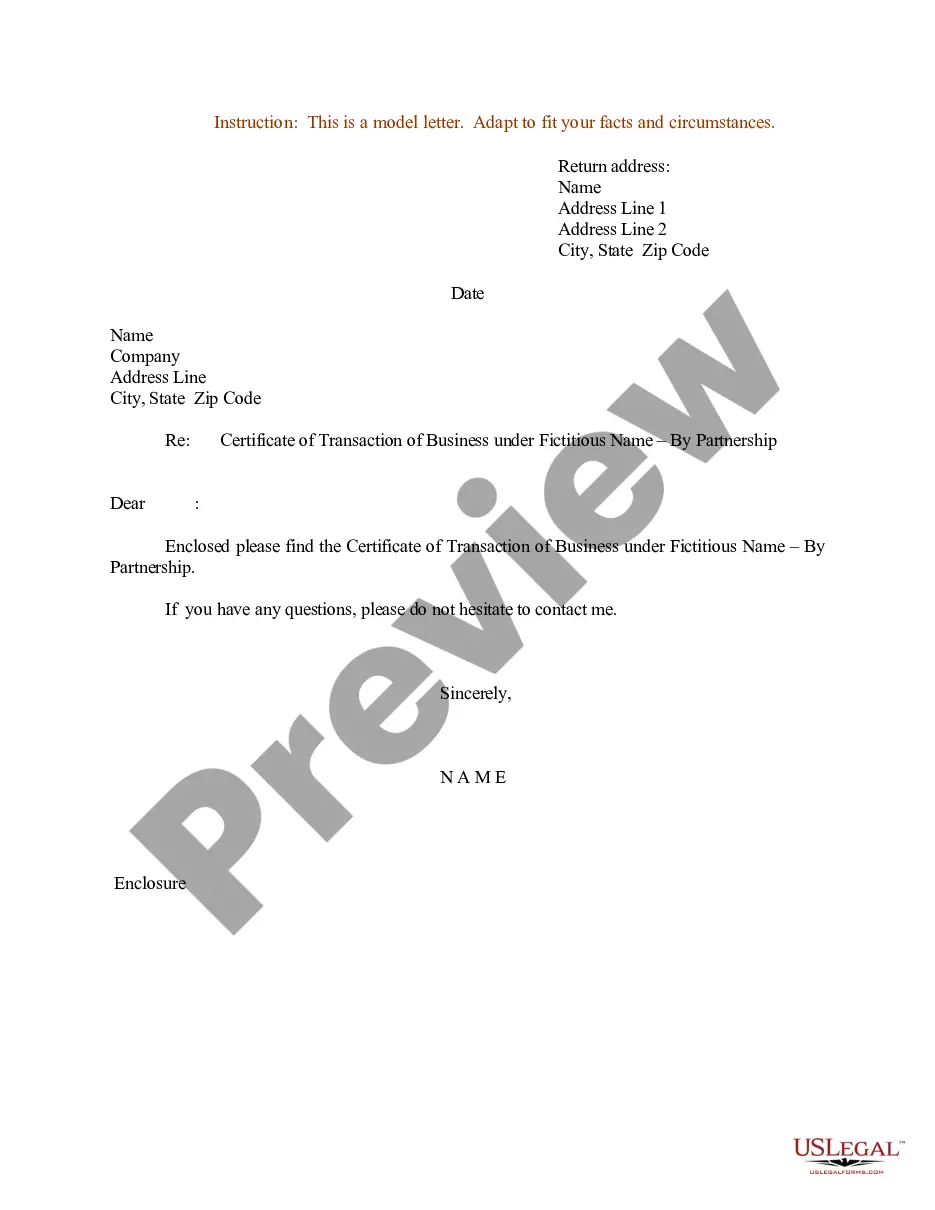
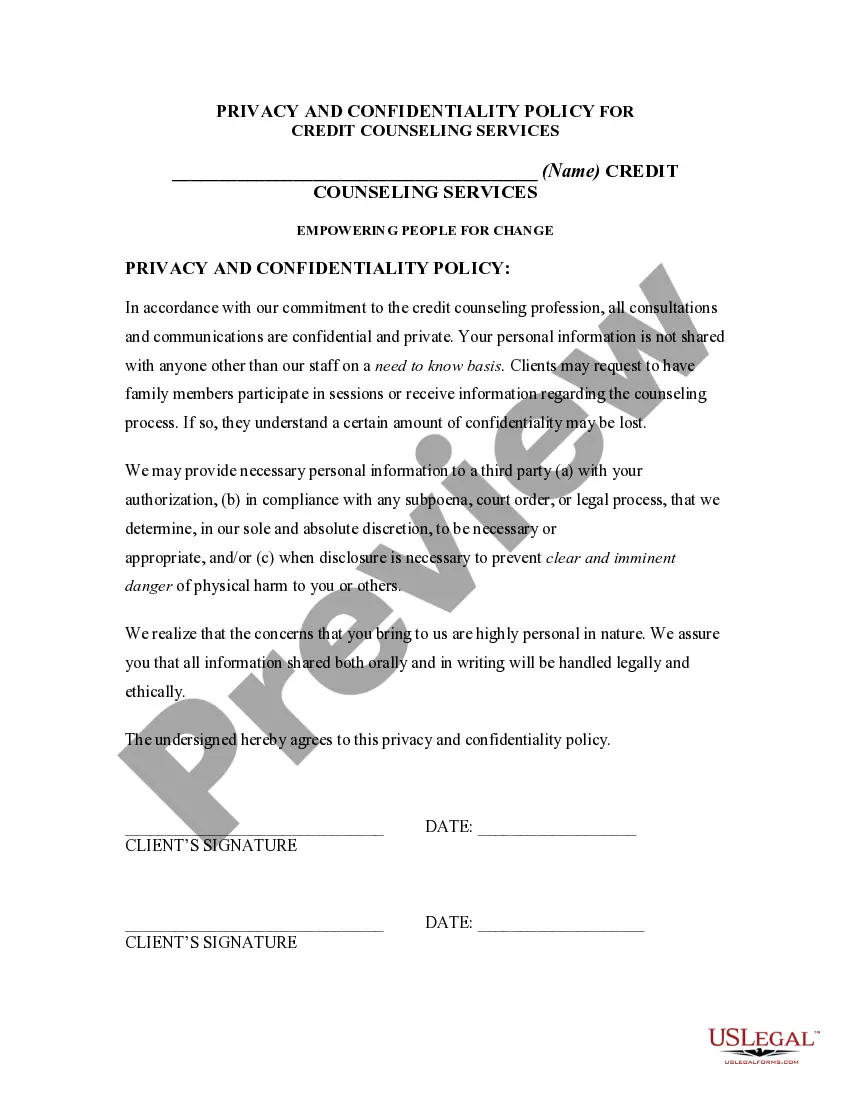
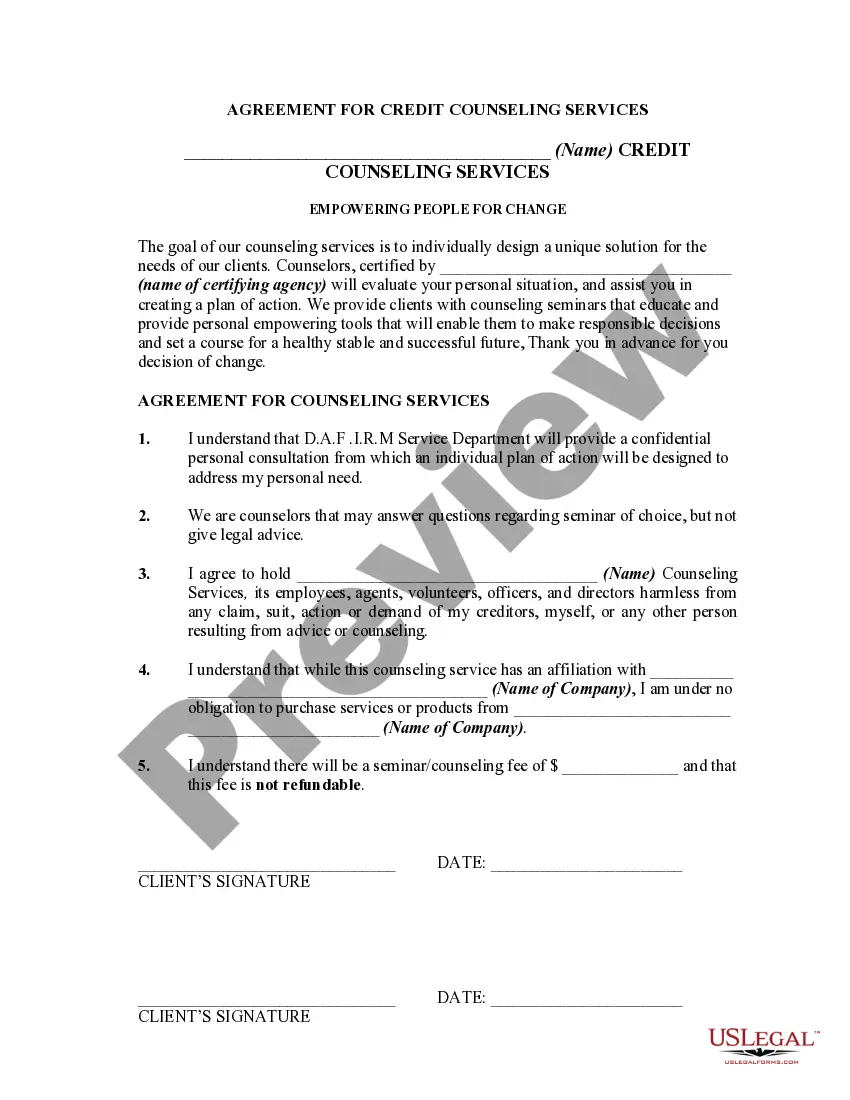
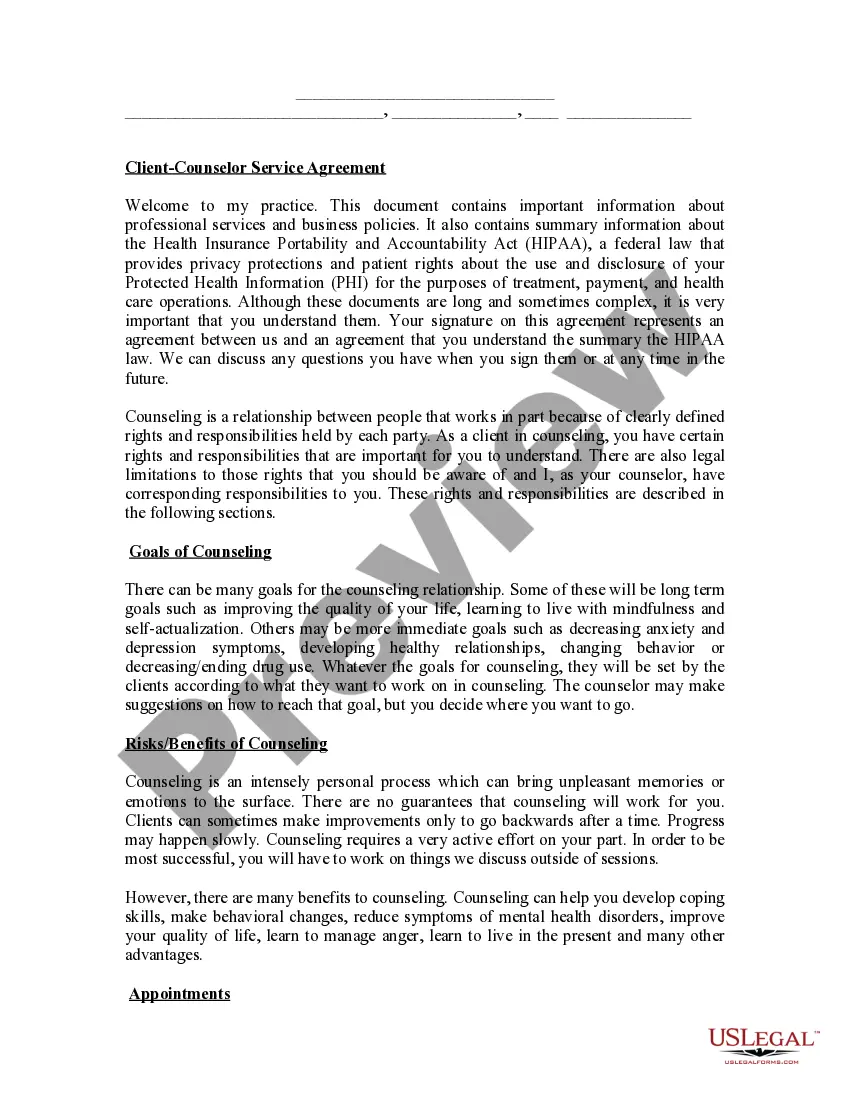
This type of form may be used in connection with a credit counseling seminar which also includes individual credit counseling. This form is a generic example that may be referred to when preparing such a form for your particular state. It is for illustrative purposes only. Local laws should be consulted to determine any specific requirements for such a form in a particular jurisdiction.
Minnesota Privacy and Confidentiality Policy for Credit Counseling Services
State:
Multi-State
Control #:
US-01605BG
Format:
Word;
Rich Text
Instant download
Description


How to fill out Privacy And Confidentiality Policy For Credit Counseling Services?
You might spend several hours online looking for the legal document template that satisfies the state and federal requirements you require.
US Legal Forms provides thousands of legal templates that are reviewed by experts.
You can download or print the Minnesota Privacy and Confidentiality Policy for Credit Counseling Services from my services.
If available, use the Review button to browse through the document template as well.
- If you already have a US Legal Forms account, you can Log In and click the Download button.
- After that, you can complete, modify, print, or sign the Minnesota Privacy and Confidentiality Policy for Credit Counseling Services.
- Every legal document template you acquire belongs to you permanently.
- To obtain an extra copy of the purchased form, visit the My documents tab and click the relevant button.
- If you are using the US Legal Forms website for the first time, follow the simple instructions below.
- First, ensure you have selected the correct document template for the county/town of your choice.
- Read the form description to make sure you have selected the right form.
Form popularity
FAQ
The term 'private' generally refers to information that a person wishes to keep to themselves, while 'confidential' pertains to information that is protected by an agreement or obligation to keep it secret. The Minnesota Privacy and Confidentiality Policy for Credit Counseling Services highlights these differences, emphasizing the importance of both in establishing trust. Understanding these terms is key to navigating counseling services.
The duty to protect a client’s confidential information lies primarily with the counselor, who must implement strict measures to ensure that personal information remains secure. This is especially crucial within the framework of the Minnesota Privacy and Confidentiality Policy for Credit Counseling Services, which outlines the responsibilities of credit counselors. Clients should feel assured that their privacy is prioritized.
For instance, when a counselor notes sensitive client information in session, confidentiality means that those notes are kept secure and not shared with others without permission. In contrast, privacy allows the client to decide who, if anyone, can know that they are receiving counseling. The Minnesota Privacy and Confidentiality Policy for Credit Counseling Services reinforces these distinctions, promoting a safe environment for clients.
When discussing counseling, confidentiality involves the techniques and practices that ensure client communication remains secure, while privacy pertains to the client’s ability to keep certain matters personal. The Minnesota Privacy and Confidentiality Policy for Credit Counseling Services emphasizes both principles so that clients can feel comfortable and protected. This sets the foundation for effective counseling.
Confidentiality focuses on the measures taken by professionals to safeguard client information, whereas privacy relates to the individual's autonomy over their personal data. For those utilizing credit counseling services, the Minnesota Privacy and Confidentiality Policy is vital in highlighting these rights. Understanding both concepts helps clients make informed decisions about what they share.
In counseling, privacy refers to the client's right to control their personal information, while confidentiality involves the counselor's obligation to protect that information from unauthorized disclosure. The Minnesota Privacy and Confidentiality Policy for Credit Counseling Services ensures that clients feel secure sharing sensitive information. This distinction is essential, as it establishes trust in the counseling relationship.
Mandatory Exceptions To Confidentiality They include reporting child, elder and dependent adult abuse, and the so-called "duty to protect." However, there are other, lesserknown exceptions also required by law.
5 ways to maintain patient confidentialityCreate thorough policies and confidentiality agreements.Provide regular training.Make sure all information is stored on secure systems.No mobile phones.Think about printing.13-May-2019
5 ways to maintain patient confidentialityCreate thorough policies and confidentiality agreements.Provide regular training.Make sure all information is stored on secure systems.No mobile phones.Think about printing.
Counselling is confidential, even if a third-party (such as an employer or family member) is paying for it. So, you have the same rights to confidentiality, whoever foots the bill. We have to share some information to get paid. Typically, this is a confirmation of your attendance and participation (or otherwise).