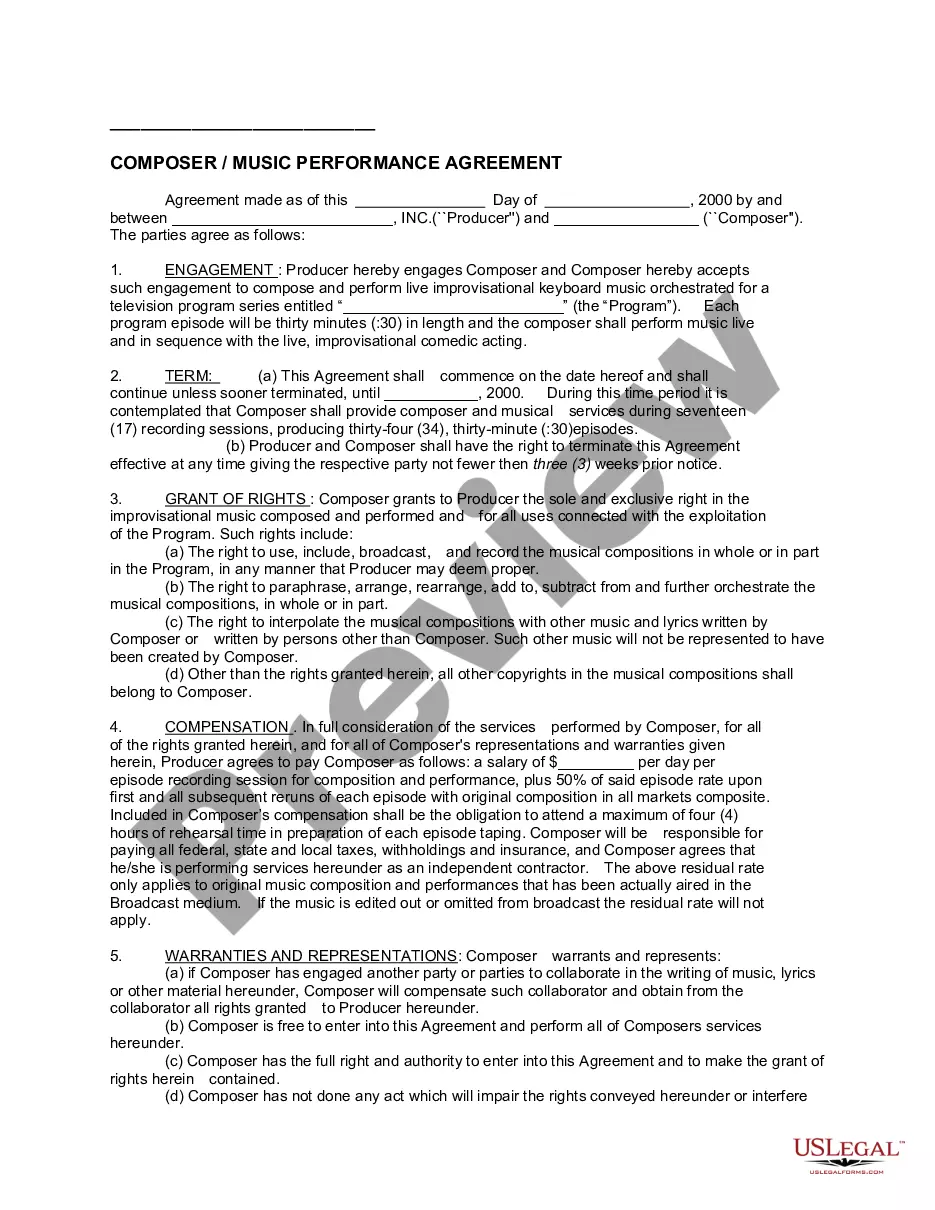
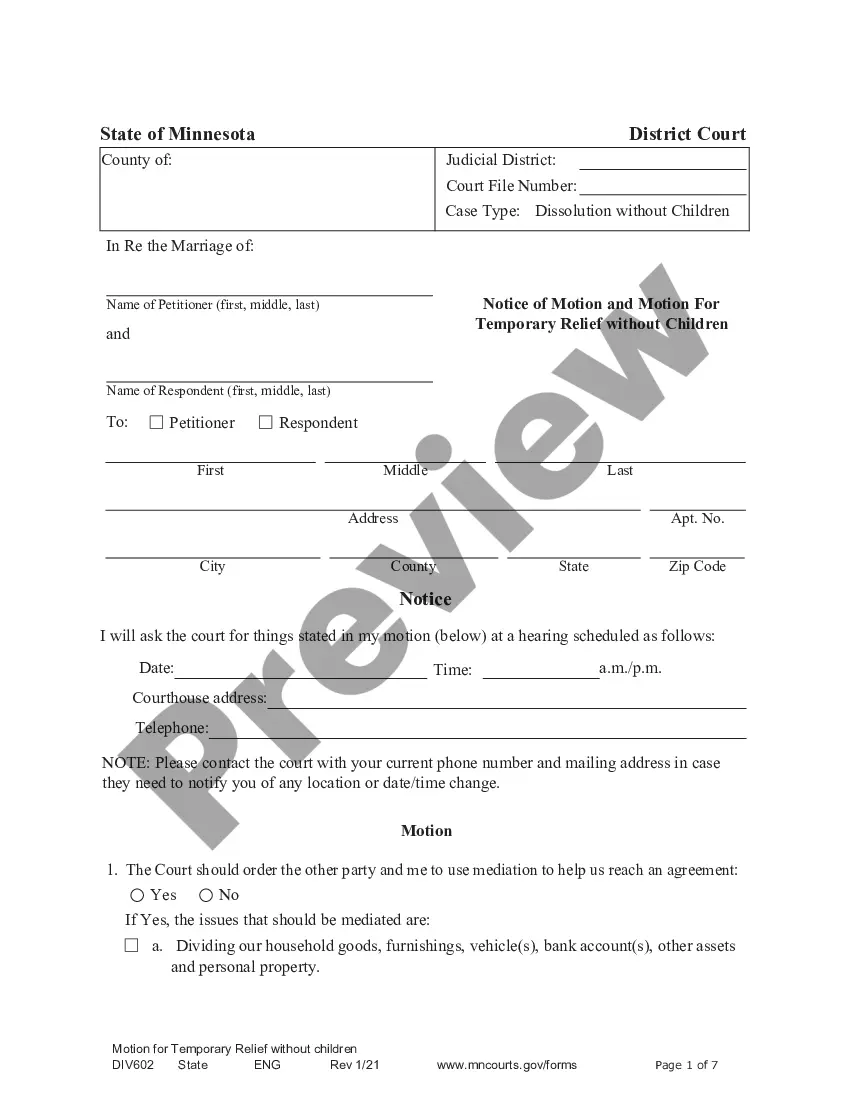
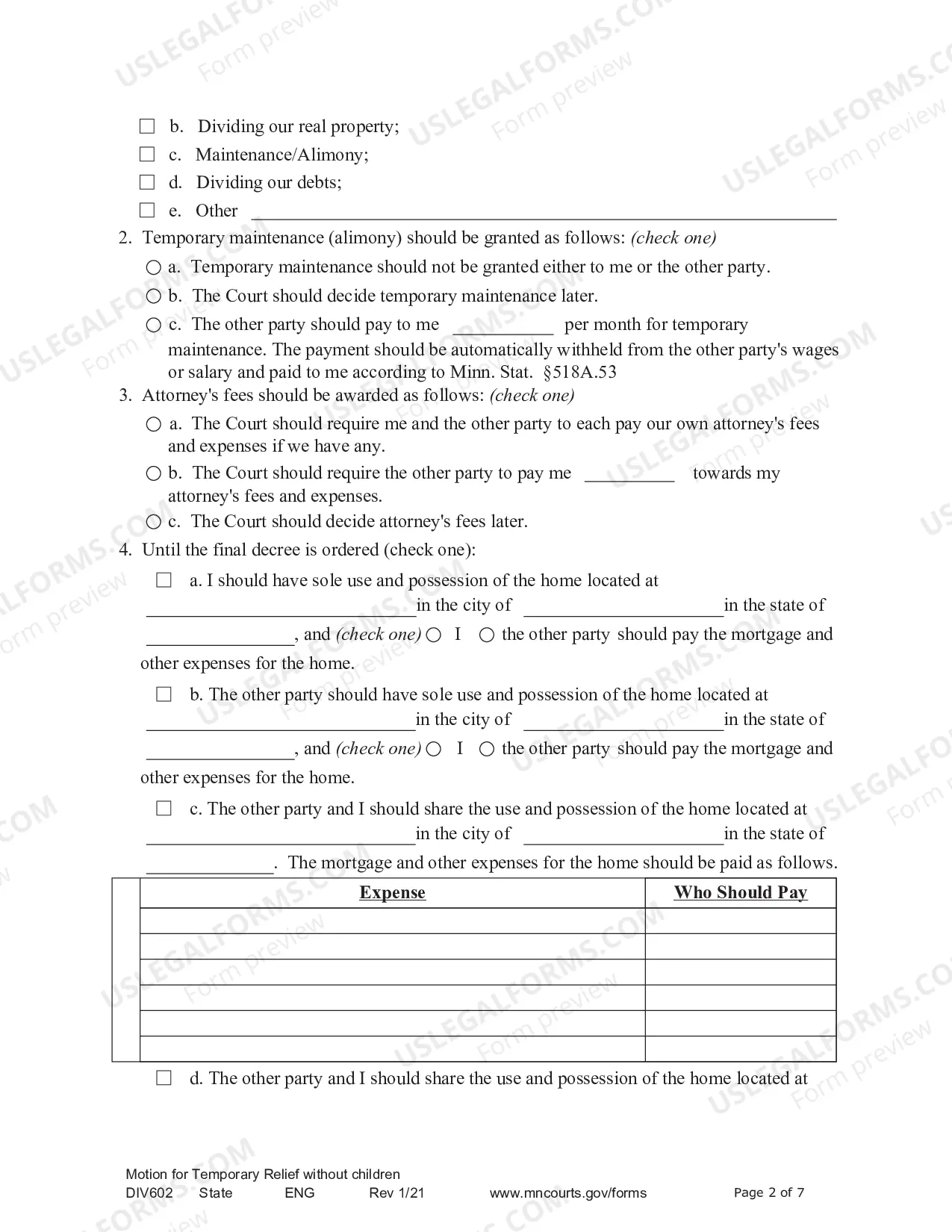
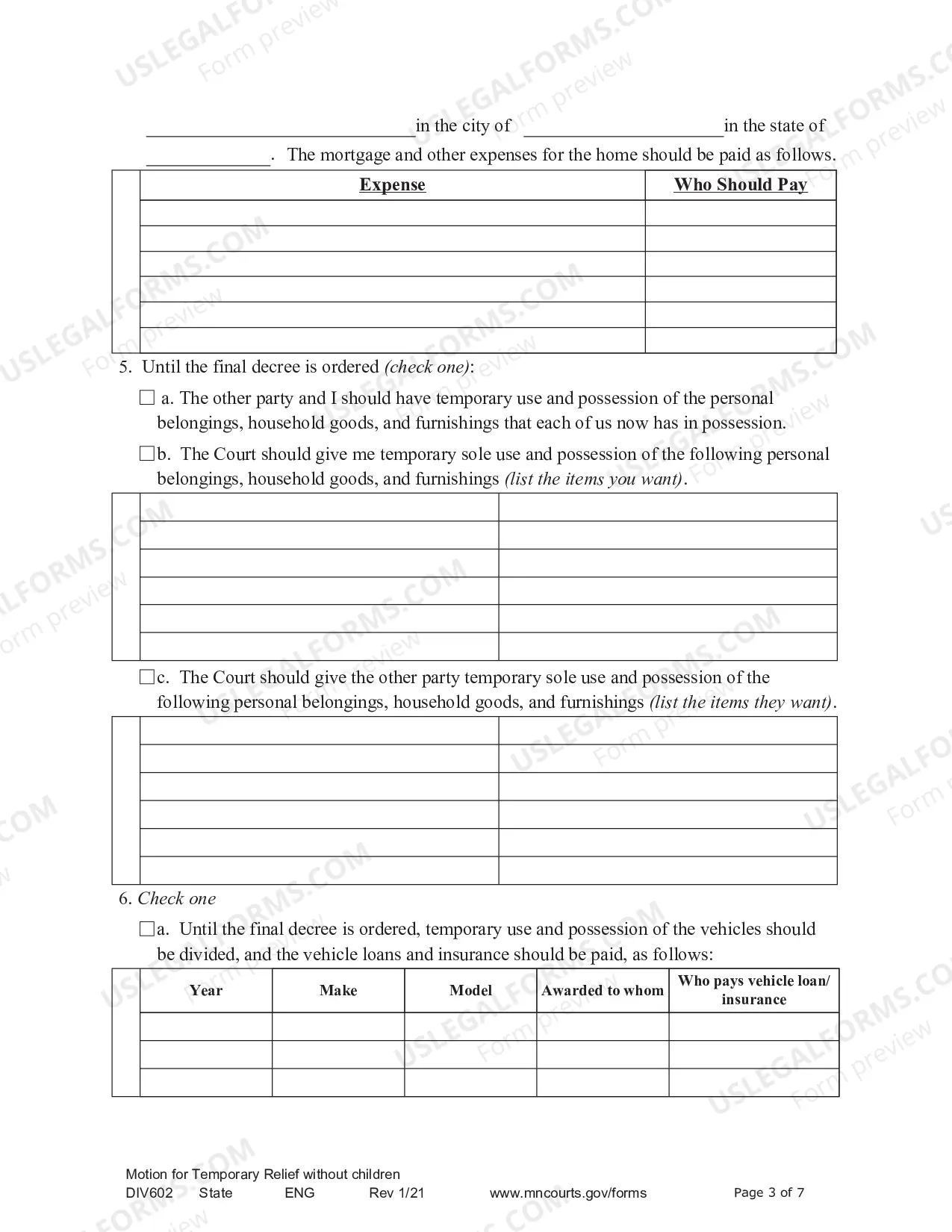
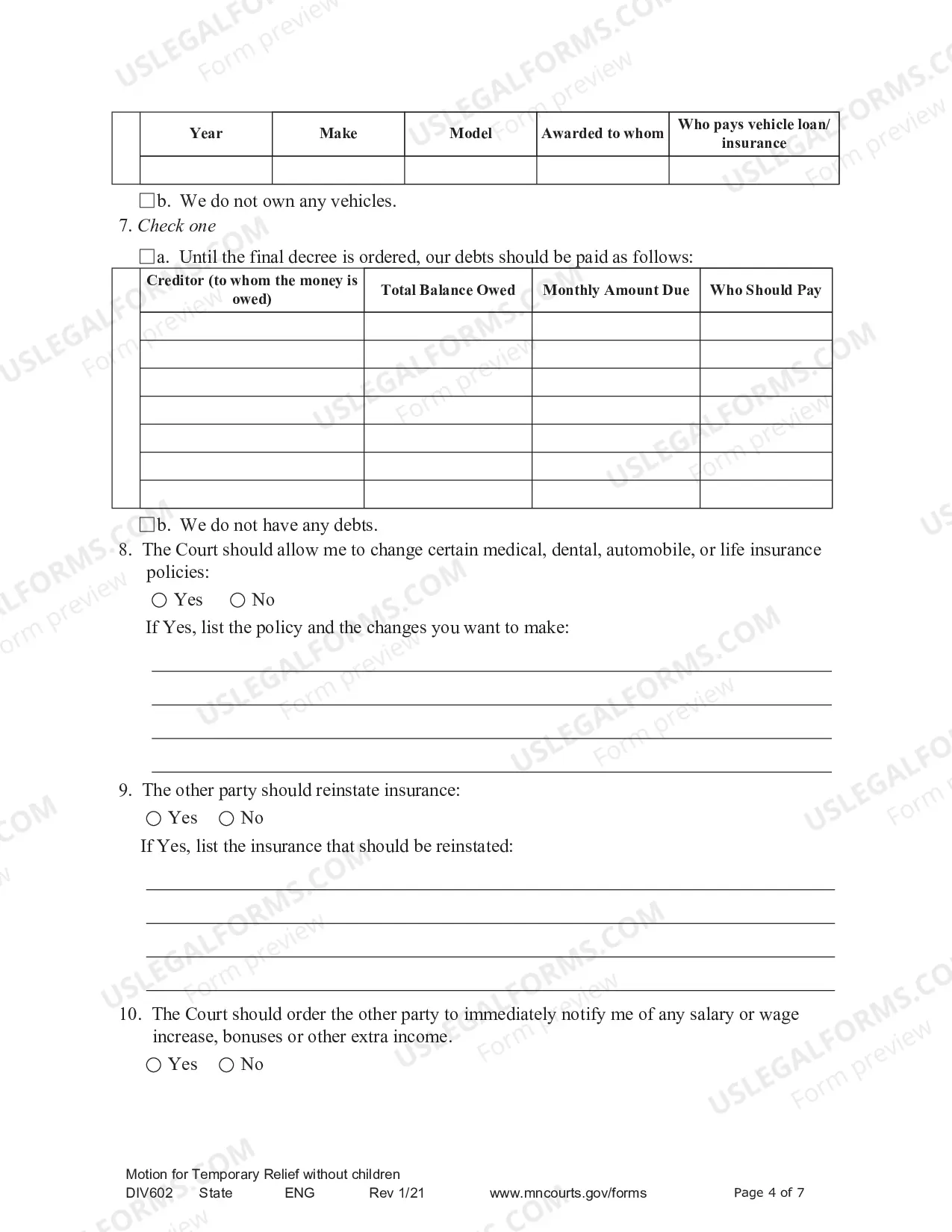
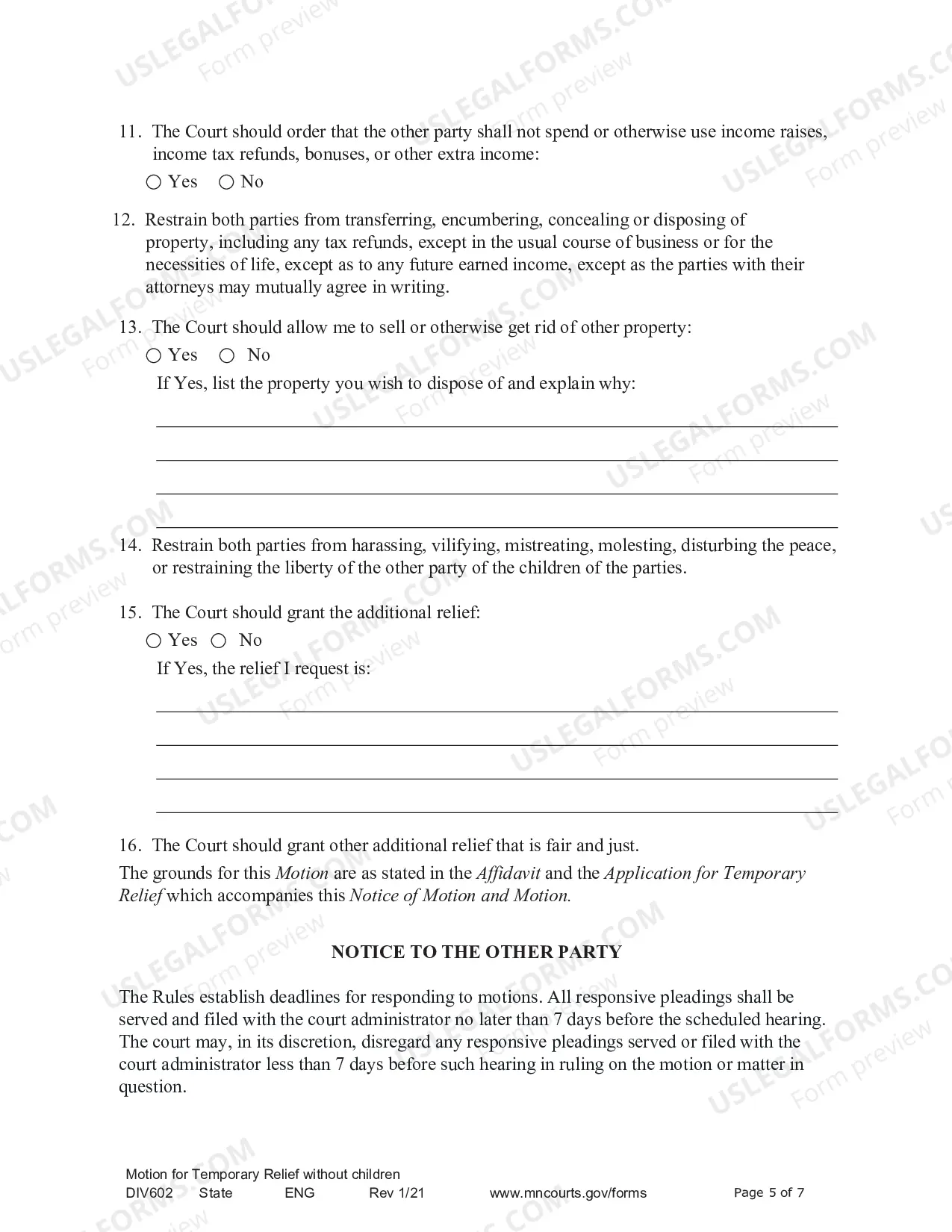
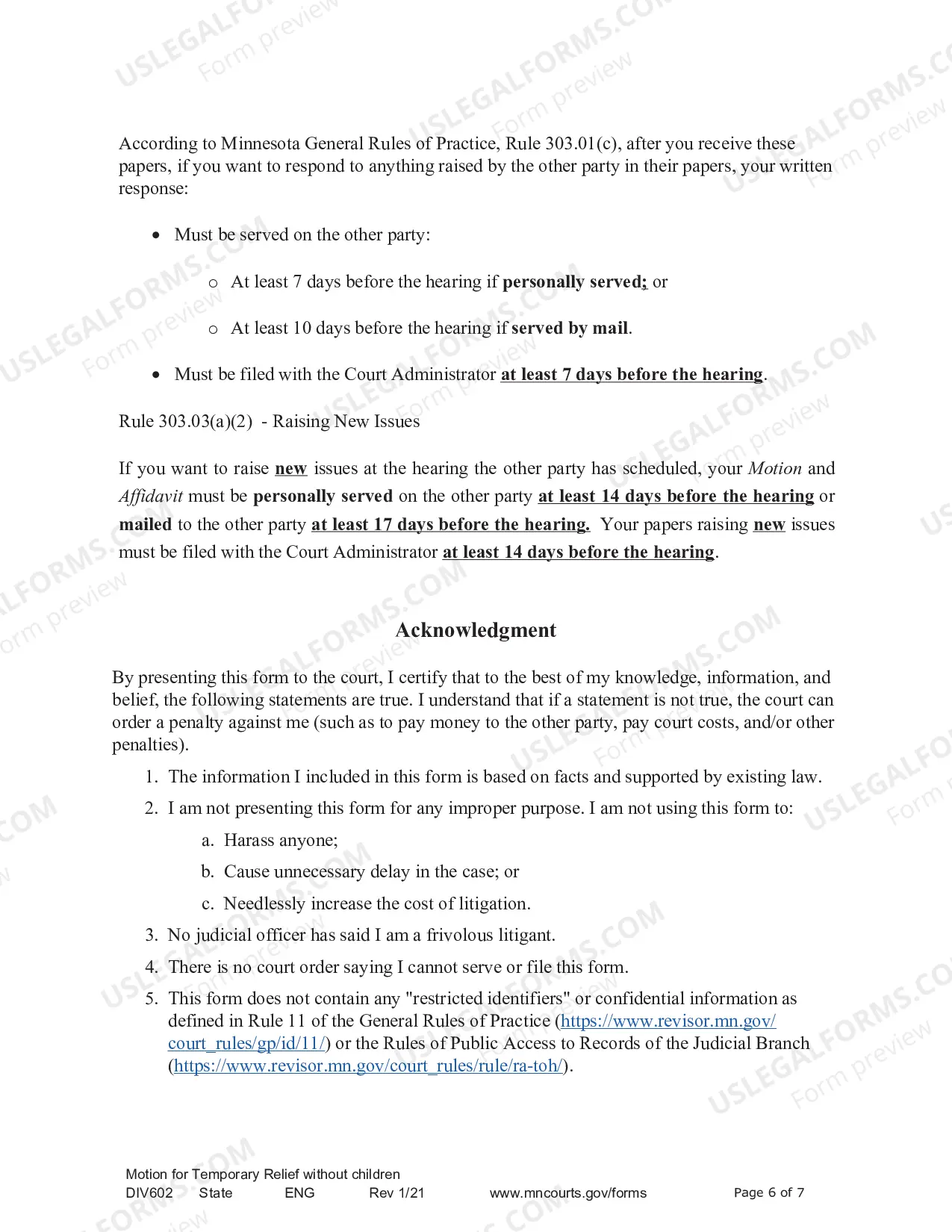
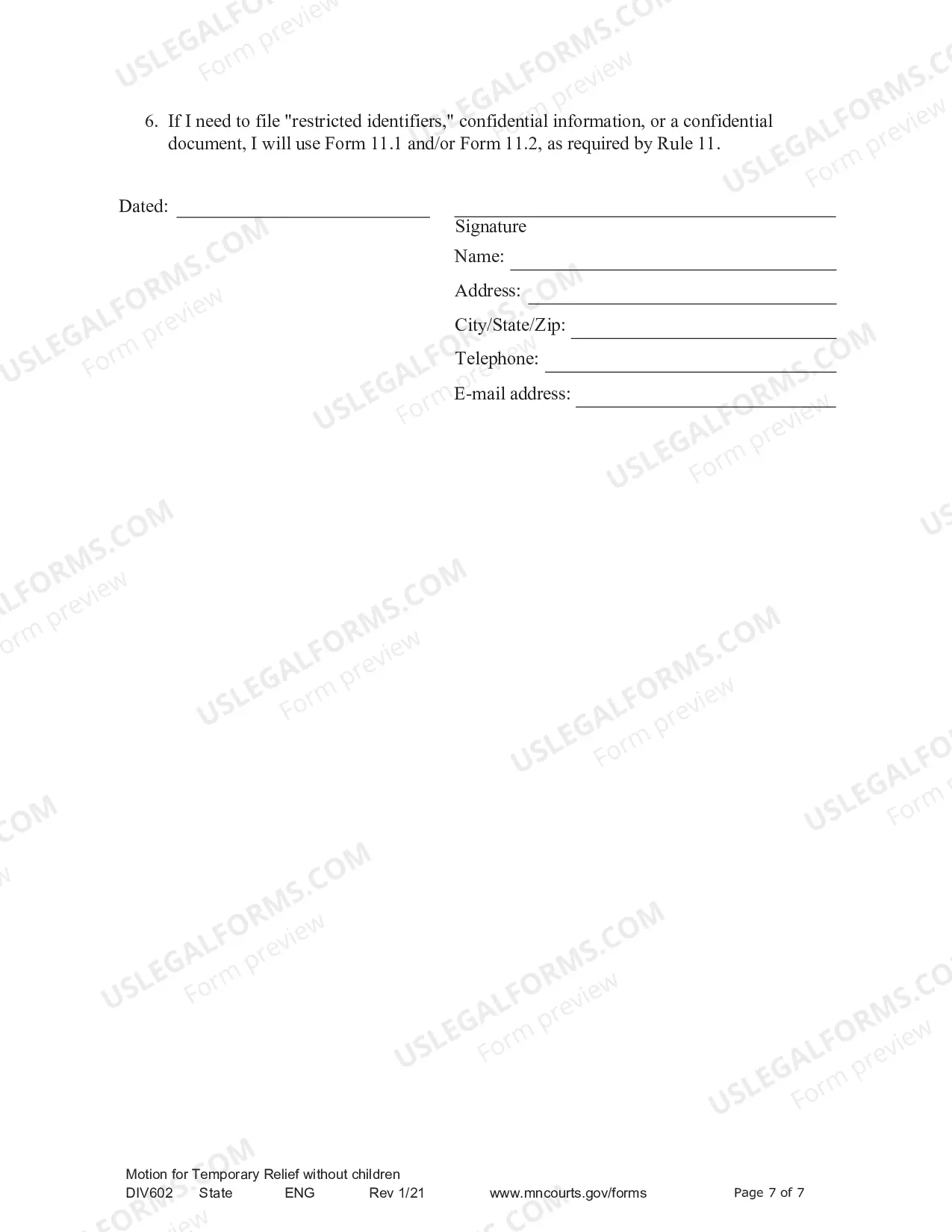
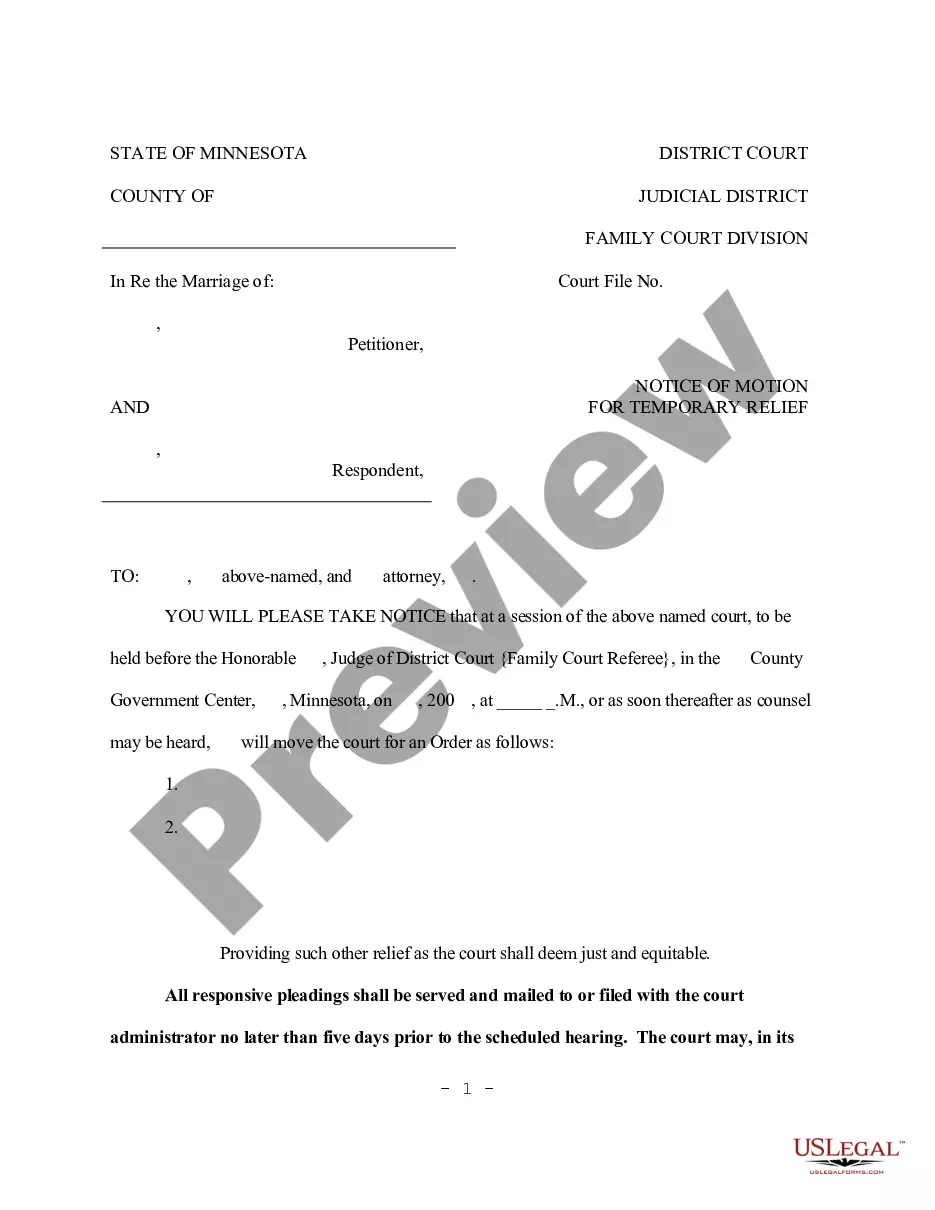
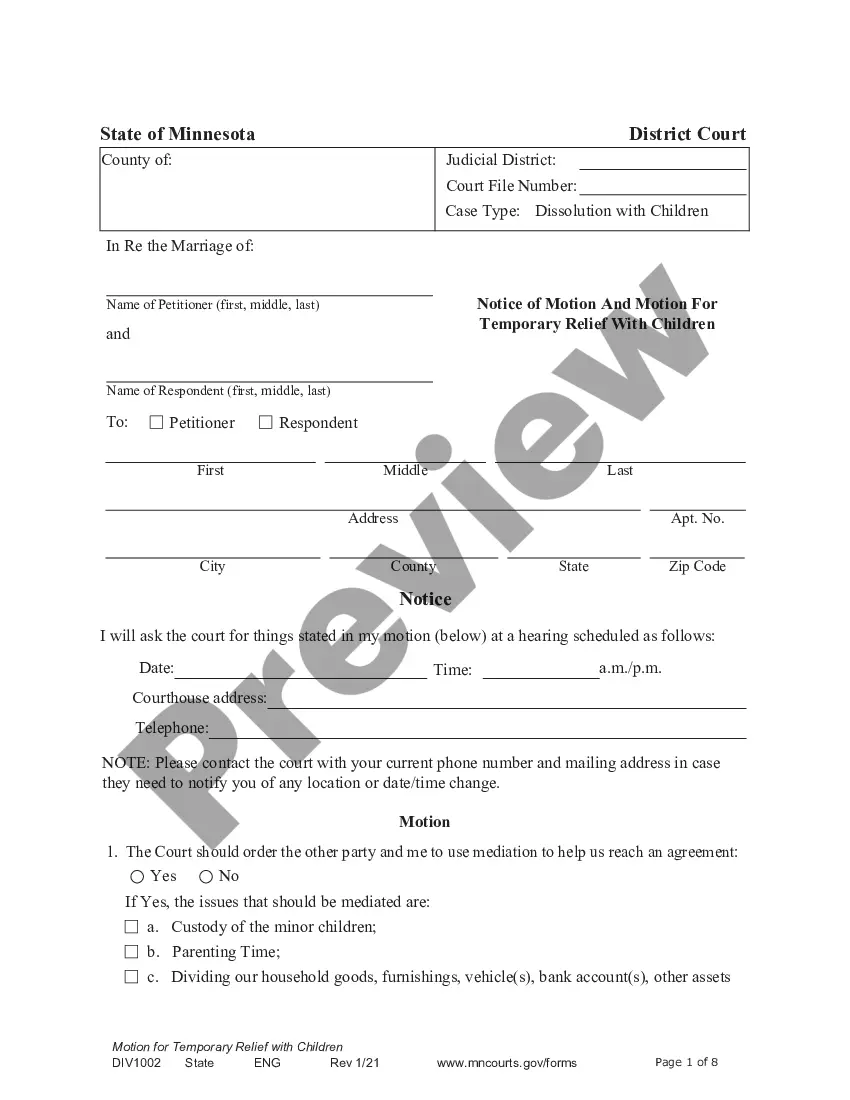
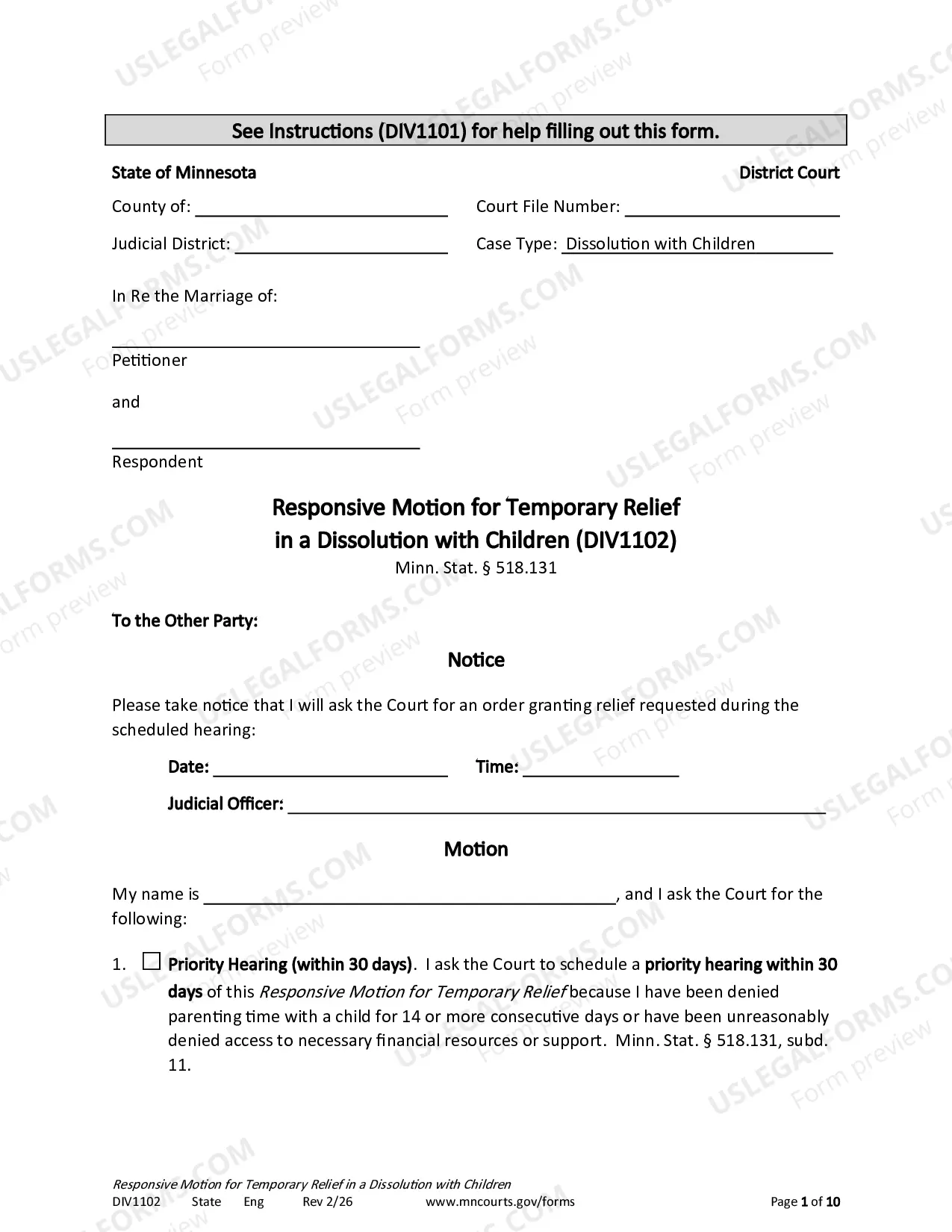
This is an official Minnesota court form for use in a divorce case, a Notice of Motion and Motion for Temporary Relief without Children. USLF amends and updates these forms as is required by Minnesota Statutes and Law.
Minnesota Notice of Motion and Motion For Temporary Relief Without Children
State:
Minnesota
Control #:
MN-DIV602
Format:
PDF
Instant download
This website is not affiliated with any governmental entity
Public form
Description
Free preview
Get your form ready online
Our built-in tools help you complete, sign, share, and store your documents in one place.
Built-in online Word editor
Make edits, fill in missing information, and update formatting in US Legal Forms—just like you would in MS Word.
Export easily
Download a copy, print it, send it by email, or mail it via USPS—whatever works best for your next step.
E-sign your document
Sign and collect signatures with our SignNow integration. Send to multiple recipients, set reminders, and more. Go Premium to unlock E-Sign.
Notarize online 24/7
If this form requires notarization, complete it online through a secure video call—no need to meet a notary in person or wait for an appointment.
Store your document securely
We protect your documents and personal data by following strict security and privacy standards.

Make edits, fill in missing information, and update formatting in US Legal Forms—just like you would in MS Word.

Download a copy, print it, send it by email, or mail it via USPS—whatever works best for your next step.

Sign and collect signatures with our SignNow integration. Send to multiple recipients, set reminders, and more. Go Premium to unlock E-Sign.

If this form requires notarization, complete it online through a secure video call—no need to meet a notary in person or wait for an appointment.

We protect your documents and personal data by following strict security and privacy standards.
Looking for another form?
How to fill out Minnesota Notice Of Motion And Motion For Temporary Relief Without Children?
Obtain any template from 85,000 legal documents like the Minnesota Notice of Motion and Motion for Temporary Relief without Children online with US Legal Forms. Each template is created and updated by state-approved lawyers.
If you already possess a subscription, Log In. Once you are on the form’s page, click the Download button and proceed to My documents to access it.
If you have not subscribed yet, follow the instructions outlined below.
With US Legal Forms, you will always have prompt access to the appropriate downloadable template. The service grants you access to forms and categorizes them to streamline your search. Use US Legal Forms to obtain your Minnesota Notice of Motion and Motion for Temporary Relief without Children swiftly and effortlessly.
- Verify the state-specific criteria for the Minnesota Notice of Motion and Motion for Temporary Relief without Children you need to utilize.
- Read the description and preview the template.
- When you are assured that the sample is what you require, click on Buy Now.
- Select a subscription plan that fits your budget.
- Create a personal account.
- Make a payment using one of two suitable methods: by credit card or via PayPal.
- Choose a format to download the document in; two choices are available (PDF or Word).
- Download the file to the My documents section.
- After your reusable form is downloaded, either print it or save it to your device.
Form popularity
FAQ
In Minnesota, there is no specific age at which a child can outright refuse to see a parent. However, as children grow older, their preferences may carry more weight in custody decisions. If you are navigating custody issues without minor children, a Minnesota Notice of Motion and Motion For Temporary Relief Without Children can help clarify the legal context and facilitate discussions.
A motion for temporary relief is a legal procedure that provides temporary orders during a divorce or separation process. It can address various issues, including spousal support and property matters, even when children are not involved. In Minnesota, filing a Minnesota Notice of Motion and Motion For Temporary Relief Without Children ensures that both parties have clarity on their responsibilities while the case is ongoing.
A motion for temporary relief in Minnesota is a request made to the court for immediate orders regarding issues such as property division or support while the divorce is pending. This is especially relevant in cases without children, as it allows parties to establish temporary arrangements until the final decree. Utilizing a Minnesota Notice of Motion and Motion For Temporary Relief Without Children can streamline this process.
Dissolution without a minor child refers to the legal process of ending a marriage when no children are involved. In Minnesota, this can simplify proceedings, allowing couples to focus on asset division and other matters without child custody concerns. Using a Minnesota Notice of Motion and Motion For Temporary Relief Without Children can help clarify the terms of this dissolution.
Yes, parents in Minnesota can agree to waive child support, especially in cases involving no minor children. However, this agreement must be documented properly in a Minnesota Notice of Motion and Motion For Temporary Relief Without Children. It's essential to ensure that both parties understand their rights and obligations, as the court may have to approve the arrangement.
Typically, a temporary orders hearing will be handled in one of two ways, either by calling witnesses (including the parties) to the stand and asking them questions aimed at eliciting direct testimony from them (referred to as an evidentiary hearing) or by your attorney offering summaries of what witnesses would say,
In divorce cases "general relief" can mean the Petitioner is asking the court for other relief he requested plus the option to get anything else which he is entitled to under the law.
All temporary orders do not always become permanent orders. However, be aware that temporary orders regarding children have a good chance of being a part of the final orders and, therefore, you must be prepared for the temporary orders hearing regarding all child issues.
If a family court lawsuit is administratively dismissed, all temporary orders become void and any outstanding obligations under the temporary order also become void. If there is a prior final order between the parties, that final order regains its effect (to the extent a temporary order in the new action modified it).
Temporary relief refers to a procedure in a Florida family law case where one side or the other requests the Court order temporary provisions in the early phase of a case.It is intended to keep the situation under control during a long court case. Any temporary orders are subject to change later in the case.